
Designing a dish to a target cost: start with the price, not the recipe
Most new dishes reach the board the same way. Someone makes a version they're proud of, you cost it, and then you pick a price that feels right next to everything else. Whatever margin falls out, you live with.
Turn it round. Decide the price first. Take the VAT off, take off the gross profit the dish needs to earn, and what's left is the most it's allowed to cost. Then design the dish to fit that number.
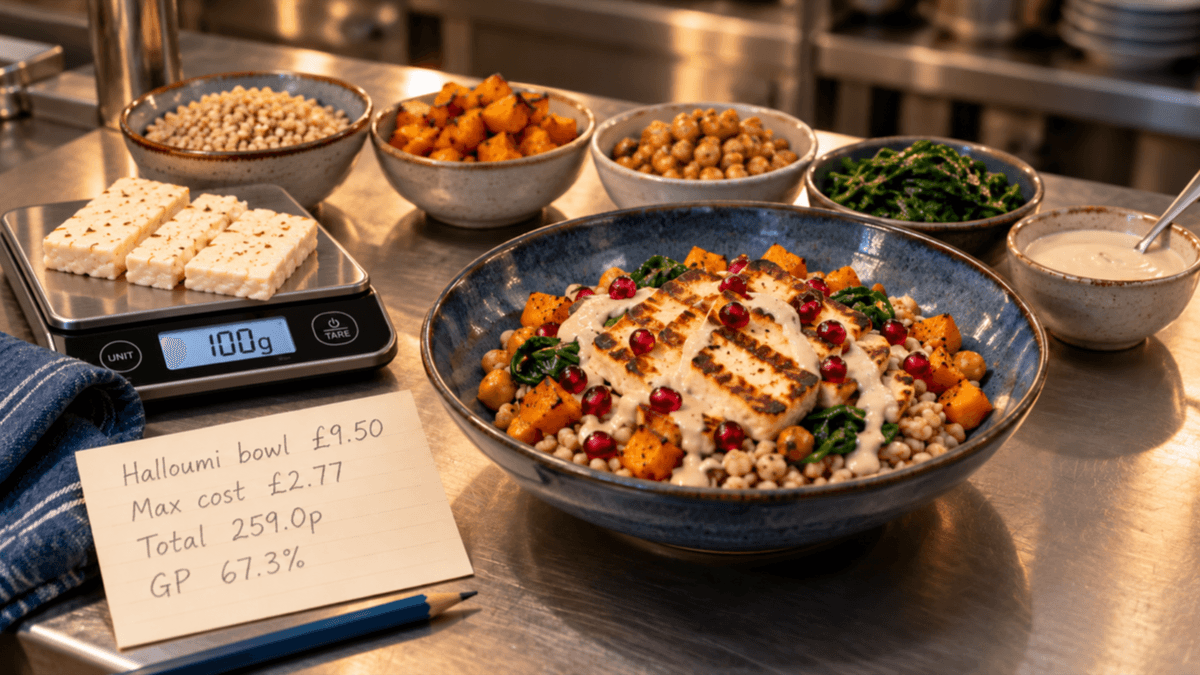
Here's one worked from start to finish, for a hypothetical café: a warm halloumi, roast squash and grain bowl for the winter lunch board, at £9.50. The first version comes in 23p over budget. The second lands inside it without touching the halloumi.
VAT and the National Living Wage are UK-wide, so the sums work the same in all four nations. The plastics rule under takeaway is England's; rules differ in Scotland, Wales and Northern Ireland.
Every price below is an illustrative UK trade price, ex VAT, at autumn 2026 levels, not from a real invoice. Trade prices mostly sit behind wholesaler logins, so use your own. The net price stays unrounded (£7.9167) in every sum, and results are rounded to the penny or a tenth of a penny.
Price first: questions before ingredients
Manufacturers have a name for working this way, target costing: the price the market will pay, minus the profit you need, is the cost you're allowed. For a café it starts with a couple of questions, and neither is about the recipe.
What does a comparable dish cost nearby?
Look at three or four menus within a walk of your door for a hot lunch of about the same size. For one data point, a farm coffee shop's September 2026 menu in County Durham has soup with toasted sourdough at £6.75, a roast squash panzanella salad at £7.50, and its burgers, rarebit and bruschetta at £8.50.
That's one menu in the north-east, not a survey, and I couldn't find a published average for a café lunch bowl. Your neighbours are the evidence that counts.
Where does it sit on your own board?
Our hypothetical café's lunch runs from a £5.20 sandwich and £6.50 soup with bread up to a £10.50 brunch plate. The bowl is a full hot lunch with cheese in it: more than soup, lighter than a cooked plate.
At £9.50 it sits £3 above the soup and £1 under the brunch plate, so it reads as the lighter of the two big plates rather than the cheap one. The items either side matter most: some brunch customers will trade down to it, which is only fine if the bowl earns as much. That gets checked under labour.
The worksheet: from £9.50 to a budget
Six lines turn a price into a budget.
| Step | Sum | Figure |
|---|---|---|
| Menu price, incl VAT | Your choice | £9.50 |
| Net price | £9.50 / 1.2 | £7.9167 |
| Target GP | Your choice | 65% |
| Maximum cost | £7.9167 x (1 - 0.65) | £2.77 |
| Cash GP at that cost | £7.9167 - £2.7708 | £5.15 |
| Design window, 5 to 10% under | £2.7708 x 0.90 to x 0.95 | £2.49 to £2.63 |
VAT: 20% in or out
Eaten in, the bowl is standard-rated. HMRC's VAT Notice 709/1 is plain: "You must always charge VAT at the standard rate if you make a supply of food and drink for consumption on the premises".
To take away, it's still 20%. "Hot takeaway food and drink that meets certain tests set out below is standard-rated", and "Something is hot if it's at a temperature above 'the ambient air temperature'". The bowl is heated to order and kept hot for the customer, so it meets the notice's tests. Food that's only warm because it's still cooling from the oven can be a different matter.
A cold grain salad to take away would be a different sum: "Cold takeaway food and drink is zero-rated, as long as it's not of a type that's always standard-rated". If you're not VAT registered, your net price is the menu price.
Picking the GP target
Our café GP benchmarks by category put hot food and brunch at 55 to 65%, from a full cooked breakfast at the bottom to eggs on toast at the top. I've set 65% for this bowl: no meat, mostly batch-prepped, and no plate of bacon and sausages to pay for. GP here means ingredients and packaging, ex VAT, before labour.
It's a choice, not a rule. A café with high rent may need more from its food; one using the bowl to win a lunch trade might accept less. Each point of target moves the budget by about 7.9p: at 62% the maximum is £3.01, at 60% it's £3.17.
Why design under the line
I design to come in 5 to 10% under the maximum. That's my rule of thumb, not a published standard. Prices creep between invoices, a generous hand adds 10g here and there, and some of every batch ends up as waste or staff lunch. A dish designed to exactly £2.77 drops below 65% the week the first price rises.
Version 1: the bowl nobody was counting
Here's the bowl as a cook might build it with no budget in mind: warm farro, roast squash, chickpeas, wilted spinach, griddled halloumi, a tahini yoghurt dressing, pomegranate seeds, a pinch of microgreens and a toasted slice on the side.
| Line | Spec | Price | Cost |
|---|---|---|---|
| Halloumi, griddled | 100g, weighed raw | £11.00/kg | 110.0p |
| Roast butternut squash | 160g roasted | £1.875/kg roasted | 30.0p |
| Farro | 60g dry | £5.50/kg | 33.0p |
| Chickpeas | 80g drained | £2.95/kg drained | 23.6p |
| Baby spinach, wilted | 40g | £6.00/kg | 24.0p |
| Tahini yoghurt dressing | 30g | £3.58/kg made | 10.7p |
| Pomegranate seeds | 20g | £14.00/kg | 28.0p |
| Microgreens | 5g | £40.00/kg | 20.0p |
| Oil, spice and seasoning | 3.1p | ||
| Bloomer slice, toasted | 1 slice | 16.9p a slice | 16.9p |
| Ingredients | 299.3p | ||
| Napkin | 0.7p | ||
| Eat-in cost | 300.0p |
A few notes on the lines:
- Squash. The US Department of Agriculture's Food Buying Guide gives whole butternut as "1 lb AP = 0.84 lb ready-to-cook pared squash", so £1.26 a kilo as bought is £1.50 a pared kilo. The oven takes more, and with no reliable published roasting loss I've used an illustrative 20%: £1.50 / 0.8 = £1.875 a roasted kilo. Weigh a tray in and out for your own figure.
- Chickpeas. The same guide gets "about 72 oz" of heated, drained beans from a 110oz US can, about 65%, and I've used 65%. A 2.5kg tin at £4.80 is £1.92 a kilo in the tin, so £1.92 / 0.65 = about £2.95 a kilo drained. Check the drained weight on your own tin's label, or weigh one.
- Pomegranate and microgreens at £14.00 and £40.00 a kilo are my illustrative figures. Check yours: garnish is where pence hide.
- The bread is a thick-sliced 800g bloomer at £2.37 with 14 usable slices: 16.9p a slice.
- Oil, spice and seasoning is 10ml of rapeseed oil at £1.90 a litre (1.9p) and 1g of spice at £12.00 a kilo (1.2p).
The dressing is a sub-recipe, costed once as a batch:
| Tahini yoghurt dressing | Quantity | Price | Cost |
|---|---|---|---|
| Greek-style yoghurt | 1kg | £3.50/kg | 350.0p |
| Tahini | 250g | £5.00/kg | 125.0p |
| Lemon juice | 100ml | £2.80/litre | 28.0p |
| Garlic | 20g | £6.40/kg | 12.8p |
| Water | 100ml | ||
| Batch | 515.8p |
The inputs weigh about 1.47kg and about 1.44kg comes out of the bowl, so it's 515.8p / 1.44 = £3.58 a kilo made, and 30g is 10.7p. Cost the batch once and use it as an ingredient in every dish it touches.
So version 1 costs 300.0p eaten in. Against a net price of 791.67p, that's (791.67 - 300.0) / 791.67 = 62.1% GP, or £4.92 a bowl. It's 22.9p over the £2.77 maximum and 36.8p above the top of the design window.
62.1% sits inside the benchmark band, and plenty of cafés would launch it. But it's about three points short of what you decided this dish needs, before any price rise, heavy hand or takeaway box. To land in the window you need to find 36.8p to 50.6p.
Version 2: price every lever in pence
Before changing anything, put a number on every option. These are the five I'd look at, each against version 1:
| Lever | Change | Saving |
|---|---|---|
| Cut what nobody notices | Microgreens, 5g, out | 20.0p |
| An equal, cheaper grain | Farro 60g (33.0p) to pearl barley 60g at £2.00/kg (12.0p) | 21.0p |
| Garnish swap | Pomegranate 20g (28.0p) to toasted pumpkin seeds 10g at £6.00/kg (6.0p) | 22.0p |
| Your own bread, as a sub-recipe | Bloomer slice (16.9p) to a slice of your own sourdough (7.2p) | 9.7p |
| Hero portion | Halloumi 100g to 90g | 11.0p |
Pull all five and the bowl costs 216.3p, a 72.7% GP: past the window, and into things the customer can see. You only need 36.8p, so start with what nobody orders the bowl for.
The microgreens go. A pinch on top is 20.0p a bowl.
Pearl barley replaces farro. A similar chew and a proper winter grain, at little more than a third of farro's price per kilo. Change the menu wording to match, and the allergen matrix: both contain gluten, but farro is a type of wheat and barley is declared as barley.
That's version 2: the version 1 card without the microgreens and with 60g of pearl barley at 12.0p. Ingredients 258.3p, napkin 0.7p, 259.0p eaten in. That's 67.3% GP and £5.33 a bowl, 18.1p (6.5%) under the line and inside the window.
I'd keep the garnish swap and your own bread, 31.7p between them, in reserve for when a price moves after launch. The sourdough only applies if you already bake, and the 7.2p slice from the sourdough loaf in our recipe costing guide is ingredients only: the baking time sits with labour, as in the sub-recipe post.
What you don't cut
Halloumi is 110.0p of a 259.0p bowl, 42% of the cost, so it's the obvious target. It's also the reason the bowl sells: it's in the dish's name. Taking 100g to 90g saves 11.0p, and a customer might not spot it this month. Taking it to 60g saves 44.0p, and they would. That's a chickpea bowl with some halloumi on it, sold at a halloumi bowl's price.
Cut around the hero before you ever cut into it. Then hold the spec you've designed. At £11.00 a kilo, every 10g of halloumi over spec is 11.0p, and a heavy hand that serves 130g adds 33.0p: 292.0p, back over budget on its own.
Cash, not just percentage
Now the number that pays the bills. Say the bowl replaces a cold lunch salad for the winter, illustrative at £7.50 on the board and £1.75 to make, eaten in.
| Eaten in | Menu price | Net price | Cost | GP% | Cash GP |
|---|---|---|---|---|---|
| Lunch salad | £7.50 | £6.25 | £1.75 | 72.0% | £4.50 |
| Bowl, version 1 | £9.50 | £7.9167 | £3.00 | 62.1% | £4.92 |
| Bowl, version 2 | £9.50 | £7.9167 | £2.59 | 67.3% | £5.33 |
Even version 1, at 62.1%, keeps 42p a plate more than the salad at 72.0%. Version 2 keeps 83p more. A lower percentage on a dearer dish can be the better earner, which is why margin, not markup, is the percentage to design in, and pounds are how you choose between dishes.
But only if it sells. Thirty salads a day is £135.00 of cash GP. At £5.3267 a bowl, the bowl needs 26 a day to beat it: 25 makes £133.17, 26 makes £138.49.
So why not launch version 1, since it already beats the salad? Because 65% is what you decided this dish has to carry towards rent and wages, and version 2 adds 41p a bowl for changes the customer won't notice.
Labour sits beside it, not inside it
Labour stays out of the cost and out of GP, for the reasons in putting prep time beside your recipe cost, but check it separately before launch.
That post's rate is 26.5p a minute, fully loaded on the £12.71 National Living Wage. It rises when the National Living Wage goes to £13.21 from April 2027, so re-run the check then.
Illustrative minutes for the bowl: 45 minutes of hands-on batch prep for 30 bowls (squash, barley and dressing), so 1.5 minutes each, plus 2.5 minutes at the pass to griddle the halloumi and build the bowl. Four minutes is 106.0p.
That trips the post's time test, more than about a minute and a half per portion, though not its share test: 106.0p is 13.4% of the net price, under the 15% line of 118.75p. Either test is enough, so it gets an after-labour figure: £5.3267 - £1.06 = £4.27 a bowl, 53.9% of the net price.
That answers the trade-down question. The made-to-order brunch plate in that post keeps more before labour (£5.65) but only £3.79 after its seven minutes. Once the minutes are counted, a customer who swaps brunch for the bowl leaves you better off, because most of the bowl is made before the doors open.
The takeaway box
Hot to take away, the bowl is standard-rated, so the net price stays £7.9167 and the packaging comes straight off GP.
An illustrative 750ml kraft bowl suitable for hot food at £26.99 for 300, ex VAT, with lids at £21.99 for 300, works out at 9.0p and 7.3p. Add a wooden fork at an illustrative 3.0p, because single-use plastic cutlery has been banned in England since 1 October 2023. The napkin is the 0.7p from costing the cup, lid and box per sale, which goes out either way.
| Version 2 | Eaten in | Taken away |
|---|---|---|
| Ingredients | 258.3p | 258.3p |
| Napkin | 0.7p | 0.7p |
| Bowl and lid | 16.3p | |
| Wooden fork | 3.0p | |
| Cost | 259.0p | 278.3p |
| GP% | 67.3% | 64.8% |
| Cash GP | £5.33 | £5.13 |
To take away, the bowl is 1.2p over the £2.77 maximum. The box, lid and fork (19.3p) have spent all 18.1p of headroom before a single price has moved. If a big share of your lunch leaves in a box, design with the box inside the budget from the start, or move the price.
When the target can't be met
Sometimes no lever gets you there. Say you'd rather use a premium halloumi at an illustrative £15.00 a kilo. 100g is 150.0p, 40.0p more, and version 2 comes out at 299.0p eaten in: 62.2% GP, 21.9p over the line. There are three honest answers.
- Change the price. To hit 65% at 299.0p you need a net price of £8.5429 (£2.99 / 0.35), so at least £10.26 on the board (£8.5429 x 1.2 = £10.2514, rounded up). At £10.50 you're level with the brunch plate, and the ladder stops making sense.
- Change the dish. Go back to the standard halloumi, make the halloumi an extra on a cheaper base bowl, or build the bowl around a different hero.
- Don't launch it. A dish that can't meet its budget at a price customers will pay is a dish you subsidise every time it sells. Leaving it off the board is a perfectly good result of an hour's costing.
What you shouldn't do is launch it anyway and hope. That's the old way round, with extra steps.
After launch: re-run it when halloumi moves
The worksheet isn't finished when the bowl goes on the board. Its cost is only as current as the halloumi price inside it: the recipe cost staleness audit ages a dish by the invoice date of its biggest single ingredient, and in this bowl that's the halloumi by a distance.
If halloumi goes from £11.00 to £12.50 a kilo, the bowl goes up 15.0p to 274.0p eaten in: 65.4% GP, just 3.1p inside the line. The headroom has absorbed one price rise. It won't absorb a second.
That's when the reserve levers come out. The pumpkin seed swap and your own bread take it to 242.3p and 69.4%, without touching the halloumi.
If the bowl lives in CostingBrik, its docs describe every recipe using an ingredient being re-costed automatically when a processed invoice changes that ingredient's price. The Recipe Tuner lets you change a quantity, replace a line or delete one and see the new cost per portion, margin and profit impact at your sales volume.
A blank worksheet to copy
| Target-cost worksheet | Your dish |
|---|---|
| Menu price, incl VAT | £ |
| Net price (/ 1.2 if standard-rated) | £ |
| Target GP% for this category | % |
| Maximum cost: net x (1 - GP) | £ |
| Design window: maximum x 0.90 to x 0.95 | £ to £ |
| Version 1 cost, eaten in | £ |
| Levers, each in pence | |
| Version 2 cost, eaten in | £ |
| Version 2 GP% and cash GP | % and £ |
| Takeaway packaging | p |
| Takeaway cost, GP% and cash GP | £, % and £ |
| Hands-on minutes x 26.5p | p |
| Biggest line, and its invoice date |
This week
- Pick the next dish you want to add and write its price before its recipe: three nearby menus, your own ladder, and the items either side.
- Fill in the top half of the worksheet: net price, target GP, maximum cost and design window.
- Write version 1 the way you'd love to make it, and cost it line by line. The free recipe costing calculator will do the sums.
- Price every lever in pence. Pull the ones nobody will notice first, keep a couple in reserve, and leave the hero alone.
- Add the box and time the minutes, then decide: launch, reprice, redesign or drop.
- Date the biggest line and re-run the worksheet when its price moves.
A dish costed after it's designed tells you what margin you got. A dish designed to a cost gets the margin you chose.
Ed O'Brien has run Hunters Cake Company for 17 years across cafés in Witney, Burford, and a bakery in Carterton, Oxfordshire. He's building Brikly - modular tools that give independent café owners the same data the big chains have, without the big chain price tag.