
Dogs in your café: what the law says, and what being dog-friendly costs
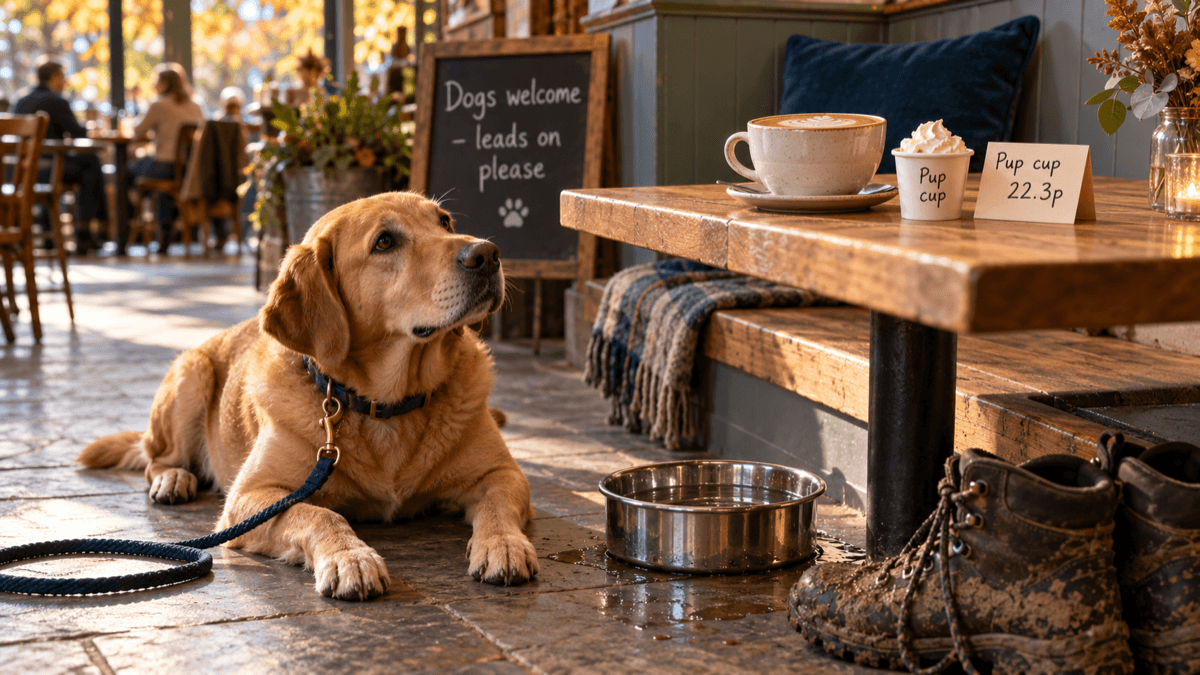
Have a look at your front door. There might be an old "No dogs" sign nobody remembers putting up, a water bowl someone put out one hot summer, or nothing at all. Ask three of your team whether a wet spaniel can come in, and you may well get three different answers.
Is this a dog-friendly café? Nobody has ever actually said.
That's how a lot of dog policies get made: at the door, by whoever's on. Two parts of it aren't really yours to decide, and the rest has a cost you can put a number on.
The Equality Act 2010 covers England, Wales and Scotland; Northern Ireland has the Disability Discrimination Act 1995, with similar duties for service providers. The hygiene rule on animals is equivalent across the UK.
Hygiene law: out of the kitchen, your call on the café floor
The rule is in Regulation (EC) 852/2004, which still applies in the UK (as assimilated law in Great Britain). Annex II, Chapter IX says:
"Adequate procedures are also to be in place to prevent domestic animals from having access to places where food is prepared, handled or stored (or, where the competent authority so permits in special cases, to prevent such access from resulting in contamination)."
It covers places where food is prepared, handled or stored, not the seating area. A dog in your café isn't illegal, and a "no dogs" sign isn't a hygiene requirement. Carmarthenshire County Council puts it plainly: "Whether or not to allow a pet dog into the public areas of a food business is a matter for the individual food business operator to decide."
What an inspector will reasonably expect
Dogs aren't a scored item in their own right, and I've found nothing saying an officer will mark you down for allowing them. What you should be able to show is a routine, and Dover District Council's guidance for dog-friendly food businesses is the clearest I've found:
- No dogs where food is prepared, handled or stored, which Dover spells out as "the kitchen, storage rooms or behind the counter". In a small café, the counter is the line.
- Handwashing after contact. "Food handlers must wash their hands immediately if they have direct or indirect contact with dogs." Picking up a lead or a bowl is indirect contact.
- Bowls kept out of food areas and "washed separately to food equipment". Not in the glasswasher with the cups.
- A clean-up procedure. Fouling cleaned "with disposable materials and disinfectant", then thorough handwashing.
My own additions, not Dover's: your own dog stays out of those areas too, and bags, disposable cloths and disinfectant live together as a fouling kit, away from your food cleaning kit. And no open food at nose height: an unwrapped cake stand at Labrador height is asking for trouble.
Written down and followed, that's the kind of routine that sits under what the rating scheme calls confidence in management.
Assistance dogs: not a house-rules question
Everything above is about pet dogs. Assistance dogs are different.
Under the Equality Act 2010, a café is a service provider with a duty to make reasonable adjustments for disabled customers. The Equality and Human Rights Commission's guidance for businesses says "Assistance dogs are not pets", and "It would be unlawful to refuse a service to a disabled person accompanied by an assistance dog except in the most exceptional circumstances." It adds that "Ultimately only a court can determine whether a refusal of service is unlawful", so the honest summary is generally unlawful, rather than always.
That includes food premises. The EHRC says "Assistance dogs should be allowed access to restaurants, cafes, hotels, food shops and other food premises." The FSA's advice, as Carmarthenshire passes it on, is that "an exception is usually made for assistance dogs".
It still goes wrong. In the latest figures I could find, published by Guide Dogs in December 2024, 72% of guide dog owners "have faced access refusals in the past year alone, including 41% turned away from food and drink premises".
A no-dogs policy needs an exception
The EHRC says "it will often be reasonable to disapply a 'no dogs' policy for assistance dog owners and a failure to do so would amount to unlawful discrimination." It also counts an advert stating "that assistance dogs are not welcome on the premises" as discrimination. A bare "No dogs" sign leaves people guessing. "No pets, except assistance dogs" doesn't.
No jacket, no ID, no register
The EHRC says "the law does not require the dog to wear a harness or jacket to identify it as an assistance dog", and that people "should not be refused a service simply because they do not have an ID book." The quick guide for businesses from Assistance Dogs UK (ADUK) adds that there is "no official registration or certification process for assistance dogs in the UK", so there's no legal proof to ask for.
Neither the EHRC nor ADUK gives staff a script of questions, and I wouldn't ask about anyone's disability: ADUK points out that not everyone with an assistance dog has a visible disability. Its advice is to treat each person as an individual. If they say they're disabled and the dog is a trained assistance dog, and it behaves as expected, "it may be unlawful to deny them access".
What else the guidance is clear on
- Behaviour is where you have room. If a dog is barking, lunging, jumping up, aggressive or not toilet trained, ADUK says "refusing, or revoking access may be justifiable", though it notes that barking, lunging or jumping up are sometimes alert behaviours. Staff fetch you; they don't decide at the door.
- Don't steer them to the dog corner. ADUK says assistance dog users "should not have their access restricted by being expected to sit in pet friendly areas or outside seating areas."
- Allergies and fear aren't grounds to refuse. The EHRC says refusing access "because other people might be allergic to dogs is likely to be unlawful disability discrimination", and ADUK says much the same of fear.
- You can't charge for it. Section 20(7) of the Act says a business can't require a disabled person "to pay to any extent" its costs of a reasonable adjustment, and the EHRC says passing on cleaning costs after an accident is "likely to be unreasonable".
Emotional support animals are greyer: the EHRC says they "are not defined in the Equality Act 2010", but depending on the facts "it may be a reasonable adjustment to give access".
Everyone else in the room
For pet dogs you're balancing customers against each other. Some people are allergic, some are frightened, and some just don't want a dog under the next table. Dog-friendly doesn't have to mean dog-everywhere: a dog-free area if the layout allows, dog-free times such as lunch, or a limit indoors. None of those apply to assistance dogs.
Then there's the floor. Leads across a walkway and bowls by the door are trip hazards, and in England and Wales the Occupiers' Liability Act 1957 expects reasonable care to see that visitors "will be reasonably safe" (Scotland and Northern Ireland have their own Acts). Two tables against a wall, away from the route to the counter, solve most of it.
House rules worth writing down
Give the team the full version and customers a short one:
- Short leads. Dover suggests "not a long retractable lead unless it is locked to the shortest position".
- Paws on the floor, not on seats or tables.
- Owners clear up, with your kit if they need it. Staff who help wash their hands afterwards.
- Ask the owner before giving a dog anything.
- Staff can ask the owner of a disruptive pet dog to leave, and you back them when they do.
- Assistance dogs are welcome wherever customers are.
For the door: "Dogs welcome - leads on, paws on the floor please. Assistance dogs welcome in all customer areas." Then put the dog jobs on your closing checklist: bowls washed away from food equipment, fouling kit restocked.
Insurance: one question, in writing
The guide to café insurance covers what public liability is for. How your policy treats dogs on the premises, I can't tell you; wordings vary. So email your insurer or broker: "We allow customers' dogs inside and at our outside tables. Does that change anything about our cover?" Keep the reply with your policy.
What being dog-friendly costs
The cost isn't the dogs. It's the bowls, the freebies and, mostly, the mop.
Everything here is illustrative: a hypothetical café open 300 days a year, ex VAT, with costs rounded to a tenth of a penny and totals added from the rounded figures. Rates are as they stood in October 2026, before the 28 October Budget; if it moved VAT or the wage rates, rerun the sums.
The pup cup
A small paper cup of whipped cream, for the dog. Aerosol cream at £4.15 for a 500g can is 0.83p a gram, so a generous 25g is 20.8p (20.75p). Add a 4oz paper cup at 1.5p (my estimate, £15 per 1,000) and it's 22.3p.
Milk foam is cheaper: 60ml of whole milk at £1.05 a litre is 6.3p, or 7.8p with the cup. Either way, write "Pup cup" on the side and hand it straight to the owner, so nobody mistakes it for a child's treat.
The year
Say 8 dogs a day (2,400 visits a year), 5 free pup cups a day (1,500), a 6p biscuit per dog (a £6 tub of 100, my estimate) and 10 extra minutes of cleaning a day. Time is costed at £15.93 an hour, the fully loaded cost of someone on the £12.71 National Living Wage once holiday, employer NI and pension are added: 26.55p a minute (£15.93 / 60, exactly; our other costing posts round it to 26.5p).
| Cost line, illustrative year | Workings | Cost |
|---|---|---|
| Free pup cups | 1,500 x 22.3p | £334.50 |
| Dog biscuits | 2,400 x 6p | £144.00 |
| Water bowls, replaced yearly | 4 x £4.50 | £18.00 |
| Extra cleaning time | 10 min x 26.55p = 265.5p a day, x 300 days | £796.50 |
| Disinfectant, cloths and bags | £4 a month x 12 | £48.00 |
| Total | £1,341.00 |
That's £4.47 a day, or 55.9p per dog visit (£1,341.00 / 2,400). Time is 59.4% of it, and it's only cash if it adds paid hours or pushes other work out. If not, the cash cost is the other four lines: £544.50.
The pup cups are the line you control most directly. The post on free extras as a margin decision calls free oat milk "a marketing position", and the same goes here: £334.50 a year is fine if you've chosen to spend it.
What it has to bring in
A 12oz latte at £3.60 is £3.00 ex VAT, costs 87.0p and leaves £2.13 of gross profit (71.0%). £1,341.00 / £2.13 = 629.6, so the dog policy needs 630 extra lattes a year, or 2.1 a day. Leave the time out and it's 256 (£544.50 / £2.13 = 255.6), under one a day.
So the question isn't whether dog owners spend money. It's whether being dog-friendly brings in two coffees a day that wouldn't have come anyway, net of anyone it puts off. Only your own till can answer that.
Free, or £1?
Assuming the standard 20% rate, with ex VAT prices rounded to a tenth of a penny:
| Pup cup price, incl VAT | Ex VAT | Cost | Gross profit | GP % |
|---|---|---|---|---|
| Free | None | 22.3p | 22.3p lost | None |
| £1.00 | 83.3p | 22.3p | 61.0p | 73.2% |
| £1.50 | 125.0p | 22.3p | 102.7p | 82.2% |
| £2.00 | 166.7p | 22.3p | 144.4p | 86.6% |
Charging will sell fewer. If £1.00 halved the number to 750 a year, £334.50 of cost becomes 750 x 61.0p = £457.50 of gross profit (using the rounded 61.0p), a swing of £792.00 a year. Free can still be right, for the goodwill. Just choose it, and never tie it to a review.
On VAT, HMRC's Notice 701/15 says animal food "held out for sale as pet food" is standard-rated, and "All biscuit and meal for cats and dogs is standard-rated", so dog biscuits or packaged treats sold at the till are 20%. A pup cup sold for a dog fits that first wording, which is why the table uses 20%. The notice doesn't name pup cups, so check with your accountant.
You can cost it on the free recipe costing calculator. In CostingBrik it's a two-line recipe, the cream as an ingredient and the cup as a consumable, re-costed automatically when a new invoice changes the cream price.
The upside, honestly
I looked for solid evidence that dog-friendly cafés take more money and found none I'd trust: most of it is old, about pubs, or paid for by companies selling dog products. Here's what is solid.
- There are a lot of dogs, and walks are habits. The PDSA's 2026 PAW Report estimates 10.2 million in the UK, with 27% of adults owning one, down from 30% in 2025. A café on the route becomes part of the walk, and regulars are what a small café runs on.
- Outside tables do the work on muddy days. The national conditions in the pavement licence guidance are "a no-obstruction condition and a smoke-free seating condition", nothing about dogs, though councils add their own. My inference: dogs tied to table legs eat into the clear route the pavement licence post puts at 1.5 metres or more.
- Reviews mention dogs both ways. A weekly Google reviews routine catches the praise and the complaints. Reply calmly, and say what your rules are.
The takeaway
Dogs in the café are your call. Assistance dogs aren't. Get the second right first, then decide the first with a number in front of you.
This weekend:
- Decide your policy for pet dogs and write it down: where, when and how many.
- Check the sign on the door. "Dogs welcome" with your rules, or "No pets, except assistance dogs". Never a bare "No dogs".
- Brief every member of staff on assistance dogs, using the warning box above.
- Set the hygiene routine: dogs on the customer side of the counter, bowls out of food areas, hands washed after contact, fouling kit stocked.
- Email your insurer the one question, and keep the answer.
- Cost the pup cup at 22.3p, or whatever yours comes to, and decide: free on purpose, or a price.
Ed O'Brien has run Hunters Cake Company for 17 years across cafés in Witney, Burford, and a bakery in Carterton, Oxfordshire. He's building Brikly - modular tools that give independent café owners the same data the big chains have, without the big chain price tag.