
Butter and cream have halved at wholesale. Has your invoice noticed?
When butter went up, it reached your invoice within weeks. Sometimes with a letter, a new price list tucked into the top of a crate or a rep ringing to soften the news, sometimes as a few pence a delivery that nobody mentioned. In September 2024, AHDB's UK wholesale butter price averaged £6,730 a tonne, the highest monthly figure in a series that runs back to 2000. In October 2026 it was £3,300.
That's a fall of just over half. I'd be surprised if anyone wrote to tell you.
Rises tend to reach a café's invoice quickly, announced or not. Falls arrive late, quietly, or not at all unless someone asks. Butter and cream are the clearest case this autumn, so here's how to check whether the fall reached you, ask for it and decide what to do with the money. Milk is a different story, and I'll come to it.
What wholesale butter and cream have actually done
AHDB's UK wholesale prices are monthly averages from a phone survey of dairy sellers, traders and buyers. Selected months from AHDB's series, with percentages rounded to whole numbers unless shown:
| Month | Butter, £ a tonne | Bulk cream, £ a tonne |
|---|---|---|
| September 2024 (the peak) | 6,730 | 3,147 |
| August 2025 | 6,050 | 2,730 |
| December 2025 | 3,710 | 1,312 |
| January 2026 | 3,600 | 1,185 |
| June 2026 | 3,240 | 1,387 |
| September 2026 | 3,540 | 1,708 |
| October 2026 | 3,300 | 1,528 |
AHDB updated the page on 23 October, so treat October as the latest figure rather than a final one.
Butter in October was 51% below its peak, 29% down on a year (£4,680) and £240 down on September.
Most of the drop came in four months, from £6,050 in August 2025 to £3,710 in December (down 39%). Through 2026 it has sat between £3,240 (June) and £3,980 (March), with AHDB reporting stocks "still very high here and abroad".
Bulk cream was also 51% below its peak, 23% down on a year (£1,986) and £180 down on September. But it bottomed at £1,185 in January and climbed through the summer, so October sits above every month from January to June except March (£1,556). AHDB says it slid during October "from the £1.70's down to the mid-high £1.30's" a kilo, so November may look different again.
Mild cheddar hit its 2024 and 2025 high of £4,300 in October 2024. October's £3,290 is 23.5% below that, but 6% up on a year and 16% up on December's £2,830: the weakest case of the three.
Farmgate isn't your price either
The farmgate price is what a dairy pays a farmer, the "average price paid by dairies for all milk purchased in the month" in AHDB's words. Defra's figures, updated on 29 October, put the UK average for September 2026 at 38.45p a litre, "a 16% decrease on September 2025" though up 1.8p on August. A café paying £1.24 a litre delivered pays more than three times that, for processing, bottling, delivery and everyone's margin.
The one cut I can find announced for December is Freshways'. Farmers Weekly reported on 30 October that "Freshways is cutting its base milk price by 7p/litre from 1 December, taking it to 29.4p/litre", after "increases totalling 9p/litre in September and October". In the same report the analyst Chris Walkland didn't expect other processors to make similar cuts for December, but added: "I do not think we can rule out further reductions for January if commodities do not pick up soon."
Farmers Guardian reported the same day that "Muller has confirmed no price change for its December price." For November, Farmers Guide reported on 1 October that First Milk and Barber's were holding, and Muller's price for farmers on its Advantage terms was going up to 37.5p a litre.
One processor's price to its own farmers isn't your invoice, and nothing published says a café's milk bill will fall. Watch milk from December; don't count on it.
Why the fall reaches you late, if at all
None of this needs a villain. In my experience it comes down to ordinary things:
- A rise recovers a cost; a fall gives one up. A supplier passes on a rise because it has to, with a letter or a few pence at a time. Nobody's job is to ring you with money they could keep.
- Price periods and contracts. Lists are often set for a month or a quarter, and the packer behind your block may buy on contract, which AHDB's spot averages leave out.
- Stock in the pipe. AHDB's spot trades allow up to six weeks for butter to be delivered and two for cream, and a warehouse holds stock bought at the old price.
- Costs that don't fall. Wages, fuel and packing don't get cheaper because butter did, so the fair test is how many pence of the fall reached you, not the percentage.
Economists have a name for the pattern. Loy, Weiss and Glauben's study of up to 90 brands of milk in 327 German stores found support for "rockets and feathers": "prices increase more quickly than they decrease". They found it weaker where retailers had more market power, and better explained by product-specific menu costs ("mistake costs"). German shop prices, not UK trade invoices, but the same shape.
My rule of thumb is to allow one to three months for a wholesale fall to show on a delivered price list, longer on a fixed-price contract. Butter's big fall finished in December 2025. Ten months on, any lag has run out.
Check your own invoices
Build the history
Take four lines: butter per kilo, double cream per litre, cheese per kilo and milk per litre. Go back twelve months at least, and to August 2025 if you can, the last month before butter's big fall. One price a month. Milk, cream, butter and cheese are zero-rated as ordinary food, so there's no VAT to take off.
Convert every pack first. A case of 40 x 250g and a 2kg block only compare as a price per kilo, which the like-for-like per-unit method does in a minute. Then put AHDB's figures beside butter and cream.
What it looks like when the fall hasn't arrived
An illustrative, hypothetical café that bakes its own scones and traybakes. Its butter fell 30p in February 2026 and hasn't moved since. Its cream hasn't moved at all.
| Line, per unit, ex VAT | Aug 2025 | Oct 2026 | On the invoice | The market, same months | Ask? |
|---|---|---|---|---|---|
| Butter, 2kg block, per kg | £12.60 | £12.30 | -30p (-2.4%) | AHDB butter £6,050 to £3,300 a tonne, -45% | Yes |
| Double cream, per litre | £3.60 | £3.60 | No change | AHDB bulk cream £2,730 to £1,528, -44% | Yes |
| Mild cheddar, per kg | £7.85 | £7.85 | No change | AHDB £3,830 to £3,290, -14%, but up 16% since December | Probably not |
| Milk, per litre | £1.20 | £1.24 | +4p (+3.3%) | Defra farmgate down 16% on a year in September, up on August | Ask about the review date |
Bulk butter is £2.75 a kilo cheaper than in August 2025, and 30p of that has reached this café. Nobody would expect all of it, but 30p is a question worth asking. Cream has passed on nothing at all.
The milk line tells the asymmetry story on its own. The 4p rise in October arrived within weeks of September's farmgate rise. The year of lower farmgate prices before it never showed up.
Put a pound figure on it
A gap is only real against a price someone will actually charge you, so get a second quote for the same pack, delivered, on an order you'd place anyway. Same café, annual figures at 52 weeks:
| Line | A week | Invoice | Second quote | Gap | A year | Each 10p is worth a year |
|---|---|---|---|---|---|---|
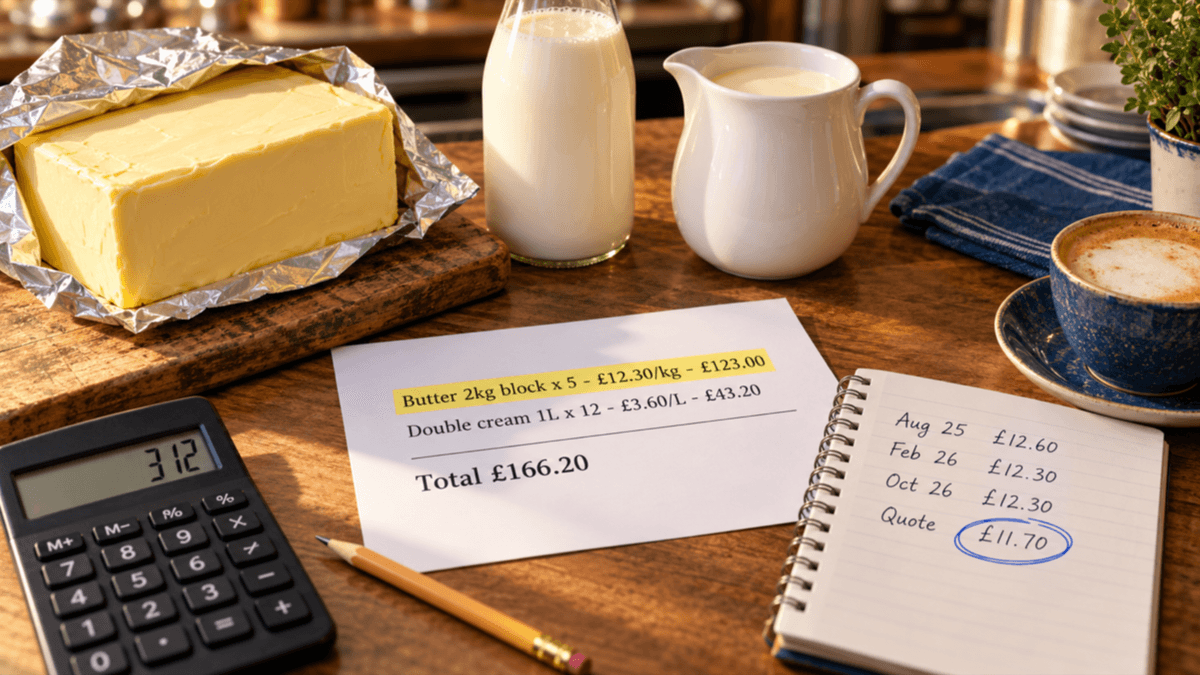
| Butter, per kg | 10kg | £12.30 | £11.70 | 60p | £312.00 | £52.00 |
| Double cream, per litre | 12 litres | £3.60 | £3.40 | 20p | £124.80 | £62.40 |
| Mild cheddar, per kg | 6kg | £7.85 | £7.70 | 15p | £46.80 | £31.20 |
| Milk, per litre | 160 litres | £1.24 | £1.25 | None | None | £832.00 |
| Butter and cream | £436.80 |
£436.80 a year on butter and cream, the two lines where the market has fallen, and 71% of it is butter. The cheddar's £46.80 is a shopping question, not a market one, since cheese hasn't really fallen.
Watch the last column: every penny a litre on milk is worth £83.20 a year here, so milk deserves the closest watch from December. The 160 litres a week is the example in the guide to the milk bill nobody negotiates.
Ask for it
Ring the account manager, or the owner of a local dairy, not the driver or the depot line. Take your per-unit history for the line, AHDB's figures for the same months, the second quote and your annual volume: 520kg of butter a year sounds like an account, 10kg a week sounds like a drop.
Something like:
"I've been going through my butter. I paid £12.60 a kilo in August last year and I'm paying £12.30 now. Over the same months AHDB's wholesale butter price has gone from £6,050 a tonne to £3,300. I know that's bulk wholesale butter, not what you pay, and your wages and fuel haven't come down. But bulk is £2.75 a kilo cheaper and 30p of it has reached me. I've had £11.70 quoted, delivered, for the same 2kg block, and I'd rather stay with you. What can you do, and from which invoice?"
If the price is fixed until a review, ask when it is and what it's tied to; the milk guide covers what a good answer sounds like.
Then check the next invoice. If the old price turns up, that's an invoice that doesn't match an agreed price, one of the four situations in claiming credit notes from suppliers, and you claim it the same way.
Then shop it
If the answer is no, the second quote becomes an option. Compare it delivered, on the order you'd really place: a delivery charge belongs to the whole order.
Butter is one of the few dairy lines where a planned cash and carry run can make sense, because it keeps. Price the trip in first. Illustratively, a 24-mile round trip at HMRC's approved mileage rate of 55p a mile for 2026 to 2027 (it covers the whole cost of running the car, not just fuel) is £13.20. Over two weeks' butter at 20kg, that adds 66p a kilo before you count your time. The shelf has to beat the £11.70 delivered quote by more than that, so under £11.04 a kilo. It works on a trip you're making anyway, and only until the delivered price comes down.
Milk, no. The milk guide calls it "the worst thing in the building to fetch yourself", and a falling market doesn't change that.
Re-cost the recipes the fall touches
The items that gain most carry the most butter or cream per portion, times the most portions. Here they are at the £11.70 butter and £3.40 cream the café would pay if its supplier matched the quotes:
| Item, illustrative | Dairy in it | Before | After | Saving each | A week | A year |
|---|---|---|---|---|---|---|
| Plain scone | 10g butter | 12.3p | 11.7p | 0.6p | 200 | £62.40 |
| Butter-heavy traybake slice | 20g butter | 24.6p | 23.4p | 1.2p | 80 | £49.92 |
| Cream with a scone | 40ml double cream | 14.4p | 13.6p | 0.8p | 60 | £24.96 |
| Hot chocolate with cream | 25ml double cream | 9.0p | 8.5p | 0.5p | 100 | £26.00 |
| Total | £163.28 |
That's the share of the saving that lands on these four items; the rest sits in everything else the café makes.
The scone in full, on the 25-scone batch from the guide to which invoice price goes in the recipe: 250g of butter and £1.75 of everything else comes to £4.825 at £12.30 a kilo (19.3p a scone) and £4.675 at £11.70 (18.7p).
Eaten in at £2.64, the net price is £2.20 (£2.64 / 1.2, as eat-in food is standard-rated). Cash gross profit on ingredients goes from 200.7p to 201.3p, or 91.2% to 91.5%.
Pennies a portion. The portion matters more than the price: a scone's cream at 60ml instead of 40ml costs an extra 6.8p at £3.40 a litre, more than eight times what the cheaper cream saved on that portion (0.8p). Measure it.
For a new bake on the winter board, start with the price instead: take off VAT and the gross profit you need, and design the bake to the budget that's left, as in designing a dish to a target cost.
Hold the price or cut it?
The case for holding is strong. If you absorbed part of the 2024 and 2025 dairy peak rather than putting all of it on the board, as in my experience many cafés did, a fall is that margin coming back.
Your customers haven't watched butter halve either. AHDB's Q3 review found the average price shoppers paid for butter fell just 3.9% on a year in the 12 weeks ending 5 September, while wholesale butter in August was 43% down on a year (£6,050 to £3,450).
The case for cutting is narrower: a line customers compare on price, a price you raised and blamed on butter, or a line that has lost volume since.
Here's the rule I'd use, line by line, after the re-cost:
- Below your target gross profit: hold. The fall is repairing margin you gave up at the peak.
- At or above target, but the saving per item is smaller than your smallest price step: hold, and write the headroom on the recipe card. A 10p cut on the board costs 8.3p of net price eaten in (10p / 1.2), and the full 10p on a cold takeaway, which is zero-rated.
- Cut only when all three are true: the line is above target, the saving clears the price step, and customers compare it on price.
Run the table through it and every line holds: savings of 0.5p to 1.2p an item against an 8.3p step. Even if the rest of the bulk fall reached the invoice, another £2.45 a kilo, the 20g traybake slice would cost only 4.9p less than today. On dairy this autumn the rule says hold almost everywhere, and keep the headroom for the next cost that goes up.
Keep a price history so you see it next time
One sheet, the four dairy lines, a row per invoice: date, supplier, pack and price per kilo or litre. Once a month, add AHDB's butter and cream figures beside them. For the recipe, follow the invoice price guide's rule: cost on the latest price you actually paid, keep every earlier price, and read the direction.
My trigger, and it's a rule of thumb: if the market has moved more than 10% since your price last changed, in either direction, ring. Date each recipe by the invoice behind its biggest cost line, as the recipe cost staleness audit does, and anything butter-led that's over 16 weeks old gets re-costed first.
CostingBrik's docs describe the same trail kept for you: each processed invoice line updates the ingredient's price and re-costs every recipe that uses it, all of an ingredient's prices sit on one timeline whatever the supplier, and the Trends tab lists top fallers as well as top risers.
This week
- Pull every dairy invoice back to August 2025, or twelve months at least.
- Convert butter, cream, cheese and milk to a price per kilo or litre, one row per month.
- Put AHDB's figures beside butter and cream and circle any line that hasn't moved since autumn 2025.
- Get one second quote for the same packs, delivered.
- Ring your account manager with the history, AHDB's figures, the quote and your annual volume, and get any new price and its start date in writing.
- Check the next invoice against it, and claim a credit if the old price appears.
- Re-cost the butter and cream recipes once the new price is invoiced (the free recipe costing calculator does the sums), and hold board prices unless the rule says cut.
- Diary the milk invoice for December and ask your dairy when your price is next reviewed.
Rises find their way onto the invoice. Falls arrive when you ask for them, and the butter one has been waiting since last winter.
Ed O'Brien has run Hunters Cake Company for 17 years across cafés in Witney, Burford, and a bakery in Carterton, Oxfordshire. He's building Brikly - modular tools that give independent café owners the same data the big chains have, without the big chain price tag.