The April 2026 Cost Cliff: Every Price Rise Hitting Your Café This Month
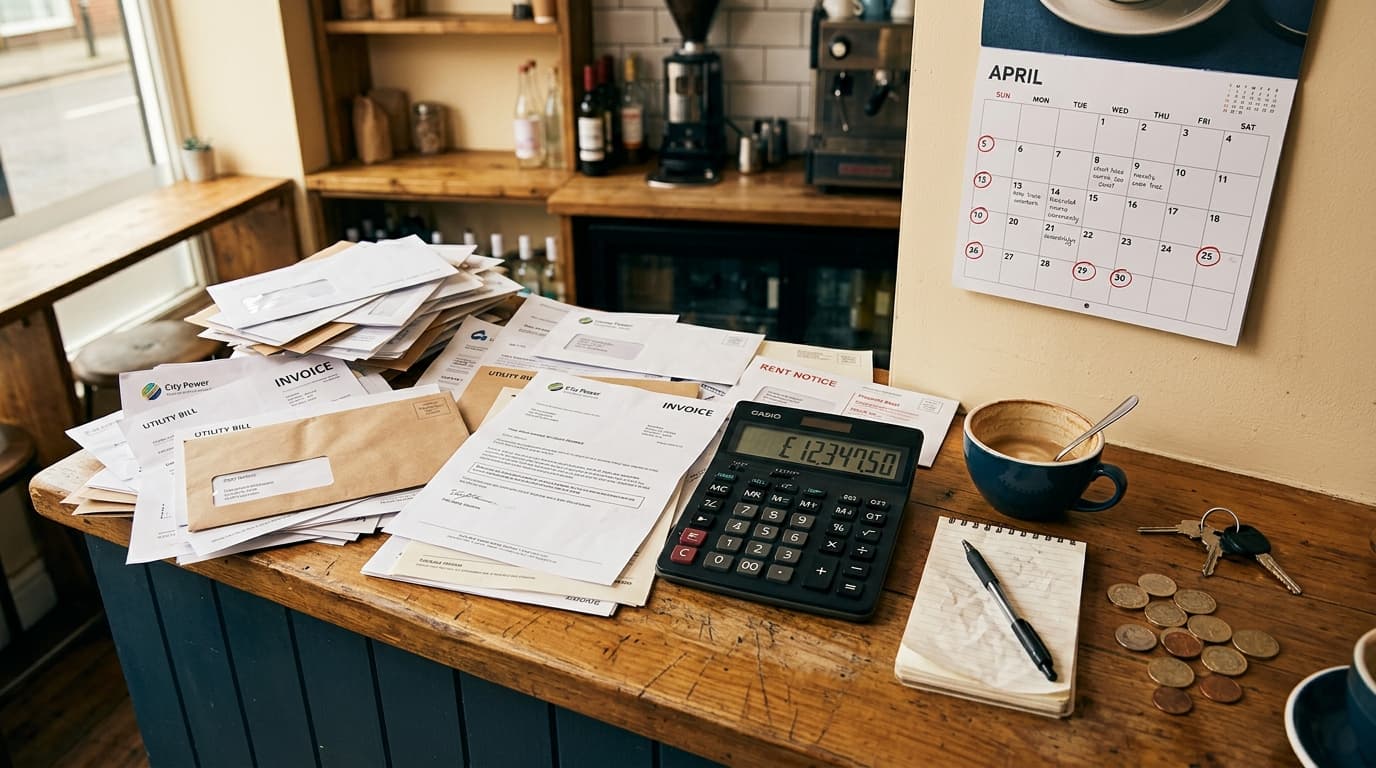
April is always an expensive month for hospitality. But April 2026 is something else entirely.
Five separate cost increases land on the same date. Each one has been covered individually - by us, by the trade press, by UKHospitality. But nobody has put them all in one place and added them up. So here it is: every price rise hitting your café, coffee shop, or restaurant this month, what it actually costs you, and what you can do about it.
1. National Minimum Wage: not 50p, more like 75p
The National Living Wage rises from £12.21 to £12.71 per hour on 1 April. The headline is a 50p increase. The reality, once you add employer NI, pension, and holiday accrual, is closer to 75p per hour - roughly £1,500 extra per full-time employee per year.
The 18-20 rate jumps 8.5% to £10.85, which hits hardest if you rely on younger staff for weekend and evening shifts.
We broke this down in detail in The April 2026 NMW Rise Isn't 50p, including the full employer cost calculation. If you haven't modelled it yet, our free Pay Rise Planner does the maths for your whole team in minutes.
2. Employer National Insurance: the quiet one
This isn't a new April 2026 change - it landed in April 2025. But it's still biting, and most operators haven't fully absorbed it yet.
Two things happened at once: the rate went up from 13.8% to 15%, and the threshold dropped from £9,100 to £5,000 per year. That threshold change means you're paying NI on an extra £4,100 of earnings per employee. On a team of eight, that's NI on an extra £32,800 of wages you weren't paying it on before.
The threshold is frozen until at least April 2028. So every time wages go up - including this month's NMW rise - your NI bill grows on a bigger base.
The Employment Allowance increased to £10,500, which helps smaller employers offset some of this. But for most hospitality businesses with more than a handful of staff, the net effect is still an increase.
3. Business rates: the big one
The Retail, Hospitality and Leisure business rates relief - which has shielded the sector since the pandemic - ends completely on 1 April 2026. No taper, no extension.
For the last two years you've had 75% off your rates bill. This year it dropped to 40%. From April, it's gone. The government has replaced it with a slightly lower multiplier (38.2p for small hospitality premises vs 49.9p previously), but that 5p discount doesn't come close to replacing a 75% discount.
And it gets worse: April 2026 also brings a business rates revaluation based on April 2024 rental values - up 28% on average from the pandemic-era 2021 valuations.
A small café with a rateable value of £15,000 in 2024-25 paid roughly £1,871 after relief. The same café, revalued at £20,000, will pay £7,640 from April. That's a jump of over £5,700.
Pubs got a 15% additional relief package. Cafés and restaurants got nothing.
We covered this in full in Business Rates 2026: The 'Tax Cut' That's Costing Cafés More Than Ever.
4. Statutory Sick Pay: day one, everyone
From 6 April, three SSP changes hit simultaneously:
- Day-one eligibility - the 3 waiting days are gone
- No earnings threshold - the £125/week Lower Earnings Limit is removed entirely
- Percentage-based rate - 80% of average weekly earnings, capped at £123.25/week
For hospitality, this is significant. Most of your team are part-time. Many were previously below the earnings threshold and got nothing when they were sick. From April, every employee is eligible from their first day of absence.
The maths is particularly awkward for weekend workers. A Saturday-only team member calling in sick now receives 80% of their normal pay - roughly £80 in SSP. Under the old rules, they'd have received nothing.
If you have a team of 10 and each person has two short absences per year, that's 20 SSP payments you weren't making before. The full breakdown is in The April 2026 SSP Changes Will Hit Hospitality Hardest.
5. Food waste separation: fines from day one
From March 2026, separate food waste collection became mandatory for all businesses in England. If you're not already separating food waste from general waste, you're now non-compliant - and fines can exceed £1,000.
For most cafés this isn't a huge operational shift - you probably already separate food waste in the kitchen. But if your waste contractor hasn't set up a separate food waste collection, or if your bins aren't clearly labelled and your team isn't trained on it, you're exposed. Environmental health officers are now checking for compliance during routine inspections.
Add it all up
Here's what a typical small café - say 8 staff, £15,000 rateable value, £350,000 turnover - is looking at from April:
| Cost increase | Estimated annual impact |
|---|---|
| NMW rise (8 staff, mixed hours) | £6,000 - £10,000 |
| Employer NI (threshold + rate) | £2,000 - £3,500 |
| Business rates (relief ending + revaluation) | £4,000 - £6,000 |
| SSP (day-one, no threshold) | £400 - £800 |
| Food waste compliance | £200 - £500 |
| Total new annual cost | £12,600 - £20,800 |
That's between £1,000 and £1,700 per month in new costs. For a business running on 5-10% net margin, that's the difference between profitable and not.
The tax burden nobody talks about
It's not just April. A recent report by the Independent Coffee Collective - which Brikly contributed to - found that over 30 separate taxes, levies, and mandatory costs apply to a typical UK coffee shop. The compliance burden alone consumes 9-16 hours every week, valued at £14,000 to £25,000 per year in lost productivity.
The UK charges 20% VAT on hospitality - the second highest in Europe. France has operated a 10% rate since 2014. Ireland legislated 9% permanently from July 2026. No comparable European economy applies its full standard rate to hospitality.
On a £3.50 flat white, 58p goes straight to HMRC. At 10%, it would be 32p - putting 26p per cup back into the business. Across a busy café doing 200 covers a day, that's not trivial.
The report makes a clear case: a VAT reduction to 10% for hospitality would be the single most impactful policy change the government could make. Over 4,000 hospitality businesses became insolvent after VAT returned to 20% following the pandemic reduction. The sector is now losing venues at a rate of six per day.
If you want to read the full report and add your voice, it's available at independentcoffeecollective.com.
What you can do this week
You can't change government policy overnight. But you can make sure April doesn't catch you off guard.
1. Model your full cost increase
Don't look at each change in isolation. Add up the NMW impact, the NI increase, the rates bill, and the SSP exposure together. That's your real number. Our free New Hire Calculator shows the true cost of each employee including all the hidden multipliers.
2. Reprice your menu
If your costs are going up 5-10%, your prices need to reflect that. Most customers understand - especially if the quality stays the same. A few pence across each item absorbs a lot. If you need to understand which items to adjust first, start with your food cost percentages and focus on the biggest sellers.
3. Check your business rates
Verify your new rateable value at gov.uk/correct-your-business-rates. If it looks wrong, challenge it. Make sure transitional relief is being applied correctly - small properties are capped at a 5% annual increase in year one.
4. Talk to your suppliers
Your suppliers face the same cost pressures. Some will be raising prices this month. Get ahead of it: review your invoices, benchmark your key ingredients, and don't accept increases without a conversation. If you're processing invoices manually, that's hours per week you could be saving.
5. Get your absence tracking right
With day-one SSP, you need accurate records of hours worked and absences taken. Tighten up your rota system, timesheets, or POS clock-in data now - before the first April sick day lands.
6. Support the campaign
The Independent Coffee Collective's report includes a parliamentary petition for a VAT reduction to 10% for hospitality. Whether or not it succeeds, adding your voice matters. The more operators who engage, the harder it is for policymakers to ignore.
The bigger picture
April 2026 is not one cost increase. It's five, landing simultaneously, on a sector that was already running on thin margins after years of pandemic recovery, energy crises, and food price inflation.
UKHospitality puts the total annual cost burden on the sector at £3.4 billion - £1.9 billion in wages, £1 billion in employer NI, and £500 million in business rates. Their survey found that 70% of hospitality businesses plan to reduce employment levels. A third will cut trading hours.
The businesses that survive this won't be the ones who absorb costs and hope for the best. They'll be the ones who know exactly what every dish costs to make, understand their true labour costs, and adjust their pricing before the margin disappears.
None of this is easy. But all of it is knowable - and that's where the advantage lies.
Ed O'Brien has run Hunters Cake Company for 17 years across cafés in Witney, Burford, and a bakery in Carterton, Oxfordshire. He's building Brikly - modular tools that give independent café owners the same data the big chains have, without the big chain price tag.