
The real cost of your card machine - merchant fees eating 2-3% of turnover
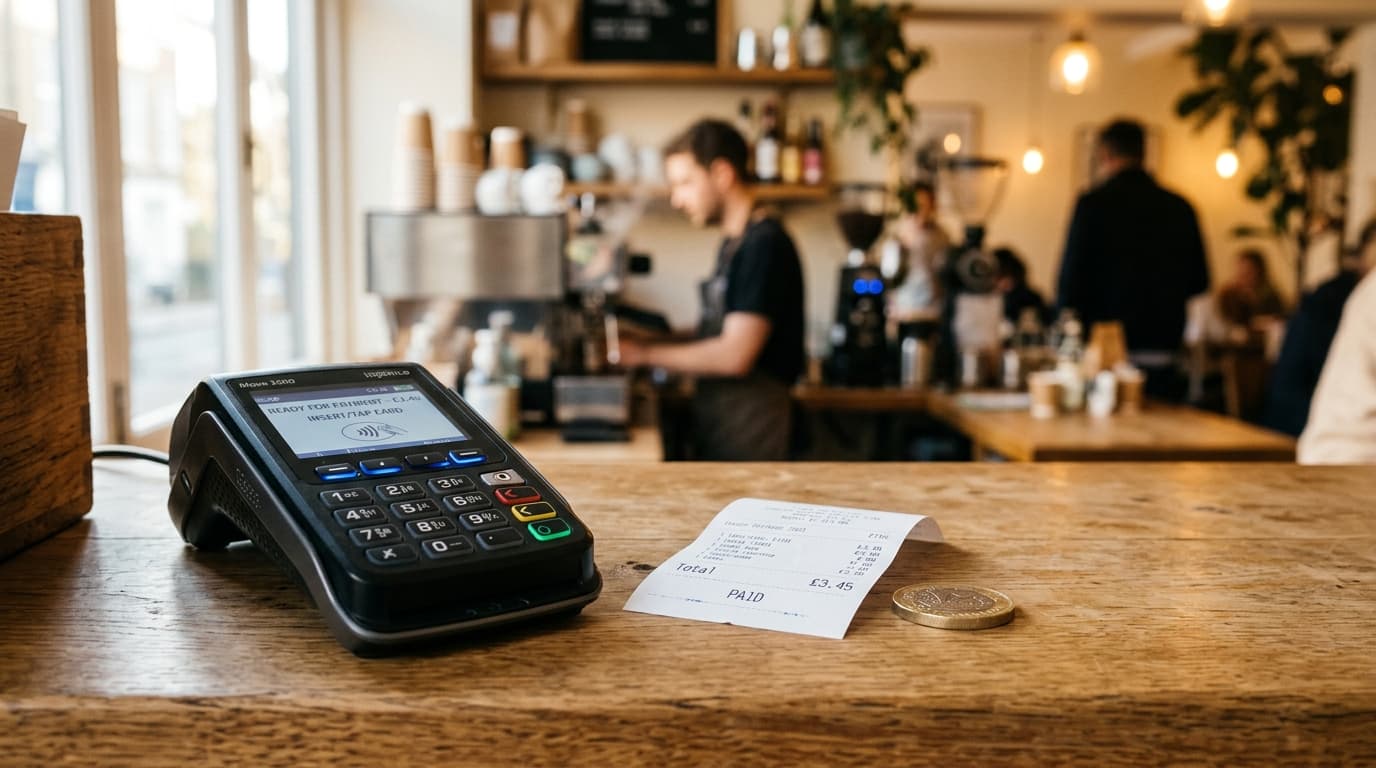
You'll scan right past it on the P&L. "Card fees" or "merchant charges", tucked in somewhere between bank charges and software subscriptions. A line item that just exists, quietly, month after month.
On a £500k turnover café, that line is usually £10,000 to £15,000 a year.
Most operators can't tell you their blended card rate. They know their coffee supplier's price per kilo to the penny, but the number of pennies taken out of every £10 spend at the till? Vague. And that's exactly how the payment providers like it.
What your blended rate actually is
Your blended rate is the only number that matters. It's simple:
Total card fees ÷ total card turnover = your blended rate.
Pull last month's statement from your provider. Find the total fees charged. Divide it by your total card takings for that month. That's your real rate, not the headline number on the marketing page.
Do it now. It takes three minutes.
For most independent cafés in 2026, a healthy blended rate sits somewhere between 1.4% and 1.9%. If you're north of 2.2%, you're overpaying. If you're north of 2.5%, someone's being rude to you and you haven't noticed yet.
The reason this matters: a 0.5% difference on £500k turnover is £2,500 a year. That's a month's wages for a part-timer. Or a new espresso grinder. Or just £2,500 that stays in your pocket.
The full cost stack - it's not just the headline %
When a provider quotes you "1.75%", they're quoting one slice of the stack. Here's the full picture.
Transaction fees
The headline rate usually applies to standard UK consumer debit cards. Everything else costs more:
- Consumer credit cards - typically 0.3% to 0.5% more than debit
- Commercial/business cards - can be 1% to 2% more
- Amex - often charged separately at 1.5% to 3%, sometimes not accepted at all
- International cards - a surcharge on top, usually 1% to 2%
In a café with a lot of tourist trade or business customers buying rounds for meetings, your actual mix can push your blended rate up by 0.3% to 0.5% over the headline.
Terminal rental or purchase
Some providers sell you the terminal outright for £30 to £80. Others rent it to you for £15 to £30 a month - which adds up to £180 to £360 a year per machine. On a three-terminal setup, that's over £1,000 a year in rental alone.
Rental contracts often have lock-ins of 18 to 48 months. Read the small print.
PCI DSS compliance fees
Payment Card Industry Data Security Standard. It's a real thing you genuinely need to comply with. But many providers charge £10 to £25 a month for "PCI compliance management" - effectively a fee for sending you a questionnaire once a year. £300 a year for a form.
Minimum monthly service charges
If your card turnover drops below a threshold, you get charged the difference. Quiet January? You pay to not pay them. Watch for this clause.
Chargeback fees
When a customer disputes a transaction, you're charged £10 to £25 per chargeback regardless of whether you win the dispute. Rare in a café, but it happens.
Statement and authorisation fees
Some legacy providers still charge for paper statements, per-authorisation fees (a few pence per tap), and "account maintenance" fees. All small individually. All add up.
UK providers in 2026 - who fits who
This isn't a ranking. Different cafés need different setups.
Square, SumUp, Zettle - flat-rate simplicity
These are the default for smaller independents, and for good reason. Flat-rate pricing (usually 1.5% to 1.75% in-person), no monthly fees, no long contracts, terminal bought outright for £30 to £100.
Good fit for:
- Cafés turning over under £300k
- New openings still finding their feet
- Operators who value predictability over optimisation
- Anyone who doesn't want to read a 40-page merchant agreement
The catch: above roughly £400k turnover, the flat rate starts costing you more than negotiated tiered pricing would.
Stripe Terminal - flexible, needs integration
Stripe Terminal pairs physical card readers with Stripe's full payment platform. Great if you're already running online ordering, a booking system, or a custom setup through Stripe. Rates are in the same ballpark as Square.
Good fit for cafés with a strong online/click-and-collect side, or anyone whose POS already integrates cleanly with Stripe.
Less good if you just want a machine on the counter and no tech to think about.
Worldpay, Barclaycard, Global Payments - tiered and negotiable
The traditional acquirers. Pricing is tiered (interchange++, or blended tiers), contracts are longer, but for busier sites the rates can beat flat-rate providers significantly - often landing at a true blended 1.3% to 1.6%.
Good fit for:
- Cafés doing £500k+ and willing to negotiate
- Multi-site operators
- Anyone who takes a lot of Amex or international cards
The catch: these contracts are where the hidden fees live. You have to actually read them, and renegotiate every 18 to 24 months, or you'll drift back up.
How to negotiate (or switch)
You have more leverage than you think. Here's the playbook.
1. Get your blended rate. You can't negotiate without the number.
2. Get two quotes from other providers. Real written quotes, not marketing pages. Give them your monthly card turnover and average transaction size. Ask for an all-in number including terminal rental, PCI, and minimums.
3. Take the best quote back to your current provider. Nine times out of ten, retention teams have discretion to match or beat. They'd rather lose 0.2% than lose you entirely.
4. If they won't move, switch. The switching process is a couple of weeks of admin. Worth it for £2,500 a year.
5. Put a reminder in the diary for 18 months' time. Rates drift. Check again.
The takeaway
Card fees are the most ignored line on your P&L, and one of the easiest to fix.
This week:
- Pull last month's merchant statement
- Work out your blended rate (total fees ÷ total card turnover)
- If you're above 2%, get two competing quotes
- Take them back to your current provider or switch
The money is sitting there. You just have to bother to pick it up.
Ed O'Brien has run Hunters Cake Company for 17 years across cafés in Witney, Burford, and a bakery in Carterton, Oxfordshire. He's building Brikly - modular tools that give independent café owners the same data the big chains have, without the big chain price tag.