
Food Waste Separation Is Now Law: What Your Café Needs to Do
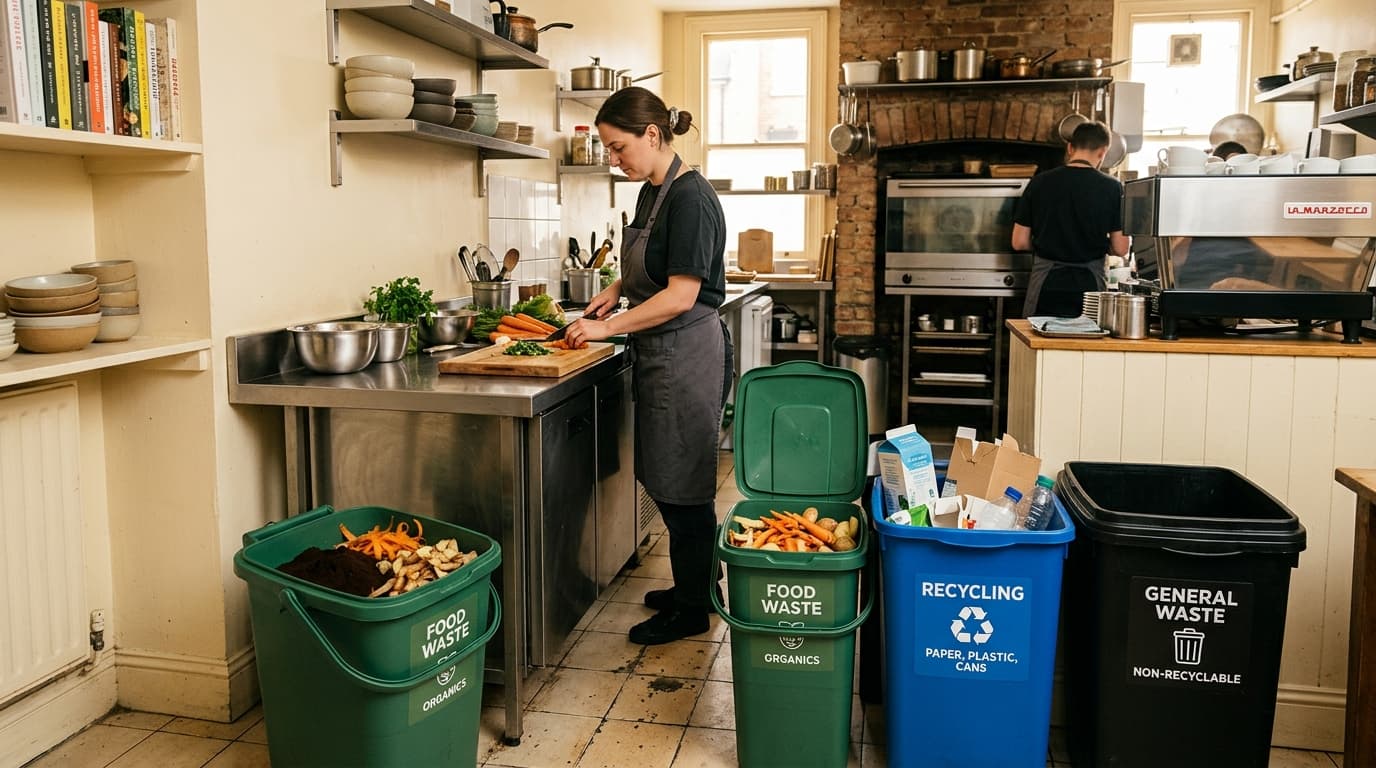
If you're still tipping coffee grounds and sandwich crusts into the same black bag as everything else, you're breaking the law.
Since 31 March 2026, every business in England that produces food waste must separate it from general waste. No exceptions for size. No grace period. It applies to your 30-cover café the same way it applies to a 200-cover restaurant.
This comes from the Environment Act 2021, delivered through the Simpler Recycling regulations. The rules have been coming for years - but the enforcement date has now passed. Here's what you actually need to do.
What the law requires
The core requirement is straightforward: food waste must be collected separately from other waste streams. You cannot mix food waste into your general waste bin or your dry recycling.
This means:
- All food scraps, peelings, and plate waste go into a dedicated food waste container
- Coffee grounds, tea bags, and milk waste go in food waste - not general waste
- Expired stock and prep trimmings are food waste
- Cooking oil has its own collection requirements (most operators already have an oil drum pickup)
The rules also require you to separate dry recyclables (paper, card, plastic, metal, glass) - but most businesses were already doing this. The food waste element is the new enforcement focus.
Who enforces it and what happens if you don't comply
Your local authority is responsible for enforcement. In practice, it's the environmental health team or the waste and recycling enforcement officers - the same people who inspect your food hygiene.
Penalties start with a compliance notice. If you ignore it, you're looking at fixed penalty notices of up to £300 for initial offences, escalating to prosecution and fines that can exceed £1,000 for repeated non-compliance. In the worst cases, your waste carrier can refuse to collect non-compliant waste entirely - which creates a whole different set of problems.
The early enforcement approach will likely be educational. But "we didn't know" stopped being a defence on 31 March.
How to set up compliant waste streams in a small kitchen
This is where most café operators get stuck. You've got a kitchen the size of a parking space, three bins already fighting for floor space, and a team that's too busy to think about which bin gets the banana skin.
Here's what works in practice.
The three-bin minimum
You need at least three clearly separated waste streams:
- Food waste - a green caddy or bin with a lockable lid (to contain smells)
- Dry mixed recycling - card, clean plastic, tins, glass
- General waste - everything else
If your kitchen is tight, use stackable bins or wall-mounted caddies. A 7-litre countertop caddy for food waste works well on a prep station - it's small enough to fit beside a cutting board and easy to empty into a larger outdoor bin at the end of service.
Labelling
Every bin needs a clear label. Not a piece of masking tape with "food" scrawled on it in marker pen - proper colour-coded labels that your team (including anyone who doesn't have English as a first language) can read at a glance.
Most waste contractors will supply free labels and posters. WRAP (the Waste and Resources Action Programme) also has free downloadable signage for businesses.
Where to put them
The flow matters more than the position. Place the food waste caddy where waste is generated - next to the prep counter, beside the coffee machine, near the wash-up area. If people have to walk across the kitchen to find the right bin, they won't use it.
Your larger food waste wheelie bin (usually 120 or 240 litres) stays outside. The indoor caddy gets emptied into it at the end of each shift.
Working with your waste contractor
This is the step most people forget. You can set up perfect bins inside your kitchen, but if your waste contractor isn't collecting food waste separately, you're still non-compliant.
What to do:
- Call your waste contractor and ask about their food waste collection service. Most now offer it - some have been preparing for this regulation for years
- Check collection frequency - food waste smells. In summer, you'll want at least twice-weekly collection, possibly more
- Ask about bin provision - many contractors supply the outdoor wheelie bins as part of the service
- Compare costs - your general waste bill should decrease as volume shifts to food waste and recycling streams, which are often cheaper or even free to collect
If your current contractor doesn't offer food waste collection, you need a new contractor. Your local authority website will have a list of licensed waste carriers in your area.
Training your team
The bins are only as good as the people using them. And in a busy kitchen at 8am with a queue out the door, nobody is stopping to read a poster.
Keep it simple:
- Day one briefing - show every team member the bins, the labels, and what goes where. Five minutes, maximum
- The "when in doubt" rule - if someone isn't sure, it goes in general waste. It's better than contaminating the food waste or recycling stream
- Make it part of close-down - add "empty food waste caddy" to your end-of-shift checklist
- Lead by example - if the owner is tossing coffee grounds in the general bin, so will everyone else
New starters should get the waste separation briefing on their first shift. Add it to your induction checklist alongside allergen training and fire exits.
The hidden benefit: food waste data saves you money
Here's the part nobody talks about. Once you start separating food waste, you can see how much you're producing. And once you can see it, you can manage it.
Most cafés have no idea how much food they throw away. The numbers are usually worse than expected. WRAP estimates that UK hospitality wastes around 18% of the food it purchases - and roughly two-thirds of that is avoidable.
When you start tracking what goes into the food waste bin, patterns emerge:
- Prep waste - are you peeling too aggressively? Trimming too much off the broccoli stems?
- Over-ordering - that extra box of avocados that goes brown every Wednesday
- Portion creep - your recipe says 30g of cheddar per toastie but the team is eyeballing 50g
- Expired stock - items that never sell fast enough hitting their use-by date
This is food cost management by another name. Every kilogram of food waste is money you've already spent on ingredients, plus the labour to prep them, that generates zero revenue.
If you're already working on cutting your food costs, waste tracking is one of the fastest wins available. And with April 2026 bringing cost increases across the board, finding savings in waste is more urgent than it's been in years.
Real examples from a café kitchen
To make this concrete, here's what food waste separation looks like in a typical café:
- Coffee grounds - the single biggest food waste item by weight in most coffee shops. One busy espresso machine produces 5-10kg of grounds per day. These are food waste, not general waste
- Milk waste - steamed milk left in jugs, expired fresh milk. Food waste
- Prep trimmings - carrot tops, onion skins, bread heels, cake offcuts. Food waste
- Plate waste - whatever customers leave. Food waste (even if it's mixed with a napkin - pick the napkin out)
- Expired stock - that sourdough loaf from yesterday, the yoghurt past its date. Food waste (remove packaging first)
The packaging goes in recycling or general waste depending on the material. The food itself always goes in the food waste stream.
Connecting waste to your food cost percentage
If you're tracking your food cost percentage, waste is the silent variable that inflates it. Your recipe might cost 28% on paper, but if you're wasting 15% of the ingredients before they reach a plate, your real food cost is significantly higher.
Separating and tracking food waste closes this gap. It turns a vague feeling that "we throw too much away" into a measurable number you can act on. And when your ingredient costs are being tracked automatically, you can connect rising waste volumes directly to specific suppliers or product lines.
A quick compliance checklist
Here's a summary you can print and stick on the kitchen wall:
- Separate food waste bin inside the kitchen (labelled, lined with compostable bags)
- Larger food waste wheelie bin outside (120L or 240L)
- Separate dry recycling bin (labelled)
- General waste bin (labelled)
- Waste contractor confirmed for separate food waste collection
- Collection frequency agreed (minimum weekly, ideally twice-weekly in summer)
- Team briefed on what goes where
- Waste separation added to induction checklist for new starters
- End-of-shift caddy emptying added to close-down checklist
- Compostable liner bags stocked
The bottom line
Food waste separation isn't optional any more. But it doesn't need to be complicated either. A countertop caddy, a phone call to your waste contractor, and a five-minute team briefing will get you compliant.
The real opportunity is what comes after. Once you're separating waste because the law says so, you might as well measure it - because what you find will almost certainly save you more than the cost of a few extra bins.
Compliance is the floor. Using the data to tighten your food costs is where the actual value sits.
Ed O'Brien has run Hunters Cake Company for 17 years across cafés in Witney, Burford, and a bakery in Carterton, Oxfordshire. He's building Brikly - modular tools that give independent café owners the same data the big chains have, without the big chain price tag.