
How to Set Menu Prices That Actually Protect Your Margins
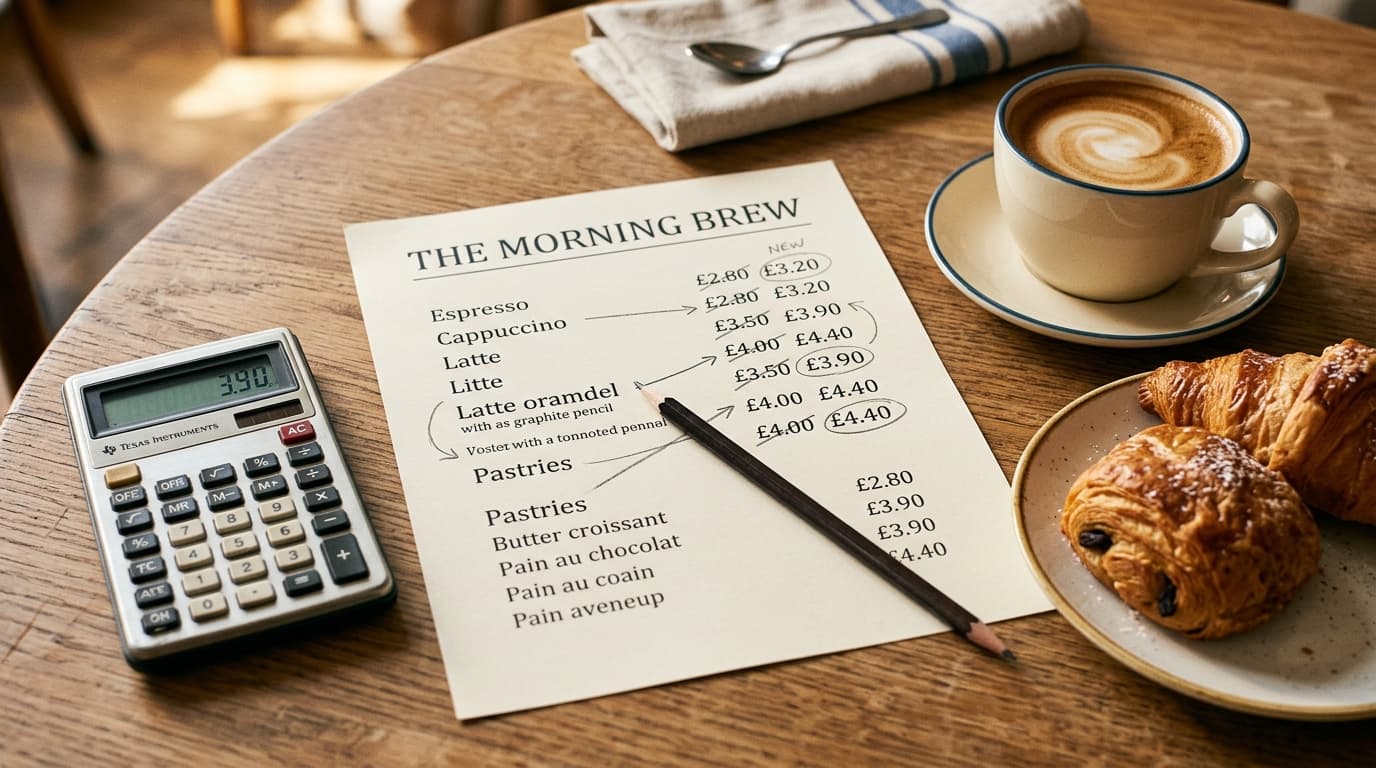
You know your food costs. You've done the recipes. You might even have a spreadsheet somewhere with margins on it. But when it comes to actually setting the price on your menu board, most independent café owners do the same thing: take the ingredient cost, multiply by three or four, round to the nearest 50p, and hope for the best.
That's not pricing. That's guessing with maths around it.
If you're repricing your menu this April - and with everything hitting at once, you probably should be - this is how to do it properly. Not theory from a textbook. Practical pricing strategy from someone who's been writing prices on menu boards for 17 years.
The Cost-Plus Trap
The most common pricing method in hospitality is cost-plus: work out what the dish costs to make, add a fixed markup, done. If your flat white costs £0.52 in ingredients and you want a 75% GP, you charge around £2.10. Right?
Wrong. Or at least, incomplete.
Cost-plus pricing treats every item on your menu the same. It ignores what customers are willing to pay, what the café down the road charges, and whether that item is pulling its weight on your menu. A flat white at £2.10 might protect your margin on paper, but you've left a pound on the table because every other café in town charges £3.20 and nobody would blink at £3.50.
The reverse is also true. Your homemade granola might cost £1.80 to make, and a 75% GP formula says charge £7.20. But your customers won't pay £7.20 for granola when the place next door charges £5.50. So you either eat the margin or you don't sell it.
Cost-plus gives you a floor. It tells you the minimum you can charge without losing money on an item. But it's a terrible ceiling. The price customers actually pay should be set by a combination of your costs, your market, your positioning, and a bit of psychology.
Pricing Psychology That Actually Works in Cafés
You don't need a behavioural economics degree to price a menu well. But understanding a few principles will genuinely change how customers perceive your prices.
Charm pricing (the £X.95 effect)
Pricing at £3.95 instead of £4.00 feels meaningfully cheaper to most people, even though it's a 5p difference. This works especially well for items over £5 - the jump from £5.95 to £6.00 feels bigger than it is because customers mentally anchor to the first digit.
For coffee and lower-priced items, round numbers often work better. £3.50 for a flat white feels clean. £3.45 feels fussy. Use charm pricing for food items over £5. Use round numbers for drinks and baked goods.
Anchor items
Put your most expensive item near the top of a section. If your most expensive brunch dish is £14.50 and it's the first thing people see, everything below it feels reasonable by comparison. That £9.50 eggs Benedict suddenly looks like good value.
You don't even need people to order the anchor. Its job is to make the items around it feel well priced.
Decoy pricing
This is the "medium coffee" effect. If you offer a small flat white for £3.20 and a large for £4.20, most people pick the small. Add a medium at £3.90, and suddenly the large looks like better value. The medium exists to make the large sell.
You can apply this to food too. A regular avocado toast at £7.50 and a "loaded" version with poached eggs, feta, and chilli flakes at £9.95 - the loaded version sells more than it would without the regular option as a reference point.
Drop the £ sign
Research consistently shows that removing the currency symbol from menus makes customers less price-sensitive. Instead of "£8.50", write "8.50" or even just "8.5". It subtly reduces the association with spending money. This works better for printed menus and boards than digital displays where the symbol aids clarity.
When to Raise Prices (And by How Much)
Here's the mistake most operators make: they avoid raising prices for as long as possible, then make a big jump all at once. Customers notice. They remember what their flat white cost last week. A 50p jump overnight is visible.
The better approach is small, regular increases.
The 3-5% rule
Raise prices by 3-5% every 6-12 months. On a £3.50 flat white, that's 10-15p. On a £9.00 brunch dish, that's 25-45p. Most customers won't notice. The ones who do will accept it because they've seen everything else go up too.
When to go bigger
Sometimes you need more than 5%. That's fine. But do it strategically:
- Raise the items customers are less price-sensitive about first. People know the price of a flat white to the penny. They're vaguer about what they pay for a toastie or a bowl of soup. Start with the items where perception is softer.
- Raise high-margin items less, low-margin items more. Your POS data combined with your recipe costs will tell you which items can absorb a price increase and which ones need one.
- Bundle increases with improvements. Adding a better sourdough to your sandwiches? That's a natural moment to add 50p. Customers associate the price change with the upgrade, not with inflation.
The April window
Right now - April 2026 - is one of those rare moments where customers expect prices to go up. The NMW increase, NI changes, and business rates are in the news. Your regulars know costs have risen. If you're going to make a larger adjustment, this is the window to do it. Waiting until summer means you've absorbed three months of higher costs for no reason.
How to Communicate Price Increases Without Losing Regulars
This is the part most operators dread. The regular who's been coming in every morning for three years, ordering the same flat white, and knows exactly what it costs. How do you tell them it's going up?
The honest answer: most of the time, you don't need to.
Small increases (10-20p on a drink, 25-50p on a food item) rarely need announcing. Just update the board. The vast majority of customers won't say anything because, honestly, they expect it.
For bigger changes - say 50p or more on a core item - here's what works:
- Be matter-of-fact, not apologetic. "We've had to adjust a few prices this month - costs have gone up across the board." That's it. No essay. No social media post explaining your electricity bill. Customers respect directness.
- Never blame the customer. "We want to keep quality high" is better than "we can't afford not to raise prices."
- Front-of-house staff need to know. If a regular comments, your team should be able to say something natural - "Yeah, suppliers have put everything up this spring" - rather than freezing. A brief heads-up to your team is all it takes.
- Add value alongside the increase. Can you improve a single element of the item you're raising? A slightly larger portion of chips. A better quality cheese. Something that makes the higher price feel justified, even if the cost of the upgrade is marginal.
The cafés that lose regulars over price increases are almost always the ones that either make a huge jump all at once or handle the communication badly. Small, regular, matter-of-fact changes keep everyone happy.
Using Your Data to Price Smarter
If you're tracking your recipe costs and your POS sales data, you have everything you need to make informed pricing decisions. If you're not, you're pricing blind.
Here's how to use the data you have:
Price elasticity by item
Some items on your menu are price-elastic - customers buy fewer if you raise the price. Others are inelastic - they buy the same amount regardless. Coffee is almost always inelastic. Your regulars need their flat white. A 10p increase won't change their behaviour. Discretionary items - a slice of cake, a second pastry - are more elastic.
Look at your POS data after a price change. Did volume drop? If not, you could have gone further. If it did, was the total revenue (volume x price) still higher? Sometimes selling 10% fewer at a 15% higher price means more money.
Contribution analysis
Stop thinking in percentages and start thinking in pounds. A croissant with a 65% GP at £3.50 gives you £2.28 profit per sale. A sourdough toastie with a 55% GP at £7.50 gives you £4.13. The toastie is a better earner despite the lower percentage.
When deciding where to raise prices, focus on the items where a price increase generates the most additional pounds, not the best percentage improvement. Menu engineering tools do this analysis automatically by connecting your sales volume to your actual recipe costs.
The VAT threshold question
If you're approaching the £90,000 VAT threshold, pricing becomes more complex. Once you register, you're effectively collecting 20% on top for HMRC - but passing all of that to customers means a visible price jump. Some operators absorb part of it by reducing margins slightly. Others use it as a reason to restructure their pricing entirely.
Either way, model it before it happens. Knowing your per-item margins means you can plan exactly which prices need to move and by how much.
Competitive Benchmarking Without Racing to the Bottom
You should know what the cafés around you charge. You should not try to match them.
Here's why: your costs are different. Your rent is different. Your labour model is different. Your product quality might be completely different. Matching the cheapest competitor's price means matching their margins - and you don't know if their margins are actually healthy.
Instead, use competitor pricing as a reference point:
- If you're significantly more expensive on a core item (50p+ on a flat white, £1+ on a food item), make sure you can articulate why. Better ingredients, bigger portions, nicer space.
- If you're significantly cheaper, ask yourself why. You might be leaving money on the table.
- For unique items - your signature cake, a house recipe - there's no benchmark. Price based on your costs and what the market will bear. Uniqueness gives you pricing power that a standard flat white never will.
The goal isn't to be the cheapest or the most expensive. It's to be priced fairly for the quality you deliver, with margins that let you pay your team, cover your overheads, and still have something left at the end of the month.
A Practical Pricing Checklist
Before you put new prices on your board, run through this:
- Do you know the ingredient cost of every item? If not, cost your recipes first. You can't set prices without knowing costs.
- Have you checked your margins against current supplier prices? Not January's prices - this month's. Costs change. Your margins change with them.
- Are you pricing based on value, not just cost? A £0.52 flat white doesn't have to sell for £2.10 just because the formula says so.
- Have you identified which items are price-elastic vs inelastic? Raise the inelastic ones first.
- Is your most expensive item visible? It anchors everything else.
- Have you briefed your team? They need to handle the "did this go up?" conversation naturally.
- Are you staggering changes? Don't reprice your entire menu on the same day.
The Takeaway
Menu pricing isn't a one-off exercise. It's something you should revisit every quarter - ideally with current cost data, not a spreadsheet from last year. The operators who protect their margins aren't the ones who charge the most. They're the ones who price deliberately, adjust regularly, and use their data to make informed decisions rather than gut calls.
If April's cost increases have forced you to look at your prices, good. Use it as the trigger to build a pricing habit, not just a one-time fix.
Your recipe costs are the foundation. Your menu analysis is the intelligence layer. And the prices on your board are where all of it comes together.
Ed O'Brien has run Hunters Cake Company for 17 years across cafés in Witney, Burford, and a bakery in Carterton, Oxfordshire. He's building Brikly - modular tools that give independent café owners the same data the big chains have, without the big chain price tag.