
Loyalty programmes for indie cafés: what actually drives repeat visits
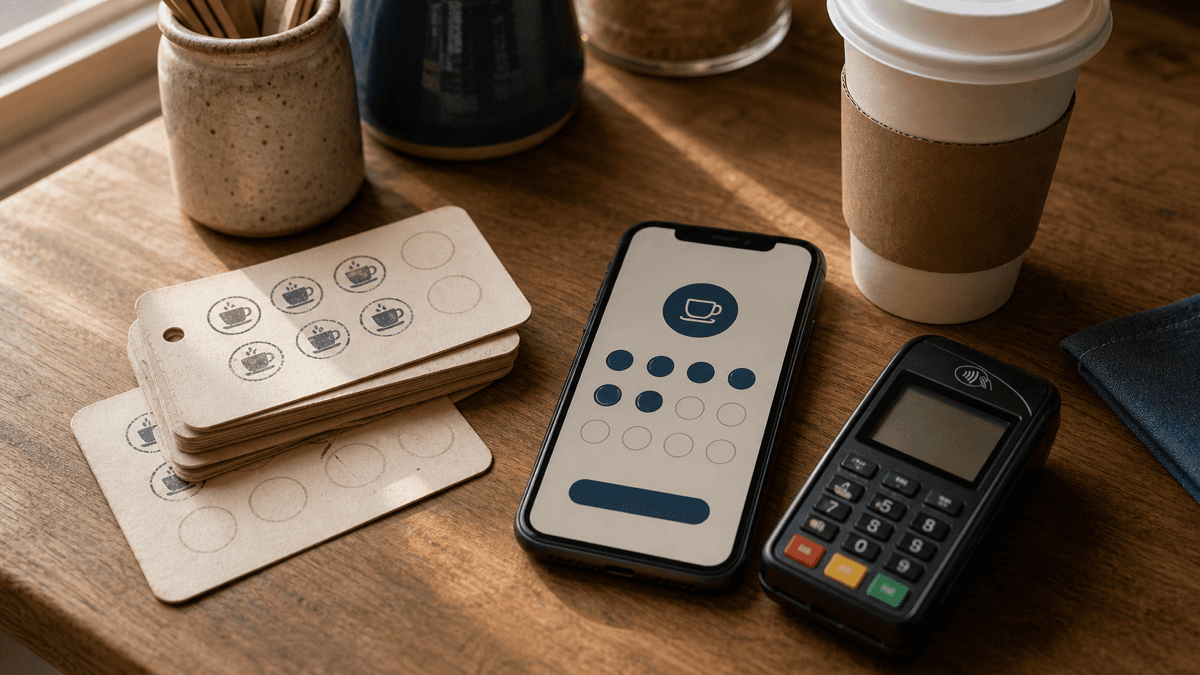
Here is the question almost no café owner asks out loud about their loyalty scheme:
Is it actually driving repeat visits, or are you just giving free coffee to people who would have walked through the door anyway?
Most independents run a stamp card or an app because everyone runs a stamp card or an app. The regulars seem to like it, the till keeps ringing, job done. Nobody puts a number next to it. Nobody asks whether the loyal cohort got more loyal, or whether you just funded a quiet discount for behaviour that was going to happen anyway.
Let's actually do the maths, then talk about what a loyalty scheme worth running looks like in 2026.
The headline number that sounds harmless
"Buy 9, get the 10th free."
Sounds like 10% off. Feels generous but not mad. The customer has to work for it, after all.
Take a flat white at £4 inclusive of VAT. Strip VAT and your turnover per cup is £3.33. On 10 cups, that is £33.33 of turnover with one given away, so the effective discount on that cohort is roughly 10% off the paying cups.
The damage is in the margin, not the headline price.
At an 80% gross profit margin (which a well-costed drink should hit), each paid cup contributes about £2.66. Ten cups contribute £26.66. The free tenth cup costs you that £2.66 of forgone profit plus the variable cost of milk, cup, lid and beans, roughly £0.67 more. So you trade about £3.33 of gross profit on a 10-cup cycle, against a base of £26.66. That is closer to a 12-13% hit to gross profit on that cohort, not 10%. You are giving away the most profitable thing on your menu. For the full line-by-line, see what a flat white actually costs.
That alone is not a reason to bin the scheme. It is a reason to actually know the number.
The lift question nobody answers
That margin hit only matters if the scheme is doing nothing. The real question is whether it drove incremental visits. More cups sold, not just the same cups stamped.
To answer that you need a baseline. Average visits per customer per month, before you launched. Then the same number six months after launch, once the novelty has settled.
Most cafés do not have that baseline. They launched on a Tuesday, the regulars seemed pleased, and the question stopped being asked. So you end up in a state where:
- You can see redemptions (free coffees given away)
- You cannot see lift (extra paid coffees bought)
- You assume the second is bigger than the first, because otherwise the whole thing is a tax on your best customers
A loyalty scheme that does not lift behaviour is not a loyalty scheme. It is a slow-motion price cut applied to the people least likely to leave you.
How to actually measure it (roughly)
You will not get a clinical answer, just a directional one. That is fine.
Any modern EPOS - Square, Toast, Loyverse, SumUp, Lightspeed - has a repeat-visit or returning-customer report. Usually clunky, hidden two menus deep, often based on card-token matching rather than identified customers. Good enough.
Segment by cohort if you can. Loyalty joiners versus everyone else. If both groups behave the same over time, the scheme is wallpaper. The same POS data that tells you which menu items make money will tell you this - see POS data versus recipe costing.
Paper card or app: which one is honest with you
This is where most operators get the decision back-to-front.
Paper stamp cards are almost free. A few quid for printing, a stamp, done. The problem is they tell you nothing. You cannot see who is collecting, how fast, how many cards never reach 10, or whether a six-month customer has stopped coming in. You cannot run targeted offers either, because no one is in any database.
App-based loyalty (Square Loyalty, Toast, Loyverse, Stamp Me, Loyally) usually runs £20-80 a month. You also pay in friction: every new customer has to be persuaded to open the app at the till, which kills throughput at peak, and some will simply refuse.
The trade-off is data. With an app you can answer the questions above. With paper you cannot.
The honest test: will you actually look at the data and act on it? If yes, an app pays for itself. If no, you are paying £40 a month for what a stamp card gives you, plus till friction. Paper is the more honest choice for an operator who will not analyse anything.
When loyalty is worth running, and when it is not
Loyalty works hardest in high-frequency, drinks-led trade. The classic indie coffee shop, weekday commuters, regulars who buy three or four cups a week. Small nudges in frequency move real money. Half a visit per week across your top 200 regulars is meaningful turnover.
It works poorly in two scenarios:
- Destination cafés where visits are inherently occasional. Weekend brunch spots, tourist tea rooms, Saturday-only bakeries. People are not coming weekly no matter what you do, and the stamp card sits in a wallet for six months.
- Peak-capacity sites already turning people away at 10am on Saturday. You do not need more visits, you need to manage the ones you have. Discounting your busiest hour is the opposite of what you should be doing. Same logic as keeping a tighter offer overall - smaller menus tend to make more money.
Better than "free 10th coffee"
If you are going to run something, run something with a job to do. A few ideas that consistently outperform a flat stamp card:
- Cohort-targeted offers. "We haven't seen you in four weeks - free pastry with your next coffee." Aimed only at lapsing regulars. Small redemption volume, big lift on customers most at risk of going to the place down the road.
- Referral offers. "Bring a friend, you both get a coffee." One drink to acquire a new customer, dramatically cheaper than ad spend.
- Early-access perks. Members get the new seasonal drink or new bake 24 hours before everyone else. Costs nothing, signals belonging, gets posted on Instagram for free.
- Upgrades instead of freebies. A 50p syrup or oat-milk upgrade instead of the full free cup. Customer perceives more than 50p of value. You discount less.
- Pastry pairings at slow hours. Free almond croissant with a coffee at 2-4pm. You give something away when you already have spare staff and an empty room, and you introduce the customer to the highest-margin food category in the building.
The common thread: none of these involve giving a free coffee at the busiest time of day to the most loyal customers. The step beyond a stamp card altogether is a monthly coffee membership, where you charge for frequency up front instead of discounting it after the fact, and the maths works very differently.
Don't forget the card fees on every paid visit
One overlooked cost. Every paid visit in your loyalty cycle still costs you 1.5-2% of turnover in merchant fees. If your loyal customer pays by card on every single visit, the real cost of card fees is quietly eating the margin you thought you were protecting. Worth knowing before you stack another scheme on top.
What a serious loyalty review looks like
If you have been running a scheme for more than a year without reviewing it:
- Total free items redeemed in the last 12 months. Multiply by gross profit per item. That is what it cost you.
- Average monthly visits per identifiable customer before and after launch. Multiply the lift (if any) by gross profit per visit. That is what it earned you.
- If 2 is meaningfully bigger than 1, keep it. If flat or smaller, change the scheme or kill it.
It is that simple. The reason almost no operator does this is not that the maths is hard. It is that the answer might be unflattering.
If a tool like MenuBrik can pull the visit data and CostingBrik already knows your gross profit per drink, the calculation takes an afternoon, not a quarter. That is the only real reason to use software for any of this - to make the honest question cheap enough that you actually ask it.
Loyalty is one retention lever. The other one almost no indie café systemises is Google reviews, and a 20-minute weekly review routine lifts local Maps visibility more cheaply than any loyalty stamp ever will.
Ed O'Brien has run Hunters Cake Company for 17 years across cafés in Witney, Burford, and a bakery in Carterton, Oxfordshire. He's building Brikly - modular tools that give independent café owners the same data the big chains have, without the big chain price tag.