
Recipe Costing for UK Cafés: How to Price Every Dish for Profit
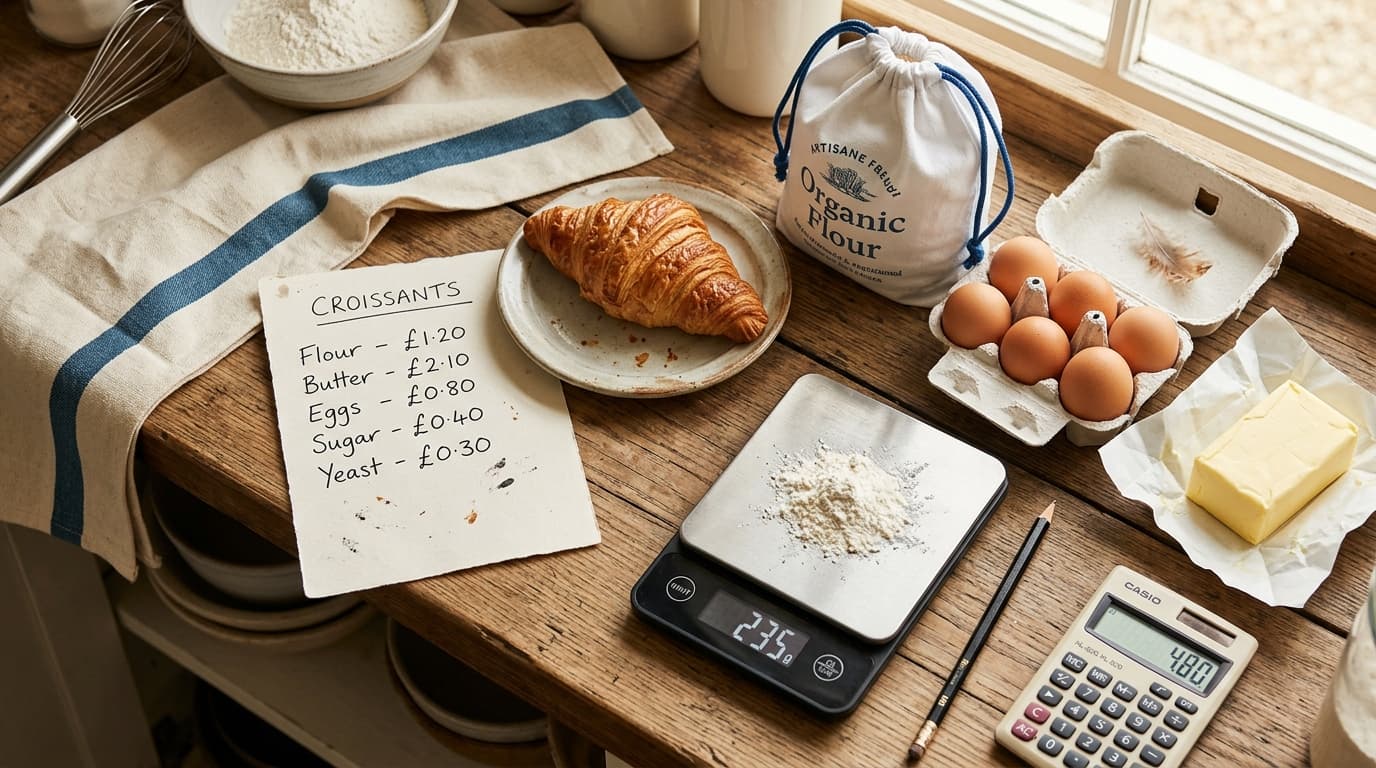
Your butter supplier put prices up last month. The NMW just rose to £12.71 an hour. Employer NI is now 15% with the threshold dropped to £5,000. And somewhere in the background, food inflation keeps quietly eating into margins you thought were fine.
If you haven't built proper recipe cost cards for your menu, you're guessing. And in 2026, guessing costs more than it used to.
This guide walks you through how to build a recipe cost card from scratch - with real numbers, worked examples, and the waste-adjusted maths that most guides skip over. Whether you're costing a flat white, a sourdough loaf, or an avocado toast, the process is the same.
Why Recipe Costing Matters Right Now
A recipe cost card is a breakdown of every ingredient in a dish, what each one costs, and what the total comes to per portion. It's the foundation of profitable pricing.
Without it, you don't know your gross profit per item. You don't know which dishes earn their place on your menu and which ones are quietly losing you money. You can't set prices with confidence, and you can't spot the impact when a supplier raises their prices - which, as we've all seen this April, they absolutely will.
The cafés that stay profitable through cost shocks are the ones that know their numbers. Not roughly. Exactly.
Step 1: List Every Ingredient
Start with one recipe. Write down every single ingredient that goes into it. Not just the headline items - everything.
That means the oil you fry in. The salt. The garnish. The sauce on the side. The napkin-thin layer of butter on the toast. These feel insignificant on their own, but across 50 portions a day, they add up to real money.
For a flat white, your list might look like:
- Espresso (coffee beans)
- Milk
- Takeaway cup and lid (if applicable)
For avocado toast:
- Sourdough bread (slice)
- Avocado
- Olive oil
- Lemon juice
- Chilli flakes
- Salt and pepper
- Microgreens or garnish
Nothing gets left off. If it goes on the plate or in the cup, it goes on the card.
Step 2: Work Out the Cost Per Unit
This is where most people get it right in principle but wrong in practice.
You know your bag of flour costs £12.50 for 16kg. But your recipe uses 500g. So you need the cost per gram, per millilitre, or per unit - whatever your recipe calls for.
Cost per unit = Purchase price / Total quantity
£12.50 / 16,000g = £0.00078 per gram
If your recipe uses 500g of flour: 500 x £0.00078 = £0.39
Do this for every ingredient. It's tedious the first time, but once you've built a master ingredient list with costs per unit, you can reuse it across every recipe.
Step 3: Apply Yield and Waste Factors
This is the step most guides skip - and it's the one that makes the biggest difference to accuracy.
When you buy a kilo of avocados, you don't use a kilo of avocado. You throw away the skin and the stone. The edible yield on an avocado is roughly 65-70%. That means your actual cost per usable gram is significantly higher than the purchase price suggests.
Yield-adjusted cost = Purchase cost per unit / Yield percentage
If avocados cost £5.00 per kg and only 65% is usable:
£5.00 / 0.65 = £7.69 per usable kg
That's a 54% increase over the purchase price. If you're costing your avocado toast using the price on the box, you're undercosting every portion.
Common yield factors for café ingredients
| Ingredient | Approximate edible yield |
|---|---|
| Avocado | 65% |
| Onions | 90% |
| Lemons (juice only) | 30-35% |
| Whole chicken | 65% |
| Prawns (shell-on) | 50% |
| Fresh herbs | 70-80% |
| Strawberries | 92% |
| Potatoes (peeled) | 80% |
Your actual yields will vary depending on your suppliers and how your kitchen preps. Measure your own where it matters - especially on expensive ingredients.
Worked Example 1: Flat White
Let's cost a standard 8oz flat white.
| Ingredient | Quantity used | Cost per unit | Recipe cost |
|---|---|---|---|
| Coffee beans | 18g | £18.00 / 1,000g = £0.018/g | £0.32 |
| Whole milk | 180ml | £1.30 / 2,000ml = £0.00065/ml | £0.12 |
| Takeaway cup + lid | 1 | £0.09 each | £0.09 |
| Total | £0.53 |
If you sell that flat white for £3.80:
Gross profit = £3.80 - £0.53 = £3.27
GP% = (£3.27 / £3.80) x 100 = 86%
Coffee drinks are your best-margin items. That's why every successful café puts them front and centre. If you want to understand how that GP% fits into your overall food cost percentage, that's where the bigger picture comes in.
Worked Example 2: Sourdough Loaf
A bakery batch recipe that makes 6 loaves.
| Ingredient | Quantity (batch) | Cost per unit | Batch cost |
|---|---|---|---|
| Strong bread flour | 3,000g | £1.20 / 1,000g | £3.60 |
| Water | 2,100ml | Negligible | £0.00 |
| Sourdough starter | 600g | £0.80 / 1,000g (flour cost) | £0.48 |
| Salt | 60g | £0.65 / 1,000g | £0.04 |
| Olive oil | 30ml | £6.00 / 1,000ml | £0.18 |
| Batch total | £4.30 | ||
| Cost per loaf | ÷ 6 | £0.72 |
If you sell each loaf for £4.50:
GP% = (£4.50 - £0.72) / £4.50 x 100 = 84%
Now, if you slice that loaf for toast on your brunch menu (10 slices per loaf), each slice costs £0.072. Your sourdough toast dish starts from a very healthy base.
Worked Example 3: Avocado Toast
Here's where yield factors start to bite.
| Ingredient | Quantity used | Cost per unit (yield-adjusted) | Recipe cost |
|---|---|---|---|
| Sourdough bread | 2 slices | £0.072 per slice (from above) | £0.14 |
| Avocado | 1/2 (approx 80g usable) | £7.69 / 1,000g yield-adjusted | £0.62 |
| Olive oil | 5ml drizzle | £6.00 / 1,000ml | £0.03 |
| Lemon juice | 10ml | £2.80 / 1,000ml yield-adjusted | £0.03 |
| Chilli flakes | 1g | £12.00 / 1,000g | £0.01 |
| Salt and pepper | Pinch | Estimate | £0.01 |
| Microgreens | 5g | £40.00 / 1,000g | £0.20 |
| Total | £1.04 |
Sell it for £7.50:
GP% = (£7.50 - £1.04) / £7.50 x 100 = 86%
Without yield adjustment, you might have costed that avocado at £0.40 instead of £0.62. Across 25 portions a day, that's £5.50 of hidden cost - every single day.
Scaling: Batches vs Single Portions
Some recipes make sense to cost as a single portion (a flat white, a sandwich). Others need to be costed as a batch first, then divided.
Batch-costed items:
- Baked goods (cakes, loaves, scones, muffins)
- Soups and sauces
- Dressings and marinades
- Granola, compotes, jams
Single-portion items:
- Made-to-order dishes (eggs Benedict, sandwiches)
- Coffee drinks
- Smoothies
The rule is simple: cost it the way you make it. If you bake 12 scones at once, cost the batch of 12, then divide. If you make each flat white individually, cost the single serve.
For batch items, be honest about yield. A tray of 12 brownies might produce 11 sellable portions if one breaks or gets trimmed. Cost accordingly.
How Often Should You Update Your Costs?
The short answer: every time a supplier price changes. The realistic answer: monthly at minimum.
Ingredient prices don't stay still. Dairy fluctuates seasonally. Produce prices swing week to week. Your coffee roaster might hold prices for six months, then jump 8% overnight. If your supplier is raising prices this month, your recipe costs need to reflect that immediately - not three months later when you wonder why margins feel tight.
Stale cost data is the most common reason café margins drift. You set prices based on last quarter's ingredient costs, and by the time you notice the squeeze, you've been undercharging for weeks.
Linking Recipe Costs to Menu Prices
Once you know what a dish costs to make, you need to decide what to charge. The most common approach is a markup multiplier.
Selling Price = Ingredient Cost x Markup Multiplier
Most UK cafés target a food cost percentage between 25-35%, which means a markup multiplier of roughly 3x to 4x.
| Target food cost % | Markup multiplier | £1.00 ingredient cost sells for |
|---|---|---|
| 25% | 4.0x | £4.00 |
| 30% | 3.3x | £3.33 |
| 33% | 3.0x | £3.00 |
| 35% | 2.9x | £2.86 |
But here's the thing - the multiplier is a starting point, not a rule. A flat white at 86% GP doesn't need a 4x multiplier. Avocado toast at 86% GP is already well above target. The multiplier helps you set a floor. Market positioning, customer expectations, and competitor pricing set the ceiling.
If you want to go deeper on pricing strategy - including pricing psychology, when to raise prices, and how to communicate increases - we've covered that in detail in our guide on how to set menu prices that protect your margins.
Common Mistakes That Kill Your Margins
After 17 years of costing recipes, these are the mistakes I see most often.
1. Ignoring waste and yield
This is the big one. Using purchase price instead of yield-adjusted price on anything with trim, peel, bones, or waste will understate your true costs. On a high-volume item, that error compounds fast.
2. Forgetting the small stuff
Oil, seasoning, garnish, sauces, packaging. Individually they're pennies. Across a full menu and a full week, they can add up to hundreds of pounds. A good cost card includes everything.
3. Not updating when prices change
You costed your recipes six months ago. Butter has gone up twice since then. Your cost cards still show the old price. Your menu prices haven't moved. Your GP has quietly dropped 4-5 percentage points and you're wondering why cash is tighter than the covers suggest.
4. Costing the recipe but not the portion
A batch of soup costs £8.40 to make. But how many portions does it actually yield? If you assume 10 but consistently serve 8 because portions are generous, your cost per bowl is £1.05, not £0.84. That's a 25% error.
5. Using round numbers instead of measuring
"About 200g of chicken" is not a recipe cost. It's a guess. Weigh it. Measure it. The first time takes discipline. After that, it's just how you work.
6. Only costing food, not drinks
Coffee, smoothies, juices, and hot chocolate all have ingredient costs. Coffee drinks tend to have excellent margins, but speciality drinks with syrups, alternative milks, and toppings can creep up. Cost them all. You might find your oat milk flat white is significantly more expensive to make than your regular one - and you're charging the same for both.
Where This Fits in the Bigger Picture
Recipe costing doesn't exist in isolation. It's one piece of a larger picture that includes your overall food cost percentage, your gross profit margin benchmarks, and the financial reports you review each month.
The cost card tells you what each dish costs. Your menu prices determine what each dish earns. Your sales mix determines which dishes actually contribute the most to your bottom line. And your P&L tells you whether all of that adds up to a business that works.
Getting the cost card right is where it starts. Everything else builds on it.
Try It Yourself
If you want to cost a few recipes right now, our free recipe costing calculator does the maths for you - including portions, margins, and cost breakdowns. No sign-up, no email capture.
For a full menu with dozens of recipes, supplier prices that change monthly, and costs that need to stay current without manual spreadsheet work - that's what CostingBrik is built for. It connects to your invoices, tracks every ingredient price as it changes, and keeps every recipe costed in real time. When your butter goes up 12%, you see the impact across every recipe that uses it, instantly.
Built by a café owner who got tired of spreadsheets that were out of date before the ink dried.
Ed O'Brien has run Hunters Cake Company for 17 years across cafés in Witney, Burford, and a bakery in Carterton, Oxfordshire. He's building Brikly - modular tools that give independent café owners the same data the big chains have, without the big chain price tag.