
Your Supplier Is Raising Prices This Month. Here's How to Push Back.
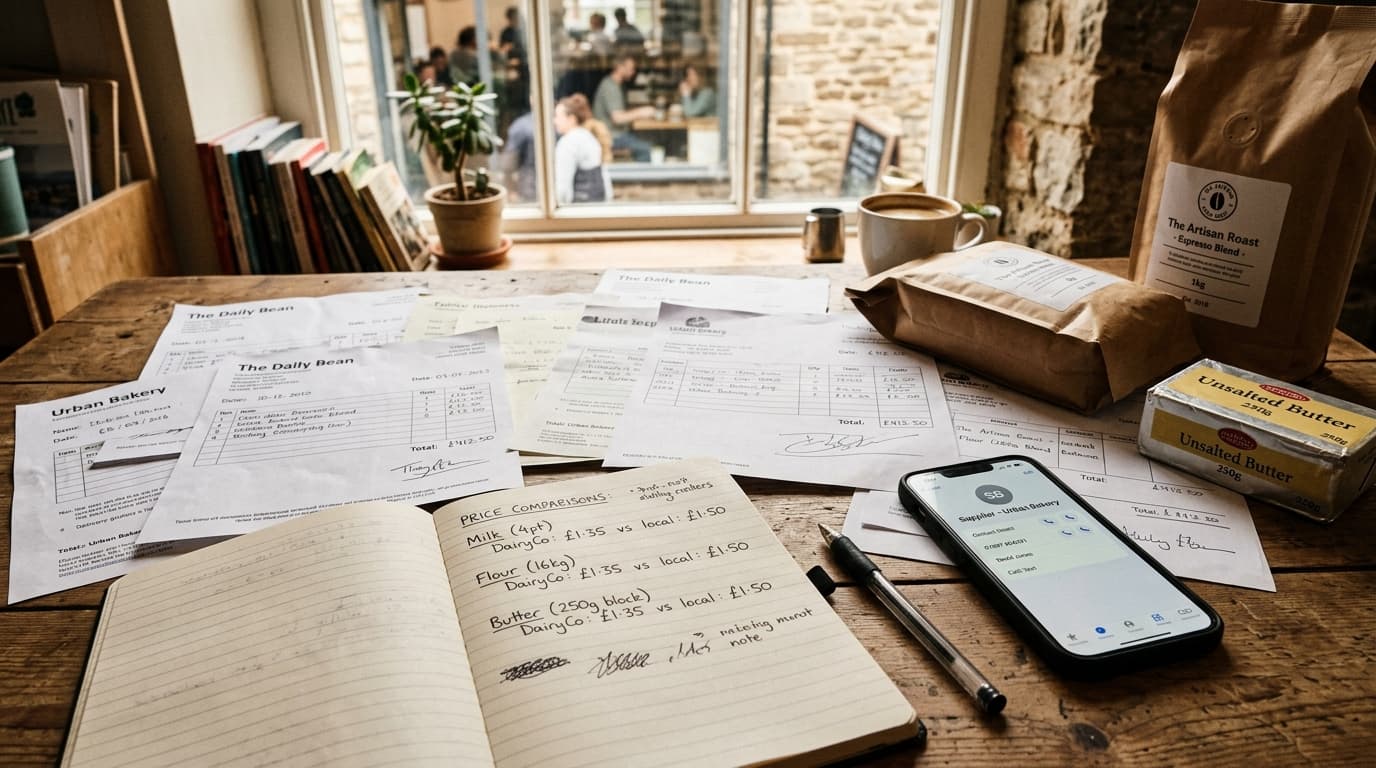
You'll have had the email already. Or maybe just a new price list slipped into the top of a delivery crate. Either way, the message is the same: prices are going up from April.
Most independent café and restaurant owners read it, sigh, and file it. That's understandable. You're busy. You've got a hundred other things on your plate - literally. But accepting every price increase without question is one of the most expensive habits in hospitality.
Here's how to push back.
Why April is the month everything goes up
Your suppliers are dealing with the same April cost cliff you are. National Minimum Wage is up. Employer NI is still biting from last year's threshold change. Business rates relief has ended. Their drivers, warehouse staff, and sales reps all cost more.
So yes, some of the increase is genuine. But "some" is doing a lot of work in that sentence.
Suppliers know that April is the month they can push through increases and nobody will question them. The political noise about NMW and NI gives cover for price rises that go beyond what their actual cost increases justify. A 3% rise in their labour costs doesn't explain a 6% rise in your flour price.
Your job isn't to deny that their costs have gone up. Your job is to make sure they're not padding the increase.
The top 10 principle: focus where it matters
You probably buy from three to five suppliers. Between them, you might have 200+ line items across your invoices. You cannot negotiate every single one. You don't need to.
Pull your invoices from the last three months and identify your top 10 ingredients by spend. For most cafés, this list looks something like:
- Coffee beans - your single biggest ingredient cost
- Milk (whole, semi-skimmed, oat, soya)
- Butter
- Flour (plain, strong bread, self-raising)
- Sugar
- Eggs
- Takeaway cups and packaging
- Cream
- Cheese
- Chicken or your main protein
These 10 items probably account for 60-70% of your total ingredient spend. A 5% saving on your top 10 is worth more than a 15% saving on items 50 through 100.
How to benchmark: the three-quote rule
The simplest negotiation tool is a competing quote. Get prices from two or three suppliers for your top 10 ingredients. You're not necessarily going to switch - you just need to know what the market rate is.
How to do it:
- Call or email two alternative suppliers and ask for a price list
- Compare like for like - same brand, same pack size, same delivery terms
- Note the delivered price, not just the unit price (delivery charges vary wildly)
What you'll often find: Your main supplier is competitive on some items and significantly over-priced on others. That's normal. Suppliers lead with loss-leaders to win your account, then make their margin on the products you never compare.
Most independents are surprised by how much variation there is. I've seen 30% differences on the same brand of butter between two wholesalers serving the same area.
Practical negotiation tactics
You have more leverage than you think. Here's what actually works.
1. Call, don't email
Emails get filed. Phone calls get attention. Ask to speak to your account manager, not the general sales line. Be friendly but direct: "I've had the new price list. Can you walk me through what's changed and why?"
2. Challenge the percentage, not the principle
Don't say "your prices are too high." Say "I understand costs have gone up, but a 7% increase feels steep when NMW went up 4%. Can we meet somewhere in the middle?" This is reasonable, and it works more often than you'd expect.
3. Offer something in return
"If I commit to weekly deliveries of at least £400, can we hold the old price on my top five items for three months?" Suppliers value volume certainty. Give them predictability and they'll often flex on price.
4. Ask about alternatives
"Is there a different brand of cheddar at a lower price point that you'd recommend?" Your rep knows their range better than you do. Sometimes a different product at a better price is the right move.
5. Know your walk-away number
Before you call, decide what increase you'd accept. If flour has gone up 8% and you'd be happy with 4%, say so. Having a number in your head stops you from accepting whatever they offer.
The hidden price creep problem
The big, headline price increases aren't the ones that hurt most. It's the small ones.
A 2% increase in January. Another 3% in March. A quiet 1.5% adjustment in June. None of them feel significant on their own. But compounded over 12 months, your butter has gone from £2.80/kg to £3.10/kg and you never noticed because each step was too small to trigger alarm bells.
This is how most cafés lose margin. Not through one dramatic increase, but through a steady drip of small ones that nobody tracks.
The fix is simple but requires discipline: Record the price of your top 10 ingredients once a month. A spreadsheet works. A notebook works. Just write down the date, the item, and the price. After three months, you'll see trends that are invisible on any single invoice.
If you're processing your invoices through a tool like CostingBrik, this happens automatically - price changes on any ingredient get flagged as soon as they appear. But even doing it manually is better than not doing it at all.
When to switch vs when to stay
Switching suppliers is disruptive. You lose the relationship, the delivery schedule, the familiarity. So when is it actually worth it?
Stay and negotiate when:
- The price difference is less than 10% on most items
- Your current supplier is reliable on delivery and quality
- They're willing to negotiate and have a responsive account manager
- You've been with them less than two years (switching costs are high early on)
Switch when:
- You're consistently 15%+ above market rate on key items
- They refuse to negotiate or don't return your calls
- Quality or reliability has dropped
- You've found a supplier who matches on service AND undercuts on price
The middle ground: Split your account. Use your main supplier for most items but buy your highest-volume ingredients from whoever offers the best price. Many operators buy their coffee beans direct from a roaster but everything else through a wholesaler. There's no rule that says you have to buy everything from one place.
Real examples: what a 5% increase actually costs you
Let's make this concrete. Here's what a 5% price increase on common ingredients means for a café doing £5,000/week in food sales.
- Coffee beans at £18/kg, up 5% to £18.90/kg. If you use 15kg/week, that's £702 extra per year
- Butter at £3.50/kg, up 5% to £3.68/kg. At 20kg/week, that's £187 extra per year
- Semi-skimmed milk at £1.15/litre, up 5% to £1.21/litre. At 200 litres/week, that's £624 extra per year
- Takeaway cups at £0.08 each, up 5% to £0.084 each. At 500/week, that's £104 extra per year
Add those up: £1,617 per year from a 5% increase on just four items. That's profit, straight off the bottom line.
Now imagine you accepted that 5% without question, but could have negotiated it down to 3%. The difference is £647/year. That's a decent month's worth of takeaway cups - just for making a phone call.
Buying groups and co-operatives
If you're a single-site operator buying £2,000/week from a wholesaler, your negotiating power is limited. But you're not the only independent in your area.
Buying groups pool the purchasing power of multiple small operators. You maintain your own supplier relationship, but you negotiate as a collective. Some are formal co-operatives, others are just a WhatsApp group of five local café owners who compare prices and negotiate together.
How to start one:
- Talk to three or four non-competing independents in your area (different enough that you're not direct competitors)
- Share your top 10 prices quarterly
- Approach suppliers as a group: "We represent £15,000/week in combined orders. What can you offer us?"
Even without a formal group, just knowing what other operators pay gives you a benchmark. If the café down the road is paying £2.40/kg for flour and you're paying £2.80, you have a conversation to start.
The loyalty trap
This is the uncomfortable one.
You've been with your supplier for eight years. Dave the driver knows your name. He brings the delivery round the back without being asked. You chat about the football. You feel loyal.
But loyalty in business is a two-way street. If your supplier has been quietly raising your prices by 3-4% every six months while offering new customers better rates to win their business, they're not being loyal to you. They're taking advantage of your loyalty.
Check this: Ask your supplier what their new customer pricing is for your top 10 items. If it's significantly lower than what you're paying, you have a problem - and a negotiation.
Your April action plan
This doesn't need to take all week. Here's a realistic plan:
- Monday: Pull your last three invoices from your main supplier. Identify your top 10 by spend
- Tuesday: Request price lists from two alternative suppliers
- Wednesday: Compare prices on your top 10. Note where your current supplier is above market
- Thursday: Call your account manager. Have the conversation. Ask for a meeting if needed
- Friday: Record your top 10 prices in a spreadsheet or notebook. Set a monthly reminder to update it
That's five hours of work, spread across a week. The savings could be thousands of pounds per year.
The bigger picture
Supplier prices feed directly into your recipe costs, which feed into your menu prices, which determine your margin. One number moves everything downstream.
If you're tracking your costs properly - whether with a spreadsheet, a notebook, or a proper costing tool - a supplier price increase should trigger a review of every recipe that uses that ingredient. Not necessarily a price change on your menu, but at least an awareness of what it's doing to your numbers.
The operators who stay profitable through cost increases aren't the ones who ignore them. They're the ones who see them early, negotiate what they can, and adjust what they must.
Your supplier's costs went up. That's real. But your margin matters too - and the only person protecting it is you.
Ed O'Brien has run Hunters Cake Company for 17 years across cafés in Witney, Burford, and a bakery in Carterton, Oxfordshire. He's building Brikly - modular tools that give independent café owners the same data the big chains have, without the big chain price tag.