
The £90,000 VAT Threshold: When Growing Your Café Actually Costs You Money
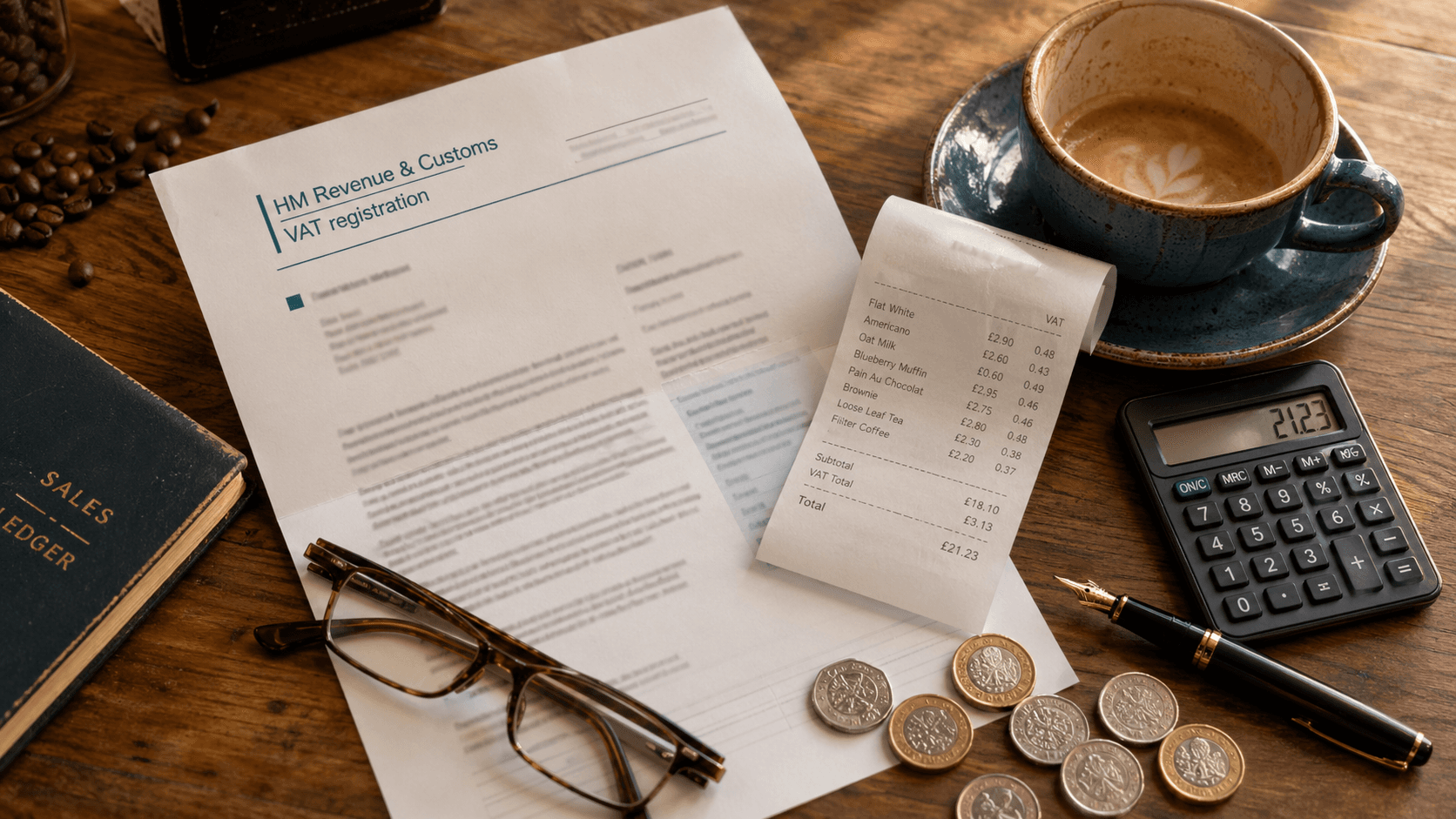
You have a quiet conversation with your accountant in October. Trade has been good. You're going to clear £92,000 turnover this year. Then she says the line that ruins your week.
"You're going to need to register for VAT."
Suddenly the year you finally pulled ahead becomes the year you're worse off than when you were turning over £85k. Every flat white you sell needs to give 20p to HMRC. Every cake plate eaten in. Every catering tray.
This is the VAT threshold trap. And almost every independent café in the UK runs into it sooner or later, usually without a plan.
This post walks you through what the threshold actually is, how it works for hospitality specifically, and how to plan for it before HMRC plans for you.
What the Threshold Actually Is
You must register for VAT if your VAT-taxable turnover crosses £90,000 in any rolling 12-month period. Not a tax year. Not a calendar year. A rolling 12 months, checked at the end of every month.
There are two tests:
- Looking back. At the end of any month, total your taxable sales for the previous 12 months. If the total is over £90,000, you must register within 30 days, and your effective registration date is the first day of the second month after you crossed.
- Looking forward. If at any point you expect your taxable turnover to exceed £90,000 in the next 30 days alone, you must register immediately. (This catches one-off jumps, like a big catering contract.)
Once registered, you charge VAT on your standard-rated sales, submit a return every quarter through Making Tax Digital, and pay HMRC the difference between the VAT you've charged and the VAT you've paid on purchases.
What Counts Toward "VAT-Taxable Turnover"
Here's where it gets fiddly. Not all café sales are taxed the same way, but they almost all count toward the £90,000 threshold.
Standard rated (20% VAT):
- All hot food and hot drinks - eat in or takeaway
- All eat-in food, hot or cold
- Confectionery (chocolate bars, sweets)
- Crisps and savoury snacks
- Soft drinks, fruit juices, smoothies, alcohol
Zero rated (0% VAT, but still taxable):
- Cold takeaway food (a sandwich eaten on the move, a cold pasty bagged up to go)
- Most cold cakes and bakery items taken away
- Bottled water and milk taken away
Outside the scope of VAT (does not count):
- Loans, grants, sale of equipment, owner contributions
Notice the key point: zero-rated sales still count toward the £90,000. A bakery that does 60% of its trade in cold takeaway loaves and pastries can still be obliged to register, even though most of its sales would be charged at 0% afterwards.
It's also why two cafés with identical turnover can have very different VAT bills once they register. Eat-in driven cafés get hit harder than grab-and-go ones, because more of their revenue is standard-rated.
The Cliff Edge: Why £92,000 Can Pay Less Than £88,000
This is the bit that catches people out, and it's worth running the numbers.
Imagine you're a typical eat-in café. Sales mix is roughly 80% standard-rated (hot drinks, eat-in cakes, hot food) and 20% zero-rated (cold takeaway).
Before registration. Turnover £88,000.
That £88,000 is yours. After 30% COGS (£26,400), 28% labour (£24,640) and 20% overheads (£17,600), you're sitting on around £19,360 net profit.
After registration. Turnover £100,000 gross.
You haven't put prices up. You've just grown.
- Standard-rated portion: £80,000 gross = £66,667 ex-VAT + £13,333 VAT owed to HMRC
- Zero-rated portion: £20,000 gross = £20,000 ex-VAT + £0 VAT
- Total ex-VAT revenue: £86,667
You also reclaim input VAT on your purchases. If you spend roughly £30,000 a year on VAT-able inputs (ingredients with VAT on them, packaging, utilities, subscriptions, repairs), that's about £5,000 of input VAT recovered.
Net VAT bill to HMRC: £13,333 - £5,000 = £8,333.
So your real revenue, after VAT, is about £91,667. Your costs are largely the same as before. Your net profit moves to roughly £19,200 - slightly less than when you were at £88,000.
You've grown turnover by £12,000 and made the same money. Or, depending on your mix, less.
The Three Ways Cafés Handle It
There's no single right answer. The right one depends on your trajectory and your stomach.
1. Put your prices up
The cleanest answer. If you can pass 10-15% of the VAT onto customers through a price rise, you protect your margin and grow through the threshold.
The catch: most café customers are price-sensitive. A flat white going from £3.80 to £4.40 in one move loses you regulars. Most operators stage it: a small rise three months before registration, another at registration, another six months later.
If you've got recipe costing and you understand your gross profit margins, you can model exactly which items take a price rise best. Some products absorb it invisibly (eat-in cakes, lunch plates). Others don't (a £4.50 flat white starts feeling steep).
2. Absorb it
You eat the VAT and accept lower margins for a year or two while you grow into a bigger turnover. This is fine if you're confident the trajectory is upward and you've got reserves to fund the dip.
What kills cafés here is the combination of VAT registration with the wider cost cliff - NMW rises, employer NI changes, business rates, energy. If you're absorbing VAT and every other cost increase, your margin doesn't recover.
3. Stay under
Some cafés deliberately keep turnover under £90,000 by closing on quiet days, shortening winter hours, refusing catering jobs, or capping their growth.
This works for genuine lifestyle businesses where the owner is comfortable at £85-89k and doesn't want the operational complexity of going further. It rarely works as a strategy because you're throttling the operational scale that makes a café profitable in the first place.
Standard Scheme vs Flat Rate Scheme
Once you're registered, you have a choice of how to calculate what you owe.
Standard scheme. You charge VAT on every standard-rated sale. You reclaim VAT on every VAT-able purchase. You pay HMRC the difference each quarter. More admin, more accurate.
Flat Rate Scheme. Available if your VAT-inclusive turnover is under £150,000. You pay HMRC a fixed percentage of your gross turnover and skip the input/output calculation. For "Catering services including restaurants, takeaways and cafés" the flat rate is currently around 12.5% (with a 1% discount in your first year of VAT registration).
The catch with Flat Rate: you can't reclaim input VAT on most purchases. If your café has meaningful VAT-able costs - ingredients, packaging, energy, equipment - you usually do better on the standard scheme. If your costs are mostly zero-rated food and labour with little VAT to reclaim, Flat Rate can be simpler and cheaper.
Most cafés model both before deciding. Your accountant can run the comparison in an afternoon. Don't assume one is better - calculate it.
When Voluntary Registration Makes Sense
You can register before you hit £90,000. Most operators don't, because charging 20% VAT on a £80,000 café actively hurts margin. But there are three situations where it pays:
- Big capital spend coming. A refit, a new oven, new till system, a coffee machine upgrade. If you're about to spend £30,000 on equipment with VAT on it, registering early means you can reclaim £5,000 of that. Worth doing if you'd be registering inside 18 months anyway.
- Heavy zero-rated sales mix. A bakery doing mostly cold takeaway is charging 0% on most of what it sells but paying 20% on flour, packaging, energy and equipment. Voluntary registration unlocks a permanent input VAT recovery.
- B2B sales. If you wholesale to other cafés, restaurants or coffee shops, those buyers can usually reclaim the VAT you charge them anyway. So adding 20% costs them nothing and gets you recovery on inputs.
For everyone else - mainstream eat-in cafés growing toward the threshold - voluntary registration is rarely worth it.
What to Do 6 Months Before You Cross
If you can see the threshold coming, here's a practical timeline.
6 months out. Talk to your accountant. Model the registration. Decide between standard scheme and Flat Rate. Look at your sales mix and identify which lines can absorb a price rise.
4 months out. First small price rise on the items where customers are least price-sensitive (eat-in lunches, hot food, cake plates). Watch sales for two weeks. If volume holds, lock it in.
2-3 months out. Decide your registration date. You can choose - HMRC just needs you registered before the deadline. Some cafés time it to the start of a quarter so the admin is cleaner.
1 month out. Set up your accounting software for VAT. If you're on Xero, Sage or QuickBooks, this is mostly a setting change and a quick training session. If you're not, now is the time to get on it.
Registration date. Final price rise. Brief your team so they can answer customer questions calmly. ("VAT, I'm afraid - we've grown too big for the threshold.")
Quarterly thereafter. Submit your return through Making Tax Digital. Reconcile VAT to your bank. Watch the cash flow gap (you collect VAT throughout the quarter and pay it in a lump three months later - many cafés get caught short here if they treat the VAT pot as turnover).
How This Connects to Your P&L
When you read your profit and loss statement once you're VAT-registered, the headline numbers should always be ex-VAT. Revenue ex-VAT. Costs ex-VAT. Gross profit ex-VAT.
That means the day you register, your turnover number on the P&L will look like it dropped. It hasn't. You've just stopped including HMRC's money in your top line. Same goes for COGS - your invoices now have recoverable VAT stripped out.
If you don't move to ex-VAT reporting on the day you register, every margin percentage you calculate will be wrong, and you'll spend a year wondering why your numbers feel off.
This is also why your monthly financial reporting habit gets more important post-registration, not less. Quarterly VAT returns expose any mess in your bookkeeping. Tidy bookkeeping in real time means a quiet quarter end.
A Simple Checklist
If you're anywhere near the threshold, here's what to do this week.
- Pull your last 12 months of sales and calculate VAT-taxable turnover (sales ex any non-business income)
- If you're within £10,000 of £90,000, book a call with your accountant
- Model the impact of registration on your specific sales mix
- Decide standard scheme vs Flat Rate
- Plan a staged price rise, not a single jump
- Open a VAT savings account and start ring-fencing 20% of standard-rated sales weekly
- Make sure your accounting software is MTD-ready
You can't avoid the threshold forever if you're growing. But you can stop it from quietly costing you a year of profit.
Where Brikly Fits
The two numbers that matter for VAT planning are your rolling 12-month turnover and your sales mix (hot/cold, eat-in/takeaway). Both of these are exactly what MenuBrik and PulseBrik track in real time.
MenuBrik pulls your POS data and breaks down sales by category, so you can see at a glance what proportion of your turnover is standard-rated versus zero-rated, and how that mix is shifting season by season. PulseBrik surfaces your rolling 12-month turnover continuously, so you get warning months before HMRC does - not a panicked phone call from your accountant in October.
You can plan for the threshold or you can be surprised by it. The data to plan it properly is sitting in your till. It just needs surfacing.
Ed O'Brien has run Hunters Cake Company for 17 years across cafés in Witney, Burford, and a bakery in Carterton, Oxfordshire. He's building Brikly - modular tools that give independent café owners the same data the big chains have, without the big chain price tag.