
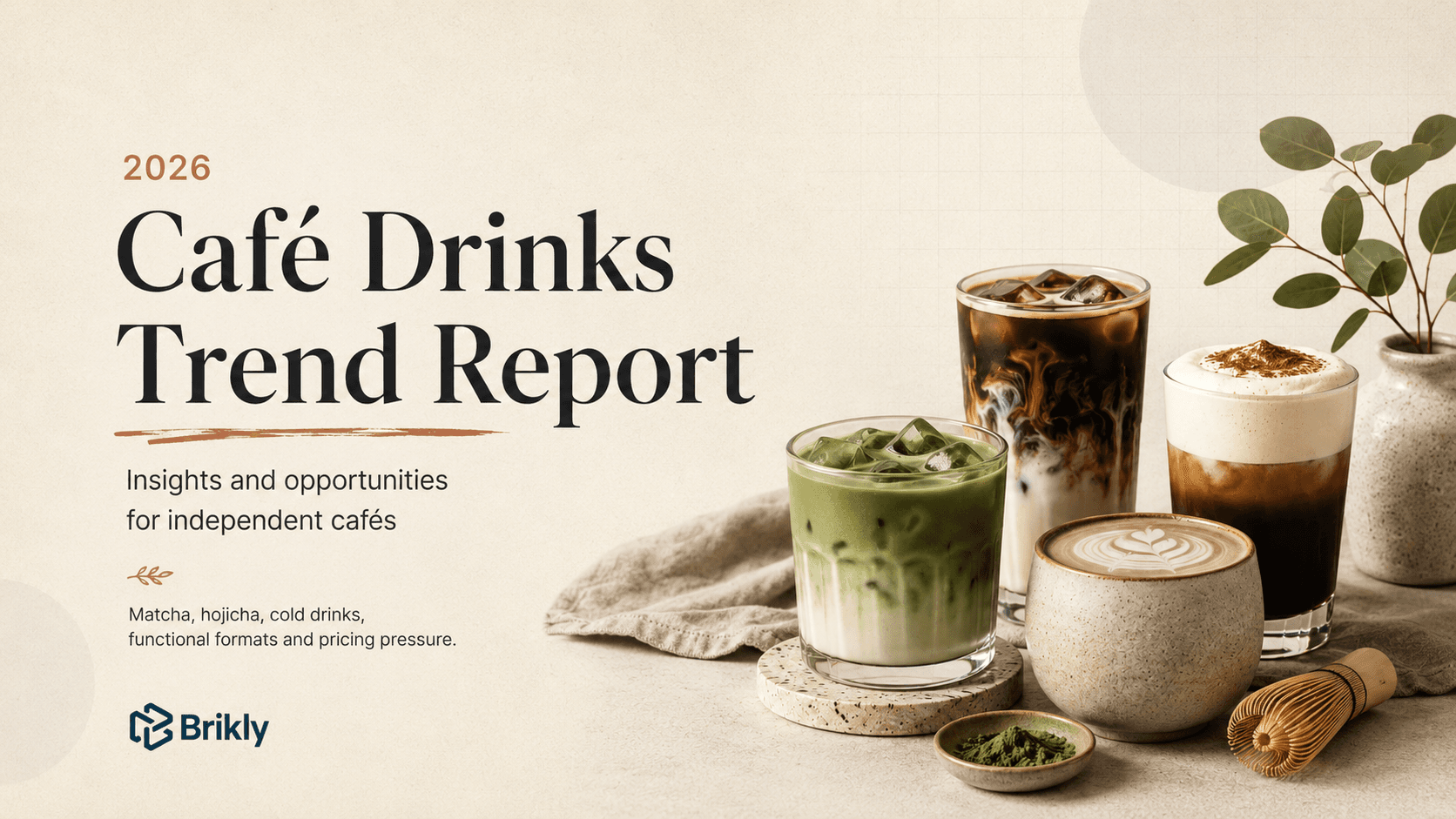
2026 Café Drinks Trend Report
Insights and opportunities for independent cafés
Prefer the slide version?
Save the executive deck as a PDF for menu planning, team meetings, or supplier reviews.
Scope: UK + US + Australia + Scandinavia + Japan + Middle East. Coffee, matcha, tea, cold formats, functional drinks, plant milks, and signature/zero-proof beverage programmes. Current state through April 2026 plus a 12-18 month forward view. Written for independent café operators.
TL;DR
- Matcha is no longer a trend; it's a category. Operators without a credible matcha programme are leaving margin on the floor - properly built, matcha lattes deliver ~83% gross margin (≈9 points above a caffè latte) and at chains like Blank Street drive ~50% of orders. But a 2024-25 Uji shortage tripled top-grade tencha prices and broke old sourcing playbooks. Sourcing discipline is now the differentiator, not just having matcha on the menu.
- Cold is the default, not the seasonal upsell. Cold beverages are tracking toward 70% of US coffee shop revenue, 68% of Gen Z prefer cold formats year-round, and US menu data shows iced lattes pricing ~15¢ above hot lattes - operators can defend margin in cold espresso. UK and Australian markets have followed: cold coffee is now a year-round category.
- The "drinks as identity" customer is here. Gen Z and younger millennials customise constantly (75% choose flavoured syrups, 72% try a new beverage monthly), default to plant milk, photograph the cup before they drink it, and migrate freely between coffee, matcha, hojicha and functional drinks. Menu, packaging and cup design are now a marketing channel.
- Functional and protein drinks have crossed from niche to mainstream. Starbucks and Peet's both put proffee (protein coffee, 20-36g protein) on permanent menus in late 2025; the global functional coffee market is growing ~8.5% CAGR. Adaptogen, collagen and mushroom adds are no longer fringe - though they remain incremental, not core.
- Hojicha is the credible 12-18 month watch. Searches for "hojicha latte" are up +173% globally, the drink solves matcha's caffeine and bitterness objections, and it's already on menus at Farmer J in the UK and across Dubai. The supply chain is also markedly less stressed than matcha's. Plan a pilot now.
- Coffee bean costs are still elevated, volatile, and politically exposed. Arabica peaked at $4.41/lb in early 2025 and traded in the high $2 - low $3 range through Q1 2026, with Strait of Hormuz disruption keeping freight and insurance costs up. Beverage menu pricing should assume coffee COGS stays meaningfully above the five-year average through 2026.
1. The Macro Picture
Five forces are shaping every café drinks decision in 2026.
Coffee is no longer the only profit centre. For a generation, the espresso machine paid the rent. That's still true at most independents, but the maths has shifted: matcha gross margin now beats coffee gross margin in nearly every operator-disclosed comparison, and at chains designed around it (Blank Street, Black Sheep) matcha has overtaken coffee on share of orders during summer. Operators who treat matcha and tea as afterthoughts are running an unbalanced P&L. Lumina Intelligence and the British Coffee Association both flag the same trend in the UK: cafés are now multi-beverage businesses where coffee is the anchor, not the entirety.
Cold has won. US data points are converging on a single conclusion: cold beverage sales are tracking toward 70% of total coffee shop revenue, 68% of Gen Z prefer cold coffee, and 57% of Melbourne coffee drinkers consume cold coffee year-round. Iced lattes price ~$5.59 in the US vs. $5.44 for hot lattes (Q2 2026 data, n=7,479 latte prices) - operators can run a small cold-format premium and customers don't push back. UK Lumina data shows the same shift: cold coffee is no longer seasonal but a daily category, particularly for hybrid-working consumers under 35.
Wellness is now a beverage feature, not a marketing skin. 80% of Americans now prioritise protein in their diet daily; 61% of specialty coffee drinkers cite health benefits as a primary driver; 66% of global consumers say purchasing decisions are influenced by health and wellbeing. The result: protein lattes, adaptogen add-ins, mushroom blends, lower-caffeine alternatives (decaf, hojicha), and reduced-sugar formats are now table-stakes options, not points of differentiation.
Social media is the R&D department. TikTok and Instagram are now the primary discovery channel for café drinks. Yelp searches for "dirty soda" jumped 1,289% after a single TV show; matcha mentions grew 107% YoY; hojicha searches +54.6% in a year. The implication for operators is simple: visual presentation (clear cups, layered colour, contrasting cold foam, edible powder dustings) is no longer optional theatre - it's how you get a free customer-acquisition channel.
Supply chain is the silent operator killer. Arabica peaked at $4.41/lb in February 2025, settled into the high $2s through early 2026, and remains exposed to Brazilian harvest volatility, Vietnamese drought, and Strait of Hormuz freight disruption following the US-Israel-Iran conflict. Matcha tencha auction prices jumped 265% YoY in 2025. Pistachio is supply-constrained globally. Independents that don't model these into their drinks margins, or aren't running quarterly menu price reviews, are eroding margin invisibly.
2. Coffee Drink Format Trends
The hot espresso menu is mostly stable - the action is in cold, in functional, and in flavour-forward iced builds.
| Format | Status | Notes | Where it's heading |
|---|---|---|---|
| Flat white / latte / cappuccino | Mainstream / table stakes | Still the volume backbone in UK and AU. Pricing is the only real lever - US average $5.44 hot latte. | Premium milk options expanding (high-protein dairy, pistachio milk barista). |
| Iced latte / iced flat white | Mainstream / table stakes | Year-round category in UK and US. Iced now prices ~15¢ above hot. | Default builds with cold foam, brown sugar, salted caramel - increasingly customised. |
| Cold brew | Mainstream | UK demand growing strongly; Climpsons reports 1L/3L/5L concentrate formats outselling smaller bags. Tap-served cold brew in larger café sites. | Concentrate / RTD cans. Single-origin cold brew as differentiator. |
| Nitro cold brew | Emerging - established in AU / patchy in UK | Melbourne projection: 28% of specialty sales by 2026 (was 9% in 2022). 24.4% global CAGR through 2030. Nitro posts 3.2x social engagement. | UK and US independents will follow AU lead. Equipment cost is the gating factor. |
| Brown sugar shaken espresso / iced shaken | Mainstream | Starbucks-led, now everywhere. Format is the chassis; flavour rotates. | Ube, toasted coconut, pistachio versions on chain menus through 2026. |
| Dirty chai (espresso + chai) | Mainstream | Moved from specialist cafés into chain menus over the last 24 months. | Gateway drink for chai expansion - masala chai, dirty matcha chai. |
| Espresso tonic | Niche - established in specialty | Standard on most third-wave menus; not yet mainstream chain. | Yuzu, citrus and botanical variants. Strong fit for non-alcoholic drinks programmes. |
| Snap-chilled / flash-chilled coffee | Emerging | AU-led. Preserves volatile aromatics that ice dilution destroys. | Premium iced format for specialty operators wanting to differentiate from cold-brew ubiquity. |
| Pour-over / single-origin filter | Niche - specialty only | Caffè Nero launched its first single-origin light roast in 2025; specialty bars expanding tasting flights. | Continues as the "geek" anchor. Light-roast Asian-origin coffees from Thailand, Myanmar gaining traction. |
| Fermentation-led / co-ferment coffees | Niche - competition + ultra-specialty | Co-fermented Colombian coffees a top search trend in early 2026. | Stays specialty-only. Mass-market continues to want clean, balanced cups for milk drinks. |
| Espresso martini / coffee mocktails | Emerging | Coffee mocktail market projected +$261m 2024-29 at 10.5% CAGR. Half of Gen Z cutting back on alcohol. | Real white space for cafés with evening trade or events. |
| Drive-thru / app-ordered coffee | Mainstream - US | Record 59% of US consumers used drive-thru in late 2025; 38% ordered via app. | UK and AU still under-indexed but moving fast. |
Notable cold and iced builds to study
- Blank Street's spritz format: matcha + fruit syrup + soda. Watermelon Matcha Spritz, Blueberry Matcha Spritz. Visual gradient = social media gold. Low ingredient cost, high perceived value.
- Iced ube coconut shaken espresso (Starbucks spring 2026): a chain reading the Asian-flavour trend correctly. Operators can build a cleaner version with proper ube paste rather than syrup.
- Iced lavender cream matcha / chai (Starbucks spring 2026): floral cold foam as a permanent menu element rather than seasonal.
- Cold brew with pistachio cold foam + kataifi crumb ("Dubai chocolate" cold brew variant - appearing across UK and US menus).
3. Flavour Trends
The story of 2026 flavour is hero ingredients with cultural provenance, plus a decisive return of nostalgia and dessert references.
Hero ingredients - current and saturated
Pistachio is the flavour of the year and arguably already past peak hype, though it has become a permanent fixture rather than a fad. Pacific Foods reports +27.3% YoY demand for pistachio milk and a 60% increase in social mentions; 30% of consumers say they're more likely to visit a café offering pistachio. The Pacific Foods Barista Series Pistachio is the first pistachio-formulated barista milk, debuted at the 2025 SCA Expo. Califia Farms launched UK Pistachio Oat Barista in mid-2025. Watch supply: pistachio is global-supply-constrained and prices have run hard. Expect a shake-out where operators using poor-quality pistachio syrup look downmarket vs. those using genuine pistachio paste or pistachio milk.
Dubai chocolate - the milk chocolate / pistachio cream / kataifi pastry construction the Wall Street Journal called "the next pumpkin spice" - is appearing on café menus as Dubai chocolate mochas, cold brews with pistachio cold foam and kataifi crumb. It's the format that sells the flavour: snap-crunch-melt texture is the photogenic hook. Long-term staying power is unproven; treat as a 12-month signature opportunity.
Matcha is dealt with separately in section 5 below - too important to compress into a flavour bullet.
Asian-inspired - emerging into mainstream
Ube (purple yam) lattes have moved from specialty to chain menus during 2025-26. Starbucks introduced the Iced Ube Coconut Macchiato and Iced Ube Coconut Cream Shaken Espresso for spring 2026. The colour drives social; the flavour (sweet, vanilla-nutty) is approachable. Sourcing is straightforward via syrup or ube paste from Filipino or pan-Asian distributors.
Hojicha is the strongest emerging signal - see section 5.
Yuzu is up +501% in searches and pairing well with espresso tonic builds. A genuine niche ingredient with crossover into the savoury and pastry world. UK supply via Japanese specialty importers; expect price volatility.
Hot honey and Korean-inspired flavour combinations (sweet potato, black sesame) showing early traction on independent menus.
Middle Eastern and "swavory"
Cardamom, rose, saffron, date and sidr honey are moving from heritage product into mainstream café menus, particularly in independents wanting cultural specificity rather than chain-style novelty. Cardamom-orange lattes, cardamom-honey lattes and rose mochas are credible signature drinks; saffron cappuccinos remain niche but premium-priced.
Swavory - savoury-leaning sweet builds - is an emerging flavour family. Miso-caramel, salted pistachio, brown butter, spring onion (a viral 2025 TikTok flavour that is, surprisingly, not a joke) are showing up on independent menus. Treat the more extreme variants as content plays; lean swavory builds (miso caramel, salted pistachio) are credible permanent menu candidates.
Botanicals and floral
Lavender is in its third major wave - Starbucks brought back its Lavender Crème Frappuccino and Iced Lavender Cream Matcha for spring 2026 and is now using lavender as a permanent cold foam SKU. Rose, elderflower, juniper and rosemary have all entered specialty café menus. Lavender-rosemary and cardamom-honey botanical infusions are becoming standard offerings in upscale specialty cafés and hotel lobbies.
Nostalgic and dessert-forward
The dessert latte category continues to expand. Tiramisu lattes, crème brûlée lattes, iced cloud lattes, horchata lattes, strawberry shortcake, banana bread, gingersnap and espresso martini lattes (zero-proof) are all in active rotation across chain and independent menus. Blank Street's 2025-26 specials calendar - Banana Bread Matcha, Strawberry Shortcake Matcha, Salted Pistachio, Cookies and Cream, Earl Grey, White Chocolate Matcha, Cherry Cold Brew - shows the category playbook: rotate dessert references quarterly, name them evocatively, build playlists and content around each.
Functional and adaptogenic
Lion's Mane and Reishi mushroom blends, ashwagandha, collagen, L-theanine, turmeric (golden lattes - Gail's Bakery added iced golden turmeric to its menu in early 2026), and maca are all available as add-shot options at specialty independents. Mushroom coffee menu mentions grew 4.2x YoY through 2025. Treat as incremental margin via add-on pricing rather than category drivers.
Flavour summary table
| Flavour | Status | Worth Pursuing? |
|---|---|---|
| Pistachio | Saturated but durable | Yes - but upgrade to paste/real milk, not just syrup |
| Dubai chocolate (pistachio + kataifi) | Current peak | 12-month signature play |
| Matcha (across grades) | Mainstream / category | Mandatory |
| Hojicha | Emerging | Strong 12-18 month pilot |
| Ube | Emerging-to-mainstream | Yes - distinctive colour, easy sourcing |
| Yuzu | Niche-to-emerging | Yes for espresso tonic / iced builds |
| Cardamom / rose / saffron | Mainstream-niche | Yes for signature drink positioning |
| Lavender | Cycling back to mainstream | Yes - cold foam SKU |
| Brown butter / miso-caramel (swavory) | Emerging | Yes for one signature drink |
| Spring onion / extreme swavory | Speculative | Content only |
| Mushroom / adaptogen | Niche-mainstream | Yes as add-on |
| Pumpkin spice | Mature seasonal | Yes for September - November rotation only |
4. Dietary, Ingredient and Functional Trends
Plant milks: oat is the floor, pistachio is the ceiling
Oat milk has firmly displaced almond as the default plant milk in cafés in the UK, US and AU, with coconut continuing to perform well in tea and matcha builds. Tastewise data: coconut appears in 65% of alt-milk listings, almond 37%, oat 28%, soy 11%. Almond is in slow decline (-4% YoY conversational share) while soy is rebounding (+12% YoY) on the back of high-protein wellness positioning. Niche milks - pistachio, pecan, barley - are tiny in absolute terms but posting triple-digit growth.
Operator implications:
- A modern café needs at least: full-fat dairy, semi-skimmed dairy, oat barista, almond, coconut. Soy is optional but rebounding.
- Pistachio milk is now barista-formulated (Pacific Foods, Califia) and is genuinely worth piloting if the customer base supports the upcharge.
- High-protein dairy options (e.g. Fairlife-style ultra-filtered, ~13g protein per cup) are appearing on US menus and coming to UK independents through 2026.
- "Barista edition" oat milks are now expected - non-barista versions split, foam poorly, and damage perceived quality.
Protein
Proffee (protein coffee) has crossed from social media trend into mainstream chain menus. Starbucks added Protein Lattes (15-36g protein) and Protein Cold Foam to its permanent menu in the US and Canada in autumn 2025, and launched RTD Coffee & Protein bottles (22g protein) in March 2026. Peet's Vitality Menu features protein lattes in vanilla, golden, and matcha versions at 20g+ protein each. Dutch Bros has launched its own range.
For independents: protein cold foam as a £0.80-1.20 add-on is the easiest entry point. A proper protein latte requires whey or plant protein integration that doesn't curdle, foam, or leave off-notes - this is a real product development task. The functional coffee market is growing at ~8.5% CAGR to a projected $13.2bn by 2029.
Decaf - quietly important
Decaf is the silent grower. Climpson & Sons reports decaf now outperforms many of its long-standing bestsellers; 67% of Americans consumed decaf in the past day in late-2025 surveys. The story is not "decaf is trendy" - it's that consumers are managing caffeine across the day, switching to decaf in the afternoon, and noticing quality. Independents that still serve poor decaf are losing 15-20% of evening trade unnecessarily. Specialty decaf (Swiss Water, sugarcane EA, Mountain Water) is now a credible third-wave category.
Reduced sugar / clean label
The "clean caffeine" positioning is increasingly important. Customers - particularly female and Gen Z - are reading labels, asking for fewer pumps, and migrating to unsweetened or naturally-sweetened (date syrup, maple, honey) builds. Reduced-sugar matcha and reduced-sugar chai are credible menu positioning rather than apologetic alternatives.
Heritage and traceability
Single-origin coffee, named-farm matcha, named-region cardamom - provenance is now an upsell rather than an indulgence. Saudi Arabia is investing $319m via the Saudi Coffee Company to develop Jazan as a credible specialty origin; Asian origins (Thailand, Myanmar, China, India) are appearing on UK third-wave menus through importers like Indochina Coffee. For UK independents, named-origin offerings are a credible way to defend a £4+ flat white pricepoint.
5. Hero Drinks Deep Dive
Three categories deserve their own treatment: matcha, hojicha and functional/protein drinks.
Matcha - the operator playbook
Matcha is no longer a "should we?" question. The data:
- Matcha menu items grew 30.22% YoY (Tastewise); operator menu share +6.9% YoY.
- Matcha mentions on social +107.35% YoY.
- Blank Street: ~50% of total orders are matcha, with summer days where matcha outsells coffee outright.
- Black Sheep Coffee reported +227% YoY lift in iced category after expanding matcha lineup.
- Costa Coffee launched its first full matcha range in early 2026.
- Caffè Nero and Black Sheep have both reported matcha occasionally surpassing coffee in sales.
- A properly-engineered matcha latte delivers ~82.9% gross margin vs. ~74% for a caffè latte.
- Global matcha market: $4.47bn (2025) → projected $7.74bn by 2033 at 7.1% CAGR.
Sourcing reality check. The 2024-25 Uji harvests were severely disrupted: heatwaves and erratic rainfall during the spring shading period, hand-picked premium tencha yields fell 40% in worst-affected plots, and Kyoto auction prices jumped 265% YoY in 2025 to JPY 8,235/kg average and JPY 43,330/kg for top lots. Japan's powdered green tea exports broke a 71-year record (10,000+ tons total tea exports), with matcha at 58% of shipments to NA and Europe. Pre-2024 sourcing playbooks are now wrong. Three actions for operators:
- Have two suppliers, not one. Single-source matcha is now an operational risk.
- Don't promise "ceremonial grade" without auditing. Grade designations are being stretched as supply tightens.
- Run a "matcha shot" workflow - pre-batched, refrigerated matcha base - to maintain quality and speed at high volume. This is how Blank Street scales.
Build trends to deploy.
- Iced is winning: among under-35s, ~50% of matcha orders are iced.
- Plant milk is the default, not the upsell - oat, almond, coconut all work.
- 60%+ of customers will request a sweetener (vanilla, honey, strawberry) without prompting - build the SKU rather than fight it.
- Visual gradient drinks (strawberry matcha layered with cold foam, blueberry matcha, watermelon matcha spritz) generate 3-4x more social engagement than coffee equivalents.
- Premium positioning works: ceremonial-grade single-origin matcha (Honyama, Uji-named) is a credible £5-6 hot drink even in regional UK markets.
Hojicha - the strongest 12-18 month pilot
Hojicha (roasted Japanese green tea) is matcha's quieter cousin and the most credible emerging beverage trend for 2026.
The signals are compelling:
- Searches for "hojicha latte" up +173% globally; "hojicha" up +54.6%.
- ~20mg caffeine per 100ml - significantly lower than matcha - solves the "I can't drink matcha after lunch" objection.
- Roasted, nutty, caramel-leaning flavour solves the "matcha is too grassy" objection.
- Naturally smoother with milk than matcha - lower training burden for baristas.
- Already on permanent menu at major operators: Starbucks Japan (long-standing), Farmer J (UK lunchtime spring 2026 menu), Maison Cha Cha and Gato (Dubai), and dozens of London independents.
- Supply chain is markedly less stressed than matcha's - Shizuoka and Kagoshima are the primary sources, with broader producer base.
The build playbook: start with a hojicha latte (vanilla syrup or maple), add an iced version, then innovate (chai hojicha is performing well in London; white chocolate hojicha sea salt latte at Gato Dubai). Pair the positioning explicitly to the matcha-without-the-jitters narrative - that's how the customer base will discover it.
This is the single strongest "pilot now, deploy by Q3 2026" recommendation in this report.
Protein and functional - incremental, not transformative
Proffee, mushroom blends and adaptogen lattes are now mainstream-aware but remain incremental categories - Peet's has explicitly noted they drive complementary sales without cannibalising core espresso. The operator question is therefore not "should we have these?" but "what's the simplest add that captures the wellness customer?"
Recommended order of deployment for independents:
- Protein cold foam as a £0.80-1.20 add-on. Easiest entry; minimal product development risk.
- One adaptogen blend (mushroom or ashwagandha) as a £0.50 add-shot. Almost zero ops risk.
- A protein latte in 1-2 flavours (vanilla, matcha) as a tertiary menu line - only if you have margin to do product development properly.
- A signature functional drink (turmeric latte, golden matcha, ginger-cardamom hojicha) as a permanent rotational item.
Don't build a full Vitality-style menu unless functional drinks are core to your brand positioning - the inventory complexity and customer education burden don't pay back at independent scale.
6. Regional Deep Dives
United Kingdom
The UK café drinks market in 2026 is shaped by three forces: the matcha boom (Caffè Nero, Costa, Gail's all now have permanent matcha programmes), the cost squeeze (NLW, business rates, energy costs all hitting in April 2026), and the continued rise of the small independent third-wave operator. Cold coffee is a year-round category, oat is the default plant milk, and decaf is quietly outgrowing the bestseller list at quality roasters.
Operators to know:
- Blank Street - 40+ UK sites by early 2025; matcha-led; £3.20-£3.90 price point undercutting Costa/Pret. Spring 2026 menu: Cherry Cold Brew, White Chocolate Matcha, Golden Matcha, Mel's Maple Matcha. Recently acquired seven West London sites from Over Under.
- Black Sheep Coffee - reported 227% YoY iced category growth post-matcha expansion.
- Joe & The Juice - serving Climpsons-roasted specialty since 2023; appointed first Chief Culture Officer in March 2026.
- Farmer J - added hojicha and maple iced latte to spring 2026 menu; lunchtime-led positioning.
- Gail's Bakery - added iced turmeric drinks early 2026; matcha now a permanent line.
- Climpsons & Sons - pushing 1L/3L coffee concentrates; reports decaf surging.
- Catalyst, Prufrock, Carbon Kopi, Specialty Cafetière, Curators, Kaffeine, Monmouth, Origin, Workshop, Small Street Espresso - among the 44 UK shops on the Best Coffee Shops UK list for 2026.
Emerging signals: hojicha rolling out from London independents to mid-tier chains by Q3 2026; protein cold foam moving from US chains to UK independent menus through 2026; pistachio milk barista becoming standard; functional add-shots normalising at premium independents.
United States
The US market is leading on cold (cold beverages tracking toward 70% of revenue), on RTD/grocery convergence (Starbucks Coffee & Protein RTD launch), and on chain-led trend mainstreaming (Starbucks ube, Dubai chocolate matcha, banana bread matcha, lavender cream chai). The big chains are setting the agenda; independents are differentiating on quality, provenance and signature drinks.
Pricing benchmarks (Q2 2026, n=42,663 menu prices, Joe data):
- US 16oz iced latte average: $5.59
- US 12oz hot latte average: $5.44
- Matcha now sits above latte, mocha, chai and cold brew on average price - clearest premium anchor on the menu.
- Regional spread is wide: San Diego $6.73, LA $6.47 vs. Philadelphia $4.79 average among 30+ sample cities.
Operators to know:
- Blank Street (NYC origin, expanding nationally; ~$500m valuation built on matcha)
- Peet's Coffee - Vitality Menu protein lattes
- Dutch Bros - protein coffee programme
- Joe Coffee, Black & White Coffee Roasters, Reserva, Madcap, Café Comunión, Sey Coffee, Onyx, Verve, Saint Frank, Sightglass - independent specialty leaders
- Live Mas Café (Taco Bell) and Kwench (KFC) - fast-food chains entering the beverage-led café space
Emerging signals: dirty soda crossover into café formats (Yelp searches +1,289%); beverage-led fast food (Taco Bell Live Mas Café opening 30 sites in 2025); "swavory" flavours moving from social media to permanent menus; functional beverages going RTD via Starbucks/Pepsi NACP.
Australia
Australia continues to lead on espresso quality and has now also taken the lead on cold formats - particularly nitro cold brew and snap-chilled coffee. Melbourne projections suggest nitro will hit 28% of specialty coffee sales by 2026 (up from 9% in 2022). Cafés running nitro report ~35% profit lift, 26% labour cost reduction per cold serve, and 3.2x social media engagement on nitro posts.
Operators to know:
- Aunty Peg's, Axil, Sensory Lab, Industry Beans, Touchwood, Dukes, Cup of Truth - Melbourne specialty cold leaders
- Long Brew Nitro, Black Nitro (Byron Bay), Rocketman - RTD nitro at scale
- Single O, Market Lane, ST. ALi, Toby's Estate - established specialty roasters with strong cold programmes
- Next Door Espresso (Burleigh Heads / Gold Coast) - pioneering the matcha-meets-coffee viral playbook outside Sydney/Melbourne
Emerging signals: RTD specialty coffee in cans as a serious retail/wholesale category; coffee mocktails as a non-alcoholic evening trade play; coconut and nut-milk cold brew as differentiation; experimental processing (carbonic, anaerobic) reaching mainstream specialty.
Scandinavia / Nordic
Per capita coffee consumption remains the world's highest (Finland ~7.8kg, Sweden ~7.6kg, Norway ~6.6kg) and the fika tradition continues to anchor café culture. The dominant drink remains black drip coffee or filter on a light Nordic roast - espresso-based drinks have gained traction but black coffee plus pastry remains the protected ritual.
The Nordic light-roast aesthetic continues to influence specialty culture globally, and Scandinavian café concepts are spreading internationally (FIKA NYC, Süti & Co. in Boulder, Fika in Toronto).
Operators to know:
- Johan & Nyström, Drop Coffee, Koppi, Tim Wendelboe, La Cabra, The Coffee Collective, Pascucci - leading Nordic specialty roasters
- Pom & Flora, Mellqvist Kaffebar, Söderberg & Sara, Noir Kaffekultur - Stockholm/Malmö independents
Emerging signals: the Scandinavian "intentional pause" café aesthetic is influencing café design globally; cardamom is a Nordic export flavour now mainstream in US/UK menus; light-roast Asian-origin coffees from Scandinavian-influenced specialty roasters are gaining UK distribution.
Japan
Japan's café culture is bifurcated: the kissaten tradition (siphon coffee, dark roasts, slow service) coexists with a vibrant third-wave specialty scene. Plant milks have moved from niche to mainstream - Alpro/Danone successfully launched oat milk into Japan from 2020 - and matcha continues to be a deep cultural product rather than a trend. Hojicha is, of course, native - the international hojicha boom is largely a Western catch-up to a long-standing Japanese drink.
Operators to know:
- % Arabica - minimalist Japanese-aesthetic specialty chain that has expanded into the Middle East and globally
- The Matcha Tokyo - matcha-bar concept exporting to Dubai
- Blue Bottle Japan - Japanese-influenced US chain with strong Tokyo presence
- Onibus Coffee, Glitch Coffee, Koffee Mameya - Tokyo specialty leaders
Emerging signals: Japanese specialty influence on Middle Eastern café aesthetics (% Arabica is the bridge); hojicha continuing to outgrow matcha by % terms in international markets; sumiyaki (charcoal-roasted) coffee as an emerging niche.
Middle East - UAE and Saudi Arabia
This is the most dynamic and under-discussed café drinks market in the world. Specialty café count in Dubai alone exceeds 2,000; Saudi Arabia has 60%+ of population under 30 driving demand for "third places"; espresso consumption grew +15% in Abu Dhabi and Riyadh in 2024. The Saudi government is investing $319m via the Saudi Coffee Company to develop the country into a specialty coffee origin, with plans to plant 1.2m additional trees by 2026.
Operators to know:
- Elixir Bunn, Brew92, Camel Step (Saudi Arabia) - leading Saudi specialty roasters
- % Arabica, Maison Cha Cha, Gato, Terra, OLAB, The Matcha Tokyo, Avantcha (Dubai) - leading specialty / matcha / hojicha cafés
- The Espresso Lab, Raw Coffee Company, Nightjar, Salento Coffee Roastery (UAE) - third-wave specialty
- Urth Caffe (LA-origin, expanded to Riyadh, Jeddah, Dubai)
Drink trends specific to the region:
- Cardamom espresso, saffron lattes, rose mochas, mastic cold brew - heritage flavours integrated into modern specialty formats.
- Late-night café culture: 24-hour cafés in Riyadh, Jeddah, Buraydah are normalising post-9pm specialty coffee consumption - a direct export opportunity to Western markets struggling with evening trade.
- Majlis-inspired café design (slow service, hospitality-first, ritual-led) is influencing Western specialty design.
- Hojicha is having a particularly strong moment in Dubai - the smooth, low-caffeine, easy-with-milk profile fits perfectly with the region's coffee-curious-but-not-acid-tolerant consumer base.
- Pistachio and Dubai chocolate originated here and have been globally exported.
This is the most directly transferable regional playbook for UK independents - late opening, hospitality-led service, signature drinks built on specific provenance.
7. Cross-Cutting Themes
Customisation is non-negotiable. 75% of Gen Z choose flavoured syrups; 72% try a new beverage monthly; 60%+ of matcha customers will request a named sweetener without prompting. The implication: a clean, simple "this is the drink" menu is a Gen Z accessibility problem. Cafés need a structured customisation framework (milk choice, syrup choice, foam choice, ice level) that is easy to order via app, kiosk or counter without overwhelming staff. Tech that manages this - POS-integrated modifier trees, kiosk ordering - is now operationally important rather than optional.
Visual presentation is a customer acquisition channel. Clear cups, layered gradient drinks, photogenic cold foam, contrasting colours, dustings of matcha or pistachio crumb on top - these aren't aesthetics, they're free marketing. Operators that don't think about how a drink looks in a customer's hand on Instagram are missing the largest source of new-customer trial. Spend on cup design and lid design accordingly.
The "third place" matters more, not less. Café visit volumes are pressured by hybrid working - Climpsons reports fewer daily visits but bigger per-customer spend on equipment and beans for home use. The cafés holding volume are those that have invested in design, atmosphere, and intentionality of service. Majlis-inspired hospitality, fika-inspired calm, Japanese omakase-inspired curation - these aren't aesthetic flourishes, they're commercial design patterns for staying relevant.
Late-night and evening trade is a credible new daypart. Riyadh and Jeddah have demonstrated that cafés can operate 24 hours profitably; coffee mocktails, espresso martinis (zero-proof and otherwise) and signature non-alcoholic drinks are the menu solution. Half of Gen Z are reducing alcohol; the coffee mocktail market is growing 10.5% CAGR; cafés already employ skilled drinks professionals. Cafés that can extend trading hours profitably are an operator white space in 2026.
Premium positioning is more defensible than discount positioning. US menu data: matcha now prices above latte, mocha and cold brew. Specialty operators that price confidently (£4.50-6.00 for a flat white in central UK markets) are holding margin; those competing with chains on price are losing on volume and margin simultaneously. The customer has bifurcated - they're willing to pay £6 for a great signature drink and £0 for chain coffee they can replicate at home - and the middle is being squeezed.
Tech is now a beverage-quality lever. Self-serve kiosks (e.g. SumUp Terminal, Square KDS), app-based ordering (record 38% of US consumers ordered coffee via app in 2025), and barista-free automation (Eversys espresso machines, Rozum robotics) are no longer optional efficiency tools but core to cost structure. The smart café question is not "should we have this?" but "where in the workflow does this go without damaging the human element customers came for?"
8. Practical Prioritisation for Operators
Saturated - do well or skip
- Pumpkin spice latte - autumn only, do it well, don't try to extend it
- Vanilla / caramel syrup builds - minimum requirement, no halo
- Salted caramel - peak passed in 2024
- Basic iced latte / iced flat white - table stakes; differentiation is in the build (cold foam, cold brew base)
- Mushroom coffee as marketing positioning - the wellness customer has moved on to specifics (lion's mane vs. reishi vs. ashwagandha)
Table stakes - expected of any premium independent in 2026
- A credible matcha programme with at least one ceremonial-grade SKU
- Oat barista milk as a no-upcharge default; almond and coconut available
- Iced versions of every hot drink, year-round
- Quality decaf that doesn't taste like a punishment
- At least one named-origin / single-origin coffee on the espresso bar
- A cold brew option, batch-prepared
- App or QR-code ordering for at least takeaway/pre-order
- Visual cups - clear cold cups, branded hot cups
Emerging - pilot now, deploy by Q3 2026
- Hojicha latte (hot + iced), with at least one signature build (chai hojicha, white chocolate hojicha, vanilla maple hojicha)
- Protein cold foam as a £0.80-1.20 add-on
- Pistachio milk barista as a paid milk upgrade (£0.50-0.80)
- One signature spritz (matcha + fruit + soda, served in a clear cup, layered)
- One signature evening / coffee mocktail if you have evening trade ambition (espresso tonic with yuzu, cold brew negroni-style)
- A "Dubai chocolate" cold brew or mocha for 12-month signature rotation
- Iced ube or iced lavender cream matcha seasonal LTO
- A nitro cold brew tap if your volume justifies the equipment (>£200/week cold brew sales)
- A high-protein dairy option (Fairlife-style ultra-filtered) for the proffee customer
Speculative - content-heavy, low-volume
- Spring onion latte and other extreme swavory builds - TikTok content only
- Adaptogen blends beyond mushroom (cordyceps, chaga) - niche customer base
- Cocoa-free chocolate - too early, but watch for 2027
- Charcoal / sumiyaki coffee - Japanese-aesthetic café niche
- Botanical infusions (lavender-rosemary, juniper-sage) - specialty positioning only
- Coffee cocktails proper (alcoholic) - only if you have or can secure a licence
9. Caveats
Trend cycles are accelerating, not stabilising. Drinks that took five years to roll out from US chains to UK independents in 2015 now take six months. This means menu agility is more valuable than menu correctness - the cafés winning are the ones with a structured quarterly menu rotation discipline, not the ones picking the "right" trend at the start of the year.
Vendor forecasts are not consumer reality. Trade publications and ingredient suppliers (Tastewise, Mintel, Innova, Puratos, Califia, Oatly, et al.) have a vested interest in talking up specific ingredient categories. Treat their data as directional but cross-check against your own POS and menu engineering data.
TikTok virality ≠ in-store sales. The viral pistachio drink with 12m views might convert at 0.4% of foot traffic. Don't reformulate your core menu around a TikTok signal without piloting first. Use viral drinks as LTOs, not category bets.
Supply chain is more fragile than at any time in recent memory.
- Coffee: arabica volatility persists; Strait of Hormuz disruption is ongoing; Brazilian record harvest may push prices down by Q3 2026 but freight and insurance remain elevated.
- Matcha: 2024-25 Uji shortage is ongoing; auction prices up 265% YoY; ceremonial-grade availability cannot be assumed.
- Pistachio: global pistachio supply tight, prices elevated through 2026.
- Hojicha: less stressed than matcha but emerging demand growth could change this within 18 months.
- Ube and yuzu: specialist importer dependency; UK supply chain thin.
Operators should run quarterly menu price reviews (not annual) through 2026 and have alternative supplier relationships for any hero ingredient.
Plant milk pricing is structurally above dairy and unlikely to fully converge. Don't undercharge the milk upgrade. £0.50-0.80 is the credible range; £0.30 leaves margin on the table.
The customer base is bifurcating, and the middle is dangerous. Premium specialty (£4.50-6.00 flat white) and accessible-quality (£3.20-3.90 Blank Street) are both growing. Mid-market chain pricing (£3.90-4.40 for a Costa-style flat white) is the squeezed segment. Operators positioning between these two pricepoints without a clear differentiator should expect volume pressure.
Specialty ingredient sourcing for independents is a real operational task. The chains are vertically integrated or have buying power. Independents need either a great wholesale relationship or a specialist importer for matcha, ube, yuzu, hojicha, kataifi and pistachio paste - generic "syrup" versions of these ingredients are increasingly transparent to customers and damage perceived quality.
Sources: Perfect Daily Grind, Climpson & Sons, Tastewise, World Coffee Portal, Bowers Lake Coffee, WebstaurantStore, Glimpse, Joe.coffee Q2 2026 State of Coffee Report, Country & Town House, Caterer Middle East, New Lines Magazine, Inspiring Arabs, First Agri, Rabobank, ICO, Fortune, Axios, Food Institute, GlobalData, FoodNavigator, Dairy Reporter, Barista Magazine, Sucafina, Lumina Intelligence, Sprudge, Time Out, plus operator and roaster sources cited inline. Where two sources conflicted, the operator-disclosed or trade-press-verified figure was used.