
Cold brew on tap: the margin and yield maths nobody publishes
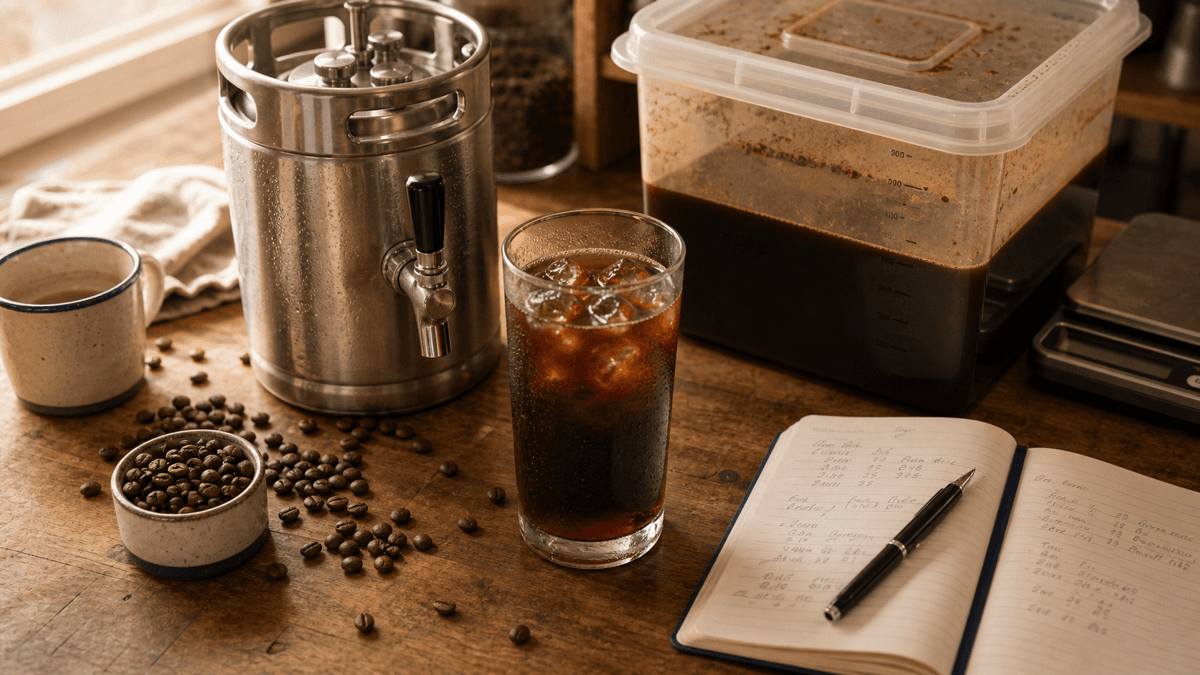
Every May, the same conversation happens in indie cafés up and down the country. The thermometer hits 18 degrees, a customer asks for cold brew, the owner says "we should really do that next year", and the year rolls on.
The assumption is that cold brew is just iced coffee, slowed down. Higher ticket price, smoother flavour, easy summer margin. Pour from a tap, charge £4.50, watch the GP roll in.
It is more complicated than that. Cold brew has a yield problem, a labour problem, and a shelf life problem that espresso over ice simply does not have. Get the maths wrong and you are pouring £30/kg coffee down the sink every Sunday night.
Here is what the numbers actually look like in 2026.
Why cold brew is its own thing, not slower iced coffee
Espresso over ice is a 30-second drink. You pull two shots, pour over ice and milk, done. The cost is whatever your espresso shot costs plus milk and a cup. Waste is near zero because you make it to order.
Cold brew is a 12 to 24 hour cold water extraction. You weigh out coarse-ground coffee, steep it in cold filtered water, then filter it through paper, cloth or a fine mesh. What comes out the other end is low-acid, smooth, and noticeably sweeter than anything you can pull from an espresso machine. That is what justifies the £4.50 to £5.50 ticket.
But it also means:
- You batch ahead. Once you commit to a batch, that coffee is gone whether you sell the cold brew or not.
- Yield is not 100%. Spent grounds hold onto water. Paper filters take more.
- It has a shelf life. Five to seven days in a sealed keg, less in an open Cambro.
- You need fridge real estate. A 10L Cambro or a 5L keg is not a small ask in a typical café walk-in.
Espresso over ice is a margin story like any other espresso drink. Cold brew is a manufacturing decision.
The yield reality: 1kg of coffee does not give you 1kg of cold brew
The industry standard concentrate recipe is 1:8 by weight. One kilo of coarse-ground coffee, eight litres of cold filtered water, steeped 16 to 20 hours, then filtered.
After filtration loss, you get roughly 6.5 to 7 litres of finished concentrate from that 1kg of coffee. The spent grounds keep the rest, holding two to three times their dry weight in water. Paper filtering loses a bit more than cloth or mesh.
That concentrate is not what you serve. Standard practice is to dilute 1:1 with cold water (or milk, for a white cold brew) before pouring over ice. So 1kg of coffee becomes:
- 6.5 to 7L of concentrate, then
- 13 to 14L of ready-to-drink after dilution, then
- About 36 to 40 servings at 12oz (355ml) once you account for ice displacement
If you batch ready-to-drink at a 1:15 ratio instead (no dilution step, just pour straight from the tap), you skip the dilution but use more coffee per litre. The per-serve cost lands in roughly the same place. The choice is about workflow, not economics.
Cost per serve: the number nobody wants to publish
Let's run the maths at realistic 2026 UK speciality prices. Roasted beans land at £24 to £32 per kg wholesale for a decent single-origin or seasonal blend. Call it £28/kg for the worked example.
Concentrate batch (1:8 ratio):
- 1kg coffee at £28
- ~13L ready-to-drink after 1:1 dilution
- Coffee cost per litre: £28 / 13 = £2.15/L
- Per 12oz serve (355ml, minus ice): roughly 250ml of liquid = £0.54 in coffee
Add a 12oz takeaway cup and lid (£0.18), a paper straw (£0.03), and the labour to pour (~£0.15 fully loaded). Ignore ice and water for now, they round to nothing.
True cost per serve: about £0.90.
At a £4.50 ticket price (takeaway, zero-rated VAT in summer), your gross margin is £3.60, or 80%. That looks fantastic on paper.
Now subtract what nobody puts in the spreadsheet:
- Batch labour. 20 minutes to weigh, mix, and clean up. At fully-loaded £14/hr that is £4.67 per batch, or about £0.12 per serve across 40 serves.
- Filter consumables. Paper, cloth, or replacement mesh. Pennies per batch.
- Shelf life waste. This is the killer. If you batch 13L expecting 40 sales and only sell 28 before the 7-day window expires, the remaining 4.6L (about £2.50 of coffee) goes down the drain. That waste, spread across the 28 you did sell, adds £0.09 per serve.
True all-in cost: ~£1.11 per serve. GP drops to about 75%.
Still strong. But not the 90%+ that the back-of-the-envelope suggests. And it falls apart quickly if your batch-to-sale match is worse than 70%.
Run your own numbers properly using the recipe costing calculator, or build it once in CostingBrik and let it track the supplier price changes for you. Cold brew is one of the few drinks where a £2/kg shift in your bean price moves the per-serve cost by enough to notice.
Espresso over ice vs cold brew, side by side
For a fair comparison, assume the same £28/kg beans.
| Espresso over ice | Cold brew (concentrate) | |
|---|---|---|
| Coffee per 12oz serve | ~18g (£0.50) | ~25g effective (£0.70) |
| Prep labour per serve | 30 seconds | ~30s pour + batch labour amortised |
| Shelf life waste | ~0% | 5-15% depending on volume |
| Capex | None (espresso machine you own) | Cambro + filter (£60) or keg system (£800-£2,500) |
| Ticket price | £3.80-£4.20 | £4.50-£5.50 |
| True GP% | 78-82% | 72-78% |
Cold brew wins on ticket price. Espresso over ice wins on simplicity and waste. The GP gap is smaller than most operators assume.
For more on how iced drinks shift your summer margin through the VAT side door, see the iced coffee and takeaway cake summer VAT post - same principle applies to cold brew. And if you are weighing cold brew against the blended end of the menu, the margin maths on frappes, milkshakes and smoothies is worth a look before you commit the fridge space.
Kit decisions: Cambro, keg, or nitro
Cambro and gravity filter (~£60 total). A 10L food-grade plastic container, a coarse filter bag, and patience. Batch on a Sunday, decant into 2L bottles, store in the walk-in. This is how 90% of indie cafés should start. Low capex, fully reversible if it does not sell.
Keg on tap (~£800-£1,500). A 5L corny keg, a CO2 or nitrogen cylinder, a tap, and a small fridge or kegerator. Better shelf life because the keg stays sealed and pressurised. Looks professional on the counter. Worth it once you are reliably selling 30+ serves a week.
Nitro cold brew on tap (~£1,500-£2,500). Same as a keg system but with a nitrogen line and a stout-style spout that gives you the cascading, creamy pour. Genuine differentiator if you are competing with chains. Hard to justify under 50 serves a week.
The mistake operators make is jumping straight to nitro because it looks the part on Instagram. Start with a Cambro. Prove the demand. Upgrade when the numbers say so, not when the kit catalogue does.
When cold brew is worth it. When it isn't.
It's worth it when:
- You're on site two or three of a multi-site operation, where systems and rotation are already disciplined
- Your demographic orders flat whites and oat lattes year-round (they will trade up to cold brew, not down to iced filter)
- Your summer footfall reliably hits 200+ covers a day
- You have a manager who will batch on schedule without being reminded
It's not worth it when:
- Summer footfall is patchy and weather-dependent
- Your walk-in is already at capacity (and it is, isn't it?)
- Your team is two part-timers who already struggle to remember to defrost the croissants
- You're using it to look like a third-wave café when your customer base wants builder's tea
Use your POS sales mix to settle the argument. MenuBrik will tell you, by week, whether your current iced drinks are pulling enough volume to justify adding a SKU with batch labour and waste attached. If your iced latte is doing 8 serves a week in June, cold brew will do less.
The practical bit: batching for the week
If you go ahead, this is the rhythm that works:
- Sunday afternoon. Weigh out the week's beans, start the steep at 4pm. Label the Cambro with the brew date and a "discard by" date 7 days out.
- Monday morning. Filter through paper or cloth into 2L sanitised bottles. Refrigerate immediately. Decant the day's pour jug from one bottle at a time so the rest stays sealed.
- FIFO rotation. Oldest bottle pours first. Always.
- Day 7. Whatever is left goes down the drain. No exceptions. Cold brew does not visibly spoil, but it dulls fast and you will notice in the cup before the customer does.
Track the daily pours. By week three you will know whether to batch 10L, 13L, or 16L for the next week. That feedback loop is the difference between 75% GP and 60% GP.
Cold brew is a real margin line if you treat it like a manufactured product. It is a waste sink if you treat it like a coffee.
The maths is doable. The discipline is the hard bit.
Ed O'Brien has run Hunters Cake Company for 17 years across cafés in Witney, Burford, and a bakery in Carterton, Oxfordshire. He's building Brikly - modular tools that give independent café owners the same data the big chains have, without the big chain price tag.