
Iced Coffee and Takeaway Cake: The Summer VAT Trick That Boosts Café Margin
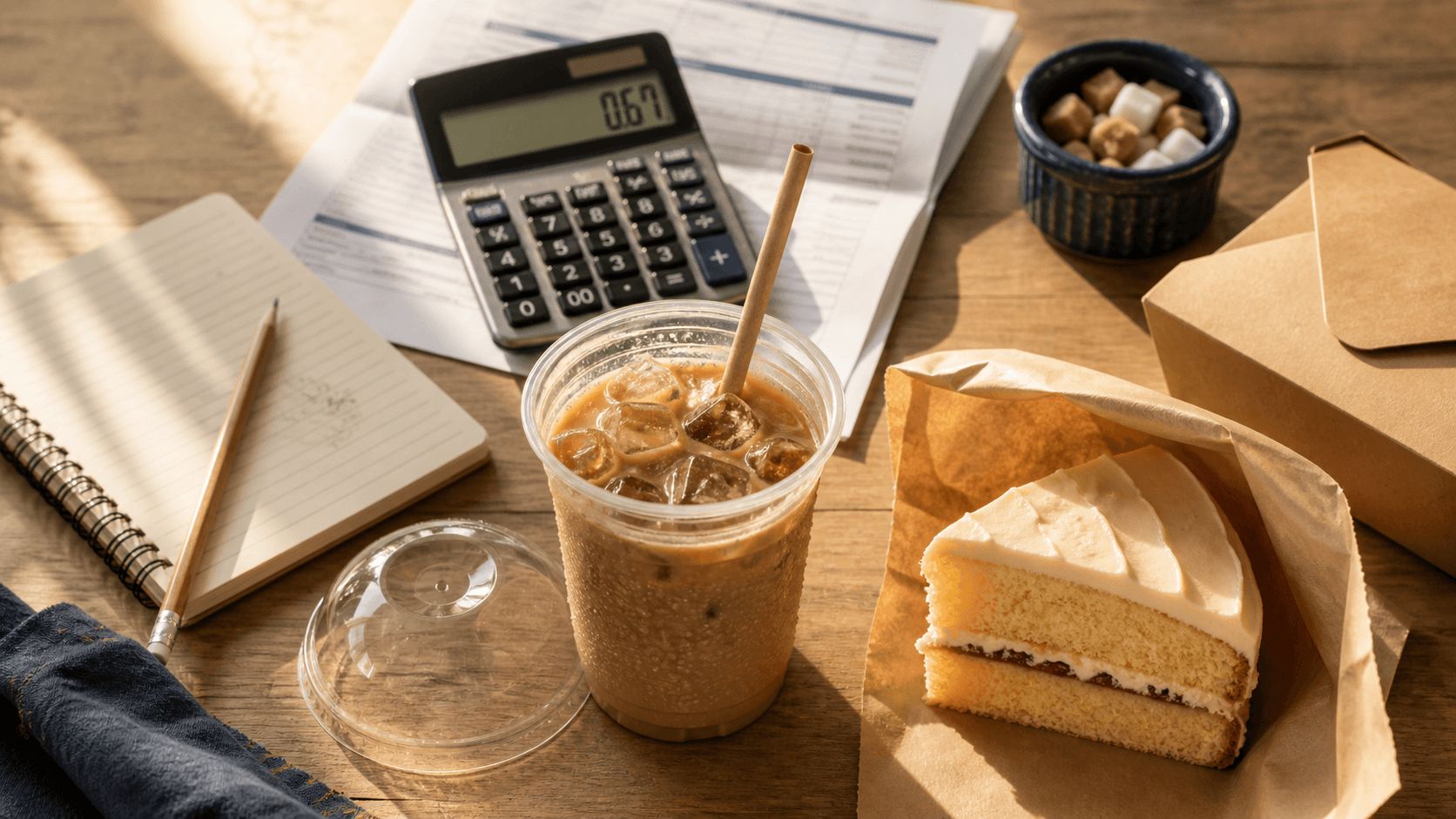
Two customers walk in on a hot Tuesday in July. Both order a £4 drink. Both pay with a contactless tap. The first orders a flat white and sits down. The second orders an iced latte to take away.
Same price. Same minute of barista time. Same milk, near enough.
Your till sees them as identical £4 sales. HMRC does not.
On the flat white, you keep £3.33. On the iced latte, you keep the full £4. That is 67p of pure margin, sitting in the difference between standard-rated and zero-rated VAT. Multiply across a hot summer week and the maths starts to matter.
This is the summer VAT trick. It is not a loophole. It is just how the rules are written. And if you are not paying attention to the eat-in versus takeaway split on iced drinks and cakes, you are leaving real money on the counter.
This, by the way, is the summer VAT lever worth your attention. Not the temporary children's-meal VAT cut that runs from June to September, which for most independents is built for the chains and barely worth the menu reprint.
First, the obvious caveat: this only matters if you are VAT-registered
If your café turnover is under £90,000 a year, you are not VAT-registered, and none of this applies to you. All your sales are effectively zero-rated to you because you are not collecting VAT in the first place.
If you are sitting just below the threshold, this is also where it gets interesting (and a bit dangerous). I have written separately about the VAT threshold and what it actually costs to cross it. Read that first if you are unsure where you stand.
For everyone above £90k turnover collecting and paying VAT, what follows is for you.
The VAT rules, on one screen
Here is the table I wish someone had pinned next to my till in year one, and if you want the wider rulebook behind it, the complete UK café VAT guide covers the hot/cold and eat-in/takeaway logic in full. These are the categories that cover roughly 95% of what an independent café sells.
| Item | Eat-in VAT | Takeaway VAT |
|---|---|---|
| Hot drinks (coffee, tea, hot chocolate) | 20% | 20% |
| Iced coffee, iced latte, cold brew (barista-made) | 20% | 0% |
| Bottled water, plain milk, plain fruit juice | 20% | 0% |
| Fizzy soft drinks, sweetened canned drinks | 20% | 20% |
| Cake, brownies, cold pastries | 20% | 0% |
| Cold sandwich, cold wrap, cold salad | 20% | 0% |
| Toasted sandwich, hot panini, soup, hot pasty | 20% | 20% |
Two patterns to notice.
First, hot food and hot drinks are standard-rated everywhere. There is no escape. A flat white is 20% whether the customer drinks it at your window seat or jogs out the door with it.
Second, cold food and most cold drinks flip to zero-rated the moment they leave the premises. Cake, sandwiches, iced coffee. Same product, different VAT, depending on whether the customer eats in or takes away.
The exceptions to be careful with: fizzy and sweetened soft drinks (Coke, Fanta, energy drinks, anything carbonated and sugared) stay at 20% even taken away. They are classed as standard-rated regardless. Smoothies and milkshakes are nuanced and depend on composition. But a barista-made iced latte, an Americano poured over ice, or a cold brew taken away in a takeaway cup is zero-rated as cold takeaway food and drink.
The £4 flat white versus the £4 iced latte
Let us run the basic comparison side by side. Same retail price. Same customer. Different VAT outcome.
| Sale | Retail price | VAT | You keep (ex-VAT) |
|---|---|---|---|
| Flat white, eat-in | £4.00 | £0.67 (20%) | £3.33 |
| Flat white, takeaway | £4.00 | £0.67 (20%) | £3.33 |
| Iced latte, eat-in | £4.00 | £0.67 (20%) | £3.33 |
| Iced latte, takeaway | £4.00 | £0.00 (0%) | £4.00 |
The first three rows are identical from your perspective. The fourth row is the one that matters. 67p of additional revenue sitting in your account at the end of the day, not HMRC's, on the same drink at the same price.
That 67p is not pure profit, of course. You will spend more on packaging for the takeaway cup. But the gross margin uplift is real, and it is meaningful at volume.
The takeaway cake angle: same product, 75p more margin
The same trick applies, often more cleanly, to cake.
| Sale | Retail price | VAT | You keep (ex-VAT) |
|---|---|---|---|
| Slice of cake, eat-in | £4.50 | £0.75 (20%) | £3.75 |
| Slice of cake, takeaway | £4.50 | £0.00 (0%) | £4.50 |
Cake is a cleaner case because the packaging cost is tiny. A folded paper bag and maybe a napkin. We are talking 4p to 7p of packaging, against 75p of recovered margin. The till button you press, "eat-in" or "takeaway," is doing the heavy lifting.
This is why I get genuinely twitchy when I see staff defaulting to whichever button is on the left, regardless of what the customer is actually doing. If the customer takes the cake to a park bench round the corner, that is a takeaway sale. Ringing it as eat-in costs you 75p you did not need to give up.
A typical July week, modelled
Let us put numbers on the summer mix shift. Take a hypothetical café doing 100 drink-and-cake transactions a day during a normal May week, then track what happens by mid-July.
May (normal mix):
- Hot drinks: 70% of drink sales (mostly eat-in)
- Cold drinks: 30% of drink sales, of which about 30% are takeaway
- Cake mix: about 60% eat-in, 40% takeaway
July (hot week):
- Hot drinks: 50% of drink sales
- Cold drinks: 50% of drink sales, of which about 60% are takeaway
- Cake mix: about 40% eat-in, 60% takeaway
If your average drink price sits at £4 and your average cake at £4.50, here is what changes across 100 drink and 50 cake transactions in a day.
| Day mix | Cold takeaway drinks | VAT saved on drinks | Cake takeaway | VAT saved on cake | Total daily uplift |
|---|---|---|---|---|---|
| May | ~9 | £6.03 | ~20 | £15.00 | £21.03 |
| July | ~30 | £20.10 | ~30 | £22.50 | £42.60 |
That is roughly £21 a day of additional ex-VAT revenue captured purely by mix shift, assuming the same retail prices and the same customer count. Across a 7-day hot week, that is around £150 of extra retained margin. Across a 12-week summer where conditions hold, that is closer to £1,800.
Not life-changing. But meaningful, and quietly running in the background while you are focused on getting orders out.
The point is that this uplift happens by itself if you let it. The risk is that you cancel it out by ringing every sale as eat-in regardless of what the customer is doing.
How to nudge customers toward takeaway (without being weird about it)
This is not about deceiving customers or refusing them a seat. It is about asking the right question first.
The standard café question is: "Anything else?" followed by ringing it through.
The better question, for cold drinks and cake especially, is: "To take away, or to eat in?"
That single question, asked before the till button is pressed, does three things. It clarifies the order properly. It signals to the customer that takeaway is the natural option (especially if it is a sunny day and they were already half thinking it). And it makes the till entry honest.
In summer, with the door open and a queue building, plenty of customers genuinely have not decided yet. They will go with whichever the staff member suggests first. Asking "to take away?" first, with a smile, often gets a "yes, that works."
If the queue is long and seating is tight, this is also operationally good. A takeaway cup turns over the bar faster than an eat-in mug needing a tray, condiments, and a wash later.
The packaging cost trade-off
Be honest with the maths. A takeaway cup, lid, and sleeve costs you somewhere in the 16p to 21p range depending on what you buy and your wholesale relationships. A paper bag for cake is nearer 4p to 7p.
So the real net uplift on an iced latte takeaway versus eat-in is closer to 46p to 51p, not the full 67p. On cake takeaway, the net is closer to 68p to 71p out of the headline 75p.
Still substantial. But worth tracking properly because if you switch to fancier compostable cups (35p to 40p+) the gain shrinks meaningfully. I have written more about how packaging and modifier extras quietly eat margin and how to handle them in your costing.
The point is to know your real packaging unit cost per drink and per cake and net it out. Do not just look at the VAT line and pretend that is your gain.
The till setup that makes this work
None of this matters if your till cannot tell eat-in from takeaway, or if staff bypass the prompt.
The minimum setup:
- Separate eat-in and takeaway buttons for every relevant item. Iced coffee eat-in. Iced coffee takeaway. Cake eat-in. Cake takeaway. They are different SKUs from a VAT point of view, and they should be different buttons.
- A compulsory prompt for ambiguous items. Most modern POS systems let you set a "modifier required" flag. For cold drinks and cake, set it. The order cannot complete without the staff member choosing eat-in or takeaway.
- VAT codes on the right SKUs. Standard-rated for eat-in. Zero-rated for takeaway (on the relevant items). If your POS hands data to your accounting software, make sure those codes are right or your VAT return will be wrong both directions.
- Reporting that splits eat-in versus takeaway by item. This is how you know whether the mix shift is actually happening, or whether staff are defaulting everything to one button.
If you cannot answer "what was my eat-in versus takeaway split on iced lattes last week" from your till in under a minute, you cannot manage this. That is a real-world POS configuration problem, and it is worth fixing before summer hits.
Staff training: the question, the flow, the customer experience
Train staff on three things. Not more.
The question. "To take away, or to eat in?" Asked early, asked warmly, asked before the till entry. Not "is that to eat in?" (which biases toward eat-in). Not "takeaway?" (which can come across as pushy). The neutral framing is the both-options question with takeaway first.
The till flow. Two buttons, no shortcuts. If your iced latte takeaway button is buried two menus deep and the eat-in is on the home screen, staff will hit eat-in for everything because the queue is moving. Surface the right buttons. Make them equally easy to press.
The customer experience. A takeaway cup, lid, sleeve, paper bag, sticker, napkin. Make it feel cared-for. The packaging is the second-most-touched part of your brand after the drink itself, and a wobbly lid or a soggy bag undoes the experience.
This is exactly the sort of consistency that benefits from a smaller, sharper menu rather than trying to do everything. I wrote about why smaller menus make more money and the takeaway version of the argument is even stronger: fewer SKUs to set up properly, fewer places to get the VAT codes wrong, fewer chances for staff to fumble the till flow.
The summer planning calendar
A simple month-by-month for what to push and when, based on what the British weather usually does.
| Month | Push | Quietly pull back |
|---|---|---|
| April | Cold-drinks menu refresh, takeaway cake display, outdoor seating ready | Heavy hot food, soup |
| May | Iced coffee specials, cold brew launch, packaging order in | Hot pastry counts at noon |
| June | Full cold mix on the menu board, grab-and-go fridge stocked | Hot lunch SKUs |
| July | Iced specials front and centre, cake to-go boxes by the till | Toasted sandwich line if it is dragging margin |
| August | Maintain. This is the peak | - |
| September | Soft pivot back, but keep iced on the board until mid-October | Phase out cold-only SKUs gradually |
This is the operational sister of the summer trading menu shift, which goes deeper on the broader seasonal product changes. The VAT angle is one input into that wider planning. The point of overlapping these is that you should not be making the menu shift decision in June. You should be making it in March, ordering packaging in April, and training in May.
Where Brikly fits
Three places this connects to what we build.
MenuBrik tracks your eat-in versus takeaway split per item, so you can see whether that "we are pushing takeaway" plan is actually showing up in the data. It pairs with sales mix and Pareto analysis to show where the margin is hiding in your top sellers.
CostingBrik lets you set up packaging as a recipe variant, so an iced latte takeaway and an iced latte eat-in are properly costed differently. The 19p of cup, lid and sleeve is in the takeaway recipe and not in the eat-in version. When you read a true drinks P&L like the flat white breakdown, you see the real number, not a guess.
PulseBrik then surfaces VAT-aware margin shifts month over month, so you can see July's mix shift compared to May's and judge whether it is paying off net of the higher packaging cost. This is the layer that closes the loop and tells you whether the pricing structure is actually defending margin, which connects back to setting menu prices to protect margins and to the gross profit margin benchmarks most independents are running against.
The summer VAT trick is small per transaction. But small per transaction across a hot July is where the difference between a flat year and a good year quietly lives. Set the till up properly, train staff to ask the right question, watch the data, and let the mix do the work.
Ed O'Brien has run Hunters Cake Company for 17 years across cafés in Witney, Burford, and a bakery in Carterton, Oxfordshire. He's building Brikly - modular tools that give independent café owners the same data the big chains have, without the big chain price tag.