
EPR packaging fees: what UK cafés are actually paying now
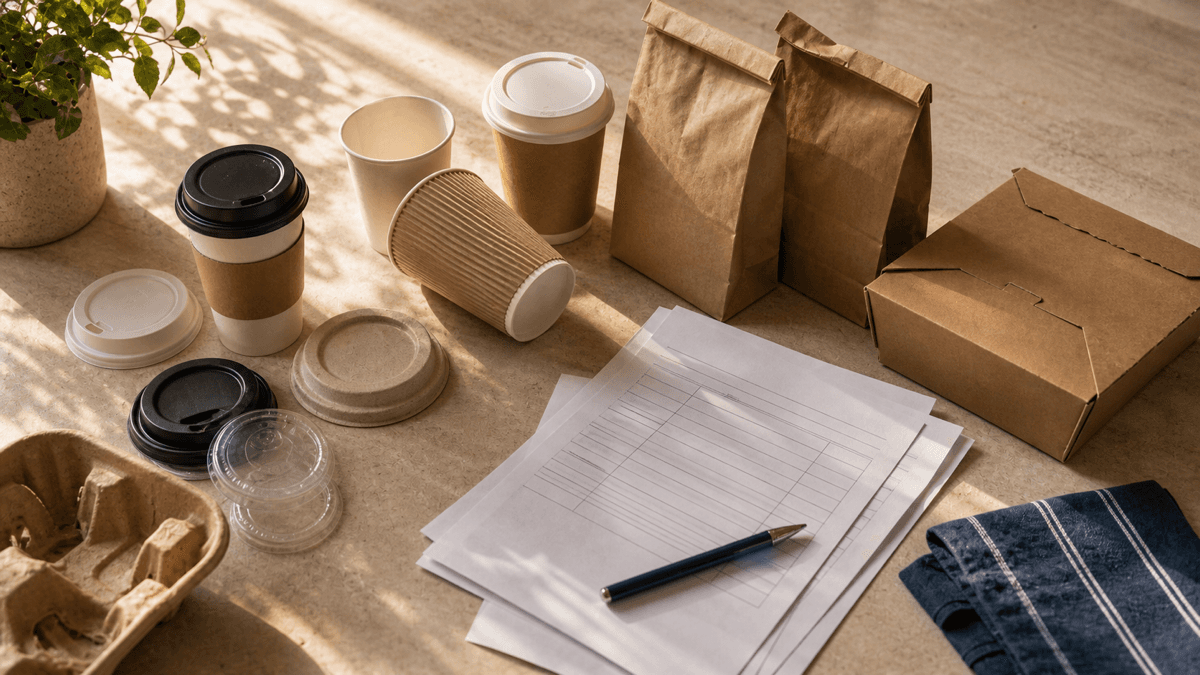
Pull a recent invoice from your disposables supplier. Now pull one from last summer. The cups look the same. The lids look the same. The price doesn't.
Most operators I talk to have noticed packaging creeping up but can't put a finger on why. Their rep mentions "regulatory costs" and moves on. The number on the bottom of the invoice goes up by a few quid, you sign it off, life carries on.
That quiet creep is Extended Producer Responsibility - EPR for short - working its way through your supply chain. Here's what it actually is, what you're paying, and the three swaps that pull the number back down.
What EPR actually is, in plain English
EPR is a UK scheme that makes the people who put packaging on the market pay for what it costs councils to deal with it afterwards. Bins, kerbside collection, sorting, the lot. The fees launched in 2025, with the first invoices in October 2025. Those first-year fees were set per material, with no extra charge for being hard to recycle. "Modulated" rates - where harder-to-recycle packaging costs more - start with the 2026 to 2027 fees, worked out on the packaging each producer supplied in 2025.
Correction, 28 September 2026: an earlier version of this post said modulated fees kicked in from October 2025. They did not. PackUK's modulation statement says modulation "will commence from year 2 of the scheme with the first modulated fees applying to disposal fee calculations for the 2026 to 2027 financial year". The earlier version also said composites sat in the middle of the fee range, when fibre-based composite had the highest first-year rate of any material; said switching to a mono-material PP lid typically cut the EPR on each lid by a few pence, when a 4g lid carries well under a penny of EPR in total; and gave cup and lid prices in the reusable-cup sum that we could not stand behind. We have corrected the post throughout.
You're not directly liable unless your business turns over £2 million and handles 50+ tonnes of packaging. So for the vast majority of independent cafés, EPR isn't a bill you pay yourself. It's a bill your packaging supplier pays, and then passes through to you in their unit prices.
That's the bit most people miss. It doesn't land as a line called "EPR fee." It lands as a quietly higher price on the same cup you've been buying for years.
How it actually gets onto your invoice
Your disposables supplier - whoever that is, big national or local wholesaler - gets charged a fee per tonne of packaging they place on the market. The fee is different for every material. Plastic is expensive, at £423 a tonne in the first year's base fees. Paper and card is cheaper, at £196. Composites (a paper cup with a plastic lining, for example) are dearest of all: fibre-based composite was £461 a tonne. And from the 2026 to 2027 fees, packaging rated red, the least recyclable, pays more again.
The supplier doesn't absorb that. They build it into their pricing. Sometimes it's transparent and shows as a separate line. More often, it's baked silently into the unit cost of the cup, the lid, the bag, the box.
If you're a CostingBrik user, you can spot this on the supplier price tracking - the unit cost moves but the pack size and product haven't changed. That's the tell. If you're not, the manual version is the same: pull two invoices from the same supplier six months apart and compare line by line. Our pattern-learning invoice processing catches these silent unit-cost drifts automatically, but a spreadsheet and twenty minutes will do the same job.
What a typical café is actually paying
I've looked at our own numbers across the Hunters sites and compared notes with a few operators running similar volumes. Here's roughly where it lands:
- Small café, 80-120 takeaway drinks a day, mostly hot, paper cup and plastic lid: roughly £25-40 a month in EPR pass-through. About £300-480 a year.
- Busier independent, 200-300 takeaway drinks plus food-to-go bags and boxes: roughly £50-80 a month. About £600-960 a year.
- Small group, 3-5 sites with strong takeaway and brunch boxes: comfortably into £200-400 a month when you total it.
These aren't headline numbers. They're not going to close you down. But they sit alongside everything else hitting this year - the April 2026 cost cliff of NMW, NICs, business rates, and supplier rises - and they don't go away.
Three packaging swaps that cut both EPR and unit cost
The good news: the same swaps that reduce your EPR exposure tend to reduce your unit cost too, because lighter and simpler packaging is cheaper to buy. This is one of those rare overlaps where doing the right thing for the bin lorry is also doing the right thing for your gross profit.
1. Lighter paper cups
A standard 12oz double-wall paper cup weighs around 16-18g. A modern single-wall with a recycled-fibre cup sleeve weighs 9-10g and uses sleeves only when needed. EPR fees are charged per tonne, so halving the cup weight roughly halves the EPR component, and the cup itself is usually 10-15% cheaper at the same quality.
The catch: you need to be honest about which drinks need a sleeve. Flat whites going to a customer who's drinking on the walk to the car park, no. A 16oz latte going on a 30-minute commute, yes. Train your team on the call and the maths works.
2. Single-material lids
Composite plastic lids - the kind with two different polymers fused together - are a nightmare to recycle, and hard-to-recycle packaging is what a red rating, and the higher fee that comes with it, is for. Single-material PP lids (one polymer, clearly marked) are easier to recycle, so ask your supplier how each lid is rated: from the 2026 to 2027 fees, red-rated packaging pays more than amber and green-rated pays less. Fibre lids without a plastic layer come under paper and card, which was less than half plastic's rate in the first year.
Whatever a move to mono-material PP does to the lid price, do not expect EPR to do the work: at plastic's first-year rate of £423 a tonne, a 4g lid carries well under a penny of it, on our arithmetic. On 200 takeaway drinks a day, that is 73,000 lids a year, so every half a penny off the lid is worth about £365 a year. Ask your supplier specifically for the mono-material spec - they have it, they just don't always lead with it.
3. Reusable cup discount programmes
The cheapest cup is the one you don't buy. Every reusable cup saves you the cup, the lid and the EPR fee on both, but weigh that against the discount you give. Price your own cup and lid from your latest invoice: if a 25p discount is more than the packaging it saves, the difference is what you are paying for a customer who feels rewarded, which can still be worth it. Set the discount with that number in front of you.
Run it for a month and check your sales mix in your till reports. If reusable-cup transactions are sitting under 5% of takeaway drinks, the discount isn't working hard enough or your team aren't asking. If they're above 15%, the discount is changing behaviour; just check it costs you less than the cup and lid it saves, or that you are happy paying the difference.
How to spot the EPR pass-through on your invoices
Three quick checks, none of them clever:
- Compare same-product unit prices six months apart from the same supplier. If the unit cost on a SKU you've bought for years has moved by 3-8% and the pack size hasn't changed, EPR may be part of it, alongside general supplier rises; the next check tells you how much.
- Ask your supplier rep for a written breakdown of how their packaging prices have moved since October 2025 and what's EPR-driven versus raw material or freight. A good rep will tell you. A bad one will fudge it - which is also useful information.
- Watch the composite items hardest: paper cups with plastic linings, foil-lined bags, lined sandwich boxes. If they are rated red, the least recyclable, these are the lines modulation charges more for, starting with the 2026 to 2027 fees.
If you're already getting hit by supplier price increases more broadly, bundle the EPR conversation into the same negotiation. Don't accept "regulatory costs" as a one-line explanation. Make them show you the breakdown. And whatever the fee does, the bigger question is whether the cup is in your recipe cost at all; costing packaging per sale is where most cafés find the real number.
The takeaway
EPR isn't a headline cost, and it won't be the thing that makes or breaks your year. But it's a real, structural rise in your packaging-as-input-cost that compounds quietly month after month, and most operators are paying it without realising.
The fix isn't to fight the scheme. It's to design lighter, simpler packaging into your operation, and to make sure the cup you don't sell is worth a little more than the cup you do. Twenty minutes with your last six invoices and a chat with your supplier rep will tell you where you stand. From there, one swap at a time.
Ed O'Brien has run Hunters Cake Company for 17 years across cafés in Witney, Burford, and a bakery in Carterton, Oxfordshire. He's building Brikly - modular tools that give independent café owners the same data the big chains have, without the big chain price tag.