
Profit per trading hour: does staying open the extra hour actually pay?
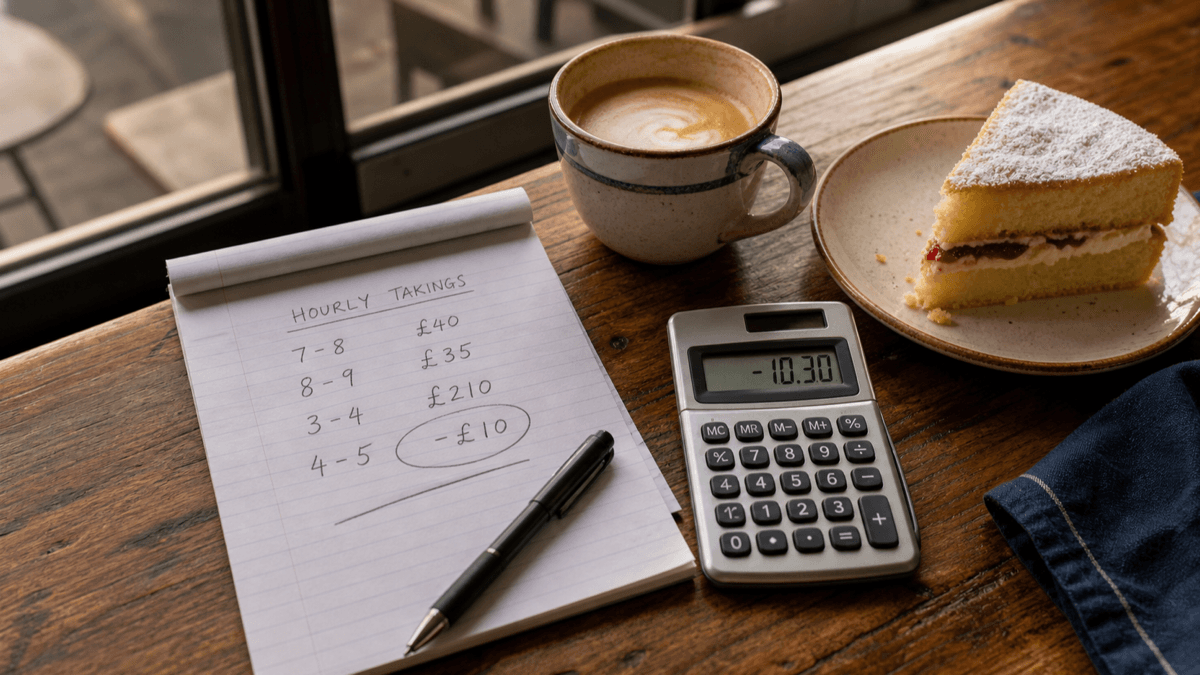
You're standing at the counter at half four, wondering whether to flip the sign to closed or hang on until five. The last hour did about forty quid. It feels like money. Turning away a customer feels like a mistake.
But forty quid in the till isn't forty quid in your pocket. Some of it was the cost of the coffee and the cake. The rest has to cover the person stood next to you, who's on the clock whether the door opens or not.
The honest question isn't "did that hour take money." It's "did that hour make money." And the two are very different numbers.
The number that actually answers it
Most hourly analysis stops at a percentage. Wage percentage, sales per labour hour, labour as a share of takings. Useful ratios, and I've written about where those benchmarks sit for 2026 elsewhere. But a percentage doesn't tell you whether to keep the lights on for one more hour. A pound figure does.
So do it in pounds, in and out.
Take an hour that rings up £40. Say the blended gross profit across what sold that hour is 65%. That hour earned you:
£40 x 65% = £26 of gross profit
Now the person on the floor. Post-April, a barista on the £12.71 minimum wage costs you closer to £16 an hour fully loaded once you add employer NI, pension and holiday. If you've got one person on, that hour cost £16 in wages, leaving £10. Fine. If you've got two on, it cost £32, and the hour is underwater:
£26 gross profit - £32 wages = minus £6
You didn't make £40 that hour. You lost £6. You paid the customer to come in, plus a bit extra.
The percentage version hides this. "Labour was 80% that hour" is technically the same fact, but it doesn't land the way "you lost six pounds" lands. Do it in pounds.
Two hours, same takings, very different profit
Here's the part that catches people out. Two hours can ring up the exact same amount and earn wildly different gross profit, because what sold was different.
Coffee is a high-margin drink. A flat white might run 75 to 80% gross profit. Food is heavier: a toastie, a filled roll, a slab of cake with real butter and eggs in it, all sit lower, often 60 to 65%. So a wet-led hour and a food-led hour that take the same money are not the same hour at all.
Watch what happens to two hours that both take £40:
| 8am coffee hour | 3pm cake hour | |
|---|---|---|
| Takings | £40 | £40 |
| What sold | flat whites, lattes, a pastry | slices of cake, a pot of tea |
| Blended gross profit | 80% | 62% |
| Gross profit earned | £32 | £24.80 |
Same £40 on the till. A £7.20 gap in what you actually kept, before a single wage is subtracted. The morning hour is carrying nearly a third more profit on identical takings, purely because coffee out-margins cake.
Layer the wages back on and the gap widens into a decision. Put two people on both hours at £16 each and the morning hour clears £32 gross profit against £32 wages: line ball. The afternoon hour clears £24.80 against the same £32: minus £7.20. The takings looked identical. One hour washed its face, the other quietly cost you the price of a coffee.
This is why "we took forty pounds an hour all afternoon" tells you almost nothing on its own. Forty pounds of cake is not forty pounds of coffee. If you're not sure what your blended margin is by daypart, the free Menu Profit Calculator lets you cost your lines and see which ones actually carry the profit, so you can estimate the blend for a coffee-led hour versus a food-led one.
Run it on your own worst hour
You don't need a spreadsheet model for this. You need three numbers and five minutes. Pick the hour you're most suspicious of: the first hour of the day, the last, or the dead patch mid-afternoon.
Step 1: Estimate that hour's takings
Pull a few weeks of that specific hour off your till and take a rough average. Every transaction is time-stamped, so this is already sat in your POS. On Square, the free Square Category Analyser turns a sales export into a by-hour, by-category view in seconds, which also shows you the mix you'll need for the next step. Say your 4 to 5pm averages £35.
Step 2: Apply that daypart's blended gross profit
Not your menu-wide average. The blend for what actually sells in that hour. If your late afternoon is cake and tea, that's maybe 62%, not the 72% your whole menu might average once the morning coffee is folded in. So £35 x 62% = £21.70 of gross profit.
Step 3: Subtract the true hourly wage of whoever's on
Not the headline rate. The fully loaded cost. Two people at £16 is £32.
£21.70 gross profit - £32 wages = minus £10.30
That hour loses you a tenner, every day you run it, before rent. Over a six-day week that's £62. Over a year, north of £3,000 to keep the door open for an hour that doesn't want to be open.
Run the same three steps on a genuine peak hour and you'll see the opposite: an 8am doing £210 at 78% is £163.80 of gross profit against £32 of wages, a clean £130-plus. The peaks aren't the question. It's the thin hours at the edges of the day that need this test. That said, the peaks carry a catch of their own: a food-led hour runs a much lower blended margin than a coffee-led one and needs more hands to serve it. What the weekend brunch rush really earns runs this same calculation on a Saturday morning, and the gap in pounds is a lot narrower than the gap on the till.
A full day, hour by hour
Here's what a worked day looks like once you put gross profit and wages side by side. A café open 7 to 5, staffing two on the counter most of the day and three across lunch, true wage £16 an hour.
| Hour | Takings | Blended GP % | Gross profit | Staff | Wage cost | After wages |
|---|---|---|---|---|---|---|
| 7-8am | £45 | 80% | £36.00 | 2 | £32 | +£4.00 |
| 8-9am | £210 | 78% | £163.80 | 2 | £32 | +£131.80 |
| 9-10am | £180 | 76% | £136.80 | 2 | £32 | +£104.80 |
| 12-1pm | £160 | 65% | £104.00 | 3 | £48 | +£56.00 |
| 3-4pm | £40 | 62% | £24.80 | 2 | £32 | -£7.20 |
| 4-5pm | £35 | 62% | £21.70 | 2 | £32 | -£10.30 |
Look at the two ends. The 8am hour alone earns more after wages than the entire afternoon puts together. The 7am opener scrapes £4, so it survives, just. The last two hours lose £17.50 between them, every single day.
That's not a staffing tweak. That's a question about whether those hours should exist in their current shape at all. And crucially, it's a marginal question. You're not asking whether the café is profitable. You're asking whether this one specific hour, on its own, at its current staffing, pays its way. Each hour stands or falls on its own numbers.
What to do once an hour is shown to lose money
The calc tells you an hour is bleeding. It doesn't tell you what to do about it, and there's more than one honest answer.
Broadly you've got three moves, and I've written them up in full elsewhere so I won't repeat them here:
- Drive the hour. Sometimes a losing hour is a demand problem you can fix, not a structural dead zone. A timed offer or a standing booking can turn a quiet 3pm into a paying one, and filling off-peak trade is a whole subject in itself.
- Restaff the hour. Losing money with two on doesn't mean losing money with one. That 4-5pm hour at £21.70 gross profit clears £5.70 with a single person on prep and the floor. Reshaping the rota to your real demand curve, rather than cutting blindly, is the whole subject of demand-based rotas that protect your wage percentage.
- Trim the hour. If it's the last hour, genuinely dead, and can't be filled or single-staffed sensibly, close earlier, and the week the clocks go back is the natural time to decide. There's no prize for the longest opening hours on the street, only the wage bill.
The point of the profit-per-hour calc isn't to slash your day to the peaks. It's to stop guessing. Once you can see, in pounds, which hours pay and which don't, the decision about what to do stops being a gut feel about "seeming open" and becomes a straightforward reading of the numbers.
The takeaway
Takings at the end of an hour are a vanity number. The figure that matters is gross profit earned that hour minus the true cost of who was on, in pounds, not percentages.
Run the three steps on your thinnest hour tonight: average its takings, apply the honest blended margin for what sells then, and subtract the fully loaded wage of everyone rostered. If the answer's negative, you've found an hour that's costing you money to stay open. Then you decide: fill it, restaff it, or close it.
Do it hour by hour and the shape of your day stops being habit and starts being a choice you can actually defend. Working out the blended margin per daypart is the fiddly bit, and it's exactly what MenuBrik (coming soon) reads off your POS: gross profit by hour and by day, so the profit-per-hour map draws itself instead of you building it by hand at the counter after close.
Ed O'Brien has run Hunters Cake Company for 17 years across cafés in Witney, Burford, and a bakery in Carterton, Oxfordshire. He's building Brikly - modular tools that give independent café owners the same data the big chains have, without the big chain price tag.