
Should your café pay the Real Living Wage? The cost above £13.21
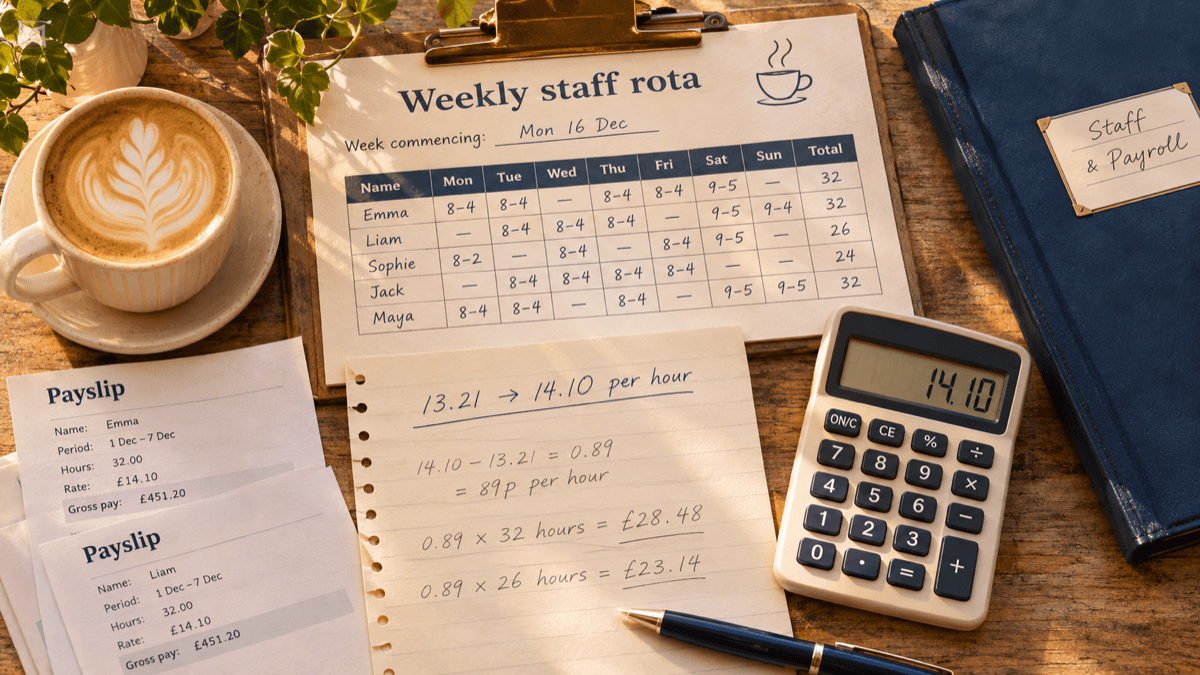
From 1 April 2027 the legal minimum for anyone 21 or over is £13.21 an hour. The Real Living Wage, the voluntary rate the Living Wage Foundation sets every autumn, is £14.10.
That's 89p an hour. It sounds like a rounding error next to the 50p the law is already adding in April. It isn't, and the reason it isn't has very little to do with your full-time adults.
This post costs the step from the legal rate to the Real Living Wage for a typical seven-person café team, explains what accreditation actually commits you to, looks honestly at whether it pays for itself, and sets out the middle options for when the full thing is too much in one go.
The two sets of rates for 2027
The Living Wage Foundation announced the 2026-27 rates on 15 October 2026: £14.10 an hour across the UK and £15.45 in London. Both are 65p up on last year's £13.45 and £14.80, a rise of 4.8% outside London and 4.4% inside it, according to Personnel Today. The rates are calculated by the Resolution Foundation from the cost of living, and paying them is voluntary.
Two weeks later the Government accepted the Low Pay Commission's recommendations in full for April 2027. Side by side:
| Age | Legal minimum from April 2027 | Real Living Wage (UK) | Gap an hour |
|---|---|---|---|
| 21 and over | £13.21 | £14.10 | £0.89 (6.7%) |
| 18 to 20 | £11.27 | £14.10 | £2.83 (25%) |
| 16 and 17 | £8.31 | No Real Living Wage rate | - |
| Apprentice | £8.31 | Not required | - |
Two things jump out.
The adult gap has widened. Last year the Real Living Wage was 74p above the legal rate of £12.71. This year it's 89p, because the voluntary rate rose 4.8% and the legal one 3.9%.
The Real Living Wage has no youth rate. The Foundation is explicit that it "applies to all workers 18 and over", on the basis that an 18-year-old's rent and bus fare cost the same as anyone else's. The legal 18-20 rate isn't catching up any time soon either: the Low Pay Commission's October letter recommended pausing the move towards a single adult rate, so the 18-20 rate stays at about 85% of the adult one. For a café with weekend students on the rota, that £2.83 is where most of the money goes.
Costing it: a seven-person café
Here's an illustrative team for April 2027. The owner's own hours aren't in it, and the supervisor is on a rate you'd already planned to give her.
| Who | Hours a week | Legal rate April 2027 | At £14.10 | Extra a year, fully loaded |
|---|---|---|---|---|
| Full-time barista, 24 | 38 | £13.21 | £14.10 | £2,326 |
| Barista, 31 | 30 | £13.21 | £14.10 | £1,836 |
| Kitchen and counter, 46 | 25 | £13.21 | £14.10 | £1,530 |
| Weekend barista, 19 | 16 | £11.27 | £14.10 | £2,639 |
| Student, 20 | 12 | £11.27 | £14.10 | £1,979 |
| Saturday junior, 17 | 8 | £8.31 | Not required | £0 |
| Supervisor, 34 | 35 | £14.20 (planned) | Already above | £0 |
| Total | 164 | £10,310 |
On the legal rates, this team costs about £137,170 a year fully loaded. Moving everyone 18 and over to £14.10 adds £10,310, or just under £200 a week. Add the accreditation fee, which I'll come to, and it's about £10,410.
Why the 19 and 20 year olds cost the most
The two youngest adults work 28 hours a week between them, less than the full-time barista alone, and they account for £4,618 of the £10,310. That's 45% of the cost for 17% of the hours. The adults' rise is 6.7%; theirs is 25%.
The multipliers behind the numbers
Same approach as the true cost of the April 2026 rise and the pay differentials post:
- Over-21s, auto-enrolled: every extra £1 an hour costs about £1.32. That's 15p of employer National Insurance (15% above £5,000 a year, per HMRC's rates for 2026 to 2027), 3p of employer pension on qualifying earnings (The Pensions Regulator), and 12.07% for 5.6 weeks' paid holiday with the NI and pension on top.
- Under-21s: about £1.12. You pay 0% employer NI on under-21s up to £967 a week, and staff only have to be auto-enrolled into a pension from age 22, so it's mostly holiday. If one of them asks to join the pension, add 3p. (The pension auto-enrolment post has the detail.)
I've used 2026-27 thresholds throughout. HMRC hasn't published the 2027-28 tables yet.
One quirk worth checking on your own team: a part-timer earning just under £10,000 a year on the legal rate can tip over the auto-enrolment trigger at £14.10. That's not a reason not to do it, but it's 3% you'll want in the budget.
The supervisor problem
The supervisor doesn't cost anything for accreditation, because she's already above £14.10. That's exactly the problem. You'd planned £14.20 for her: 99p above the legal minimum. After the move she's 10p above the barista she trains.
Keeping her 99p step means £15.09 an hour, which is another £2,142 a year. It isn't required. But if you're paying the Real Living Wage partly to keep good people, flattening the one person you can least afford to lose rather undoes the point. The pay differentials post has three ways to hold a gap.
The 17-year-old
Accreditation doesn't cover under-18s, so the Saturday junior can stay on £8.31. Some employers pay them the full rate anyway. Here that would be another £2,699 a year, because the step is £5.79 an hour.
The same team in London
On the London rate, moving the same six adults to £15.45 costs about £21,150 a year before the fee, roughly double the UK figure. Most of that is the over-21s, whose gap is £2.24 an hour.
What it does to your wage percentage
Say this café turns over £450,000 a year ex VAT. On the legal rates, the team costs 30.5% of turnover, inside the 28-33% band for counter-led cafés in the wage percentage benchmarks.
| Option | Extra a year | Wage % on flat turnover | Price rise to cover it |
|---|---|---|---|
| Legal minimum only | £0 | 30.5% | - |
| Accredited, everyone 18+ on £14.10 | £10,410 | 32.8% | 2.3% |
| Plus keep the supervisor's step | £12,552 | 33.3% | 2.8% |
| Plus the 17-year-old on £14.10 | £15,251 | 33.9% | 3.4% |
"Price rise to cover it" is the extra cost as a share of turnover: the rise that keeps your profit in pounds where it was, assuming customers keep buying the same amount. On a £3.80 flat white, 2.3% is about 9p.
That is on top of whatever price rise you're planning for April's legal increase, which this table already assumes you're paying. It's also why the Real Living Wage decision and the April pricing decision belong in the same conversation, not two.
What accreditation actually involves
You can pay £14.10 without telling anyone. Accreditation is the formal version: you sign a licence with the Living Wage Foundation and get the right to use the Living Wage Employer mark. There are nearly 17,000 accredited employers. Here's what you're signing up to, from the Foundation's own FAQs unless stated.
The fee
There's a sliding annual fee based on the size of your organisation, starting at £100 a year for fewer than 10 employees. That counts heads, not full-time equivalents, so a seven-person team of mostly part-timers qualifies. The Foundation says some councils offer a grant or a business rates discount to new Living Wage Employers, so it's worth asking yours.
Every directly employed adult, regardless of hours
Accreditation covers all your directly employed staff aged 18 and over, "regardless of the amount of hours they work". The Saturday-only student counts. You can't accredit and keep a few people on the legal rate.
Two groups are outside it: under-18s, and apprentices (the Foundation says "accreditation does not require employers to pay the real Living Wage to apprentices", though some pay it anyway).
A new rate every autumn, paid by 1 May
This is the commitment that matters most. The Foundation sets a new rate each autumn. Accredited employers must tell staff the new rate within a month of the announcement and pay it "as soon as possible but by 1st May 2027 at the latest".
So you're not signing up to £14.10. You're signing up to whatever the rate is next October, and the October after. The last two rises were 85p (from £12.60 to £13.45) and 65p. That's the part to be honest with yourself about.
What counts towards the rate, and what doesn't
Only "guaranteed non-deferred payments" count. For a café, that rules out:
- Employer pension contributions. These "cannot form part of the Living Wage payment".
- Staff meals, drinks or accommodation. The Living Wage "does not include non-cash goods".
- Tips and sales bonuses. Non-guaranteed payments "cannot be included", so a good tronc can't make up the gap.
Contractors, such as your cleaner
You need "an agreed plan in place for third party contracted staff", with contracted cleaning, catering and security named. It applies to people who work for you regularly, defined as "2 or more hours a week, for 8 or more consecutive weeks a year", and it rolls out "as the contracts come up for renewal" rather than overnight.
For most cafés that means the cleaning contract. If a company sends someone in for two hours every evening, their pay is part of the deal next time the contract renews, and the price will reflect it. It doesn't cover suppliers of goods: your milk and coffee deliveries aren't in scope.
Does it pay for itself? The honest evidence
The case for paying above the minimum is mostly about turnover. I've costed replacing a team member at £3,000 to £3,500 for a typical full-timer. On that measure, the £10,410 breaks even if it saves you about three departures a year.
Does it? Here's what the evidence actually says.
The big surveys are positive, and self-reported. The Foundation and Cardiff Business School surveyed accredited employers in 2021. Of those who answered, 94% said they'd benefited, 62% said it had improved recruitment and 60% said it had improved retention. But that's 1,532 responses, 22% of the network: employers who chose to accredit, describing a choice they made, and the happiest are likeliest to reply. The same summary says the impact was concentrated in large organisations in retail and social care.
The hospitality evidence is thinner. A 2024 Middlesex University study, the main piece of research on hospitality, interviewed 17 accredited hospitality employers and 15 workers in London. It found accreditation helped them position themselves as an "employer of choice", and that it worked best as part of a wider "good people management" approach, with training and decent hours alongside. That's useful, but it's interviews with employers who'd already done it, not a comparison with those who hadn't.
And it's genuinely hard for some. Hospitality has the highest share of jobs paid below the Real Living Wage. Scotland's Fair Work Convention found 45.8% of accommodation and food service employees there earned less than it in 2023, against 10.1% across all sectors, and its 2024 inquiry quotes one employer: "To pay the real living wage will cost us £45,000 per year. That's more than we have in profit."
My read: the money is unlikely to fix a retention problem on its own, and there's no strong evidence it reliably pays for itself in a small café. Where it helps is in hiring, especially if you're competing with a chain or a pub up the road, and in giving the people you already have one less reason to look. If your turnover is already low, you're mostly paying for something you have.
The middle options
It isn't all or nothing. Four realistic positions between the legal minimum and full accreditation, costed on the same team:
| Option | Extra a year | Accredited? |
|---|---|---|
| 1. £14.10 for over-21s only | £5,692 | No |
| 2. £14.10 as a "trained" rung (the two trained full-timers here) | £4,162 | No |
| 3. Match £14.10 for everyone 18+, don't accredit | £10,310 | No |
| 4. Accredit | £10,410 | Yes |
Option 1 is the cheapest way to say "nobody adult here is on the minimum". It keeps youth rates, so it isn't accreditable, and it leaves your 19 and 20 year olds £2.83 an hour behind colleagues doing the same job.
Option 2 ties the rate to a role rather than a promise. New starters go on the legal rate; signed-off baristas move to the Real Living Wage. It gives the rate a job to do, a reason to train, and fits the pay ladder approach neatly.
Option 3 gets you the pay without the commitment. The costs are almost identical to accrediting. What you lose is the mark on the door and on job adverts, which is most of the recruitment value. What you keep is the option to pause if next October's rate lands in a year you can't afford it.
Option 4 is the full thing. It's worth more than option 3 if you'll actually use the mark: on your job ads, your windows, your website. If you won't, option 3 is the same pay for £100 less and no annual obligation.
Whichever you choose, write it down and tell the team before Christmas, not on the April payslip. A practical point if you do accredit: you can wait until 1 May to apply the new rate, but moving everything on 1 April means one pay change and one conversation instead of two in five weeks.
How to decide
Start with your own wage percentage, not the headline rate. If you're already at the top of the band for your type of café in the benchmarks, adding two points of turnover needs a price rise or a rota rethink to go with it. If you're comfortably inside, it's a question of values and recruitment, and the numbers above will tell you what that's worth to you.
Then run your actual team. The free minimum wage 2027 calculator has a Real Living Wage button alongside the April 2027 rates: it lifts everyone except apprentices to £14.10 (or £15.45 for London) and shows the true cost with NI, pension and holiday. It doesn't know who's under 18, so take the 17-year-olds back out if you're costing accreditation. The pay rise planner has the same buttons if you'd rather compare it against a flat 3% or 5%.
Whatever you decide, the decision is easier when every person's rate and true cost of employment sit in one place. StaffBrik, coming soon, is being built to hold exactly that, so the wage bill you plan from is the real one. You can ask to be told when StaffBrik launches.
The takeaway
- The gap is 89p for over-21s and £2.83 for 18 to 20 year olds. The young adults are where most of the cost sits.
- Every extra £1 an hour costs about £1.32 for an auto-enrolled adult and about £1.12 for an under-21.
- For a seven-person café it's about £10,400 a year, roughly £200 a week, or a 2.3% price rise if customers keep buying the same.
- Accreditation means every directly employed adult, a plan for your cleaner, and a new rate every year by 1 May, set by someone else.
- The evidence that it pays for itself is real but self-reported, and thin for small cafés.
- Paying it by role, or matching without accrediting, are honest middle options. Just decide on purpose, cost it alongside April, and tell the team early.
Ed O'Brien has run Hunters Cake Company for 17 years across cafés in Witney, Burford, and a bakery in Carterton, Oxfordshire. He's building Brikly - modular tools that give independent café owners the same data the big chains have, without the big chain price tag.