
Rota'd hours vs paid hours: the wage variance nobody checks
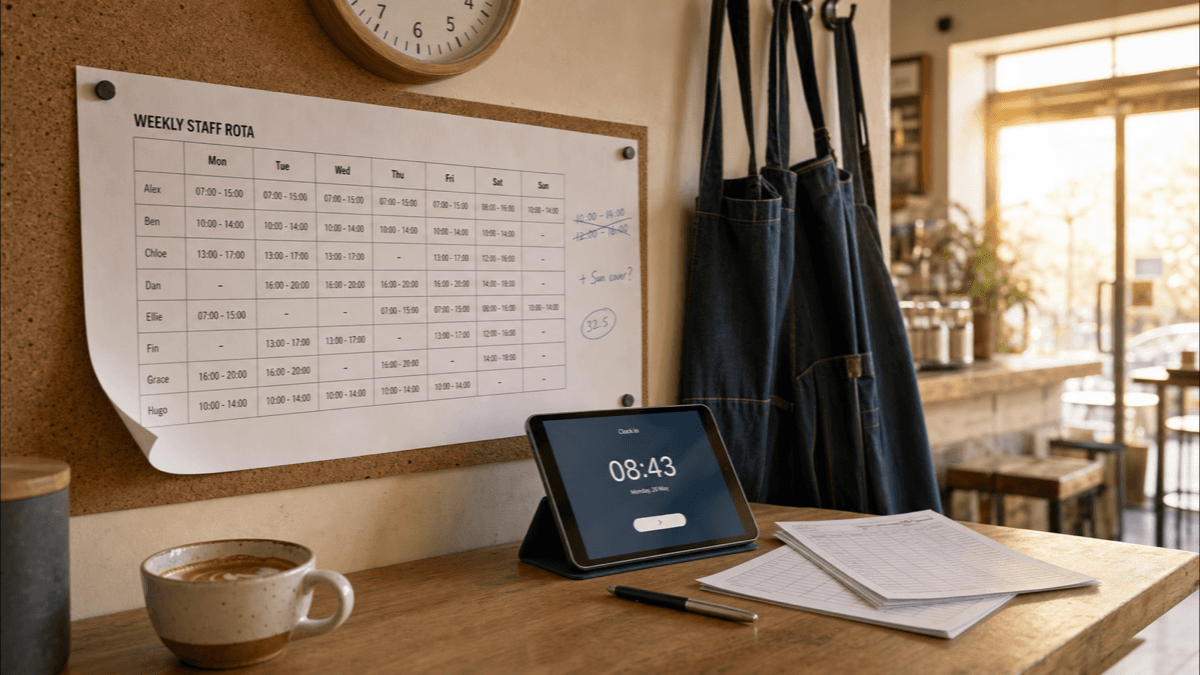
Your rota said 214 hours. Your payroll export said 229.
Nobody stole anything. Nobody lied. Nobody did anything you'd want to have a conversation about. The gap is ten minutes at the front of a shift, twenty at the end of a close, a break that got skipped on a busy Saturday, and one Sunday cover that was agreed by text and never made it onto the rota.
Fifteen hours. One week. And most operators never find out, because the rota lives on a clipboard or in a scheduling app, the wage bill arrives from payroll a fortnight later, and nobody ever puts the two numbers next to each other.
The plan and the bill are two different numbers
When you write a rota you are making a forecast. You've decided how many bodies you need, when you need them, and roughly what that costs. If you've done it properly you've built it around a rota that actually controls labour costs and around matching staff to your real footfall rather than to habit.
Then the week happens. Clocks get pressed. Shifts move. And the number that leaves your bank account is not the number you wrote down.
Here's the quiet part. When you check your wage percentage at month end, you check it against the bill, because the bill is the only number you've got. You never check it against the plan. So the plan stops being a control and becomes a wish, and the difference between the two goes unmeasured for years.
Rota'd hours are your budget. Clocked hours are your invoice. Almost nobody reconciles them.
Where the minutes actually go
One thing needs saying plainly before the list, because this topic can be read the wrong way.
None of what follows is dishonesty. Every one of these is a management failure, not a staff failure. Your team is doing what the system in front of them allows and what the shift in front of them demands. If the clock-in screen lets someone clock on at 06:48 for an 07:00 start, that isn't them taking liberties, that's you not setting a rule. Treat any of this as a trust problem and you'll damage a good team and still not fix the number.
With that established, here's where the fifteen hours went.
Early clock-ins
People arrive before their shift. They get changed, put their bag away, make a coffee, have a word with the person who's just finished. Perfectly normal. But if the clock-in screen is by the door and there's no window rule, they clock on when they arrive, not when they start.
Ten minutes early, six shifts a week, one person. That's an hour a week. Multiply by however many people do it.
Late clock-outs
The last twenty minutes of a close always overruns. A table lingers, the coffee machine needs a proper clean, somebody spills the milk crate. It's real work and you should absolutely pay for it.
But it's unbudgeted work. Your rota said 17:00 and the close finishes at 17:20 every single night. That's not a variance you should be trying to eliminate, it's a rota line you should be correcting.
Unclosed shifts
Somebody forgets to clock out. Depending on your system, that shift either sits open or auto-closes at midnight, and you pay for every hour of it until someone notices.
A 07:00 to 15:00 shift that runs to midnight is nine hours of overpayment in one line. If you're approving timesheets in a rush on a Monday, it goes straight through.
Break drift
Unpaid breaks that get shortened or skipped. Someone takes ten minutes instead of twenty because the queue is out the door. That's twenty minutes of unpaid break you deducted on paper and ten minutes of work you owe for in reality.
This one has a legal edge as well as a cost one. If breaks aren't being taken, that's a working-time issue before it's a wage issue, and worth fixing for that reason alone.
The favour shift
The big one, and the most invisible. Someone calls in sick on Friday. You text three people, one says yes, they cover Sunday. It's sorted in ninety seconds and you go back to service.
The rota never gets updated. So before the week has even started, the plan and the payroll have diverged by a whole shift, and no amount of scrutinising minutes afterwards will explain it.
Rounding
Whatever rounding rule your clock-in system uses, it leans in a direction. Rounding every entry to the nearest fifteen minutes in the employee's favour sounds generous and harmless. Over a year, across a dozen people and forty shifts a week, it isn't harmless. It isn't wrong either, if you've chosen it deliberately. Most operators haven't chosen it at all and don't know which way it leans.
Working out your variance
This takes five minutes and needs no new software.
- Total the hours on last week's rota. The plan.
- Total the hours your clock-in system or timesheets actually recorded. The bill.
- Subtract. That's your variance in hours.
- Divide by rota'd hours. That's your variance percentage.
- Multiply the hours by your true cost per hour. That's the money.
The worked example
A twelve-person café, open seven days, turning over £11,500 in the week. The rota is built at 214 hours. Payroll comes back at 229 hours. Illustrative UK 2026 figures throughout.
| Where it went | How | Hours |
|---|---|---|
| Early clock-ins | 40 shifts, average 7 minutes early | 4.7 |
| Late clock-outs | 7 closes, average 16 minutes over | 1.9 |
| Break drift | 5 unpaid breaks not taken | 1.7 |
| Rounding | Nearest 15 minutes, rounding up | 0.7 |
| The favour shift | Sunday sickness cover, never added to the rota | 6.0 |
| Total | 15.0 |
That's a 7.0% variance. No unclosed shifts that week, incidentally. Add one and you're looking at 24 hours instead of 15.
What it costs
Blended average wage across the team: £13.20/hr. So the headline cost of the gap is 15 x £13.20 = £198.
Except that's not what an hour costs you. Add employer NI at 15%, pension at 3% and holiday accrual at 12.07%, and £13.20 becomes roughly £16.76 per hour. That's a 27% loading, and it applies to every one of those fifteen hours.
- Variance at true cost: 15 x £16.76 = £251.40 for the week
- Rota'd cost: 214 x £16.76 = £3,586.64, or 31.2% of turnover
- Actual cost: 229 x £16.76 = £3,838.04, or 33.4% of turnover
You planned a 31% week. You bought a 33% week. Two full percentage points, and you'd never know which one you were looking at, because the only figure that reaches your P&L is the second one. If you're tracking yourself against what labour should actually cost you, that two points is the difference between on target and drifting.
The part you can actually recover
Be honest about which of those fifteen hours are a leak and which are just a badly written rota.
The favour shift (6.0 hours) is work you'd have paid for anyway. It's a planning failure, not a cost. The late clock-outs (1.9 hours) are real work too, and the answer is to rota the close twenty minutes longer, not to hurry people out.
That leaves the structural drip: early clock-ins, break drift and rounding. 7.1 hours a week, every week, forever.
- At the headline rate: £93.72 a week, £4,873 a year
- At true cost: £119.00 a week, £6,188 a year
Look at those two lines. The headline rate understates the leak by £1,300 a year on its own. If you're modelling anything to do with hours or rates, work it out on the true cost, not the wage, or you'll be a quarter light every time.
What a healthy variance looks like
You're not aiming for zero. Zero would mean nothing ever ran over, nobody ever covered a shift, and every close finished on the dot. That café doesn't exist.
Here's a sensible read:
- Under 2%. Normal. That's operational noise and it's the cost of running a business with humans in it. Leave it alone.
- 2% to 4%. Worth five minutes on a Monday. Usually one or two shifts are carrying most of it.
- Over 5%, week after week. Your rota has stopped describing your business. This is a scheduling problem, not a staff problem. If every close runs twenty minutes long, the close is a twenty-minute-longer shift than you wrote down.
Also watch for the variance going the other way. If you're consistently paying for fewer hours than you rota'd, people are going home early or shifts are being cut on the day, and you may be running thinner than you think.
The fix is not surveillance
Nothing here justifies watching people. Fitting cameras to the clock-in screen or chasing individuals over six minutes will cost you far more in goodwill than you'll ever recover in wages, and in a labour market this tight, that's a genuinely bad trade.
Three things close most of the gap.
A weekly five-minute check. Rota'd hours, clocked hours, difference, percentage. Write it in a notebook if you like. The point is the trend, not the week.
A clear rule on when clocking may start. Something like: the clock-in window opens five minutes before your rostered start. Earlier than that needs a manager to say so, because it means you're actually starting early. Say it out loud, put it in the handbook, and apply it to everyone including you. Most people have simply never been told, and they're relieved to have a rule.
Fix the two or three shifts carrying the gap. In almost every café I've looked at, three or four shift lines account for the bulk of the variance. The Saturday close. The Sunday early. The one that always overruns. Change those on the rota, and the number comes back in line without anyone changing their behaviour at all.
What to do this week
- Pull last week's rota total. One number: total scheduled hours.
- Pull last week's clocked total. One number: total paid hours.
- Work out the variance in hours and as a percentage. Under 2% and you're fine, move on.
- Break the gap into its parts. Early starts, late finishes, breaks, unrostered cover, rounding. Two or three lines will dominate.
- Fix the rota, not the people. Extend the shifts that genuinely overrun. Add the cover shifts when you agree them, not afterwards.
- Set your clock-in window and tell everyone what it is. Once, clearly, no drama.
- Check which way your rounding leans. Then decide whether that's what you meant. Then check it against the law as well as the budget: "rounding clock-in time" is on the government's published list of reasons employers were named for minimum wage underpayment in September 2026, and the 7 September Weekly Grind sets out what that list says.
- Repeat next Monday. Five minutes. Three weeks of data will tell you more than any single week can.
Where Brikly fits
The reason this variance survives in most cafés is architectural. The rota is in one place, the clock-ins are in another, and comparing them means exporting both and squinting at a spreadsheet on a Monday morning. So it never gets done.
In StaffBrik, rotas and clock-ins are the same system. Scheduled hours and actual hours are two columns of the same table, and the difference between them is just a third column. There's nothing to reconcile because there was never anything to join up.
It also costs those hours properly. The variance is shown at the true cost of employment, with employer NI, pension and holiday accrual included, rather than at the headline wage that makes the gap look a quarter smaller than it is. That's the whole trick: not catching anybody out, just being able to see the plan and the bill on the same screen.
Your rota is a budget. Start treating the wage bill as the invoice against it, and check the two agree. Five minutes a week, and the fifteen minutes here and there stop being invisible.
Ed O'Brien has run Hunters Cake Company for 17 years across cafés in Witney, Burford, and a bakery in Carterton, Oxfordshire. He's building Brikly - modular tools that give independent café owners the same data the big chains have, without the big chain price tag.