
The pack shrank but the price didn't: spotting shrinkflation on your invoices
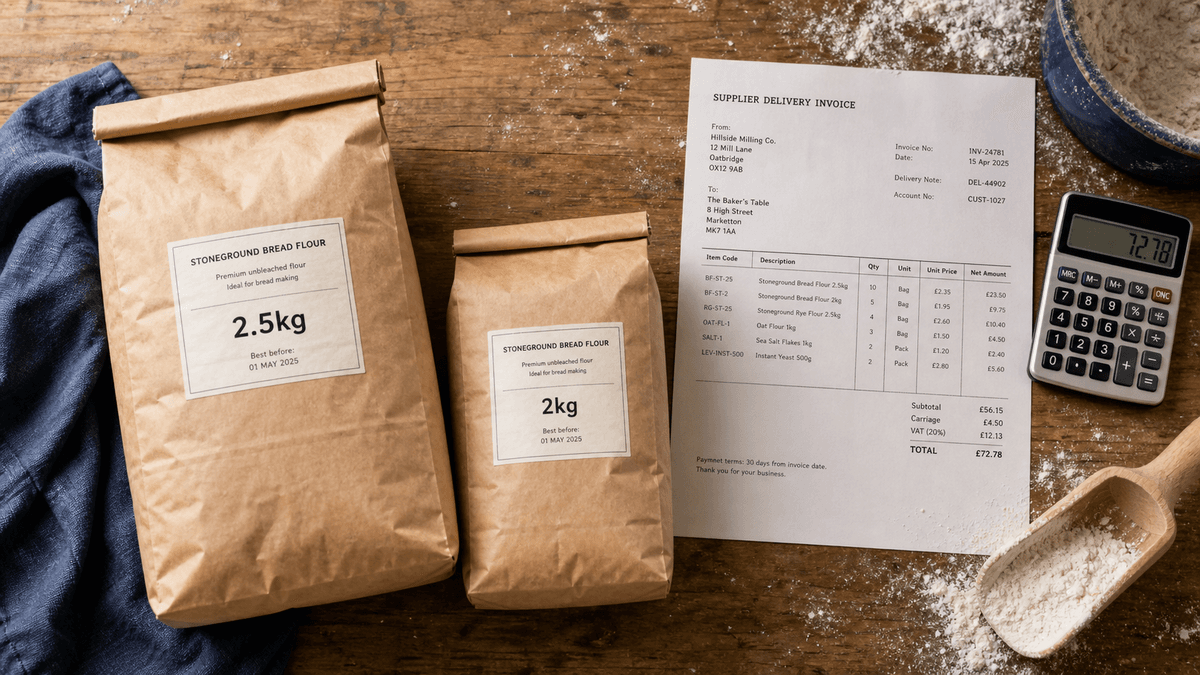
Your flour line on this week's invoice says roughly the same money it said back in spring. So it feels fine. You skim the total, it lands where you expect, you move on to the next job.
Except the bag went from 2.5kg to 2kg somewhere in there, and nobody rang to tell you. Same price, less flour. Your real cost per kilo just jumped by a quarter, and it did it completely silently.
That's shrinkflation, and it's one of the sneakiest ways your margins leak. A straight price rise at least announces itself. A pack that shrinks while the line total holds steady slips straight past the part of your brain that's checking for damage.
What it actually looks like on a trade invoice
Shrinkflation on the supermarket shelf gets all the headlines - the chocolate bar that lost two squares, the crisp packet that's mostly air. On a wholesale delivery it's the same trick, just wearing work boots. A few forms it takes:
- Same pack, same price, less in it. The 2.5kg bag becomes 2kg. The 5-litre bottle becomes 4.5. The line total barely moves, so nothing catches your eye.
- A case that used to hold 12 now holds 10. Case price stays put, but you're getting fewer units for the money. If a case of something was £6 for 12, that's 50p a unit. At 10 units for the same £6, it's 60p - a 20% rise hiding inside an unchanged case price.
- A "new improved recipe" substitute with a lighter net weight. The product gets relaunched, the SKU changes, and the new one weighs less than the old one. Easy to wave through as a like-for-like.
- Case price and unit price getting muddled. Some suppliers print a case SKU on the invoice but actually charge per unit, or the other way round. In the confusion, a smaller pack sails through unnoticed.
None of this is necessarily your rep being sneaky. Half the time the change came down from the manufacturer and your supplier is just passing it along. But it lands on your P&L all the same.
Why watching the line total misses it entirely
Here's the trap. Most of us sanity-check an invoice by glancing at the totals. Does the flour line look about right? Yes. Does the bottom line look about right? Yes. Approved.
The trouble is the number your recipes actually eat isn't the line total. It's the cost per kilo, per litre, per unit. That's the figure that flows into every cost card. And that's exactly the figure shrinkflation is designed to move without moving the total.
This isn't a fringe worry, either. When the Office for National Statistics dug into it, they found that between September 2015 and June 2017, 206 products had shrunk in size while the price recorded on the shelf mostly stayed put - the exact signature of a cost rise you never see coming. On the shelf you're the shopper. On a delivery note you're the buyer, and the same trick is landing on your gross profit.
The 20-minute audit
You don't need software to find this. You need your last invoice, one from a few months back, and a calculator. Do this once and you'll never look at a delivery note the same way again.
Step 1: Pick your top 10 ingredients by spend. Not by how often you use them - by how much money goes out the door on them. Butter, flour, milk, cream, your house coffee beans, whatever your big lines are. That's where a hidden rise does the most damage.
Step 2: For each one, work out the price per kilo, litre or unit from the latest invoice. Not the pack price. Divide the pack price by what's actually in the pack. Write it down.
Step 3: Do the same from an invoice three to six months old. Same ingredient, same maths, older delivery.
Step 4: Put the two numbers side by side. A straight price rise shows up as a higher pack price. Shrinkflation shows up as the same pack price but a smaller pack - and a higher cost per unit anyway.
Here's the kind of thing you'll turn up. Say your double cream comes in a 2-litre pot at £7. That's £3.50 a litre. A few months on, the invoice still says £7 - looks fine - but the pot is now 1.8 litres. Your cost per litre is now £3.89. That's an 11% rise on your cream, and the line total never budged a penny to warn you.
Do that across ten lines and you'll usually find at least one or two that have quietly crept up while looking perfectly innocent.
Which recipes it quietly poisons
A hidden rise on a rarely-used ingredient is annoying. A hidden rise on a high-usage one is a slow puncture across your whole menu.
Butter is the classic. It's in your scones, your shortbread, your sponges, your croissants, your buttercream, half your specials. A small per-gram rise you never noticed doesn't hit one dish - it nudges the cost of everything you bake, all at once. Same with flour, milk, cream, oil. The ingredients most exposed to a quiet pack cut tend to be exactly the ones threaded through the most cost cards.
That's why this feeds straight into your bigger numbers. A cream cost that's crept up 11% doesn't just ding one recipe - it pulls down the food cost percentage on every item that leans on it. If you costed those recipes back in spring and haven't touched them since, the margins you think you're running and the margins you're actually running have quietly drifted apart.
What to do once you've found it
Finding it is most of the battle. Then you've got three practical moves, and they're not mutually exclusive.
Re-cost the affected recipes. As soon as you know the true cost per unit, push it through every recipe that uses that ingredient so your cost cards tell the truth again. If you haven't got a system for it, our free recipe costing tool will do the maths on an affected dish in a couple of minutes, no signup, so you can at least see the damage on your worst-hit lines.
Raise it with your rep. A quiet pack cut is still a price rise, and it's fair game to challenge - the same playbook you'd use for an open increase works just as well for a covert one. The tactics in our guide to pushing back on supplier price increases apply directly. Sometimes naming it out loud ("this pack's dropped 10% but the price hasn't") is enough to get a better line or the old pack back. And if the shrink slipped through as a straight billing error against the spec you agreed, it stops being a negotiation and becomes a credit the supplier owes you back.
Switch pack size or supplier where the per-unit maths says so. Once you're comparing cost per kilo instead of cost per pack, you can compare offers properly. A bigger pack, a different cut, or another supplier might genuinely be cheaper per unit even if the headline pack price looks higher.
The wider point
The reason shrinkflation works is that nobody has time to re-derive cost per unit off every line of every delivery. You approve the invoice, you get back on the floor, and the smaller pack rides along unchecked.
That per-unit calculation is exactly the sort of grind worth handing off. Brikly's CostingBrik reads the cost per unit off each invoice as it comes in and flags it when it moves, so a pack that shrank while the price held still doesn't get to hide behind an unchanged line total. However you track it, the habit is the same: judge every ingredient on what you pay per gram, per millilitre, per unit - never on the pack price alone.
Because the pack that shrank without telling you is banking on you being too busy to notice. Make that check a five-minute ritual and it stops working.
Ed O'Brien has run Hunters Cake Company for 17 years across cafés in Witney, Burford, and a bakery in Carterton, Oxfordshire. He's building Brikly - modular tools that give independent café owners the same data the big chains have, without the big chain price tag.