
VAT on Food and Drink: The Complete UK Café Guide 2026
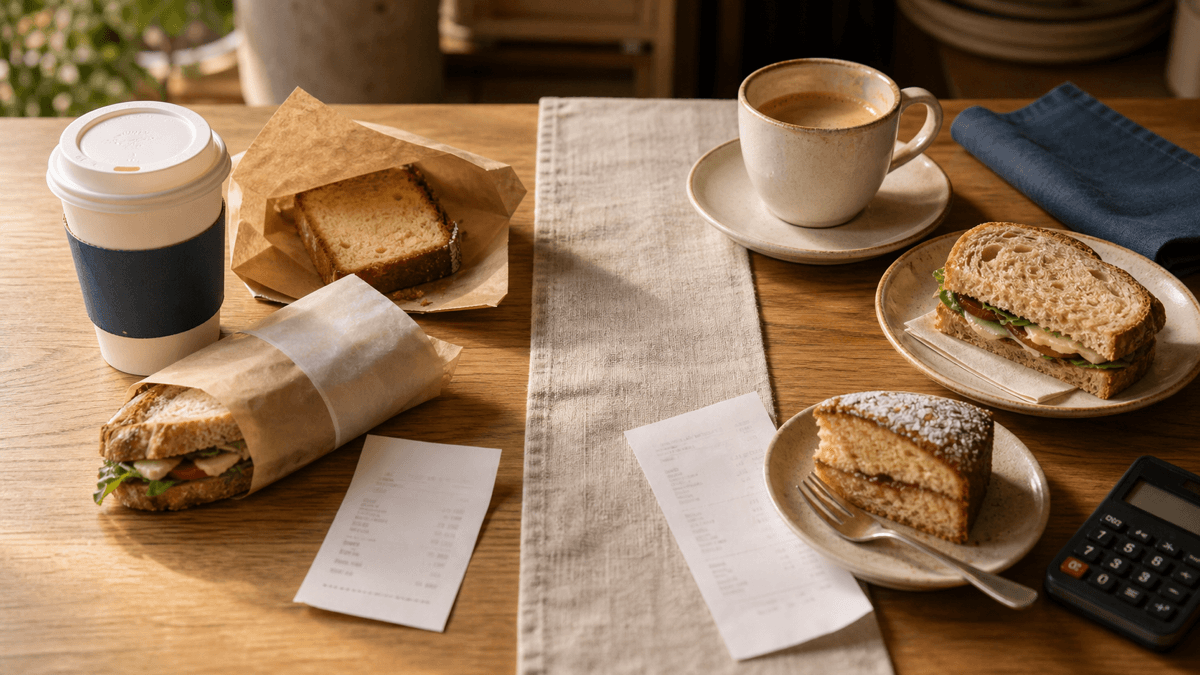
VAT on food is the most confusing tax rule in UK hospitality. A hot pasty eaten in is one rate. The same pasty cooling on a shelf, taken away, is another. A slice of cake on a plate is different to the same slice in a paper bag. Get any of it wrong and HMRC can come back four years later with an assessment, interest, and penalties.
Most operators I know have a rough idea. Not many have the full picture. And the staff ringing it through the till usually have even less.
The starting point
The default position in UK VAT is that most food is zero-rated. Bread, milk, raw ingredients, cold sandwiches sold to take away - all 0%.
But two big exceptions pull a lot of café and restaurant sales into the standard 20% rate:
- Catering. Anything served as part of a meal to be consumed on premises is standard-rated, regardless of whether the food itself would normally be zero.
- Hot takeaway food. Anything heated above ambient temperature and sold to eat hot is standard-rated, even if you're walking it out the door.
There's also a separate carve-out for things HMRC classifies as non-essential: confectionery, crisps, ice cream, soft drinks, alcohol, and most hot drinks. These are standard-rated whether you eat in, take away, or eat them at home from a supermarket shelf.
That's the framework. Everything else is detail.
The four buckets
For 90% of café sales, you can sort the menu into four buckets. This is the table to print and stick next to the till.
| Scenario | VAT rate | Example |
|---|---|---|
| Hot, eat-in | 20% | Bacon roll on a plate at a table |
| Hot, takeaway | 20% | Bacon roll in a paper bag to go |
| Cold, eat-in | 20% | Ham sandwich on a plate at a table |
| Cold, takeaway | 0% | Ham sandwich in a paper bag to go |
Two things to notice.
Anything eat-in is 20%. Doesn't matter if it's hot or cold. The moment a customer sits down at one of your tables and is served, it's catering, and catering is standard-rated.
Cold takeaway is the only zero-rated bucket. That's where the saving lives - and it's why the eat-in versus takeaway distinction is the most important question your till asks.
But this only works for items that are zero-rated by default. Some items are standard-rated in all four buckets - the takeaway saving doesn't apply. The main ones: hot coffee and tea, smoothies and fruit juices, fizzy and sweetened soft drinks, bottled water, alcohol, confectionery, and cake-with-ice-cream eaten in.
The greatest hits: where operators get it wrong
Pasties, sausage rolls, and the "naturally cooling" rule
This is the one HMRC built a whole tribunal case around. A pasty fresh from the oven, sold hot, is standard-rated. A pasty that's been baked, put on a shelf, and is naturally cooling to room temperature is zero-rated, even if it happens to still be warm when sold.
The test is your intent at the point of sale. If you're heating it specifically to sell hot - 20%. If it's cooling and the customer just got lucky on timing - 0%.
In practice: bake-off counters with a "hot food" sign are clearly catering. A bakery shelf with sausage rolls cooling from this morning's bake is not. If you sometimes reheat a cold one on request, that single item flips to 20%.
Sandwiches
The clean case. Cold sandwich made for takeaway, in a bag, walking out the door: 0%. Same sandwich on a plate at a table: 20%. Toasted sandwich, panini, or anything heated to serve: 20% in both directions.
A lot of operators charge the same price for eat-in and takeaway sandwiches. That's fine commercially, but it means your margin on the eat-in version is worse because you're handing 16.7% of the price to HMRC. Worth checking whether your eat-in pricing needs a small uplift to even out the contribution.
Milkshakes, iced coffee, and the takeaway rule
This is the one most operators get wrong, and the rule is finer than people think. A barista-made milkshake or iced coffee is zero-rated when taken away, and standard-rated when eaten in. Same goes for iced tea, cold brew, and frappés.
The reason: HMRC treats them as preparations of milk or of coffee/tea, both of which are zero-rated in their own right. The eat-in version is only 20% because of the catering rule, not because of the drink itself.
| Drink | Takeaway | Eat-in |
|---|---|---|
| Iced latte, iced Americano, cold brew | 0% | 20% |
| Iced tea, iced matcha | 0% | 20% |
| Milkshake (milk-based) | 0% | 20% |
The summer margin opportunity here is real and worth its own conversation - I covered it in the hidden VAT cost of iced coffee and takeaway cake if you want the full breakdown. Worth knowing too: the temporary 5% VAT cut on children's meals running from 25 June to 1 September 2026 sounds like it helps, but its eligibility rules are written for the chains, not the average indie.
Smoothies, juices, and soft drinks
Here's where the "cold means zero" instinct does mislead people. Smoothies, fruit and vegetable juices, fizzy drinks, sweetened soft drinks, and bottled water are standard-rated regardless of where they're consumed. They fall under HMRC's "excepted items" - specifically the fruit juice and beverage carve-outs - so the takeaway saving doesn't apply.
This is the bit that catches people out, because smoothies feel like they should be in the same bucket as milkshakes. They're not - HMRC fought a long legal battle on this and won. A milk-based shake is a milk preparation. A fruit smoothie is a fruit juice.
Plain milk on its own is zero-rated. Freshly squeezed juice prepared in front of the customer is a grey area that depends on how it's marketed (HMRC has lost and won both ways - get advice).
Cake and bakery
A whole cake or a slice of cake sold to take away: 0%. The same slice eaten in: 20%. A slice with a scoop of ice cream on top, eaten in: 20%. A slice with ice cream, takeaway: 20% on the ice cream component, 0% on the cake (in theory - in practice most operators just charge 20% on the lot to keep things simple, and HMRC doesn't usually argue).
Biscuits get their own rules. A plain biscuit is zero-rated. A chocolate-covered biscuit is standard-rated. A cake with a chocolate covering is zero-rated. This is the famous Jaffa Cake question, and yes, it really does come down to whether the thing goes hard when it goes stale.
Edge cases that catch people out
Modifiers that change the VAT
A customer orders a cold smoothie (20%) and asks you to add hot milk to it. Now it's also a hot drink. Still 20%, but on a different basis. Usually doesn't matter, occasionally does for menu structuring.
More importantly: a takeaway cold sandwich (0%) becomes a 20% sale if the customer asks you to toast it. Same physical product, different VAT, because heating to serve flips it.
Mixed groups and shared plates
A table of four orders three takeaway items in cups and one eat-in cake. The eat-in cake is 20%, the three takeaway drinks follow their own rules. You don't apply "table = 20%" to everything just because they're sat down. The question is what each item was sold as.
Likewise: if a customer orders takeaway and then sits down at your table to eat it, you can't retrospectively re-rate it. The sale was a takeaway sale at the point of the transaction.
"To go" cups consumed dine-in
A customer asks for their coffee "to go" in a paper cup, then sits at your bench seating to drink it. From a VAT point of view this is a takeaway sale (your intent at point of sale was takeaway). But coffee is 20% anyway, so it doesn't matter. If the same customer did this with a cold sandwich, you'd want them to take it with them, because that one does flip the rate.
Hot food that cools before sale
Back to the pasty rule. If you genuinely sell food that's been cooling on a shelf without intent to keep it hot, that's zero-rated. The cleanest way to evidence this is to not have hot-holding equipment for those items, and to not advertise them as hot food on signage. If you've got a heated cabinet labelled "Hot Pies", everything in it is 20% regardless of actual temperature.
How to set this up in your EPOS without daily till errors
The fastest way for a busy café to get VAT wrong is to expect staff to make the call at the point of sale on a busy Saturday. They won't. They'll hit the button that's closest to their hand. Your job is to make sure the right buttons are closest to their hands.
Three practical things:
1. Separate buttons (or modifiers) for eat-in versus takeaway. Most modern EPOS systems support this. Either two buttons per item, or one item with a mandatory eat-in/takeaway modifier that staff have to pick before the sale closes. The modifier route is cleaner because the product stays the same in your reporting.
2. Separate VAT codes per item category. Cake should have a "cake (zero-rated unless eat-in)" code. Coffee should be flat 20%. Soft drinks 20%. Cold sandwiches "zero-rated unless eat-in". The EPOS uses the modifier to pick which rate applies, but the rules sit on the product, not in the cashier's head.
3. A daily Z-report check. Five minutes at the end of the day. Total VAT by rate against total takings by category. The numbers should make sense. If your zero-rated takings drop near zero on a busy day, something's wrong with how staff are ringing things up.
I covered the broader EPOS picture in our POS integration guide for UK restaurants, but the VAT setup is worth a specific conversation with your provider.
This is also where MenuBrik earns its keep - if your VAT codes are right on the till and the sales come into Brikly cleanly, you get a true margin picture by product, not a fuzzy one with VAT mixed in. Most operators are flying blind on net contribution because their till is mixing rates.
When you cross £90k: the threshold question
The VAT registration threshold in 2026 is £90,000 in any rolling 12-month period. Cross it, and you must register within 30 days. Once registered, you charge VAT on everything standard-rated and recover VAT on your purchases.
For a café, the moment of crossing is brutal. Your prices don't automatically rise, so you're absorbing 20% on a chunk of your takings that used to be yours. The lift in recoverable input VAT helps a bit (you reclaim on rent, utilities, equipment, packaging) but rarely closes the gap.
A lot of operators try to manage turnover deliberately to stay under. The maths on whether that's wise is in our piece on the VAT threshold for cafés, with the full break-even calculation. The short version: if you're growing through £90k anyway, the cliff hurts but the alternative (capping yourself) usually hurts more.
What you should not do is approach the threshold without modelling it. The day you tick over is not the day to start thinking about pricing.
What this all means in practice
Three things to do this week:
- Walk through your menu and tag every item with its zero-rated, standard-rated, or split treatment. Print the four-bucket table. Stick it by the till.
- Check your EPOS has eat-in/takeaway modifiers wired to the right VAT codes, and re-check after every menu refresh, because a rebuilt till button can quietly lose its eat-in VAT rule. If it doesn't, your VAT return is wrong, and you may not know by how much.
- Reconcile your last quarter's VAT return against your category sales. The numbers should be defensible to HMRC line by line. If they're not, get your accountant to walk through it before the next one - it's much cheaper than fixing it after an assessment.
The good news: VAT is one of the few things in this business that, once you set it up properly, mostly runs itself. The pain is upfront. The cost of an HMRC assessment is years of attention you'll never get back. Doing this once, properly, with your EPOS and your accountant aligned, takes a Sunday afternoon. The alternative is rebuilding two years of records with a Revenue officer sitting across from you.
If your accountant integrates cleanly with your books, this stuff is mostly automated from here - we covered the practicalities in accounting software integration for restaurants.
Get the rules right. Get the till right. Then forget about it and go run your business.
Ed O'Brien has run Hunters Cake Company for 17 years across cafés in Witney, Burford, and a bakery in Carterton, Oxfordshire. He's building Brikly - modular tools that give independent café owners the same data the big chains have, without the big chain price tag.