
Bank holiday pay: what you actually owe your team on 31 August
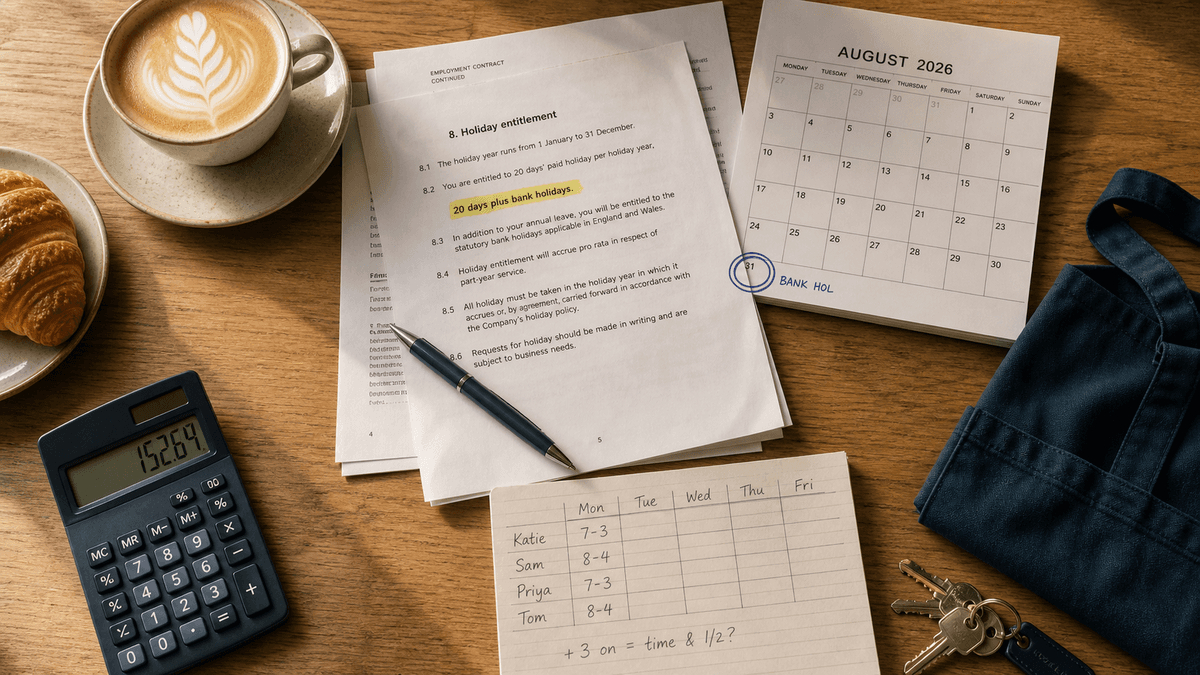
It always happens on the Friday. Someone on the closing shift asks whether Monday is time and a half, and you realise you do not actually know.
So you say you will check, and then you do not, and on Monday you either pay a premium you never budgeted for or have an awkward conversation with the person who carried your busiest day of the month.
Both of you are probably wrong about the law. And it barely matters, because the law is not what decides this. Your contract is.
Three things almost everyone believes, and none of them are true
"They have to get the day off." They do not. GOV.UK is blunt about it: your employer does not have to give you paid leave on bank or public holidays. ACAS puts it the other way round: whether someone works a bank holiday is up to their employer.
"They have to get time and a half." There is no statutory enhancement for working a bank holiday. None. Work the Monday and the default legal position is your normal rate for the hours worked. Time and a half is something employers choose to offer or have already promised.
"Bank holidays are on top of the 28 days." Not automatically. Statutory paid holiday is 5.6 weeks, capped at 28 days for a full-time worker, and an employer can include the eight bank holidays in England and Wales inside that 28. Whether yours does is a contract question, not a legal one.
What is true is simpler and less comfortable: whatever you wrote down binds you. And whatever you have quietly done every year without writing down might bind you too.
Your contract wording decides it, not the law
Two clauses. Two completely different Bank Holiday Mondays.
"20 days plus bank holidays." You have promised 20 days the worker picks, plus eight days you have already named. That is 28 in total, which is the statutory minimum, so this is not generosity, just the minimum tied to specific dates. If you open on 31 August and someone works it, you have taken back one of the eight you named. You owe it back as a day in lieu, unless the contract expressly says you pay for it instead. That is a debt, not a favour.
"28 days inclusive of bank holidays." You have promised 28 days and said nothing about which ones. Working the Monday costs you nothing extra at all. They take that day off some other time, out of the same 28.
Identical entitlement. Opposite answer on Monday.
Go and read the exact words in one contract. If it says "plus", you have named eight days. If it says "including", you have not. That one word is the whole answer.
The clause nobody wrote down
The third case is the one I see most in independent hospitality: nothing says anything useful, or there is a written statement from 2019 and a practice from 2024 that disagree with each other.
This is where custom and practice bites. If you have paid time and a half on every bank holiday for six years without exception, that habit can harden into a contractual term whether or not it appears in any document. Announcing on the Friday that this year is different is how grievances start.
The part-timer who never works Mondays
The pro rata question breaks differently depending on which clause you have.
Inclusive contracts. ACAS uses a neat example. Two people both work three days a week, both get 5.6 weeks, so 16.8 days each. One works Mondays, one does not. Because most bank holidays fall on a Monday, the Monday worker spends more of theirs on them. That is arithmetic, not unfairness. But note the other half: you cannot make someone use a day of entitlement for a bank holiday that falls on a day they never work.
"Plus bank holidays" contracts. Here is the exposure. You have given full-timers eight extra paid days off a year. Someone working Tuesday to Thursday receives none of that benefit, purely because of which days they work. That is the shape of a less favourable treatment claim under the Part-time Workers (Prevention of Less Favourable Treatment) Regulations 2000, where the pro rata principle applies to benefits like leave unless you can objectively justify the difference.
The usual fix is to give part-timers a pro rata bank holiday allowance regardless of whether the holidays land on their working days. Three days out of five means three fifths of eight, which is 4.8 days added to their leave, used whenever they like.
The better fix is to stop counting in days altogether.
Count in hours instead
Days fall apart the moment shift lengths vary, which in a café is always. A day for the 4 hour school-run shift is not a day for the person doing 10 hours on a Saturday.
Take a full-timer on 40 hours across five days. Eight bank holidays at eight hours each is 64 hours of bank holiday allowance.
- Someone on 16 hours a week: 16 divided by 40, times 64 = 25.6 hours
- Someone on 24 hours across three long days: 24 divided by 40, times 64 = 38.4 hours
Everyone's balance sits in the same unit, it survives a change of shift pattern, and nobody argues about what a day is worth.
Rolled-up holiday pay changes the answer again
If you have irregular-hours or part-year staff, some of them are probably on rolled-up holiday pay: at least 12.07% of pay in each pay period, shown as its own line on the payslip. That is lawful for those two groups, for leave years beginning on or after 1 April 2024. If you want the accrual mechanics, how holiday builds up on variable hours covers it properly.
The bit that catches people out on 31 August is this. That 12.07% buys the statutory 5.6 weeks and nothing more. If your contract counts bank holidays inside that entitlement, the Monday is already paid for, in the period it was earned, so hand a paid day out on top and you have paid for the same leave twice. If your contract gives bank holidays on top of the statutory minimum, 12.07% does not cover them and you owe the difference.
Either way, paying is not the whole duty. Rolled-up pay does not remove your job of making sure people can actually take the leave. Someone who does not work the Monday gets no extra payment for it, but the time off is still theirs to take, and the rules on when they take it are what decide whether you can say no to a Christmas holiday request.
What the Monday actually earns once you have paid the premium
31 August 2026 is the late summer bank holiday in England, Wales and Northern Ireland. It falls on the last Monday in August, which is the rule set out in the Banking and Financial Dealings Act 1971, and the 31st is the latest date that rule can ever produce. Scotland takes its summer bank holiday on the first Monday, so 3 August has already been and gone up there.
Which makes this the last big trading Monday of the season. In Burford the visitors are still arriving right up to the Monday afternoon, and then the schools go back and September lands like someone turning a tap off.
So trade it hard. Just price the premium honestly first.
Say you volunteer time and a half and put three extra people on for eight hours each. On the April 2026 National Living Wage of £12.71 for 21 and over, the premium alone is £6.36 an hour. Three people across eight hours is about £153 of extra wage, and once employer NI at 15% and pension sit on top you are nearer £180. At a 68% gross margin, you need roughly £265 of extra takings before the premium has broken even.
On a sunny bank holiday in a visitor town that is one busy hour. On a wet Monday on a commuter high street it is not. The proper way to answer it is to run profit per trading hour after wages on the hours you are adding. If you want the on-cost stack done for you, the pay rise planner does the same NI, pension and holiday maths on an hourly figure, which is exactly what a premium is.
None of this argues against paying one. Goodwill on the busiest Monday of the season is worth real money, and your strongest people are the ones you want on the floor. Decide it, cost it, and get it into the rota before you publish. Building the rota around what each shift actually costs is what turns this from a Friday argument into a Tuesday decision.
Before Friday 28 August
Half an hour, with a coffee.
- Open one contract and find the holiday clause. "Plus" or "inclusive of". Write the answer down.
- Check whether everyone is on the same wording. They usually are not, because contracts got updated at different times.
- Check your part-timers. If full-timers get bank holidays on top, part-timers need a pro rata share whether or not the day falls on a shift they work.
- Check anyone on rolled-up 12.07% pay. If bank holidays sit inside their statutory 5.6 weeks, the Monday is already paid for.
- Decide the premium, if any, and cost it. Extra hours, times the uplift, plus NI and pension.
- Tell the team by Friday, in writing. A message in the group chat counts. Silence is what causes the argument.
- Write it into the holiday record. Six-year retention started in April whether you like it or not.
Where this stops being a Friday problem
Almost all of the pain here comes from the answer living in three places at once: a contract in a drawer, a rota on the wall, and a holiday balance in someone's head.
StaffBrik keeps the rota and the true cost of every shift, including employer NI and pension, in one place, so a bank holiday with a premium on it is a number you see before you publish rather than a surprise on the payroll run. You do not need it for this, though. A spreadsheet with one row per person, their contract wording, holiday balance in hours and bank holiday treatment does the job.
Go and read one holiday clause. It takes two minutes, and it settles an argument you would otherwise be having on Friday at half past five.
Ed O'Brien has run Hunters Cake Company for 17 years across cafés in Witney, Burford, and a bakery in Carterton, Oxfordshire. He's building Brikly - modular tools that give independent café owners the same data the big chains have, without the big chain price tag.