
Borrowing for your café: merchant cash advances and money that costs more than it looks
The offer always arrives somewhere friendly. A banner in the app you open every morning to check yesterday's takings. An email from your card provider with your first name in the subject line. "£20,000 available now. No credit check. Repay as you sell."
It is the least confrontational way anyone has ever offered you money, and that is exactly the point.
I'm not here to tell you never to borrow. Borrowing built half the cafés you admire. But the product being pushed hardest at independents right now is also the most expensive one on the shelf, and it's priced in a way that stops you comparing it to anything else.
One thing up front: this is general information from an operator, not financial advice. What suits your business depends on your accounts and your position. Run any real borrowing decision past your accountant before you sign.
The four jobs borrowing does for a café
Debt is a tool, and it really only does four jobs.
- Opening. Fit-out, deposit, first stock, the months before you break even.
- Kit. The espresso machine, the deck oven, the walk-in. That one has its own rules, and whether to lease or buy café equipment covers them properly.
- A working capital bridge. A known, temporary gap. The VAT bill landing in the same week as half-term. A catering invoice you've delivered but not been paid for.
- Rescue. The café is losing money and you borrow to keep the lights on.
The first three are legitimate. The fourth almost never is, and it's what most independents are actually doing when they take a same-day advance.
Merchant cash advances, in full
A merchant cash advance is a lump sum paid to you now, repaid as a fixed percentage of your daily card takings until a set total has been collected. No monthly payment, no fixed end date, very little paperwork, money in days.
Genuinely convenient. Also the most expensive way a café can borrow.
A factor rate is not an interest rate
An interest rate is charged on what you still owe, and shrinks as you pay it down. A factor rate is a multiplier applied once, to the whole sum, on day one. Pay it back in three months or nine and the cost is identical. Nothing you do makes it cheaper. Rates in the UK typically sit between 1.1 and 1.5, with most offers landing in the middle.
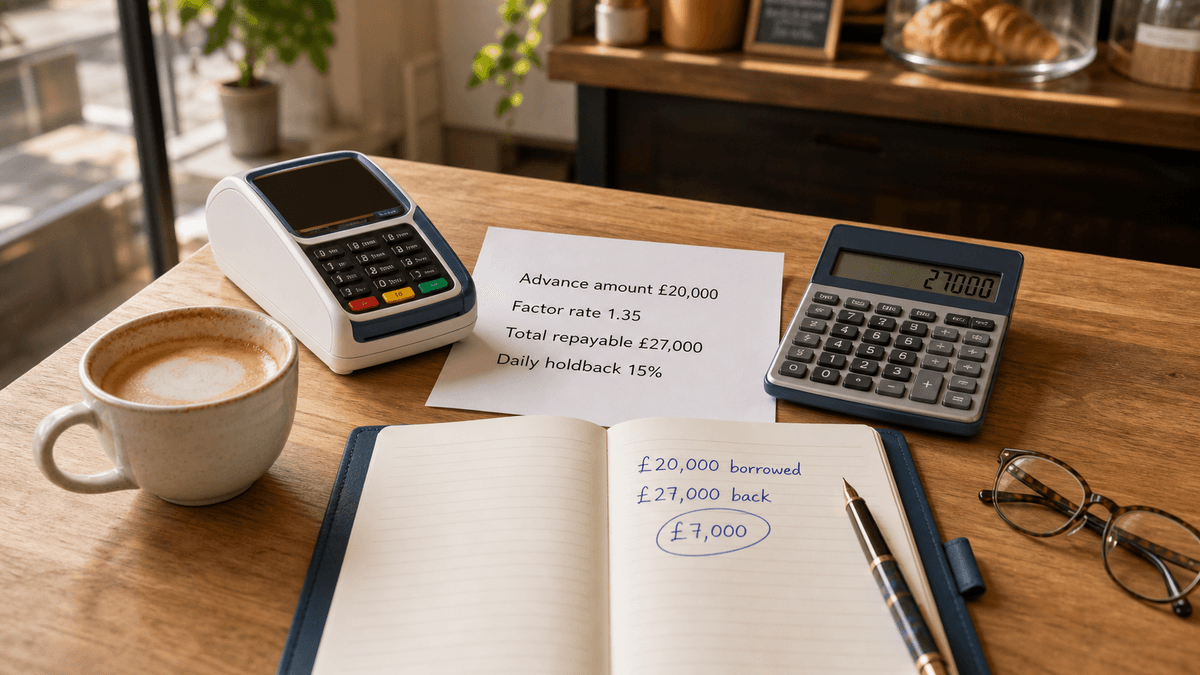
Take £20,000 at a factor rate of 1.35 and you repay £27,000. The £7,000 is the entire cost, locked in the moment you accept.
Repayment is a holdback, commonly 10% to 20% of daily card settlement. Take 15% on a café doing £10,000 a week on card and £1,500 a week goes to the lender before it reaches your account. £27,000 divided by £1,500 is 18 weeks. Call it four months.
So: £7,000 to use £20,000 for about four months.
Annualise that crudely and you're comfortably over 100% a year. Do it properly, allowing for the fact you're paying the balance down daily so your average borrowing is nowhere near £20,000, and it goes higher again. Same flat-rate versus APR gap the equipment finance piece covers under "the true cost of finance", just more extreme.
Why no APR is quoted
These are generally structured as the purchase of your future card receivables rather than a loan, which puts them outside the lending rules you might expect to protect you. And with no fixed term, an annual rate isn't even defined without guessing how fast you'll trade. Convenient for everyone except the person signing.
The mechanic that actually hurts
Here's the part the sales copy sells as a feature: you repay more when you're busy and less when you're quiet. Sounds humane. It's the problem.
Fifteen per cent is fifteen per cent. In August with a queue out the door, £1,500 a week is irritating. In January, when takings are down a third and your rent, wages and insurance haven't moved a penny, that same 15% comes off the top of a much smaller number, before you've paid a single supplier. The slice that felt survivable in August decides whether the dairy invoice clears.
And the total never shrinks. A quiet quarter doesn't reduce the £27,000, it spreads it across more weeks. You don't pay less. You pay for longer.
Your card provider is now a lender
Plenty of these offers come from acquirers, underwritten against settlement data they already hold. They can see your takings to the penny, so approval feels automatic, and collection is guaranteed because they control the money on its way to you. Worth auditing what that relationship costs you the rest of the time too, in merchant fees.
The personal guarantee
Most advances, and most small business loans, ask for one. Read it as this: a personal guarantee turns your limited company back into a sole trade for this one debt. If the café fails, the liability follows you home, and the protection you set up when you chose between sole trader and limited company does not apply to it.
The alternatives, ranked by what they really cost
Before any of them: the cheapest working capital most cafés already have is trade credit from suppliers, as the piece on supplier payment terms and going on stop sets out. After that, in rough order of cost.
Start Up Loans. A government-backed programme run through the British Business Bank. Technically personal loans used for business purposes: fixed rate, no arrangement fee, no early repayment charge, over one to five years. Up to £25,000 per founder, and co-founders in one business can each apply. Twelve months of free mentoring comes with it, worth real money on its own for a first-timer. The rate sat at 6% for years and rose in April 2026 to 7.5%, so check the current figure before you plan around it.
A plain bank term loan. Unfashionable and usually correct. Fixed monthly payment, a known total repayable, a rate you can compare against another rate. Slower, wants accounts and a plan, and your bank may say no. If it says yes, it beats anything with the word "advance" in it.
Government-guaranteed scheme lending. There's usually a scheme running where government guarantees a share of the lender's exposure, so accredited banks can say yes to businesses they'd otherwise decline. Names and terms change every few years, so ask your bank what's current. The guarantee protects the lender, not you.
An overdraft or revolving facility. The right shape for a genuine timing gap, because you pay only for what you use and only while you're using it. Watch for the facility that never returns to zero. A permanently drawn overdraft isn't a bridge, it's a loan at overdraft rates.
HMRC Time to Pay. The option everyone forgets. If the pinch is a tax bill, ring HMRC before it's overdue rather than after. Arrangements are agreed case by case, not by right, and they'll want returns filed and evidence you can clear the arrears while keeping up with what's coming. Still far cheaper than borrowing at 1.35 to pay HMRC on time.
Money from family. The cheapest capital and the most expensive relationship. Paper it: amount, repayment schedule, what happens in a bad year, loan or share of the business. Write it down while everyone still likes each other.
The one question to ask before any of it
Am I borrowing against a timing problem or a profitability problem?
Debt fixes timing. Money you've earned but haven't received, a cost that lands in the wrong week, a season you can see the other side of.
Debt cannot fix profitability. Borrow into a business that doesn't cover its costs and you've added a fixed repayment to a shortfall. That doesn't slow the decline, it accelerates it, and the guarantee you signed turns a business problem into a personal one.
You don't have to guess which you've got. The 13-week cash flow forecast answers it directly. Look at the closing balance line across the quarter:
- It dips in week seven and recovers by week ten. Timing. Borrowing, sized to the dip, is a reasonable answer.
- It drifts down every week regardless of season. Profitability. Borrowing changes nothing about the slope of that line. It buys months, not a fix.
If it's the second, the answer is in your costs and your prices, not a lender's inbox. Recipe costs nobody has recalculated since the last round of supplier increases, portions that have quietly grown, dishes priced off a gut feel from three years ago. Duller than a same-day £20,000, and it's what we built CostingBrik to make survivable. It's also the only thing that actually works.
Sign nothing until you can answer these
- What is the total amount repayable, in pounds? Not a rate, not a monthly figure, not a multiplier. If nobody will give you one number, that is your answer.
- What happens in a bad month? Run your worst week through the repayment mechanism and see what's left.
- Is there a personal guarantee, and over how much?
- What does early settlement cost? With a factor rate, usually nothing changes. With a loan, it often saves real money.
- Could this money come from somewhere other than a lender? A price rise you've put off, an invoice you've not chased, a supplier who'd give you 30 days if you asked.
The bottom line
Borrowing isn't the mistake. Borrowing without knowing the price is.
A merchant cash advance is fast, easy and roughly the most expensive money available to an independent café. Its most attractive feature, repaying as you sell, is precisely what makes it dangerous in a bad January.
So before you tap the banner in the app: work out the total repayable in pounds, decide honestly whether you're fixing timing or profitability, and check what the same money would cost from a bank, a Start Up Loan, or from pricing your menu properly.
If the answer is still the advance, take it with your eyes open. Most of the time, it won't be.
Ed O'Brien has run Hunters Cake Company for 17 years across cafés in Witney, Burford, and a bakery in Carterton, Oxfordshire. He's building Brikly - modular tools that give independent café owners the same data the big chains have, without the big chain price tag.