
Your café's water bill: the utility you can switch but never have
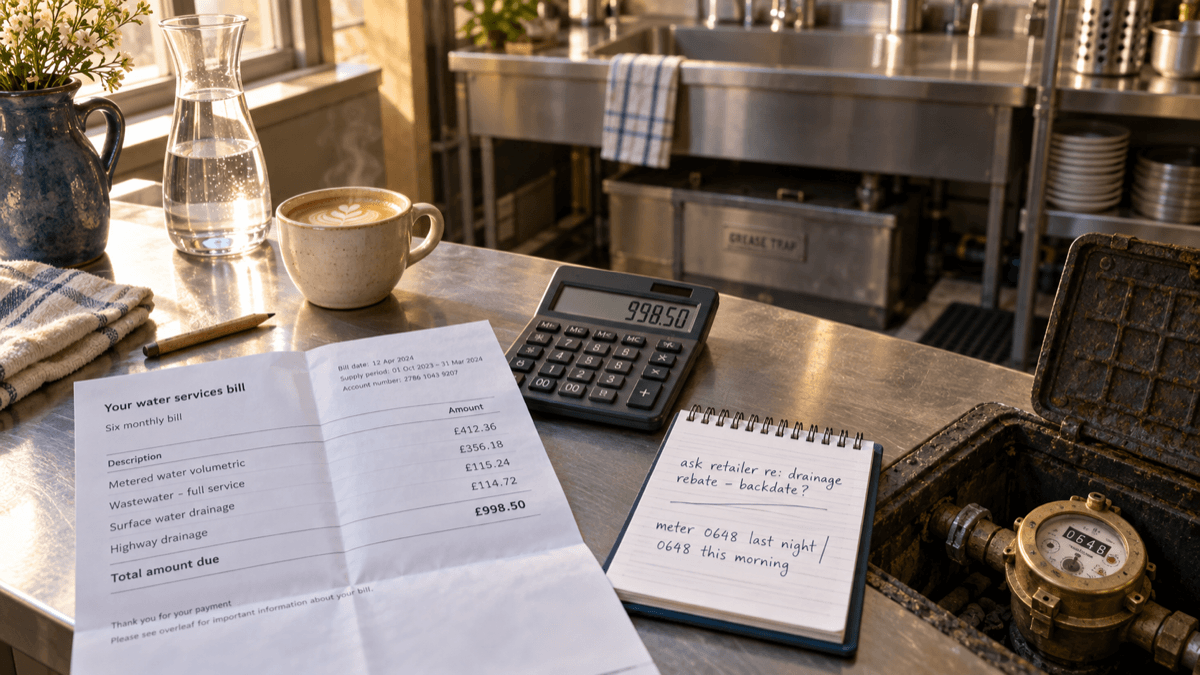
The water bill arrives, you glance at the total, you pay it, and you forget about it for six months. I have done exactly that for most of seventeen years.
You have done the hard ones: the energy renewal, the card processor, the honest conversation with your roaster about the machine on the counter. Water never makes the list.
Water is the one utility where the money is not in switching. It is in two or three questions about how the bill was built.
What you are actually paying for
A metered bill has two halves, and they behave very differently.
Water in. A fixed standing charge based on the size of your meter, plus a volumetric rate for every cubic metre through it. Unmetered, it comes off your rateable value instead - a fixed charge plus a flat rate per pound of rateable value, with nothing in it that reflects what you actually use. Where a meter cannot be fitted, some wholesalers use an assessed charge banded by trade, and those bands can assume a café uses five times the water per employee of a shop. Either way, a meter is usually the fix.
Water out. This half is never measured. Your sewerage charge comes off the same water meter at a volumetric rate, and it covers four things: treating foul sewage, surface water drainage when rain falls on your property and drains away, highway drainage from roads and pavements, and trade effluent. Ofwat's position is that if you can show you receive none of those apart from highway drainage, you should pay less.
Most sewerage wholesalers already apply a default return-to-sewer figure of 90 to 95 per cent, which quietly gives every metered customer a 5 to 10 per cent allowance for water that never reaches the drain. Some apply none, in which case you claim it through your retailer.
Can you switch, and does it matter?
This is genuinely different in all four nations.
- England. Open since April 2017 with no consumption threshold. Any business, charity or public body can choose its water retailer.
- Wales. Only customers using at least 50 megalitres a year, and only the water retailer, not the sewerage one. No café is near 50 million litres.
- Scotland. Open to all non-household customers since 1 April 2008, with twenty-plus retailers and Scottish Water as the single wholesaler.
- Northern Ireland. No retail market. NI Water bills non-domestic customers directly.
Here is the bit that stops the excitement. The retailer bills you, handles enquiries and reads the meter. The wholesaler, the water company whose name you know, owns the pipes and supplies the water. A switch changes the first and nothing about the second. When Ofwat lists the benefits of choosing a retailer, service comes first and price last.
The prize is capped by how thin that retail layer is. Under Ofwat's current Retail Exit Code, a medium-sized business customer's bill is capped at the wholesale charge passed straight through, plus a gross margin of 8 per cent on clean water and 10 per cent on wastewater.
The example below is illustrative, built on South West Water's published 2026/27 charges, among the highest in England and one of the few that show drainage separately. Say a busy café on a meter under 22mm using 600 cubic metres a year. That is 0.6 megalitres, just over the 0.5 megalitre line into Ofwat's Group Two, so the 8 and 10 per cent cap applies. Smaller sites sit in Group One, where the cap is built differently, but the conclusion is the same: the retail layer is thin. Default return to sewer is 95 per cent, so 570 cubic metres count as going back down the drain.
| Line | Charge |
|---|---|
| Water fixed charge | £31.24 |
| Water volumetric, 600 x £3.0158 | £1,809.48 |
| Wastewater fixed charge, full service | £46.58 |
| Wastewater volumetric, 570 x £5.8193 | £3,317.00 |
| Total wholesale charge | £5,204.30 |
Now the retail layer. Eight per cent of the £1,840.72 water side is £147.26, ten per cent of the £3,363.58 wastewater side is £336.36. So the most a retailer can add is £483.62, a capped bill of £5,687.92. That is 8.5 per cent, and it is the ceiling, not the prize.
Which is why, when I wrote about the eight or nine contracts that renew themselves while nobody watches, I put the honest saving on water at a few per cent. That still holds. Ofwat's July 2026 consultation proposes raising the margin to a single 13 per cent on both halves, which would widen the ceiling to about 11.5 per cent of the bill, but it is only a proposal, and a ceiling is still not a saving.
Where the money actually is
The surface water drainage question
If no surface water from your property enters a public sewer, you may qualify for a lower sewerage charge. Think roofs and yards draining to a soakaway or a watercourse. Your water company does not know how every property drains, so you have to apply, with evidence.
Now suppose none of that café's rainwater reaches the sewer. It moves to the abated tariff, foul and highway drainage only. The surface-water rate is £1.6934 a cubic metre, so 570 x £1.6934 comes off, £965.24, and the fixed charge falls from £46.58 to £13.32, another £33.26. That is £998.50 a year, about 17.5 per cent of the bill, and twice the whole retail layer a switch competes over.
Backdating is what makes this worth the email. Ofwat expects that where a company knew, or should have known, the property was not connected, the rebate should run from that date rather than from your application. One wholesaler caps it at six previous financial years.
The two allowances that mostly are not worth chasing
Extra non-return-to-sewer. You will read that a café should claim for water leaving in cups and ice. But that default is already in your price, claiming more needs sub-meters at your cost, and the guidance's food examples are bakeries and manufacturing. Leave it.
Leak allowances. Narrower than the internet suggests. Nothing is granted for leaking internal fixtures and fittings, or for negligence, so a running urinal is a repair bill, not a claim. On your own underground pipework an allowance runs twelve months from the repair, one in any 24 month period. A leak on the wholesaler's apparatus is covered in full.
Estimated bills, which are the real problem
Billing, not price, is what goes wrong here. CCW reported that escalated business complaints rose 30 per cent to 2,562 in 2025/26, with billing behind 90 per cent of them and measured billing alone over half of those. Smart business meters are coming. Until yours arrives, read your own, photograph it with the date, and never pay an estimate you have not checked.
Fat, drains, and the rule that does apply to you
Almost no café needs a trade effluent consent. One wholesaler puts it plainly: trade effluent excludes domestic sewage such as wastewater from toilets, hand washing or kitchens, and effluent from pubs, restaurants and takeaways is not currently classed as it. If there is such a line on your bill, query it.
In England and Wales you are regulated under the Water Industry Act 1991, and that is the part that matters. Section 111 makes it an offence to pass into a public sewer any matter likely to injure the sewer or drain, interfere with the free flow of its contents, or affect prejudicially their treatment and disposal. Fats, oils and grease are not named in the statute, but they fall squarely under that wording and that is how wholesalers apply it. On summary conviction the fine is unlimited, the old cap came off in March 2015, plus up to £50 for each day the offence continues after conviction.
Scotland has its own equivalent under the Sewerage (Scotland) Act 1968, and Northern Ireland under the Water and Sewerage Services (NI) Order 2006. The practical rule about fat is the same; the statute is not.
A grease trap is not named in the Act. It is simply how you stay the right side of section 111, alongside dry-wiping pans and a cooking oil collection contract. And the oldest myth in the kitchen: boiling water down the sink does not prevent blockages, it congeals further down the pipe.
On using less, there are no trustworthy pound-per-year figures for the fixes people quote at you. Here is the list a wholesaler recommends: baseline your use in litres and pounds, fit or convert to waterless urinals, fit tap aerators, use dispensers rather than a running tap, and run dishwashers only when full and on eco. Then add the ice machine and whatever runs overnight.
Where it sits, and what to do this week
In the illustrative P&L I have used before, a café on £350,000 turnover spends about £11,000 a year on utilities, 3.1 per cent of turnover, most of it energy. The example above is a heavy user on one of the most expensive tariffs in England; a typical café sits well below it. Either way, per flat white it is invisible. Which is exactly why nobody looks.
Water is not an occupancy cost. Rent, rates and service charge are costs of holding the space; energy, water, wifi and waste are running costs of trading. Water belongs in the overheads block with the rest of your utilities line.
What it borrows from occupancy is the discipline: one number, checked once a year, written on a card. Put it beside the energy contract review, while you are in that headspace anyway; it takes twenty minutes more. If you do shop for a retailer, judge on billing accuracy rather than headline price.
Where Brikly fits: honestly, less than usual. CostingBrik will read the water bill, tag it as a utility expense, apply the account code and VAT, and send it to Xero, Sage or QuickBooks as a proper bill. That is the admin gone, not the thinking. It will not tell you your drainage charge is wrong. That bit is you, a bill and an email.
So, this week:
- Dig out the last two water bills for a full year's view.
- Check the reading is actual, not estimated. If it is estimated, read the meter today and send it in.
- Walk the outside of the building and see where rain from the roof and yard goes.
- Email your retailer one question: how does my wholesaler charge surface water drainage, and how do I claim a rebate if my property does not drain to the sewer?
- Do the overnight leak test on a night you can take two clean readings.
- Diarise a water review beside your energy reminder. Once a year is plenty.
Water will never be the biggest number on your P&L. But it is the only bill where one question about a drain beats every switching decision you will ever make.
Ed O'Brien has run Hunters Cake Company for 17 years across cafés in Witney, Burford, and a bakery in Carterton, Oxfordshire. He's building Brikly - modular tools that give independent café owners the same data the big chains have, without the big chain price tag.