
Cash and carry, wholesaler or supermarket: where should your café buy?
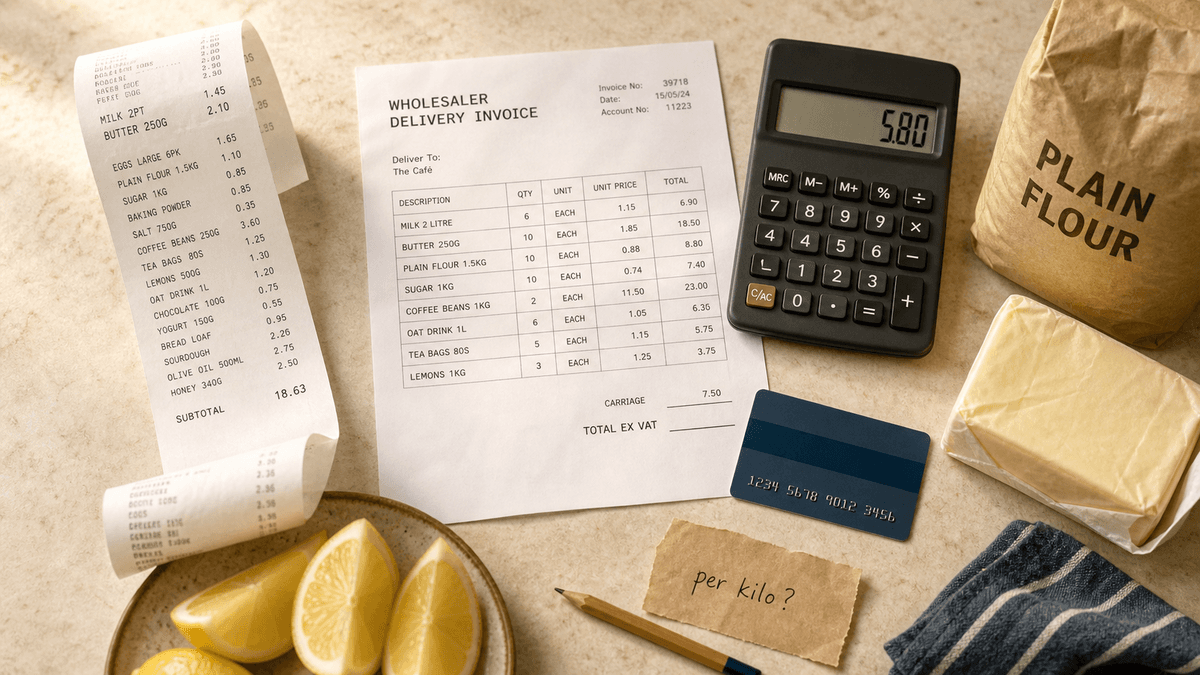
Most café owners buy from all three. A wholesaler drops the dry goods and dairy, the cash and carry fills the gaps, and the supermarket covers whatever ran short before service.
Nobody plans it that way. It just accretes. And because it accretes, almost nobody stops to ask whether the split actually makes sense, or what each channel really costs once you count everything.
Here's the honest version, from someone who's bought this way for 17 years.
The three channels, honestly
Each one has a real place. None of them is the answer on its own.
Delivered wholesale
A van comes to your door. You order from a price file, it arrives, you get an invoice with terms.
This is the backbone for most cafés, and rightly so. You're not spending your own time fetching stock, the prices are usually keen on volume lines, and account terms give you a little breathing room on cash. The paperwork lands as a proper invoice, which means the cost has a decent chance of making it into your books.
The catch is the terms. Minimum order values, carriage charges, fuel surcharges and fixed drop days all quietly move your real cost above the price on the line. The headline price you negotiate is rarely the price you pay once the minimum orders and delivery charges hiding in your invoices are counted. Wholesale is the right default, but only if you're reading the whole invoice.
Cash and carry
You get in the van, drive there, walk the aisles, load a trolley, pay, and drive back.
Shelf prices are often genuinely lower than delivered wholesale, especially on the big multipack lines. That's the pull. For a lot of operators it feels like the cheapest option, full stop.
It usually isn't, once you cost it honestly. You're paying in your own time, in fuel, and in impulse buys. An hour there, twenty minutes each way, loading and unloading at both ends: call it two hours of an owner or manager who has better things to do. Put a real number on that hour and the "saving" shrinks fast. Then there's the trolley effect. You went for cups and coffee and came back with a case of something on offer that nobody asked for.
Supermarket top-ups
You run out of milk on a Wednesday, the next drop is Thursday, and someone nips to the big supermarket to get you through.
Everyone does this. It's fine. A pint bought at retail to save a service is a sensible trade. The problem is never the top-up itself.
The problem is the receipt. It goes in the till drawer, or a pocket, or the bin. It almost never makes it into your costing. So you've bought stock at the worst price you'll pay all week, and then made it invisible on top. Do it once and it's noise. Do it every week and it's a real hole in your gross profit that you cannot see, because it never appears on a supplier invoice.
Compare unit prices, not pack prices
Before you can judge any channel, you have to compare like for like. This is where most sourcing decisions go wrong.
The cash and carry sells you butter in a 25kg block. The wholesaler quotes per kilo. The supermarket sells a 250g pack. You cannot compare those three by looking at the price tag, because the tags describe different quantities.
Strip everything back to a single unit. Cost per kilo, per litre, per each. Always ex-VAT, because that's what hits your gross profit, and because VAT treatment differs across lines.
Say the cash and carry block works out at £5.80 a kilo and your wholesaler is £6.40 a kilo delivered. The block looks like the winner by 60p. But you drove there, you'll get through the block slowly enough that the last of it is past its best, and while you were there you spent £40 on things you didn't need. The 60p per kilo was real. It just wasn't the whole picture.
Which channel suits which category
You don't pick one channel. You match the channel to the job.
- Volume staples with a decent shelf life go to delivered wholesale. Flour, sugar, tinned goods, beans, oat milk, your house lines. These are the bulk of your spend, they keep, and a proper account with regular drops is almost always the cheapest and least hassle way to buy them.
- Fresh top-ups and short-life lines are a judgement call. If your wholesaler's fresh range and drop days work, use them. If not, a planned cash and carry run every week or two can genuinely beat retail on produce and dairy, as long as you treat it as a planned trip, not a habit of nipping out whenever.
- Emergencies only go to the supermarket. That's the whole remit. If you're going more than once or twice a week, the supermarket isn't your problem, your ordering is.
That last point is the one worth sitting with. A café making three supermarket runs a week doesn't have a sourcing problem, it has an ordering problem. Setting proper par levels so you order enough without the panic supermarket runs fixes far more of your retail-price leakage than switching supplier ever will. The cheapest milk is the milk you didn't have to buy at Tesco because you ordered the right amount on Tuesday.
The receipt problem, and how to close it
Here's the quiet one that undoes everyone.
Your wholesale invoices flow into your books, because they arrive as invoices and someone processes them. Your cash and carry and supermarket spend arrives as till receipts, and till receipts get lost. So your costing system knows about your delivered stock and is blind to a chunk of what you actually spent.
That blindness has a direct cost. If a third of your dairy spend runs through cash and carry and supermarket receipts that never get logged, your recorded ingredient cost is understated and your margins look better on paper than they are in the bank. This is one of the biggest reasons your food cost percentage drifts away from reality: the recipe card says one thing, the bank says another, and the gap is the stock you bought off-invoice and never captured.
The fix is a discipline, not a tool.
- Capture every receipt the same day. Snap it before it leaves the person's hand. A photo on a phone the moment they walk back through the door beats a shoebox you promise to sort at month end. You will never sort the shoebox. A simple petty cash system for supermarket runs makes the same-day photo the habit.
- Give off-invoice spend a home. Cash and carry and supermarket receipts need to land in the same place your invoices do, coded to the same suppliers and lines, so your costing sees your true spend and not just the delivered slice.
- Review it monthly. Total up what went through retail and cash and carry. If it's climbing, that's a signal your ordering or your supplier mix needs a look, not a reason to feel guilty.
This is exactly the gap a tool like CostingBrik is built to close: it processes the whole receipt or invoice, whatever channel it came from, so your cash and carry and supermarket spend show up in your real ingredient cost instead of vanishing into the till drawer. But the tool only works if the receipt reaches it, which comes back to the same daily habit.
What to do this week
You don't need to rip up your suppliers. Start here:
- Map your spend by channel. For a single week, note what came from wholesale, cash and carry and the supermarket. Most operators have never seen this split and are surprised by it.
- Cost your cash and carry runs honestly. Add the owner-hour, the fuel and the impulse buys to the shelf price. Decide if it still wins.
- Capture every off-invoice receipt the same day. This is the single highest-value habit in the whole piece. Photo, logged, coded, done.
- Cut the emergency runs with better ordering. Par levels and planned drops do more for your margin than chasing shelf prices ever will.
The takeaway: there's no single right place to buy. Delivered wholesale, cash and carry and the supermarket all have a job, and a well-run café uses all three. What separates the cafés that make money from the ones that just feel busy isn't the channel. It's whether the spend makes it into the books. Any channel works if the numbers land in your costing. None of them work if they don't.
Ed O'Brien has run Hunters Cake Company for 17 years across cafés in Witney, Burford, and a bakery in Carterton, Oxfordshire. He's building Brikly - modular tools that give independent café owners the same data the big chains have, without the big chain price tag.