
Par Levels: How to Order Enough Without Tying Up Cash or Binning Stock
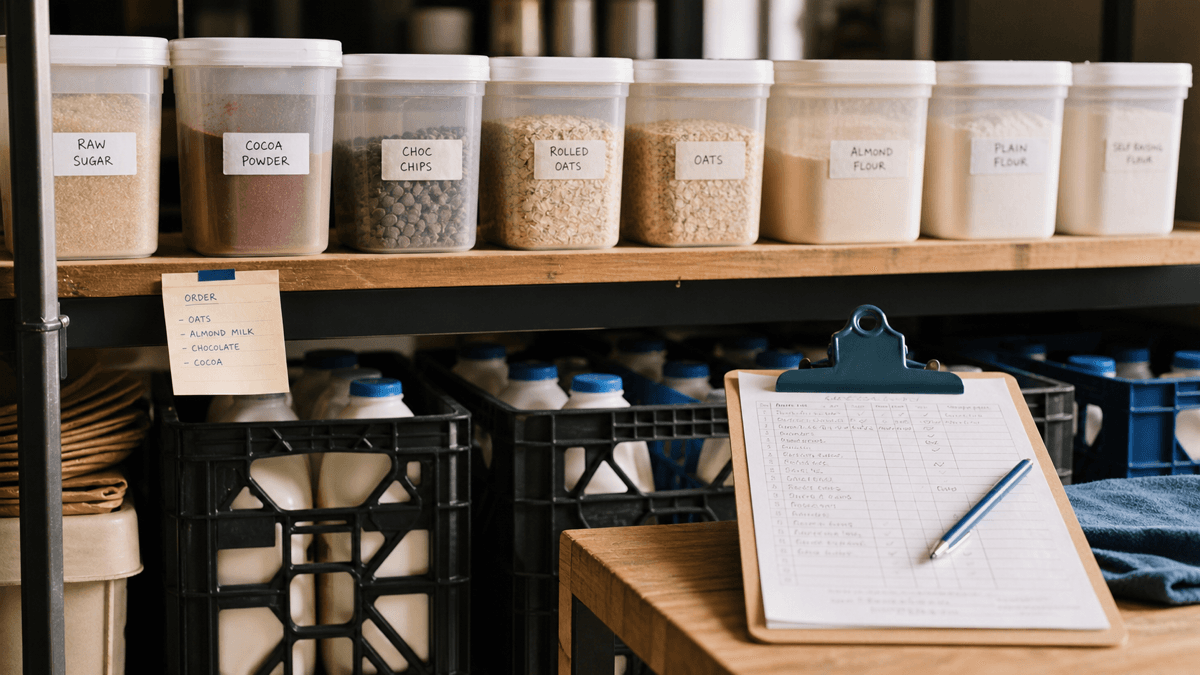
It's Sunday night. You've done a careful stocktake, the numbers are in the spreadsheet, and now you're sat at the kitchen table with the supplier portal open and a cold cup of tea. The count tells you exactly what you have on the shelf. It tells you nothing about what to order.
So you do what most operators do. You order on gut. A bit more oat milk because it felt tight last week. A few extra bags of beans because there's a bank holiday coming. Maybe skip the flour, you think you've got loads.
Then Wednesday lunchtime you run out of oat milk and send someone to the Co-op at retail price. The flour, it turns out, was nearly gone, and the beans you over-ordered are sat in the dry store using up cash you needed for wages.
The stocktake is only half the job. Par levels are the other half. They turn a count of what you had into a decision about what to buy. Here's how to set them without guessing.
What a par level actually is
A par level is the quantity you want a line topped up to so that you reach the next delivery without running out and without overstocking.
It's not your minimum. It's not your maximum. It's the target level you order up to.
The mechanic is simple. You count what's on hand, you subtract that from the par, and the difference is what you order. If your par for oat milk is 30 cartons and you've got 8 left, you order 22. No gut feel, no "that feels about right" - just par minus on-hand.
That one shift, from ordering a quantity to ordering up to a level, is what stops the Sunday-night guessing.
How to set one: usage rate times days to cover, plus a buffer
A par level is built from three things:
- Usage rate - how much of the line you actually get through in a period
- Days to cover - how long the par has to last you before the next delivery lands
- A buffer - a safety margin for the weeks that run hot
Your usage rate is the bit people guess at, and it's the bit you don't need to. It lives in your records. A run of weekly stocktakes done the same way each time gives you opening stock plus deliveries minus closing stock, which is real consumption. Your POS sales mix tells you the same story from the other end - more flat whites sold means more milk gone.
A worked example: oat milk
Say you sell through 24 cartons of oat milk a week, and that figure is steady across the last month of counts. Your supplier delivers twice a week - a Tuesday drop and a Friday drop.
Those two drops don't split the week evenly. Tuesday's delivery only has to last until Friday, three days. But Friday's has to cover the whole weekend through to Tuesday - four days, and usually your busiest ones. So you size the par to the longer gap, or you'll run dry on a Sunday.
- Daily usage: 24 cartons / 7 days = 3.43 cartons a day
- Days to cover the longest gap: 4 days
- Base cover: 3.43 x 4 = about 14 cartons
Now add a buffer. A 25% buffer on a fast-moving fresh line is sensible - it covers a busy weekend without burying you in stock:
- Buffer: 14 x 1.25 = about 18 cartons
So your par per drop is around 18 cartons. On Tuesday you count, and you order up to 18. On Friday you do the same.
Your reorder point - the level you must not let stock fall below before the next drop - is your base cover without the buffer, around 14. If a count comes in below that, you're cutting it fine and the buffer is doing its job.
Flex the par for weather, footfall and events
A par level isn't carved in stone. It's a baseline for a normal week, and some weeks aren't normal.
- Summer iced-drink surge. A hot spell can double milk and ice usage in a week. Push your dairy, oat milk and syrup pars up temporarily while the sun's out, then bring them back down.
- Bank holidays. A long weekend in a tourist town is your best three days of the month. A long weekend on a commuter high street is dead. Know which one you are and flex the right way.
- Local events. A market, a half-marathon, a festival down the road - all of it lands as extra covers you can see coming. Lift the pars on the lines those covers will hit.
The discipline is to flex temporarily and put the par back. A summer par left on through October is just over-ordering with a good excuse.
Perishables versus ambient: tighten one, loosen the other
Not every line deserves the same approach, and the difference comes down to one question: what happens if it doesn't sell?
Fresh and perishable - keep par tight
Milk, cream, fresh pastry, prepped fillings, salad. If you over-par these, you don't get to keep the cash on the shelf - you bin it. Waste risk is real money lost.
Keep pars tight on fresh lines and accept the odd stockout as cheaper than routine waste. Tight pars also lean directly on good end-of-day production planning so you're not baking to a number the day can't sell.
Ambient and long-life - you can loosen up
Tins, dry goods, bottled syrups, cleaning supplies, takeaway packaging. These don't spoil on any timescale that matters, so the only cost of holding more is cash tied up and shelf space. You can run looser pars here to hit supplier minimums or cut delivery frequency.
The cash angle: every unit on the shelf is your money
This is the part that doesn't show up on a stocktake sheet but quietly runs the business.
Every unit sat in your store is cash you've already spent and can't use. Over-par means dead cash plus, on fresh lines, a bin. Under-par means stockouts and expensive supermarket top-ups at retail instead of trade price, and the supermarket is the priciest of the channels a café can buy from.
Here's the same line ordered three ways for a single week. Oat milk, like most food, is zero-rated for VAT, so there's no VAT to strip out - the trade price of £1.10 a carton is your real cost, and the Co-op shelf price is directly comparable:
| Approach | Ordered | Used | Outcome | Cash effect (ex-VAT) |
|---|---|---|---|---|
| Under-par | 18 | 24 | 6 short, bought at Co-op @ £1.85 ea | £11.10 supermarket top-up, lost margin |
| On par | 30 | 24 | 6 carry into next week, none binned | £6.60 held, recovered next week |
| Over-par | 42 | 24 | 18 surplus, 4 spoil before use | £4.40 binned + £15.40 dead cash on shelf |
The over-par row is the quiet killer. That £4.40 of spoilage is gone for good, and the £15.40 sat on the shelf is cash that can't pay a supplier or cover a quiet Tuesday. Multiply that across forty lines and you've got a meaningful chunk of working capital frozen in the dry store - which is exactly the squeeze a 13-week cash flow forecast is built to expose.
Min-order and drop-day reality
Pars have to live in the real world, and the real world is your supplier's terms.
If a supplier won't deliver below a £150 minimum, or only drops on a Tuesday, your pars have to bend to fit. There's no point setting a par that needs a Thursday top-up from a supplier who only comes on Tuesday. You'll either pad the par to cover the longer gap or split the line across two suppliers.
This is where supplier minimums and delivery days quietly shape your ordering. A par set in a spreadsheet that ignores them just gets overridden on Sunday night, and you're back to guessing. Set the days-to-cover to match the actual drop schedule and let the minimum nudge your ambient pars up where it has to.
Closing the loop
Par levels aren't a one-off setup. They're a cycle that gets sharper every week:
- Stocktake - count what's on hand, the same way each time
- Variance - compare what you used against what you expected
- Adjust par - if a line keeps running short, lift it; if it keeps carrying surplus, drop it
- Order - par minus on-hand, respecting minimums and drop days
- Next stocktake - and round again
The variance step is where the learning happens. A line that runs out three weeks running is telling you the par is too low. A line that always carries a surplus is telling you it's too high, and tying up cash while it does. If your stocktake routine isn't nailed down yet, start there - the par cycle only works on counts you trust.
What to do this week
You don't need to par every line in the building. Start where the money is.
- Set pars on your top 20 lines first. A handful of lines tie up most of your cash and cause most of your stockouts - your milk, your house bean, your top-selling pastry, your core flour. Par those and you've covered the bulk of the risk.
- Write them down where the orderer can see them. A par level in your head helps no one when you're off and someone else is doing the Sunday order. Put it on the shelf edge, in the ordering sheet, wherever the order actually gets placed.
- Review monthly. Usage drifts with the seasons. A quick monthly look at the variance tells you which pars to nudge.
Get the top 20 right and the Sunday-night guessing mostly disappears. The order becomes a calculation, not a gamble.
Where Brikly fits
The honest problem with par levels is that they're only as good as the usage figure underneath them, and most operators are guessing at that figure.
The data you need to set pars without guessing already lives in your Brikly account. CostingBrik knows what each line costs and, once you've been running your invoices through it, how much you actually get through over time - real consumption, not a gut estimate. MenuBrik's sales mix shows you where demand is heading, so you can see a milk-heavy season coming before it empties the shelf.
Use that real consumption data to set your pars instead of going on feel. Brikly won't place the order for you and there's no dedicated stock module - but it gives you the cost-per-line and the through-rate that turn a par level from a guess into a number you can stand behind. If you're not on Brikly yet, the free recipe costing tool will at least pin down what each line costs you, which is half the calculation.
The takeaway: a stocktake tells you what you had. A par level tells you what to buy. Set pars on your top 20 lines, write them where the orderer can see them, flex them for the season, and review them monthly. That's how you order enough to never run dry without freezing cash on the shelf or filling the bin.
Ed O'Brien has run Hunters Cake Company for 17 years across cafés in Witney, Burford, and a bakery in Carterton, Oxfordshire. He's building Brikly - modular tools that give independent café owners the same data the big chains have, without the big chain price tag.