Closing checklists that actually get done - staff accountability without nagging
You unlock the café at 7am and the fridge door is hanging open. The milk is warm. Two trays of prep from yesterday are room temperature and heading for the bin. Somewhere between "who closed last night?" and "I thought Sam was doing it", about £180 of stock just evaporated.
Every café owner has a version of this story. The gas left on. The front door pulled-to but not double-locked. The coffee machine left hot overnight. The till float miscounted because two people half-did it.
The fix isn't "better staff". You already have good staff. The fix is a closing checklist that actually gets done - and a way of knowing it got done before you find out the hard way at 7am.
Why verbal handovers fail
"Sam, can you make sure the fridge is shut and the back door's locked before you go?"
Sam nods. Sam is 19. Sam is also closing the till, cashing up, restocking the fridge, and texting a mate about where they're going after work. Sam is not, in that moment, building a mental checklist.
This is diffusion of responsibility. When a task is vaguely "someone's job", it becomes no one's job. When two people are closing together, each one quietly assumes the other has handled the bit they're not sure about. "I thought you did it" is always true - for exactly the thing that didn't get done.
Verbal handovers also leave no trail. If something gets missed, you can't prove who was on. You can't coach the person who skipped it because you're not sure who it was. You just absorb the cost and mutter about it.
The three properties of a checklist that works
Not every checklist works. Most don't. The ones stuck to the kitchen wall in a plastic sleeve, curled at the corners, haven't been ticked in three weeks and everybody knows it.
A closing checklist that actually gets done has three properties.
Specific
"Clean kitchen" is not a task. It's a wish.
Compare:
- Vague: Clean kitchen
- Specific: Wipe espresso group, flush milk lines with hot water, empty knock box, wipe steam wands with damp cloth
The second one can be done or not done. The first one is an opinion. If the task is vague, the argument about whether it got done is unwinnable, and the person closing learns that "clean enough" is the standard.
Owned
Every task needs a name against it. Not "closing team". Not "whoever's on". A person, or at minimum a role for that shift (closer, barista, kitchen).
The moment a task is owned, diffusion of responsibility collapses. Sam knows the fridge is Sam's job tonight. Priya knows the gas is hers. Nobody is assuming anybody else.
Visible
You, the manager, should be able to see at 8am who ticked what. Not next week when you get round to it. Not when something goes wrong. In the morning, over the first coffee, on your phone.
Visibility is what turns a checklist from a compliance exercise into a feedback loop. When staff know you'll see the record, the record becomes honest. When you can see patterns - the same task missed on the same shift pattern - you can fix the cause, not just the symptom.
What to put on a closing checklist
Every café is different, but the bones of a good closing list cover five areas. Here's a 12-item starter you can adapt.
Food safety
- Fridge and freezer temperatures logged (under 5C / under -18C)
- All prep covered, dated, and stored correctly
- Hot-hold and display units emptied and wiped
Security
- Back door locked and bolted
- Front door double-locked, shutters down
- Alarm set (code entered, red light confirmed)
Equipment
- Coffee machine backflushed, group heads wiped, steam wands flushed
- Grinders emptied of loose beans, hoppers topped or covered
- Gas hob isolator off, oven off at the wall
Cash
- Till cashed up, float counted, variance noted (not just "matches")
Deep clean rotation
- Today's rotating task done (Monday: fridge shelves. Tuesday: behind the machine. Wednesday: bins. And so on)
- Dishwasher emptied, filter cleaned, door left ajar
The clock-out gate
Here's where most checklists fall down. Even a good one - specific, owned, visible - can still get skipped if the only thing stopping a tired closer from walking out the door is their conscience.
The problem with paper is simple. Staff sign the sheet. They walk out. You find the miss the next morning. By then the fridge has been open for nine hours.
What you actually want is for the checklist to block the shift from ending. Not completed? Not clocked out.
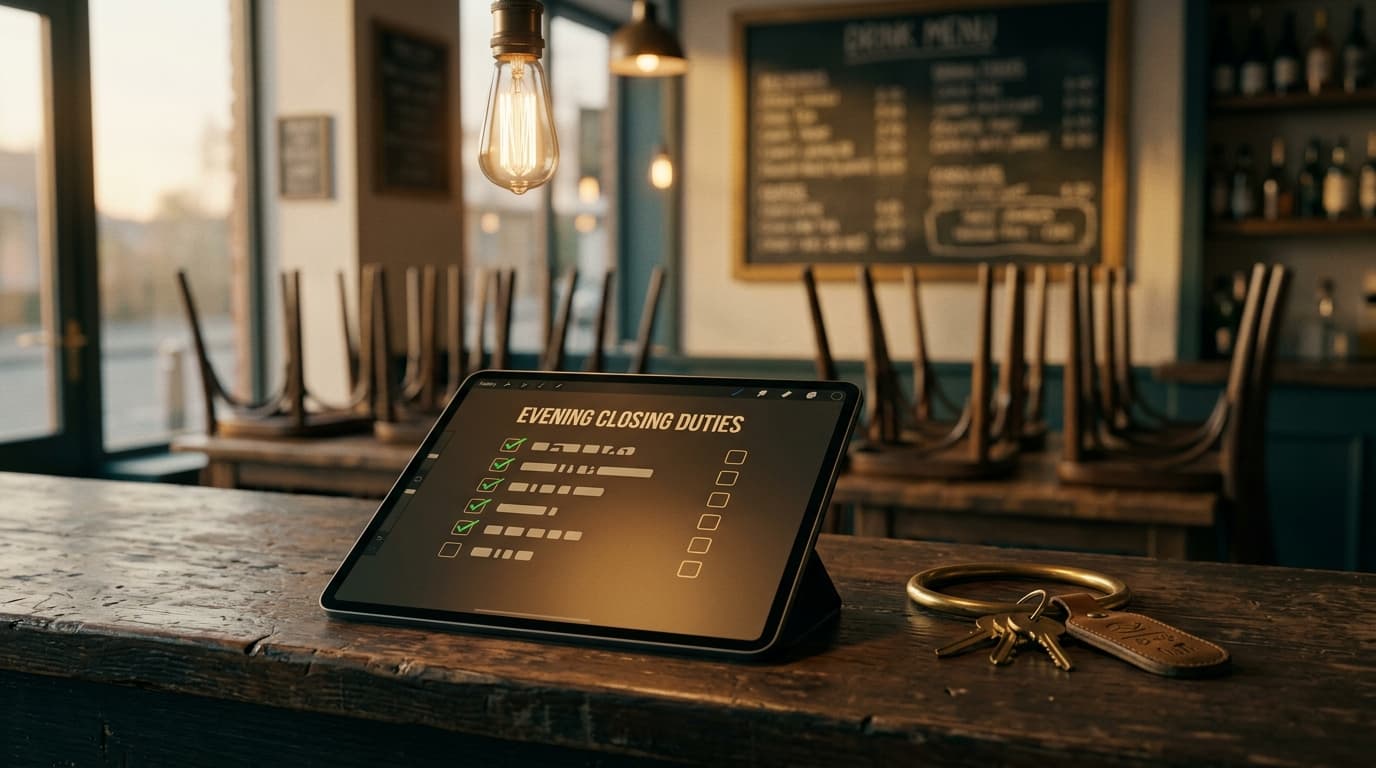
This is the approach we're building into the Brikly Team App. When a closer hits "clock out", the app checks their assigned closing checklist. If anything's unticked, they get an alert: "You still have 3 tasks to complete before clock-out." They either do them, or they flag why they can't (fridge thermometer broken, for example) and the manager gets notified immediately - not in the morning.
This one change transforms the dynamic:
- Staff can't "forget" closing tasks, because the app won't let them finish their shift
- You, the owner, don't find out about misses the next morning - you find out in real time
- The audit trail is automatic. Every tick has a name and a timestamp on it
- Shift hours captured against your labour costs are tied to an actually-completed close, not a half-done one
A checklist that isn't tied to clock-out is still a wish list. A checklist that gates clock-out is an accountability system.
Tie this into food safety
Closing checklists and food safety checklists are the same pattern applied to different tasks. End-of-day fridge temp checks, cleaning schedule sign-offs, allergen board confirmations - they all benefit from the same three properties: specific, owned, visible.
SafetyBrik, launching soon as part of the Brikly platform and free to use, applies exactly this model to food safety. Digital diary entries with timestamps and photos. Cleaning rotas staff tick off from their phone. Fridge temps that can't be fudged at the end of the week because each one is logged at the time it was taken.
The EHO cares about two things when they visit: is the food safe, and can you prove it. Digital records beat paper diaries on both counts - and a 5-star hygiene rating usually comes down to whether the paperwork matches what's actually happening on the floor.
There's also a people angle. Under the Employment Rights Act 2025, the quality of your records matters more than ever. If a dispute arises about what was done on a shift, "Sam clocked out at 10:47pm with a completed closing checklist" is a very different conversation from "I think Sam closed that night".
The takeaway
A closing checklist on its own is not an accountability tool. It's a list.
It becomes accountability when:
- Each task is specific enough to be done or not done
- Each task is owned by a named person or role
- The record is visible to you by 8am the next morning
- And the shift cannot end until the list is complete
The first three you can do today, on paper, if you write it properly. The fourth is what paper cannot do. That's the gap the Brikly Team App closes - turning the checklist from a piece of paper into the thing that actually happens before staff go home.
If you've ever walked in at 7am to a fridge left open, you already know why this matters.
Ed O'Brien has run Hunters Cake Company for 17 years across cafés in Witney, Burford, and a bakery in Carterton, Oxfordshire. He's building Brikly - modular tools that give independent café owners the same data the big chains have, without the big chain price tag.