Paper food safety diaries are dying - why digital records beat the folder
It's Friday night. The café is shut, the floors are mopped, and someone is sat at the pass with The Folder open, inventing Tuesday's fridge temperatures from memory.
You know the one. Plastic wallet, slightly sticky, last page torn. Fridge temps, cleaning rota, probe calibration, delivery checks, allergen notes. All handwritten, half of it done at the end of the week in the same pen, in the same handwriting, at the same tidy slant.
Everyone in hospitality has done this. And everyone knows it's nonsense.
The Folder has always been a fiction
The idea of the paper diary is lovely. Record things as they happen, build a defensible trail, show the EHO on the day they walk in.
The reality is different. Paper diaries fail in three predictable ways.
Records get missed. It's 7:42am, you've got a queue, and the fridge check was supposed to happen at 7:30. You'll "do it in a minute". You don't.
Records get faked. Not maliciously. Someone realises on Friday that three days are blank, and they backfill "4C, 4C, 3C, 4C" because it's always roughly that. A well-run café with clean fridges still ends up with fabricated logs.
Records get lost. The folder walks. It gets coffee on it. The March pages come loose. Nine months later the Environmental Health Officer asks to see a specific date and you're leafing through a binder praying the right page is in there.
None of this means your food is unsafe. It means your evidence is unsafe. Those are very different problems, and only one of them gets you downgraded.
What a digital diary actually does differently
A digital food safety diary isn't just "the folder, on a screen". If all you do is retype what you used to write, you've gained nothing. The point is to change what gets recorded, when, and by whom.
Timestamps you can't fudge
When a fridge check is logged at 07:34, it was logged at 07:34. Not backfilled on Friday at 9pm. The timestamp is part of the record and it's not editable.
This sounds like a small thing. It isn't. It's the entire reason digital records are more defensible than paper. An EHO looking at a row of neatly spaced temperatures on paper knows perfectly well it was filled in at the end of the week. A timestamped digital log removes that doubt entirely.
It also catches problems while they're still cheap. A fridge struggling through a heatwave shows up as a drifting trend in the log days before it becomes a bin bag full of spoiled dairy.
Exception-based logging
This is the bigger shift. Most paper diaries ask staff to record the same thing every day, whether anything happened or not. "Fridge OK. Probe OK. Me OK. Me OK. Me OK."
Staff stop reading what they're signing. They tick. They move on. The log becomes a rubber-stamp exercise that protects nobody.
A better approach: only log when something is not normal. The fridge ran warm, log it. A delivery arrived above temperature, log it. Someone came in feeling unwell, log it in the diary on exception - not as a daily "I am fit to work" declaration that everyone signs without thinking.
Exception-based logging gives you three things paper can't:
- Fewer entries, so the ones you do have are real
- A signal, not noise, when something goes wrong
- Staff who actually engage with the record instead of autopiloting through it
Searchable, shareable, defensible
When the EHO asks for last March, you pull up last March. When your insurer asks for the delivery log for a specific supplier, you filter by supplier. When a member of staff leaves and you want to check who did what, it's there.
Paper can't do any of this. Paper is a read-only medium that degrades over time.
The "whose phone?" problem
Here's the friction that kills most attempts to go digital: "whose phone do we use?"
If the fridge check lives in an app on the manager's phone, the manager has to do the fridge check. If it lives on every staff phone, you've got five different versions of reality and a staff member who just started and hasn't installed anything.
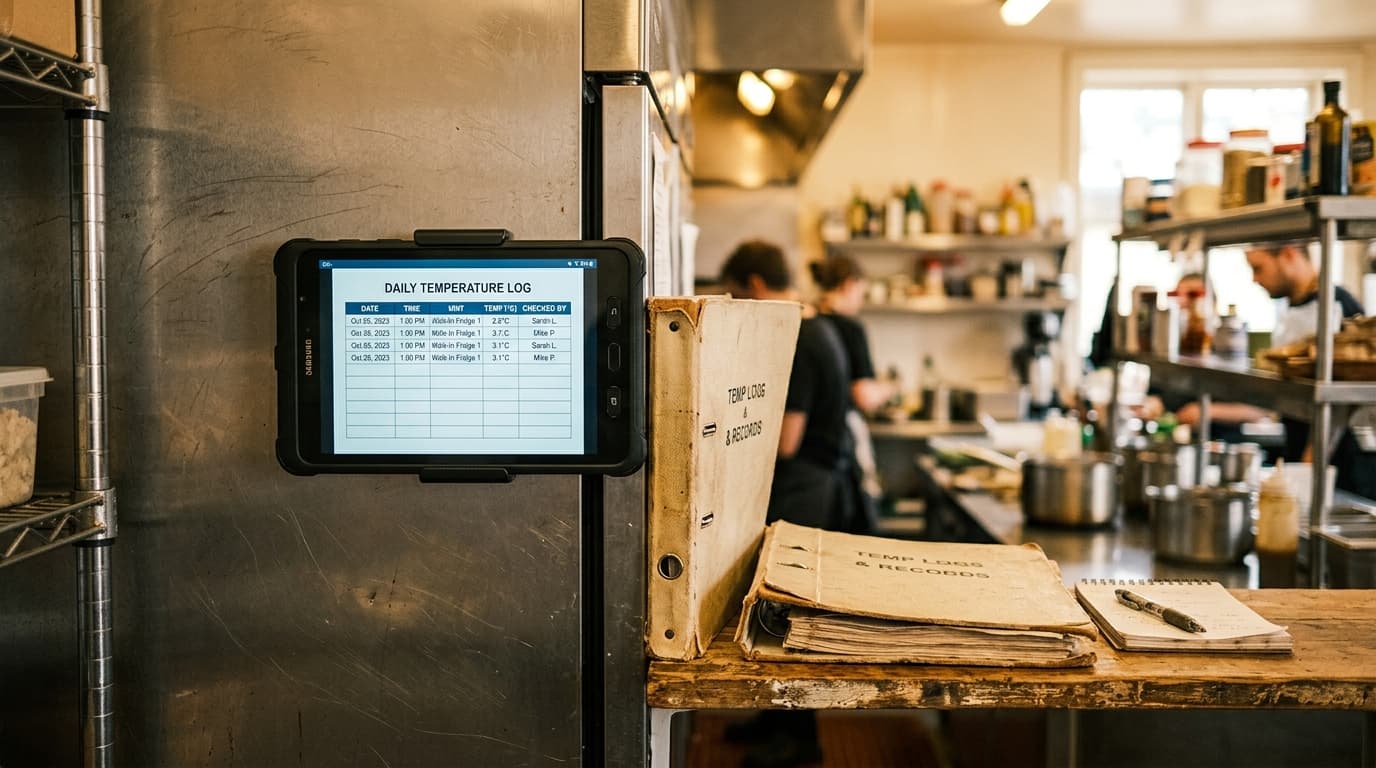
The fix is a shared surface. A tablet. Mounted by the fridge. Always on, always signed in to the right rota, staff tap their name, log the check, move on.
That's the kiosk surface. It's the missing piece in most digital diary setups. Not every record belongs on a personal phone. Some records belong on a communal screen that anyone on shift can use without thinking.
Combined with the individual pieces that do belong on a phone - a delivery photo from whoever signed for it, a closing checklist tied to the person who actually did it - you get a diary that matches how a café actually works.
What to log, what to stop logging
While you're rebuilding the diary, be honest about what's worth keeping.
Worth logging:
- Fridge and freezer temperatures (at least twice a day, one after open, one before close)
- Probe calibration (weekly, with a timestamped reading)
- Delivery checks (temperatures on chilled and frozen goods, supplier, date code issues)
- Allergen changes to recipes (the bit that matters for Natasha's Law compliance)
- Cleaning that's not daily (deep cleans, extractor, ice machine)
- Exceptions: anything that wasn't normal
Stop logging:
- Daily "fit to work" declarations that everyone signs without reading
- "Floors mopped" checkboxes (if the floor isn't mopped you'll know, you don't need a log)
- Anything you only fill in for the EHO and never actually look at yourself
The test is simple: if nobody in your team would ever go back and read it, it's not a record. It's a prop.
How SafetyBrik does it
SafetyBrik is the Brikly module for food safety diaries, checklists, and the allergen matrix. It's free. It's launching soon. And it's built around the three surfaces a real café needs.
- Web for managers and owners. Reporting, trends, what got logged, what got missed, exportable for your EHO visit.
- Team App on staff phones. On-shift actions for whoever is working - delivery photos, exception reports, their own cleaning tasks.
- Kiosk app on a shared tablet. The one by the fridge. Anyone on shift can tap in, log a check, tap out. No accounts to remember, no personal phone to hunt for.
Three surfaces because three different people do three different jobs. A manager reviewing the week doesn't need the same interface as a KP doing a fridge check at 7am. And a KP doing a fridge check at 7am doesn't want to log into an app on their own phone.
SafetyBrik is free on purpose. Food safety shouldn't be the thing an independent café has to cut because the software budget went on rotas. If you want the paid stuff - staff tools, menu engineering, costing - those are separate Briks. Pay for what you actually use.
A diary is cheaper than a downgrade
Here's the quiet maths. A food hygiene rating that drops from 5 to 3 doesn't show up as a line item. It shows up as quieter Saturdays, fewer delivery orders, and a window sticker that hurts every time you walk past it.
Most of that damage traces back to records. Not to the food, not to the kitchen, not to the team. To the folder.
A paper diary that nobody trusts is worse than no diary at all, because it gives you false confidence that you're covered. You're not. You're one EHO visit and one missing page away from finding out.
Digital records fix the three paper failures in one go. Timestamps kill the backfill. Exception-based logging kills the rubber-stamping. A searchable database kills the lost-page problem.
And a shared kiosk by the fridge kills the "whose phone" excuse that keeps most cafés on paper in the first place.
The folder had a good run. It's time.
Ed O'Brien has run Hunters Cake Company for 17 years across cafés in Witney, Burford, and a bakery in Carterton, Oxfordshire. He's building Brikly - modular tools that give independent café owners the same data the big chains have, without the big chain price tag.