
Cooking loss: the recipe cost leak your yield table misses
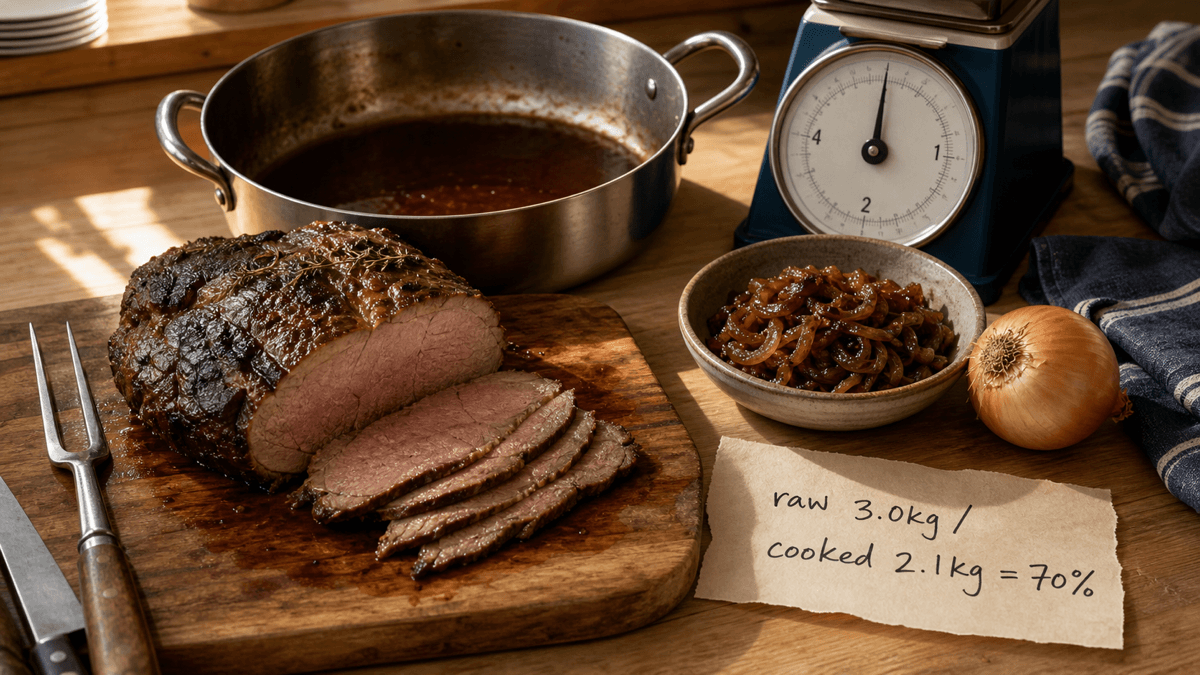
You buy a 3kg brisket, weigh it, cost it to the gram, and feel pleased with yourself. Then it comes out of the oven at a shade over 2kg, and the recipe card you built that morning is already wrong.
Prep yield gets a lot of attention, and rightly so. Peeling, trimming and stoning all shrink what you paid for before it ever hits the heat. We've covered that ground in the recipe costing guide, where the avocado loses its skin and stone and your cost per usable gram jumps.
But that's only the first cut. There's a second one that almost nobody costs, and it happens after prep. Recipe costing taught you the loss before the pan. This post is about the loss that happens in the pan and the oven.
Two kinds of yield, and only one gets counted
Think of your ingredient going through three weights on its way to the plate.
- As purchased - what you paid for, skin, bone, packaging and all.
- As prepped - what's left after peeling, trimming and stoning. This is prep yield, and it's the one your yield table already handles.
- As served - what's actually on the plate after cooking. This is the one that goes missing.
The gap between as-prepped and as-served is cooking loss, and it's mostly water and fat driven off by heat. It doesn't leave your kitchen in the bin like a peel or a stone does, so it's invisible. It goes up the extraction fan as steam and down the tray as rendered fat. You never see it, so you never cost it.
That's the trap. Prep loss you can see, so you eventually learn to account for it. Cooking loss you can't, so it quietly inflates the cost of every cooked dish on your menu.
Where cooking loss actually bites
It's not every dish. A flat white doesn't shrink. A cold sandwich fill weighs the same built as it did prepped. Cooking loss lives specifically in anything you apply heat to for long enough to drive moisture off. In a typical café kitchen, that's:
- Roast and braised meats. A joint loses 25 to 30% of its weight in the oven. Slow-roast pork, brisket, a gammon for the ham sandwiches. What went in at 3kg comes out closer to 2.1kg.
- Bacon and sausage. Bacon renders down hard. Streaky can lose a third to half its weight once the fat's cooked out. The rasher on the plate is a lot lighter than the one from the pack.
- Mince. Browned mince for a ragu or a chilli sheds water and fat and shrinks noticeably. A kilo raw is not a kilo cooked.
- Sauces, stocks and reductions. This is the big one. A jus or a gravy is deliberately boiled down to concentrate flavour. You might start with two litres and finish with 500ml. Every drop of cost you put in is now packed into a quarter of the volume.
- Caramelised onions. The most dramatic collapse in the building. Onions are mostly water, and a full pan cooks down to roughly a tenth of what you started with. That generous handful of soft, sweet onion on a cheese toastie represents ten times its volume in raw stock.
- Soups. Simmer a soup uncovered for an hour and it reduces on the hob. Fewer finished portions than the raw volume suggested.
If a dish involves the oven, the hob or the grill for any real length of time, it's shrinking, and your cost per finished portion is higher than your ingredient list implies.
The mechanic: finished weight is the denominator that matters
Here's the whole thing in one line. Your cost stays the same, but your finished quantity shrinks, so cost per finished gram goes up.
You paid for the raw ingredient. Cooking doesn't refund you for the water it removes. So when you divide your batch cost across what you can actually serve, you're dividing by a smaller number than you thought.
This is the same discipline as costing the portion, not the recipe, except the portion count itself got smaller in the oven. Cost the batch, then divide by finished portions, not raw ones. If that batch is a sauce or base that feeds several dishes, cost it as a sub-recipe so the loss is counted once and carried into every dish that uses it.
A worked example: the slow-roast beef sandwich
Let's follow one joint all the way through, because this is where the two reductions stack up and the real cost appears. Illustrative UK 2026 trade prices, ex-VAT.
Stage one: as purchased to as prepped
You buy a 3kg brisket at £9.00/kg, so £27.00 on the invoice.
You trim off silverskin, a bit of hard fat and the ragged end. Say you lose 8% to trim. That's your prep yield, and it's the step the recipe costing guide already teaches, so we won't re-derive it here.
- Prepped weight: 3,000g x 0.92 = 2,760g
- Cost is still £27.00, now spread across less meat: £27.00 / 2,760g = £0.0098 per prepped gram
So far, so familiar. If you stopped here, you'd think a 120g portion of beef costs about £1.17. That's the number most cost cards land on, and it's wrong, because this beef hasn't been anywhere near the oven yet.
Stage two: as prepped to as served
Now you slow-roast it. Brisket loses about 30% of its weight to the heat.
- Cooked weight: 2,760g x 0.70 = 1,932g
- The cost hasn't changed. It's still £27.00. But it's now carried by 1,932g of finished beef.
- Cost per cooked gram: £27.00 / 1,932g = £0.014
That's your real cost per servable gram. It's 43% higher than the raw purchase price of £0.009/g, and 30% higher than the prepped figure you might have settled for.
What the portion actually costs
You serve 120g of cooked beef in the sandwich.
- Costed on cooked weight: 120g x £0.014 = £1.68
- Costed on prepped weight (the comfortable version): 120g x £0.0098 = £1.17
That's 51p of hidden cost on every sandwich, purely from the cooking loss you didn't count. Sell 20 a day, six days a week, and that's over £3,000 a year of margin you priced away without knowing it.
Reductions are the worst offender
Meat loses a chunk. A reduction can lose most of itself, and it's the sauce you drizzle on like it's free.
Take a red wine jus. Say your ingredients for a batch cost £6.00: the wine, the stock, the shallots, the butter to finish. You start with 2 litres in the pan and reduce it hard down to 500ml of glossy, concentrated jus.
- Cost per raw litre going in: £6.00 / 2L = £3.00/L
- Cost per finished litre: £6.00 / 0.5L = £12.00/L
Same six pounds, four times the cost per millilitre, because three-quarters of the volume boiled off as steam. A 30ml spoon of that jus costs 36p, not the 9p the raw volume implied. Drizzle it generously across a day's plates and the "free flourish" is quietly one of the more expensive things you serve.
Caramelised onions are the same story, only more so. A pan of onions that cost you £1.20 raw might collapse to a tenth of its volume. The finished onion is effectively ten times its raw cost per gram. It's a cheap ingredient that becomes a surprisingly dear garnish once you account for the shrink, and if you're portioning it by eye on top of that, you've stacked a portion drift problem on top of a yield one.
What to do this week
You don't need to re-cost your whole menu. Start with the handful of dishes where heat does the most damage.
- List your cooked-down lines. Roasts, braises, anything with rendered bacon or browned mince, every sauce and stock you reduce, and your caramelised onions. These are the only dishes where this matters, so the list is short.
- Weigh in and weigh out, once. Next time you make each one, weigh the prepped input and the finished output. Divide finished by input. That's your finished-yield percentage.
- Write it on the card. A brisket at 70%, a jus at 25%, onions at 10%. Now your cost per finished portion divides by the right number.
- Cost the portion on the cooked figure. Cost per cooked gram, times the grams you actually serve. That's the honest line for your food cost percentage.
- Re-weigh now and then. Yields drift. A cooler oven, a heavier hand on the reduction, a new person on the section, and last month's percentage stops being true. Spot-check the expensive lines every so often.
Do that for five or six dishes and you'll close a gap you didn't know you had, without touching a single menu price - and you'll finally have the honest in-house figure that any make it or buy it in decision has to be argued from.
Where Brikly fits
This is the maths CostingBrik is built to carry for you. You enter a recipe once with its finished yield, and it holds cost per finished portion for you, so a reduced jus or a slow-roast is costed on what you actually serve, not on what went in the pan.
The part that saves the most time is what happens when prices move. When your beef, your wine or your onions change on an uploaded invoice, the affected recipes recalculate on their own, finished yield and all. Your cooked-dish margins stay current instead of drifting quietly through the summer while you're too busy to notice.
You already weigh your ingredients in. Weigh them out too. The oven has been taking a cut off your margin for years, and it's about time you costed it.
Ed O'Brien has run Hunters Cake Company for 17 years across cafés in Witney, Burford, and a bakery in Carterton, Oxfordshire. He's building Brikly - modular tools that give independent café owners the same data the big chains have, without the big chain price tag.