
Daily cashing up: catching till variance before it becomes a habit
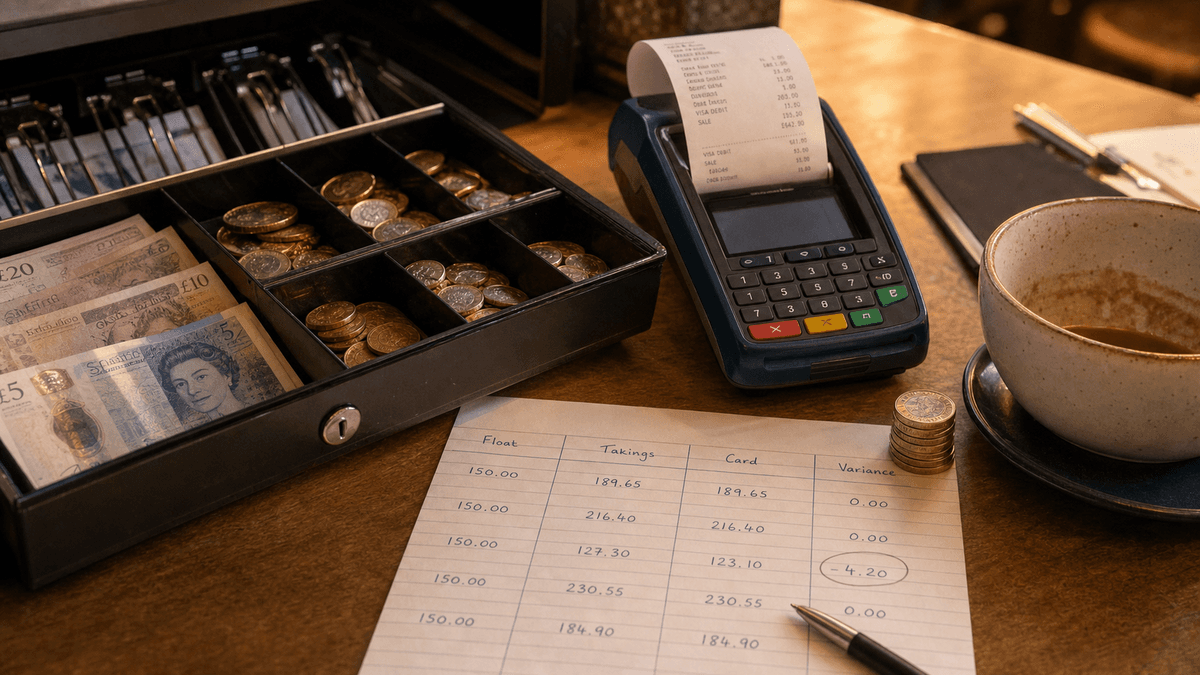
It's the end of a long Saturday. The drawer counts £6 down. You're tired, you want to lock up, so you top it back from your own change, tell yourself it was a busy day, and go home.
The next Saturday it's £5 down. The one after, £8. Nobody's stealing anything. But three months in you've quietly waved goodbye to a couple of hundred pounds and, worse, you've taught yourself and your team that a short drawer is normal.
That's the trap. Till variance is almost never one big dramatic loss. It's a small leak that becomes a habit because nobody was watching it closely enough to catch it while it was still small.
The fix isn't a spreadsheet crusade or treating your staff like suspects. It's a ten-minute routine at the end of every day. Here's the one that works.
Count the float properly
The float is the fixed amount of cash you start every shift with, so people can give change from the first sale. The single most common cashing-up mistake is treating it as a moving target.
Pick a float and keep it the same every single day. £150 in a sensible mix of coins and notes is typical for a café. Write the breakdown down so anyone can rebuild it.
Then count it twice:
- At open, before the first sale, so you know you started clean.
- At close, after you've removed the day's takings, so you know you're leaving the same £150 for tomorrow.
If the float drifts up and down day to day, you can't tell takings from float, and your variance is meaningless before you've even started. Same float, counted at both ends, is what the whole routine stands on.
Reconcile card against the POS total, not the slip
Cash gets all the attention at cashing up, but card is where the quiet errors hide, and the mistake is almost always the same one.
The terminal prints an end-of-day slip with a total. It's tempting to treat that as gospel and move on. Don't. Reconcile your card takings against the POS total, the figure your till system says you rang through on card, not the terminal slip on its own.
They should match. When they don't, it usually means one of a few things: a sale rung up as cash but paid on card, a refund that never got recorded, or a tip added at the terminal that the till doesn't know about. Each is a training or process fix, and each is invisible if you only ever glance at the terminal slip.
One thing to hold in your head while you do this. The money that lands in your bank will not equal either figure, because the real cost of your card machine comes out before settlement. Fees, terminal rental and minimums are deducted on the way through, so reconcile against your gross POS card total and treat fees as a separate line you already understand. Muddle the two and you'll convince yourself the machine is eating money that was only ever the fee you'd already agreed to.
Log the variance for every shift
Here is the part that turns a chore into a system. Write the variance down. Every shift, every day, including the clean ones.
It does not need to be clever. A hardback book by the safe, or a shared sheet, with a handful of columns:
- Date and shift
- Who cashed up
- Expected cash (float plus cash takings)
- Actual cash counted
- Cash variance
- Card POS total versus terminal, matched yes or no
- A one-line note if anything odd happened
The clean days matter as much as the messy ones, because the pattern only shows up against a run of zeros. A £4 short on Tuesday means nothing on its own. A £4 short on eleven of the last twelve Tuesdays means everything. You will never see that unless you logged the good days too.
Noise versus a pattern
Not every variance is a problem, and chasing every last penny will burn you out and make your team miserable. You need a sensible threshold in your head.
- A few pence either way is noise. Miscounted change, a rounded cash sale, a coin stuck in the tray. Let it go.
- A pound or two, occasionally, is still probably noise. Real humans making change on a busy morning.
- A few pounds, repeating, is a pattern. That's not bad luck. That's something in the process, and it's worth understanding before it settles in.
The number that should make you look up isn't the size of a single variance. It's the repetition. A one-off £15 short with an obvious explanation is less worrying than a £3 short that shows up like clockwork.
Reading the patterns
Once you've a few weeks of honest logs, the shape of the problem tends to announce itself. Three patterns come up again and again.
Always short on the same shift or the same person. This is almost never theft. It's usually training. Someone gives change too quickly, rings sales up on the wrong tender, or forgets to record refunds. The log tells you where to look, calmly, without accusing anyone.
Round-number shortages. A drawer that's short by a clean £5, £10 or £20 is a different animal from one that's out by £3.47. Round numbers suggest a whole note went astray, a miskeyed sale, or change given from the wrong drawer. Odd amounts point at ordinary counting drift. Whatever the cause, resist docking it from pay before you've read what you can actually deduct from café wages; the rules are tighter than most owners think.
Variance that started when something changed. New starter, new till layout, a switched supplier who now takes cash on delivery, a change to how tips are handled. If the log was steady and then moved, line the date up against what changed that week. The cause is usually sitting right there.
This is the same investigation muscle you'd use on the stockroom. If you've ever worked through why your stocktake won't match and what to actually do about it, you'll recognise the mindset: don't panic at the total, find the one line that's really moving, and fix the process behind it rather than writing off the number.
How to have the conversation
This is the bit that matters most, and the bit most owners get wrong.
The overwhelming majority of till variance is training or process, not theft. Somebody rushing at the peak, an unclear refund procedure, a float that keeps getting raided for petty cash. Treat every short drawer as a theft investigation and you'll destroy the trust that makes a good team good, and you'll still be short next week because you never fixed the cause.
So lead with the process, not the person. "Tuesdays keep coming up a few pounds short, let's work out what's happening on that shift" is a completely different conversation from "the till's down again, what do you know about it." The first invites help. The second makes people defensive and, frankly, makes decent staff start looking for another job.
What a clean weekly review looks like
Daily logging is the discipline. The weekly review is where it pays off, and it takes about ten minutes on a quiet afternoon.
- Pull the week's rows together. Seven days of cash variance and card matches in one place.
- Total the cash variance for the week. A few pounds across seven days is a healthy business. A steady daily short adding up to real money is a flag.
- Scan down the column for repetition. Same shift, same person, same round number. The eye catches a pattern in a list far faster than in your memory.
- Check every card day matched. Any unmatched day gets a one-line reason before you close the week.
- Action, then move on. If something needs a word or a process tweak, note it and do it. If the week's clean, that's a genuine result, not a non-event.
A tidy week is seven small variances that net to near enough nothing, every card day matched, and no note longer than a sentence. That's the target. It's boring, and boring is exactly what you want from your cash.
Some cafés sidestep the whole exercise by removing cash altogether, and if you're weighing that up, the real maths of going cashless is worth an honest read first, because it trades the cash-up entirely for a clean card reconciliation. But most independents still take a meaningful slice of cash, and while you do, the drawer needs counting.
The takeaway
Till variance you measure daily stays small. Variance you only glance at once a month becomes a habit, and habits are expensive.
Set one fixed float and count it at open and close. Reconcile card against your POS total, not the terminal slip. Log every shift, clean ones included. Treat a few pence as noise and a repeating few pounds as a pattern worth understanding. And when you find one, lead with the process and protect the person, because that's almost always where the real fix lives.
Ten minutes at the end of the day. That's the whole routine, and it's the cheapest insurance your café will ever buy.
Ed O'Brien has run Hunters Cake Company for 17 years across cafés in Witney, Burford, and a bakery in Carterton, Oxfordshire. He's building Brikly - modular tools that give independent café owners the same data the big chains have, without the big chain price tag.