
Should your café go cashless? The real maths (and what we found)
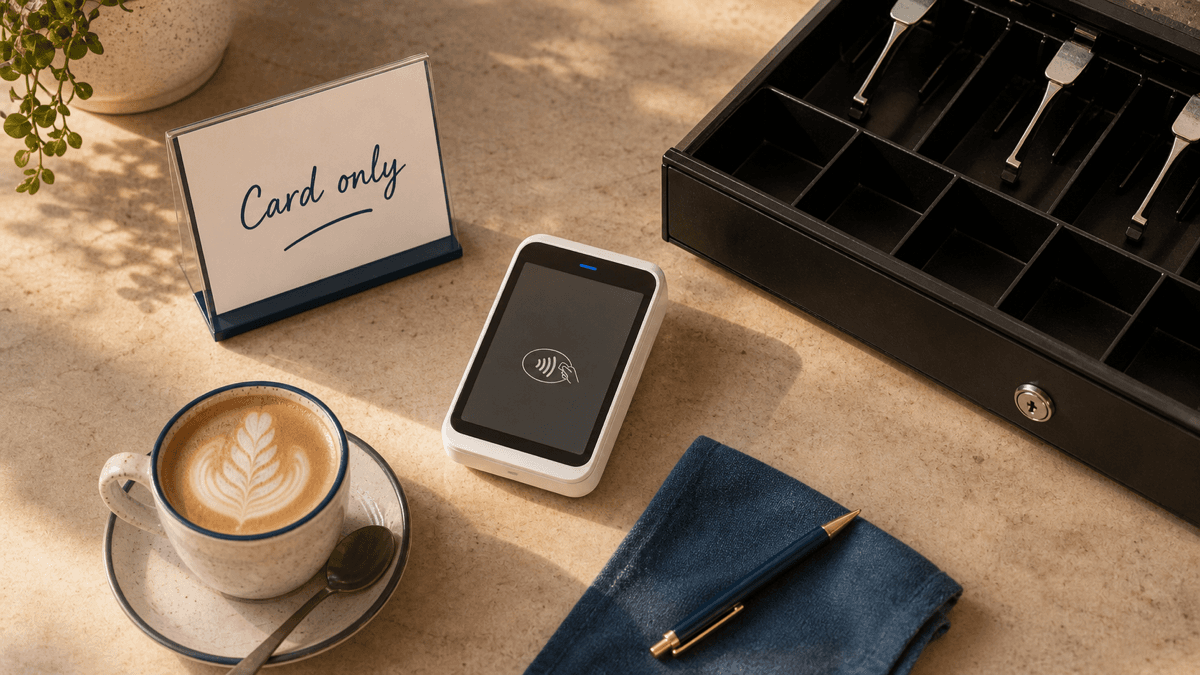
"Cash is king." You've heard it a hundred times. Usually from someone who doesn't have to count it at the end of a long Saturday.
We went fully cashless at Hunters Cake Company in October 2025. I'll be honest about how it's gone, because most of what's written about this is either payment-provider marketing or a pub argument dressed up as advice.
What cash actually costs you
Cash feels free. It isn't. It just hides its costs in places that don't show up on a P&L line.
Here's what cash quietly takes from you every week:
- Cashing-up time. Counting the drawer, reconciling against the till, chasing the £3.40 that doesn't balance. Fifteen minutes a day is over 90 hours a year.
- Banking runs. Driving to a branch that's probably closing soon anyway, queuing, paying to deposit your own takings. Some banks now charge per £100 banked.
- The float. Money sitting in a drawer doing nothing, plus the faff of getting change.
- Shrinkage and theft. Cash is the one thing in your café that walks out the door untraceably. Not always staff - mistakes, miscounts, the odd light-fingered moment. It happens everywhere.
- Counterfeit notes. Rare, but a fake £20 is £20 straight off your margin, and you only find out at the bank.
- Insurance and cash cover. Carrying cash on the premises and to the bank often sits inside your insurance terms. Less cash, less exposure.
None of these are huge on their own. Together they're a steady, invisible drain - the kind of margin leak that, like the true cost of discounting, never announces itself.
The case for going cashless
After eight months without a cash drawer, here's what genuinely improved.
Service is faster. No counting change, no "have you got anything smaller?", no fumbling. The queue moves. On a busy morning that's covers you'd otherwise lose to the door.
No cash-handling time at all. No cashing up. No float to set. No banking trips. That's real hours back, every single week.
No theft or counterfeit risk. There's nothing in the drawer to take. The whole category of problem just disappears.
Cleaner reconciliation. Card takings land in your bank and match your till. No more hunting a £4 discrepancy at 6pm when you want to go home. Your numbers are tidier, which matters when you're trying to read them honestly.
Safer for lone closers. If a barista locks up alone, there's no cash on the premises and no cash to walk to the bank. That's a genuine peace-of-mind change, and worth more than it looks on paper.
Often no extra cost. You already take cards. You already pay the merchant fees. Refusing cash doesn't add a single new charge - though it does mean every sale now carries those fees, so know your number first.
That last point is the one people miss. You're not signing up for card fees by going cashless. You're already paying them. What you should do before you flip the switch is understand exactly what they are, because the real cost of your card machine is often higher than operators think once terminal rental, PCI charges and minimums are in.
The honest case against - who should think twice
This isn't a one-size-fits-all decision, and I'd be doing you a disservice to pretend it is. Cashless is right for my sites. It might be wrong for yours.
Think hard before going cashless if any of these are you:
- A genuinely cash-heavy customer base. Some areas, some demographics, some older or rural customers still prefer cash and always will. If a real chunk of your takings is cash, you'll lose sales, not just convenience.
- The customer who only carries cash. Every café has a few regulars who'll never tap a card. Cashless means turning them away. Only you know how many that is and whether you can wear it.
- Market-stall or event trade. Pop-ups, fetes, festivals - patchy wifi and a queue that won't wait. Cash is your fallback when the signal drops.
- Charity tins. That collection box by the till runs on loose change. Cashless quietly kills it. Not a dealbreaker, but worth a thought.
- Cash tips for staff. This is the one that catches people out.
On tips: if your team relies on the cash jar, going cashless changes how they get paid. The fix is straightforward - move to card tips run through a proper tronc arrangement so tips are shared fairly and handled correctly for tax. Most modern card systems support adding a tip at the terminal. Sort this before you go cashless, not after, or your team will notice their tips dropped overnight and you'll have an unhappy floor.
The maths, kept honest
Let's be balanced, because the cashless case is easy to oversell.
What stays the same: card fees. You pay them whether you're 70% card or 100% card. Going cashless pushes every sale onto cards, so your total fee bill goes up in proportion to the cash you used to take. That's a real cost and you should price it in.
What you save: the cash overhead. Staff time cashing up and banking, the float, shrinkage, counterfeit losses, and a slice of insurance exposure. For a small independent, that's often a few hundred pounds a year in hard costs plus a chunk of time you can't easily price but definitely feel.
So the question isn't "free vs fees". It's "the extra card fees on my old cash takings vs everything cash was quietly costing me anyway". For most small cafés with a modest cash share, the overhead saved outweighs the extra fees. For a cash-heavy site, it might not.
This is the same kind of margin-leak thinking that applies to delivery platform commission - every pound that leaves your business via a third party deserves to be measured, not assumed. Card fees are no different. Know the number, then decide.
A simple decision framework
Before you flip the switch, ask yourself:
- What share of my takings is cash right now? Pull a month of till data. Under 10%, cashless is low-risk. Over 30%, tread carefully.
- Who pays in cash, and can I afford to lose them? Be honest about your regulars.
- What's my blended card rate? If it's high, fix that first.
- How are my staff tipped? Have the tronc/card-tip plan ready before launch.
- What's my backup if the network drops? Have an answer.
If those land comfortably, here's how to trial it rather than betting the business on a hunch:
- Go card-only at one till first. If you've got two terminals, make one card-only and watch what happens at it.
- Put up clear, friendly signage. "We're card only" at the door and at the till. No one likes finding out at the point of paying.
- Soft launch for a fortnight. Track lost sales, listen to the grumbles, and look at the numbers, not the loudest customer.
- Then decide for good. If your turnover holds and your evenings got quieter, you have your answer.
When you can see your costs clearly, this stops being a gut call and becomes a numbers one.
The takeaway
I much prefer being cashless. The grumbles were real but few, and day to day the business is simpler: no theft worry, no counterfeit notes, no cash-up errors, no float, no banking trips, and a faster till. For my sites, it was clearly the right move.
But it's a judgement call, not a rule. The right answer depends on your customers, your cash share, your card rate and your nerve on a bad-signal day.
So this week: pull a month of till data, work out your cash share and your blended card rate, sort your staff tips, and trial card-only at one till. You'll know within a fortnight whether cashless is right for your café. That's a far better way to decide than a saying on a chalkboard.
Ed O'Brien has run Hunters Cake Company for 17 years across cafés in Witney, Burford, and a bakery in Carterton, Oxfordshire. He's building Brikly - modular tools that give independent café owners the same data the big chains have, without the big chain price tag.