The real cost of Deliveroo, Uber Eats and Just Eat for a café
A new order pings in on the tablet. An £8 lunch plate, a £4.50 flat white, a £2.50 cookie. Fifteen quid, lovely.
You make it, bag it, hand it to a rider. The customer is delighted. You are busy. Everyone's happy.
Then the monthly statement lands and the deposit is a lot smaller than you expected. Not because the orders dried up - because somewhere between the order pinging in and the money hitting your account, a quarter to a third of every ticket quietly walked off with the platform.
Most operators sign up to Deliveroo, Uber Eats or Just Eat without ever doing the margin maths. The rep makes it sound free. "No upfront cost, you only pay when you sell." That is true, and it is also the most expensive sentence in the conversation. Because what you pay when you sell is enormous, and almost nobody works out what's actually left.
Here's what's actually left. And then, more usefully, here's how to turn the channel from a margin drain into a customer-acquisition machine.
What the platforms actually charge
The headline number is commission, and it is high.
- Deliveroo, Uber Eats, Just Eat: typically 25-35% commission on the order value, depending on your package and whether the platform handles delivery or you do.
- VAT on the commission: the fee itself is a service, so you pay 20% VAT on top of the commission. If you're VAT registered you may reclaim it, but it's still cash out of the door first, and plenty of smaller cafés aren't registered.
- Other bits: payment processing, optional "boost" or advertising spend to appear higher in the app, and the cost of the packaging that a delivery order needs and an eat-in order doesn't.
So when a platform says "30% commission," the real drag on a £15 order is closer to:
- 30% commission = £4.50
- 20% VAT on that £4.50 fee = 90p
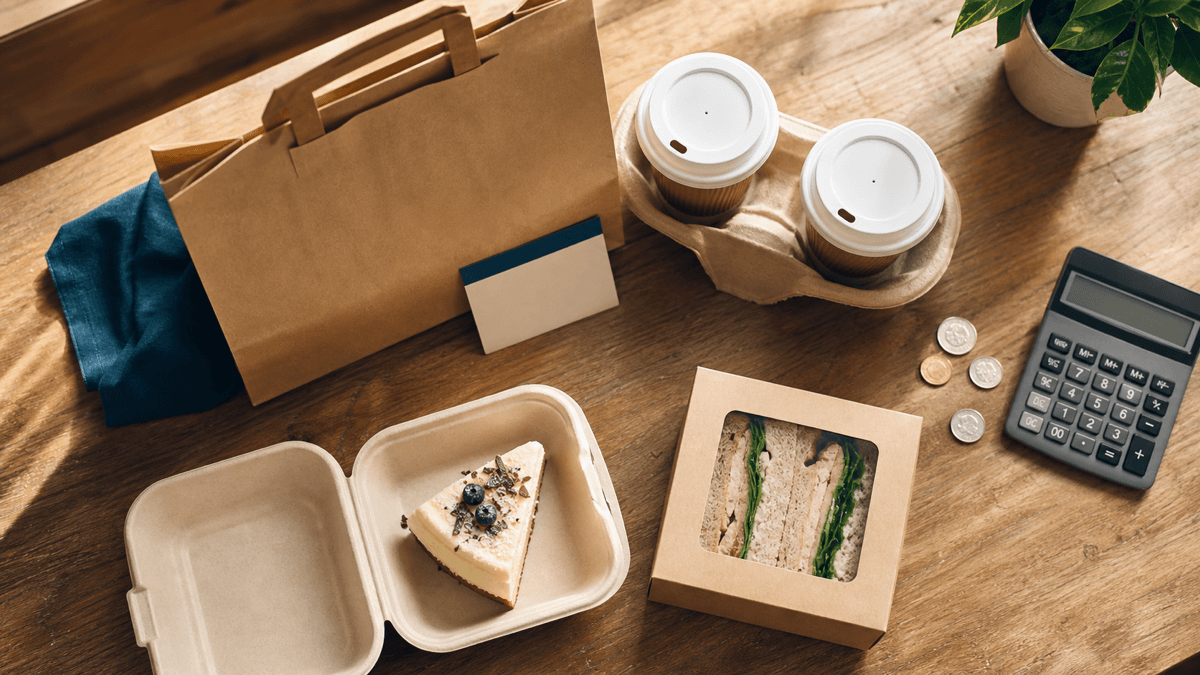
- Extra packaging (boxes, cup carriers, bags, the lot) = maybe 60-90p on a three-item order
That's roughly £6 of cost on a £15 order before you've bought a single ingredient or paid a single barista. Forty percent of the ticket, gone, on the channel alone.
Taking an £8 plate all the way through
Let's do the full maths on a single item, because the headline numbers hide where it really hurts.
Take an £8 lunch plate - a decent toastie or a salad box, the kind of thing that sells well on delivery at lunchtime.
| Line | Amount |
|---|---|
| Menu price on the platform | £8.00 |
| Platform commission at 30% | -£2.40 |
| VAT on the commission (20% of £2.40) | -£0.48 |
| Delivery packaging (box, bag, label) | -£0.45 |
| Left after the channel takes its cut | £4.67 |
| Food cost (ingredients, say 30% of £8) | -£2.40 |
| Gross margin left to cover labour, rent, everything else | £2.27 |
So an £8 plate that would leave you around £5.60 of gross margin eaten in leaves you £2.27 on delivery. Less than half. And that £2.27 still has to cover the labour to make it, the rent on the kitchen, the energy, the card fees - the same fixed costs you carry whether the order comes through the door or through the app.
On a thin-margin item, this is exactly where delivery tips into a loss without anyone noticing. If you understand why food cost percentage alone misleads you, you'll already see the problem: a 30% food cost looks healthy until a channel skims 38% off the top before the food cost even applies.
The flat white is worse in percentage terms. A £4.50 coffee with maybe 80p of inputs looks gorgeous in-store. Run it through 30% commission, VAT on the fee, and a cup-plus-carrier that's dearer than your eat-in cup, and you're handing the platform more margin than you keep. A single coffee on delivery is very often a loss-maker.
Price a separate delivery menu
This is the single most important operational move, and most cafés skip it.
Your in-store menu and your delivery menu should not be the same prices. The platforms know this - they expect it, and they allow it. A modest uplift on the delivery menu is standard practice, not sharp practice. You are simply pricing in the cost of the channel.
A few principles:
- Uplift to protect the margin you'd keep in-store, not to gouge. If commission and VAT take roughly 36% off the top, an uplift in the region of 15-25% on delivery prices brings your net back toward your in-store margin without making the menu look silly next to competitors.
- Don't uplift evenly. Low-input, high-price items (coffees, cakes) can absorb less uplift and still work. Labour-heavy, low-margin plates need more, or they shouldn't be on the delivery menu at all.
- Cost the delivery version as its own recipe. A delivery toastie is a different product to an eat-in toastie: different packaging, no crockery, no table service, but a thumping channel fee. Treat it as its own costed line so you can see its real margin, the same way you'd treat any hidden cost like a modifier or an extra as its own line rather than burying it in the base item.
- Set a floor. Decide the minimum margin you'll accept on delivery and don't list anything below it. A £4.50 standalone flat white that loses money has no business being orderable on its own.
You can model all of this before you commit. Run a few of your top delivery items through a free recipe costing tool, add the commission and VAT as a cost line, and you'll see in ten minutes which items work on delivery and which ones you're subsidising.
Now flip it: the platforms are a customer-acquisition channel
Here's the reframe that changes how you should think about all of this.
The commission is brutal on margin. There's no spinning that. But Deliveroo and Uber Eats are not just an expensive way to sell a toastie. They are one of the cheapest ways you'll ever get a new customer to discover you.
Think about what those apps actually are. Thousands of people in your area, hungry, scrolling, choosing where to order from tonight. People who have never heard of you. People who would never have walked past your door because they live two streets the wrong way. The platform puts you in front of them and only charges you when one of them actually buys.
A chain pays a fortune in advertising to get a stranger to try them once. You're getting that same first try, and you only pay for it on conversion. That's a remarkable acquisition deal - if, and only if, you treat it as acquisition rather than as your whole delivery business.
So here's the smarter way to look at that loss-making first order:
The thin or negative margin on a new customer's first order is a marketing cost. You'd happily spend a few quid to acquire a new customer through a leaflet drop or a Facebook ad. The platform is letting you spend that same few quid, but only on people who've already proven they'll buy from you. The question is not "how do I make money on this order?" The question is "how do I turn this person into a direct customer, where I keep the full margin?"
That's where the next two moves come in. The whole game is to mine the platforms for customers and then pull those customers off the platforms onto your own channels.
Move one: put something in every bag
The cheapest, highest-return thing you can do on a delivery order costs about a penny.
Put a small printed card or flyer in every single delivery bag. Not a generic advert. A short, warm, specific message that turns an anonymous app order into a relationship.
What goes on it:
- "We're round the corner." Your actual address, with a line like "That lunch came from our kitchen on the high street - come and see us." Most delivery customers have no idea you're a real place two minutes away.
- Your opening hours. Make it effortless to visit in person.
- A discount code for in-store. This is the hook. "Show this card for 20% off your first visit" or "Free cake with any coffee, in-store this month." You're trading a slice of margin to convert a platform customer into a direct one - and in-store, you keep 100% of the margin instead of 60-65%.
- A reason to come. A QR code to your own website or click-and-collect, your Instagram, a loyalty card you stamp in person.
The maths here is genuinely compelling. The discount you offer in-store comes out of margin you fully own, not margin the platform has already halved. Before you set the code, it's worth understanding the real maths of discounting so you pick a number that pulls people in without giving away more than the new customer is worth. A 20% in-store discount that converts an app customer into a regular who visits weekly at full margin is one of the best returns on a penny of card stock you'll ever get.
A few practical notes. Keep it on-brand and genuine, not a desperate "please leave the app" plea - that reads badly and the platforms don't love it. Frame it as hospitality: "Lovely to feed you. Even lovelier if you popped in." And track it. A unique discount code per channel tells you exactly how many platform customers you've converted to direct, which is the number that tells you whether the whole exercise is working.
Move two: run your own delivery and collection
The flyer pulls people toward your counter. Your own delivery and collection service pulls them onto a channel where there's no commission at all.
If a meaningful share of your delivery demand is genuinely local - the next few streets, the offices round the corner - you don't necessarily need a platform to reach them. You need them to know you'll deliver direct, and a reason to bother.
Two routes, depending on your setup:
- Click-and-collect, promoted hard. The simplest version. A page on your own site, or even just a phone number and a WhatsApp, where customers order direct and pop in to grab it. No rider, no commission, full margin. Promote it relentlessly: on the card in the bag, on your windows, on your socials. "Skip the app fees - order direct and collect, 10% off when you do."
- Your own local delivery, with a promotion. If you've got a member of staff with a quiet hour, or you're in a tight enough catchment, direct delivery for nearby orders cuts the platform fee entirely. Even after you pay for the time and the petrol, keeping the 30% you'd have handed over usually leaves you well ahead. Launch it with a promo - "free local delivery over £20, order direct" - so customers have a concrete reason to switch.
The promotion is the switching cost. People default to the app because it's frictionless and familiar. A clear, time-limited offer - free delivery, a discount, a freebie - is what's needed to break the habit and get them ordering direct the first time. After that, if your food's good and your direct channel is easy, plenty of them stick.
You will not move everyone. Some customers will only ever order through the app, and that's fine - keep serving them on a properly priced delivery menu so those orders at least wash their face. But every customer you move from a 30%-commission channel to your own direct channel is a permanent margin upgrade on someone you acquired through the platform in the first place.
That's the whole strategy in a sentence: don't just tolerate the platforms, mine them for customers and pull people off them onto channels you own.
A simple plan to stop the leak
If delivery is running and you've never done the maths, here's a tight sequence you can work through this week.
- Cost your top ten delivery items properly, including commission, VAT on the commission, and delivery-specific packaging. Find out which ones make money and which ones you're subsidising.
- Build a separate delivery menu with an uplift sized to protect your margin. Drop or reprice anything below your floor. Pull the standalone loss-making coffees off as solo items.
- Order a batch of in-the-bag cards with your address, hours, a unique in-store discount code, and a QR to your own ordering. Put one in every order, starting tomorrow.
- Stand up a direct collection option - even a simple one - and promote it on every card, window and post you have.
- Track conversions with channel-specific codes, so you can see how many platform customers become direct regulars. That number tells you whether the strategy's working.
None of this stops you using the platforms. It stops the platforms using you.
Where Brikly Fits
Delivery margin is a costing problem before it's a strategy problem. You can't price a delivery menu sensibly if you can't see what's actually left after the channel takes its cut.
CostingBrik lets you cost a separate delivery menu as its own set of recipes. A delivery toastie and an eat-in toastie are different products - different packaging, different price, and one of them carries a 30-plus-percent channel fee. Cost them separately and you can see the real margin on each, side by side, instead of assuming delivery works because the counter version does. When packaging or ingredient prices move, every delivery recipe updates with them, so the margin you're looking at is today's, not last year's.
MenuBrik then pulls your sales mix so you can see what's actually selling on delivery versus in-store. That tells you which items deserve a place on the delivery menu, which ones are quietly losing money on every order, and - over time - whether your in-the-bag cards and direct-collection push are genuinely moving customers off the platforms and onto channels you own.
The strategy in this post is yours to run. The job of knowing, item by item, whether delivery is making or losing you money is the kind of thing software should just tell you.
Ed O'Brien has run Hunters Cake Company for 17 years across cafés in Witney, Burford, and a bakery in Carterton, Oxfordshire. He's building Brikly - modular tools that give independent café owners the same data the big chains have, without the big chain price tag.