
The goods-in check: matching what arrived to what you ordered before you pay
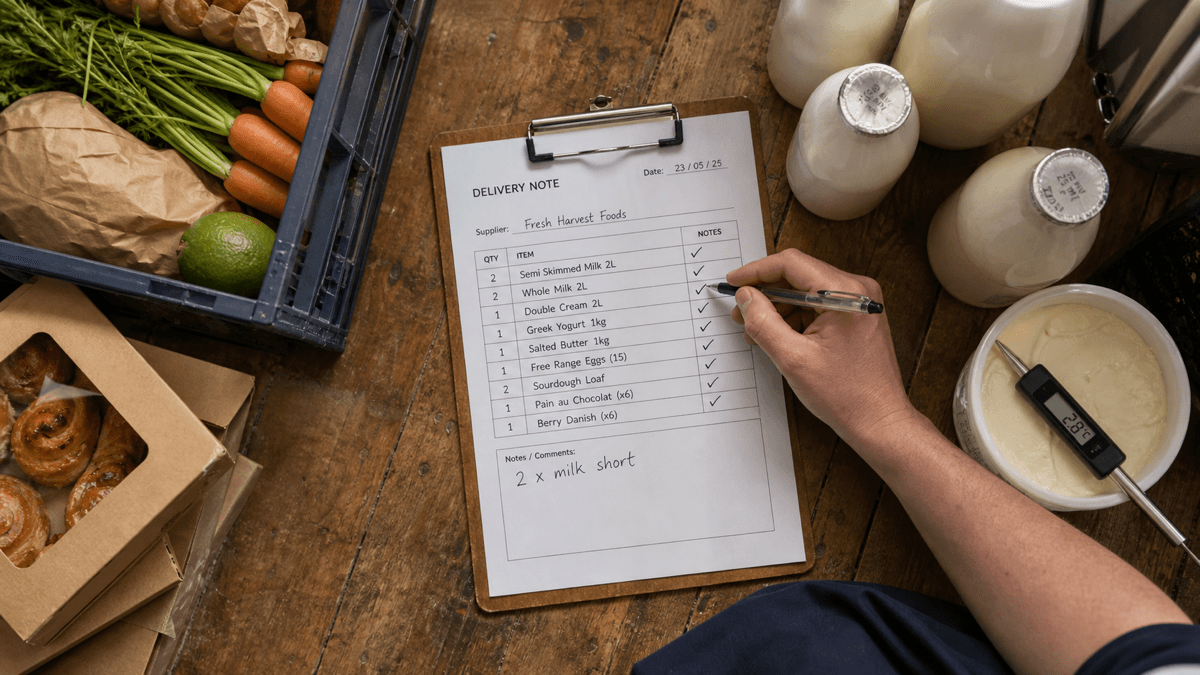
It's 8:40am, the machine's already three flat whites deep, and the driver is stacking crates by the back door with the engine still running. He hands you a delivery note and a pen, taps the screen on his handheld, and says the line every operator knows: "Just need a signature, boss."
So you sign. Of course you do. There's a queue building and the crates look about right.
That signature is where a lot of small, invisible losses begin. Because you didn't just confirm the van turned up. You confirmed you received everything on that note, in full, in good condition. And you've now got no leg to stand on when one of those crates turns out to be light.
The one job goods-in actually has
Receiving a delivery is not about being handed boxes. It's about answering one question before you commit: does what physically arrived match what you ordered and what the paperwork says you're being charged for?
That's three things, not two, and they don't always agree:
- Your original order - what you actually asked for, placed by someone who was allowed to place it.
- The delivery note - what the supplier says they've sent.
- The physical goods - what's really in the crates on your floor.
When all three line up, sign and move on. When they don't, you've caught something before it becomes a cost. Miss the check and the gap doesn't disappear. It just travels downstream, quietly, onto an invoice you'll pay in full for stock you never got.
This is the human step that has to happen before any clever software gets involved. AI invoice processing is brilliant at pulling every line and charge off the document, but it matches what's printed. It has no way of knowing the crate marked "6" only had 4 in it. The honesty of the whole chain starts at your back door, with a person counting.
The 60-second three-way check
You don't need a receiving bay or a clipboard system. You need one minute of attention while the driver is still there. Here's the routine.
Count the goods against the note, not the note against the goods. This sounds like hair-splitting. It isn't. If you read the note first and then look at the crates, your brain fills in what it expects to see. Count what's physically there, out loud, then find it on the note. Six litres of milk on the floor, tick it off. Two boxes of pastries, tick. You're verifying reality, not confirming a story.
Watch for the three things that go wrong:
- Shorts. You ordered 6, the note says 6, the crate has 4. The most common loss of all, and the easiest to miss because the paperwork looks perfect. Only a physical count catches it.
- Substitutions you didn't ask for. They were out of the 2.5kg block of cheddar, so they've sent two 1.25kg blocks, or a different brand, or a mild instead of a mature. Sometimes that's fine. Sometimes it wrecks a recipe or comes at a different price. Either way, you decide whether to accept it, not the packer in the depot.
- Damage and condition. Crushed bread, split bags, a leaking tub, produce that's turned. If it's not usable, it's a short by another name.
Probe anything chilled or frozen before it goes anywhere near your fridge. If dairy, cooked meats or fresh cream turn up warm, you're within your rights to refuse them on the spot. I won't re-teach the temperatures here - there's a full cold-chain delivery playbook in the heatwave guide covering probe-on-arrival, the reject decision and why you never sign for chilled stock and leave it by the door. Read that one and bake it into this same 60 seconds.
Then check the paperwork's own maths. Glance at the bottom of the note for anything that isn't a product line: a carriage charge, a small-order surcharge, a delivery fee. Those aren't errors, but they're real money, and minimum-order and delivery charges have a habit of quietly inflating what you pay. You want to have seen them before they land on the invoice, not after.
Sign nothing you haven't counted
Here's the bit that matters most and costs nothing to fix: your signature is a legal receipt, not a hello.
When you sign a delivery note or tap the driver's handheld clean, you're providing proof of delivery. In plain terms, you're on record saying "I received all of this, as listed, in good condition." If a short or a damaged item surfaces later, the supplier's first question is: well, you signed for it. And they're not wrong to ask.
So change what your signature means. Two simple disciplines:
- Check off, then sign. Tick each line as you physically confirm it. The ticking is the check. A note with every line ticked and then signed is a note you've actually verified.
- Sign short, in writing. If something's missing, damaged or substituted, don't sign the note clean. Write the discrepancy on it before you sign: "2 x milk short", "cheddar substituted, not ordered", "1 bread crate crushed". Note it on your copy and, ideally, the driver's. That written note is your claim. A clean signature is the supplier's defence.
That's the whole game. A signature says "all good." An annotated signature says "here's exactly what wasn't." One of those protects you.
When the driver won't wait
The honest objection: drivers are on a tight route and half of them won't stand around while you count. Fair. You still have options, and none of them is "sign it clean and hope."
- Count the high-value and the perishable first. You can't inspect every napkin before the van pulls off. You can prioritise. Check the meat, the fish, the cheese, the coffee, the fresh cream - the lines where a short actually hurts - and eyeball the ambient long tail. This is the same 80/20 logic that makes a café stocktake worth doing at all: a handful of lines carry most of the money.
- Write "unchecked" on the note before you sign. If they genuinely won't wait, don't sign as if you've verified it. Write "received unchecked, subject to inspection" next to your signature. It's not as strong as a full count, but it puts the supplier on notice that a clean signature isn't a full acceptance, and it protects a later claim.
- Photograph what looks off. A crushed crate, a leaking tub, a pallet count that's clearly light. Ten seconds on your phone, timestamped, before the van leaves. Photos win credit-note arguments that "he said, she said" loses.
A driver in a hurry is a reason to be quicker and firmer, not a reason to sign blind.
What to do with a discrepancy
You've caught a short. Now close it, or it's just a note in a drawer.
Raise it the same day. Ring or email the supplier while it's fresh, quote the delivery note number, and state exactly what was wrong: line, quantity, the annotation you made. Ask for a credit note, not a vague "we'll sort it." A credit note is a document. A promise is not. And even a promised credit is only money once you have chased it and reconciled it against the invoice, not the moment the depot says yes.
Don't pay the invoice against the note, pay it against what arrived. This is the join that catches everything. When the invoice comes in, it'll almost certainly bill the full ordered quantity, because it's generated from the order, not from your back door. If you've got your annotated delivery note, you can match invoice to reality and short-pay or claim the difference. If you signed clean, you've got nothing to match against, and the invoice-matching step downstream will happily reconcile a perfect paper trail for goods you never received. That annotated note is also what lets you prove a phantom drop when you check the statement at month end.
Watch for the repeat. One short is a mistake. The same line short three weeks running is a pattern, and it's costing you every time. A short that clears your back door unchallenged doesn't just cost you that stock - it inflates your purchase records, which quietly throws off your COGS and makes your stocktake variance harder to read when you go looking for where the money went.
The 60-second habit, start tomorrow
You don't need a system. You need a minute and a rule that your signature is earned, not given.
- Count the physical goods, out loud, against the note - reality first, paperwork second.
- Flag shorts, unrequested substitutions and damage on the spot.
- Probe anything chilled and refuse it if it's warm.
- Glance at the footer for carriage and surcharges you weren't expecting.
- Tick each line, then sign - and if something's wrong, write it on the note before you sign, never after.
- Raise a credit note the same day and match the eventual invoice to what actually arrived, not to what was ordered.
The invoice, and every automatic match that runs off it, is only ever as honest as this one check. Get it right at the back door and the whole chain downstream is telling you the truth. Skip it when you're busy - which is exactly when the shorts show up - and you're paying full price for stock that never made it past the van.
Brikly's CostingBrik does the downstream half: it reads the whole invoice, tracks supplier prices as they move, and updates every recipe cost automatically. But it's reading the invoice, and the invoice trusts the delivery note. The count is still on you. It always was. Sixty seconds, back door, pen in hand.
Ed O'Brien has run Hunters Cake Company for 17 years across cafés in Witney, Burford, and a bakery in Carterton, Oxfordshire. He's building Brikly - modular tools that give independent café owners the same data the big chains have, without the big chain price tag.