
What's your café actually worth? Getting the numbers sale-ready
Somebody asks what your café is worth and the first number out of your mouth is the turnover. Mine used to be. It's the figure you know by heart, so it feels like the answer.
It isn't. A buyer never pays for turnover. They pay a multiple of a profit figure, and not even the profit figure on your accounts. They pay a multiple of an adjusted profit figure that they, or more likely their accountant, are willing to defend in front of a lender.
That distinction is where most of the money in a sale sits. Every adjustment you can evidence gets added back and multiplied. Every adjustment you cannot gets quietly deleted, and at a multiple of two, a £4,000 add-back you can't prove costs you £8,000 off the price.
Here's what actually gets multiplied, which adjustments survive scrutiny, and what to do in the three years before you sell.
The number that gets multiplied
Kill the instinct first: "it turns over £180,000 so it's worth £180,000" is not how anything works. Nobody buys a top line.
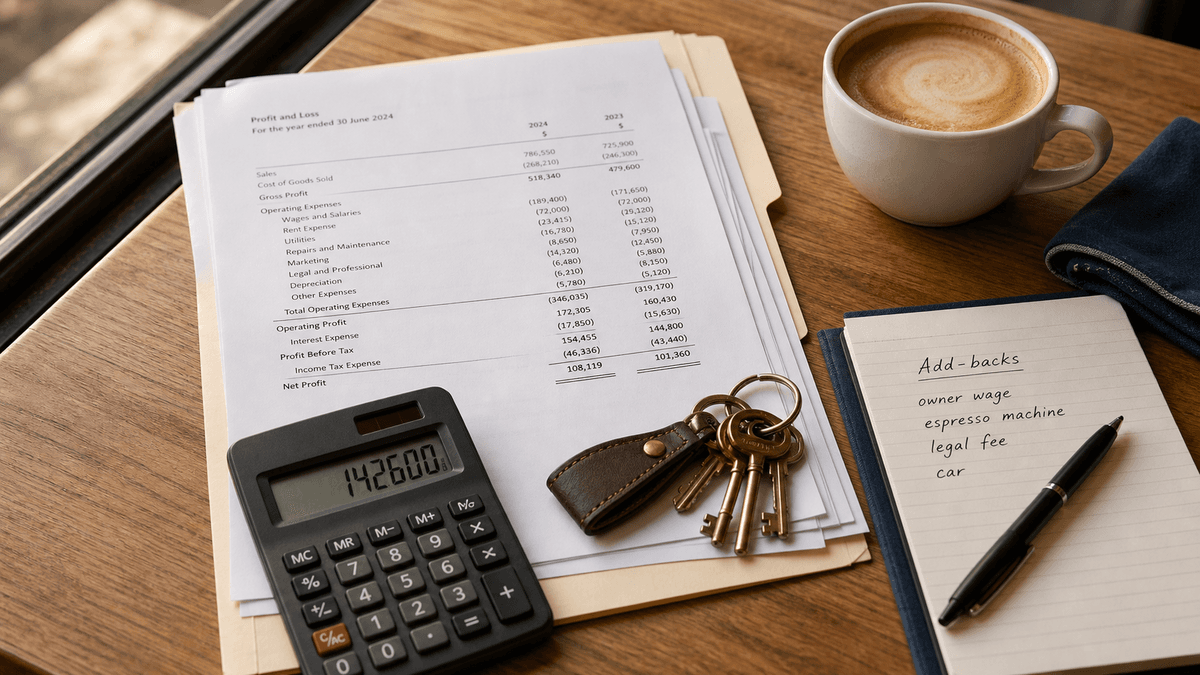
What gets valued is adjusted net profit, sometimes dressed up as seller's discretionary earnings. Start with your net profit, add back the things a new owner genuinely wouldn't have to spend, and the result is the annual earnings a buyer believes they'd be stepping into. That's the number the multiple lands on.
Brokers typically talk about somewhere around 1.5 to 2.5 times adjusted annual profit for a small leasehold, owner-run café, with the stronger end reserved for businesses that don't depend on the owner and can prove it. Multi-site groups and anything with a freehold attached get discussed in completely different terms. Treat those as conversation-starters rather than promises, because two cafés with identical profit can be a year apart on price for reasons that have nothing to do with the coffee.
One structural note worth having early. If you trade through a limited company, a buyer can take the shares and the business carries on inside the same entity: the VAT registration, the trading history, the supplier accounts, often the lease. That continuity is worth real money in the price because there's less for the buyer to rebuild. The trade-off is that they inherit the company's past as well as its present, so expect deeper digging, warranties, and sometimes a chunk of the price held back. A sole trader is selling assets instead: fit-out, lease, goodwill, customer list, with the buyer starting fresh at HMRC. The tax treatment of the money you walk away with differs meaningfully between the two routes, and while the sole trader versus limited company breakdown covers the structure, only your accountant can tell you which applies to you. Have that conversation well before you list.
Add-backs, and which ones survive scrutiny
This is the heart of it. Add-backs are your argument that the profit on the page understates what the business really earns. Made honestly, they're the difference between a fair price and a punishing one. Made greedily, they're the reason a buyer stops believing anything you say.
The ones that hold up
- Your own wage, above or below market. If you've been drawing £45,000 to do a job a manager would do for £32,000, the difference is a legitimate add-back. If you've been paying yourself nothing, the honest adjustment goes the other way, and a good buyer will make it for you. Either way you need a defensible market figure for the role rather than a number that suits you, which is exactly what the replacement-cost method for setting your own pay is for.
- Genuine one-offs. A new espresso machine, a legal fee for the lease renewal, a flood repair. Things that hit last year's profit and won't recur. Have the invoice.
- Family on the payroll who don't really work there. Common, understandable, and a perfectly fair add-back if the role genuinely disappears on completion day. Be honest with yourself about whether it does.
- The car, the phone, the trade shows. Personal-use costs run through the business that a buyer wouldn't carry. Modest, evidenced, uncontroversial.
The test for all of these is the same: could you hand a stranger a piece of paper that proves it in under a minute? If yes, it's an add-back. If it lives only in your head, it's a story.
The ones buyers laugh at
- "I'd have made more if I'd opened Sundays." Or done deliveries, or pushed catering. Nobody buys profit you didn't make. Upside belongs to the buyer, and asking them to pay for their own future work is the fastest way to look green.
- Personal spending routed through the business. Not the car. The family holiday booked as a research trip, the kitchen appliances that ended up at home. Adding these back tells the buyer two things: the profit is overstated, and so is your judgement.
- Undeclared cash. This is worth exactly nothing, and worse than nothing. A buyer cannot bank it, cannot lend against it, and cannot show it to anyone. And the moment you claim it, every other number you've given them becomes suspect. You've just told a stranger you misreport to HMRC and expected it to help your price.
Why the multiple moves
Two cafés, same adjusted profit, different prices. Here's what's actually driving that gap.
Lease length remaining is the biggest lever you control. A buyer looking at three years left is buying a renewal negotiation they haven't budgeted for. Ten years with a clean review pattern is an asset. This is the one thing you can genuinely fix before you sell, and it's worth knowing that renewing early to hand over a long term can put more on the price than the rent concession you were fighting for. If you're heading into that conversation, the levers that actually move money at lease renewal are the ones to pull, ideally two years before you list rather than two months.
Owner-dependency. A business that needs you every morning is a job with a lease attached. One that trades properly on a week you're away is a business. Buyers price the difference bluntly, and there's a whole post on building a café that runs without you that doubles as sale preparation whether you ever sell or not.
Staff retention. A settled team with a manager who's been there four years is worth a chunk of the price on its own. High churn tells a buyer they're inheriting a recruitment problem in month one.
Concentration risk. If one wholesale account is half your turnover, you don't have a café, you have a supplier relationship with a shop attached. Anything above roughly a fifth of takings sitting with one customer will get discounted, and quite reasonably.
Whether the margin is documented or vibes. "I think we run at about 68%" and "here are 36 months of recipes costed from real supplier invoices" are the same claim with wildly different prices attached, because uncertainty is something a buyer discounts for by default. Keeping recipe costs current from the invoices as they land is what tools like CostingBrik are for, and it happens to leave you with exactly the evidence trail a buyer wants.
The three-year runway
Sale-readiness isn't a fortnight of tidying. It's a calendar. Work backwards from when you'd like to be out.
Year minus three. Get every recipe costed from real invoices so gross margin is provable line by line, not asserted. And stop routing personal spending through the business today, because the last three years of accounts are the ones a buyer reads, and every scruffy line you remove now is one you won't have to explain later.
Year minus two. Move yourself onto a fixed monthly salary by standing order so the P&L reads clean and the wage add-back is one obvious line rather than a scatter of drawings. Sort the lease. If a renewal or an extension is available, take it, even if the rent isn't perfect.
Year minus one. Everything reconciles. VAT returns clean, POS exports that tie to the bank, no odd adjustments, no journal entries your accountant has to talk a buyer through. Buyers weight the final year hardest, and it's the year you have least room to fix anything.
You have already read the buyer's checklist
If you want to know how a buyer will pick your business apart, read what a buyer checks before buying an existing café with your own accounts open on the desk. Everything they're told to verify, you should be able to produce without hunting. That post also makes the uncomfortable point about goodwill being worth less when the owner is the goodwill, and it's worth sitting with honestly rather than arguing with.
Here's the awkward part. The café you'd most enjoy owning and the café that sells for the most money are the same café, which is inconvenient, because it means the preparation work is just running the place properly for three years.
Clean numbers, a long lease, a team that copes without you, margins you can prove from the invoices. That's the sale-ready business. It's also the one that's a pleasure to own, pays you a proper wage, and lets you go on holiday. Do the work because it makes the next three years better, and treat the price as what it is: a side effect of running a good business honestly.
Ed O'Brien has run Hunters Cake Company for 17 years across cafés in Witney, Burford, and a bakery in Carterton, Oxfordshire. He's building Brikly - modular tools that give independent café owners the same data the big chains have, without the big chain price tag.