
How much should you pay yourself as a café owner?
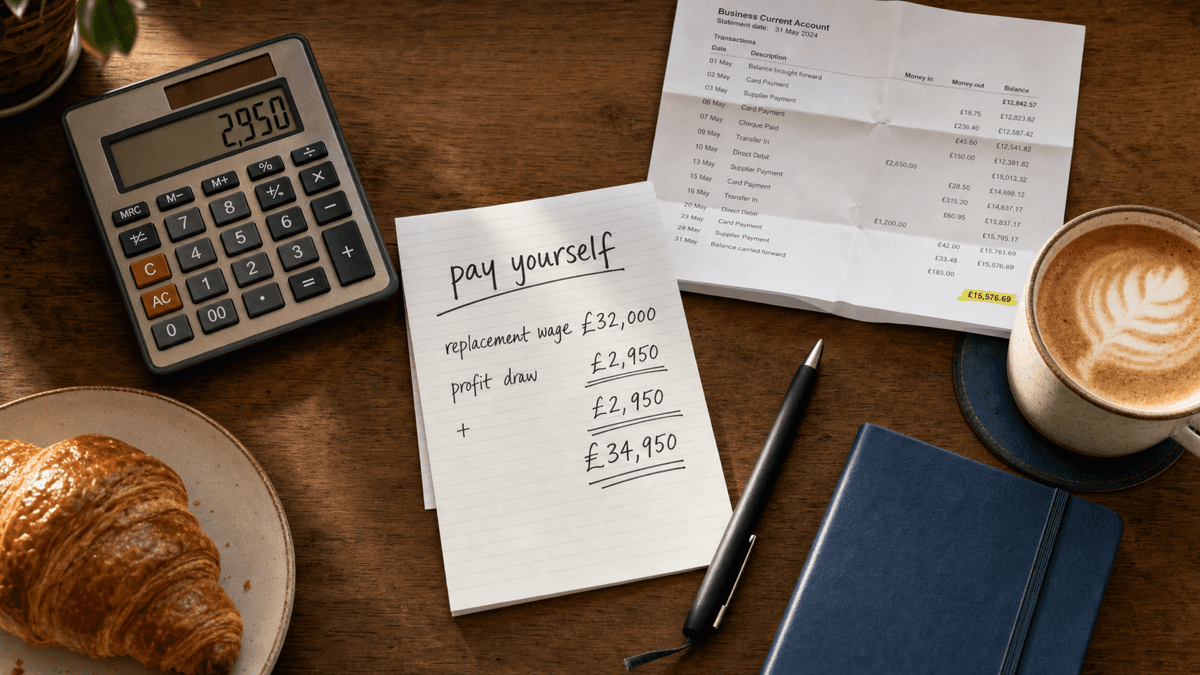
Most café owners pay themselves the same way: they check the bank on a Thursday, see there's a bit spare, and move some of it across to their personal account. Enough to cover the mortgage this month. Maybe a bit more if it was a good week.
It feels responsible. You're only taking what's there. But paying yourself out of whatever happens to be in the account on a given morning is how you end up short in January, panicking when the VAT bill lands, and quietly resenting a business you built.
You already know your wage is a real cost, not the leftovers. The guide to reading your P&L makes that case in full, and I won't relitigate it here. This post is about the question that one doesn't answer: how much can you actually take, and how do you take it without starving the business?
The bank balance on a Thursday is lying to you
Say there's £6,000 in the account. That looks like breathing room. But held inside that number is the VAT you've collected on the last few weeks of sales, which belongs to HMRC. There's next month's rent. There's the supplier invoice that hasn't cleared yet. There's the wage run on Friday.
Strip all of that out and the money that's genuinely yours to take might be £900. Or it might be nothing.
This is the same trap the P&L guide opens with, and it gets worse the moment you start drawing on it. Every pound you sweep out on a Thursday is a pound that isn't there when the quarterly bills arrive. Cafés rarely fail because the coffee was bad. They fail because they ran out of cash, and the owner's own drawings are one of the easiest leaks to miss, because it never feels like spending. It feels like getting paid.
So the first job is to stop paying yourself by feel and start paying yourself by decision.
Pay yourself like an employee, not a slot machine
Here's the single most useful change you can make: pick a fixed monthly figure and pay it to yourself on the same day every month, by standing order. Treat it exactly like a member of staff's wage. It goes out on the 28th whether it was a busy month or a quiet one.
This is a cash-flow decision before it's a tax decision. Whether you take that money as sole-trader drawings or as a small salary plus dividends through a limited company is a separate question, and the sole trader versus limited company breakdown covers the tax mechanics properly. Don't let the tax tail wag the dog here. The structure decides how the money is labelled. Your cash flow decides how much and when.
A steady figure does two things at once.
- It protects the business. A predictable monthly draw is a cost you can plan around, the same as rent. An unpredictable one that spikes whenever the account looks healthy is impossible to budget for, and it always spikes at the wrong time.
- It protects you. A fixed wage means your personal life stops riding the daily till. You know what's landing in your account, so you can run your own budget like a grown-up instead of guessing.
The variable part, the profit on top, comes later and separately. More on that below. The wage part should be boring, regular, and non-negotiable. There's a quiet bonus to doing it this way, too: a steady standing-order salary turns your wage into one obvious line a buyer can adjust, which is worth real money if you ever sell.
How much can you realistically take?
This is the part nobody wants to put numbers on, so I will, with the obvious caveat that these are illustrative ranges, not promises. Your rent, your lease age, your labour model and your site all move these more than anything I can write.
Start from net margin. A well-run independent café lands somewhere between 5% and 12% net in 2026, and what's realistic by café type breaks that down. But remember what that net figure means: on a properly built P&L, it's what's left after a market-rate wage for your role has already been counted as a cost. In the real world, most small cafés haven't counted it, so the owner's total take is the wage plus the profit rolled together. Here's roughly how that stacks up by turnover.
Around £150,000 turnover
At this level you are the labour. You're on the floor most days, and if you weren't, you'd be paying someone £26,000 to £30,000 to do what you do. Net margin at this size is usually thin, often 5% to 8%, so there isn't much genuine profit sitting on top of your wage.
Realistic total drawings: £24,000 to £32,000, and you should be honest that almost all of it is a wage, not a return. The business isn't paying you and making a profit yet. It's buying your time. That's normal at this size. It's only a problem if you tell yourself the difference is profit and spend it like it is.
Around £300,000 turnover
Now you're likely part on the floor, part running the place. Your role is worth more, call it £30,000 to £35,000 to replace. Net margins tend to firm up a little with scale, maybe 8% to 12%, which is where a real profit layer starts to appear on top of your wage.
Realistic total drawings: £36,000 to £50,000, but with a sharp warning. This is the turnover band where working capital demands grow fastest. Bigger VAT bills, a bigger wage run, more stock. Take the top of that range and you'll feel it the first quiet quarter.
Around £500,000 turnover
At half a million you're a manager or a multi-site operator, and your job is worth £35,000 to £45,000 to replace even if you're barely touching a coffee machine. Net margin of 8% to 12% is now a meaningful number, £40,000 to £60,000 of actual profit.
Realistic total drawings: £45,000 to £70,000+, but this is also where owners most often overreach, because the numbers look big enough to feel safe. They aren't. A £500k business needs a reserve to match, and drawing the full profit every month leaves nothing for the quarter when three things break at once.
The pattern across all three: the more you turn over, the more the business needs to keep back, not less. Growth eats cash. Your pay rise has to leave room for that.
A simple method for setting your number
Forget the bands for a second and build your own figure from two parts.
Part one: your replacement cost. What would you have to pay someone to do the job you actually do? Not the founder job, the day-job. If you're a full-time manager and lead barista, price that role at the market rate you'd pay a real person to fill it. This is your wage, and it belongs in your costs whether you draw it or not. If you'd pay a manager £32,000, your wage is £32,000. That's the floor.
Part two: a sustainable profit draw on top. Once the wage is covered and the reserve is funded (see below), a share of what's genuinely left over is your return as the owner for taking the risk. The key word is sustainable. Take it quarterly, after you've seen the money is real and the VAT is set aside, not monthly on a hunch.
Your pay = replacement wage (steady, monthly, by standing order) + profit draw (variable, quarterly, only from what's truly spare).
Splitting it this way fixes the core failure mode. The wage keeps your household running on a predictable number. The profit draw stops you mistaking the VAT you're holding for money you've earned. And it forces the honest question at small scale: if the business can't even cover your replacement wage, you don't have a profit problem, you have a wage problem, and no amount of Thursday sweeping fixes it.
When the honest number is too low
Sometimes you do the maths and the business genuinely can't pay you a fair wage plus a reserve. That's not a reason to underpay yourself quietly and hope. It's a signal to change something.
Usually it's one of three things: your margins are leaking (recipes costed once and never updated, so your gross is lower than you think), your labour is too high for your turnover, or you're personally doing £30,000 of work that a £13-an-hour team member could do, which pins you to the floor and caps the whole business at the size of your own two hands.
That last one is the quiet killer. If you're the cheapest way to staff every shift, you'll never build a business that pays you properly, because you are the cost you're trying to cover. Knowing when to hire your first proper member of staff is often the move that lets the owner's wage become a real number instead of a hope. Buying back your own time is what turns a job you own into a business that pays you.
Keeping the margins honest is the other half. If your recipe costs are current and your worst-performing menu lines are visible, the profit you're drawing from is real profit, not a rounding error waiting to be corrected. That's the whole reason tools like CostingBrik exist, to keep the top of the P&L grounded in what you actually paid your suppliers this month, so the number you pay yourself is built on something solid.
The takeaway
Pay yourself on purpose. Set a fixed monthly wage at the market rate for the job you do, pay it by standing order like any other member of staff, and never let it float with the bank balance. Take profit on top only quarterly, only after the VAT is parked and the reserve is funded, and only from money you've confirmed is genuinely spare.
At £150k you're mostly buying back a wage. At £300k a real profit layer appears. At £500k the numbers get big enough to be dangerous, because the reserve has to grow with them. Whatever your size, the owner who pays themselves a steady, honest figure sleeps better than the one who swept £6,000 out on a Thursday and met the VAT bill on a Monday.
Your wage is a cost. Cost it, pay it, and leave the business enough to carry you through the quiet January that's always coming.
Ed O'Brien has run Hunters Cake Company for 17 years across cafés in Witney, Burford, and a bakery in Carterton, Oxfordshire. He's building Brikly - modular tools that give independent café owners the same data the big chains have, without the big chain price tag.