
When should you hire your first member of staff?
You open on your own. You take the deliveries, pull the coffees, wipe the tables, cash up, and do the orders on your phone while the kettle boils for your own tea at half nine at night.
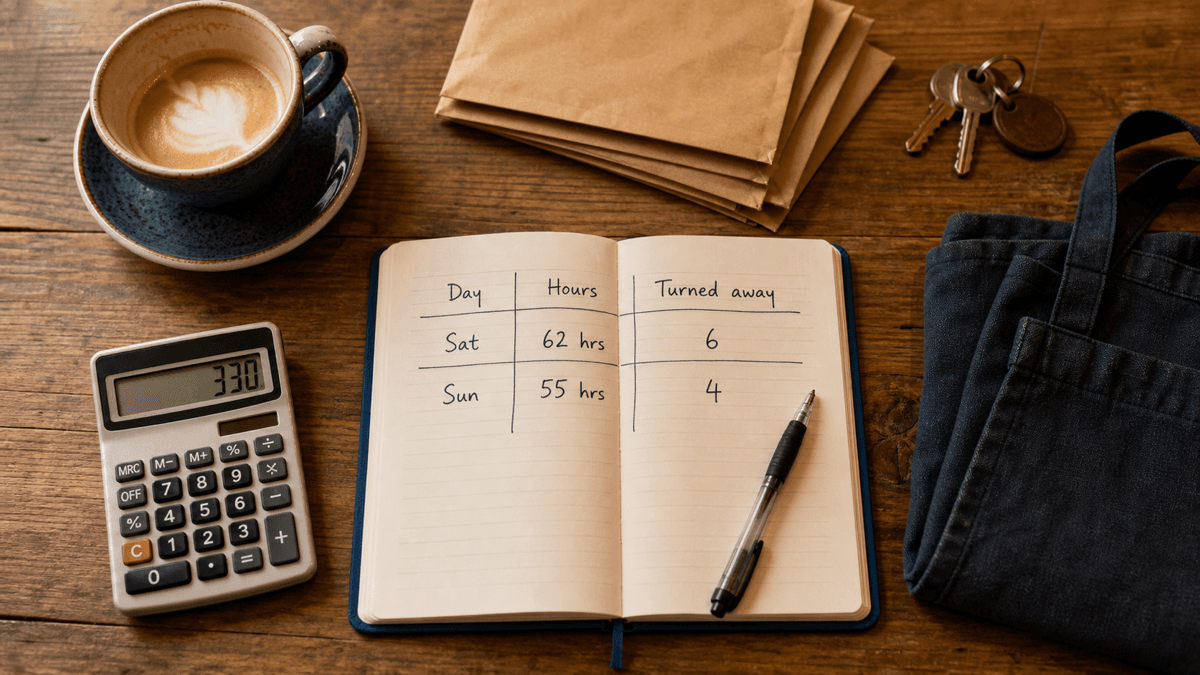
Some weeks it feels fine. Then a Saturday hits, the queue backs up to the door, you turn away a table of six because you physically cannot serve them fast enough, and you drive home wondering whether you're building a business or just buying yourself a very stressful job.
The question underneath all of it is the same one every solo operator circles for months: is it time to take someone on?
Most people answer it with their gut. Their gut says "I can't afford it." So they carry on, knackered, leaving money on the counter they never see. This is the decision that comes before your rota, before you worry about turnover, before any of the staffing mechanics. Let's do it properly.
The signals you've outgrown solo
You don't hire because you're tired. Tired is normal and tired is cheap. You hire when staying solo is costing you more than a wage would. Here are the signals that you've crossed that line.
You're hitting a turnover ceiling you can't push through. There's a number your café tops out at on a busy day, and it isn't set by demand. It's set by how fast one pair of hands can work. If the queue regularly outlasts people's patience, if you're calling "won't be a minute" while three more walk out, you have demand you cannot physically serve. That's not a nice problem. That's turnover walking out the door in trainers.
You're turning away trade you'd love to say yes to. The office round the corner asks about a standing Friday order. A regular asks if you cater christenings. A group wants to book the back tables. Solo, the honest answer is no, because you can't be in two places. Every one of those noes is recurring, predictable, high-margin trade you're declining because you have no cover.
You have no resilience. This is the quiet one. Run solo and your café is one illness, one funeral, one burst pipe away from shutting for the day. You can't take a holiday. You can't go to your kid's sports day. A business that collapses the moment you step back isn't really a business yet, it's a job you've built around yourself, and it's fragile in exactly the way that costs you the most on the worst possible day.
You're spending your hours on the wrong things. More on this below, because it's the heart of it. If you're spending your best trading hours making flat whites instead of chasing the catering lead, fixing your menu margins, or getting your Google reviews up, you're using a £30-an-hour brain on a £13-an-hour task.
If two or three of those ring true, you're not "thinking about maybe one day." You're already leaving money on the table. The only question left is whether the numbers back up what your body already knows.
Hire against a costed break-even, not a feeling
Here's the shift that changes the whole decision. You don't ask "can I afford this?" You ask "what does this person have to unlock to pay for themselves?" That's a number. You can work it out on the back of a napkin.
Step one: cost the role properly
The wage rate is never the cost. A team member on the April 2026 minimum wage costs you far more than the headline once you add employer NI, pension, and holiday accrual - the fully loaded figure lands around £16 an hour, not the £12.71 on the payslip. I'm not going to re-derive that stack here, because we've broken the true cost of a hire down line by line already, and the new hire calculator will do it for your exact numbers in about a minute.
Say you're taking someone on for 20 hours a week to cover your peaks. At roughly £16 fully loaded, that's about £320 a week. Round it to £330 to leave room for the odd extra hour. That's your target. That is the number the hire has to clear.
Step two: work out what clears it
Now, how does £330 of extra weekly value actually show up? Two ways, and most first hires do both.
Extra sales you can now capture. If your gross margin after ingredient cost is around 70p in the pound (typical once you're costing drinks and food properly), then to cover £330 of fully loaded wage you need to unlock roughly £470 of extra weekly turnover. That's about £80 a day across a six-day week. One rescued Saturday queue, one standing office order, a few tables you'd otherwise have turned away, and you're there. Not a stretch. A morning.
Owner hours redeployed to higher-value work. This is the half nobody counts. If your new hire covers 20 floor hours, that's 20 of your hours freed. If you spend even half of them on the work that actually grows the place, landing the catering contract, fixing three underpriced menu items, sorting a better coffee deal, the return dwarfs the wage. One corrected margin on a best-seller can be worth more over a year than the whole hire costs.
So the break-even isn't "£330 of new sales or bust." It's "£330, covered by a mix of trade I can now serve and growth I can now go and get." Framed like that, most cafés busy enough to be asking the question are already past break-even. They just never did the sum.
The opportunity cost of your own time
Let's put a proper number on the thing solo operators give away for free: their own hours.
You don't pay yourself £16 an hour to work the floor. You probably don't pay yourself much at all, which is a whole conversation about owner drawings worth having on its own. But the value of your time isn't your wage. It's the best thing you could be doing instead.
An hour on the espresso machine produces one hour of coffees. Valuable, but a trained 18-year-old can do it. An hour spent renegotiating your milk contract might save you £15 a week, every week, forever. An hour landing a standing corporate order might add £200 of recurring weekly turnover. An hour fixing the four menu items you've been underpricing since 2023 might claw back more margin than a whole quiet Tuesday takes.
That's the trap. As the owner you're the most capable person in the building at every job, so you do every job, and the highest-value work, the growth work, never gets done because you're behind the bar. Taking someone on isn't really buying their labour. It's buying back your own attention and pointing it at the work only you can do.
When you weigh the wage against that, the maths flips. The hire doesn't cost you £330 a week. It costs you £330 minus whatever you generate with the hours it hands back. For a lot of operators, that's a negative number. The hire pays you.
The team of one to team of two reality
None of this makes the moment feel comfortable, and it's worth being honest about why.
The cash-flow wobble is real. The wage lands weekly whether or not the extra trade shows up that week. There's a lag between paying someone and seeing them pay for themselves, and that gap sits in your bank account looking frightening. Two things help. First, don't hire at your quietest point of the year, hire into rising trade so the extra sales arrive fast. Second, build a small buffer before you start, ideally a few weeks of the wage in reserve, so the lag doesn't spook you into cutting the hire loose before they've had a chance to ramp. A new starter takes a few weeks to become genuinely productive, and pulling the plug in week three throws away the training you've already paid for.
Handing over feels like losing control. You've done every job to your own standard for years. Watching someone portion a traybake differently, or take a coffee order a beat slower than you would, sets your teeth on edge. Let it. The question is never "is this as good as I'd do it?" It's "is this good enough that the customer comes back?" Almost always, the answer is yes.
What to hand off first
Don't hand over the hardest thing or the thing you love most. Hand over the work that's high-volume, low-judgement, and easy to train. In rough order:
- The repetitive floor work first. Clearing, restocking, dishwashing, basic drinks, the till during quiet hours. It's the easiest to teach and it frees the most of your time fastest.
- Then the peak-hour bar or service, once they've found their feet, so the Saturday queue stops being a one-person bottleneck.
- Keep the judgement work last. Ordering, supplier calls, cashing up, the recipes in your head. These go once you trust the person and once you've written down how you do them. Getting that knowledge out of your head and onto paper is the same systemising work that lets any café run without the owner glued to the counter.
Hand off in that order and the hire starts paying back in week one, on the easy stuff, while you keep hold of the decisions until you're ready to let them go too.
Once you've decided, the mechanics come next
Say yes and a stack of practical questions follows. How many hours, on what contract, at what rate, matched to which parts of your trading day. Do you take on someone permanent or test the water with a fixed term. How do you schedule two people so neither of you is standing around in the dead afternoon.
That's the next layer. Once you have someone in place, building a rota that matches staff to your actual trading shape is what keeps this first hire from tipping your labour percentage the wrong way. If the pressure is seasonal, a fixed-term summer contract might be the right first step. And keep hold of a good first hire once you've made one, because replacing them costs far more than keeping them.
But all of that comes after the decision. And the decision itself is simpler than the fear around it makes it feel.
You're not asking whether you can afford a wage. You're asking whether one more pair of hands unlocks more than it costs, in trade you can finally serve and hours you can finally spend on growing the place instead of running it. Cost the role, set the break-even, count the hours you'd get back, and be honest about what you'd do with them.
Most operators who are tired enough to be reading this are already past the line. They're just waiting for permission to do the sum. Consider this it.
Ed O'Brien has run Hunters Cake Company for 17 years across cafés in Witney, Burford, and a bakery in Carterton, Oxfordshire. He's building Brikly - modular tools that give independent café owners the same data the big chains have, without the big chain price tag.