
Markup vs margin: the pricing mistake that quietly kills café profit
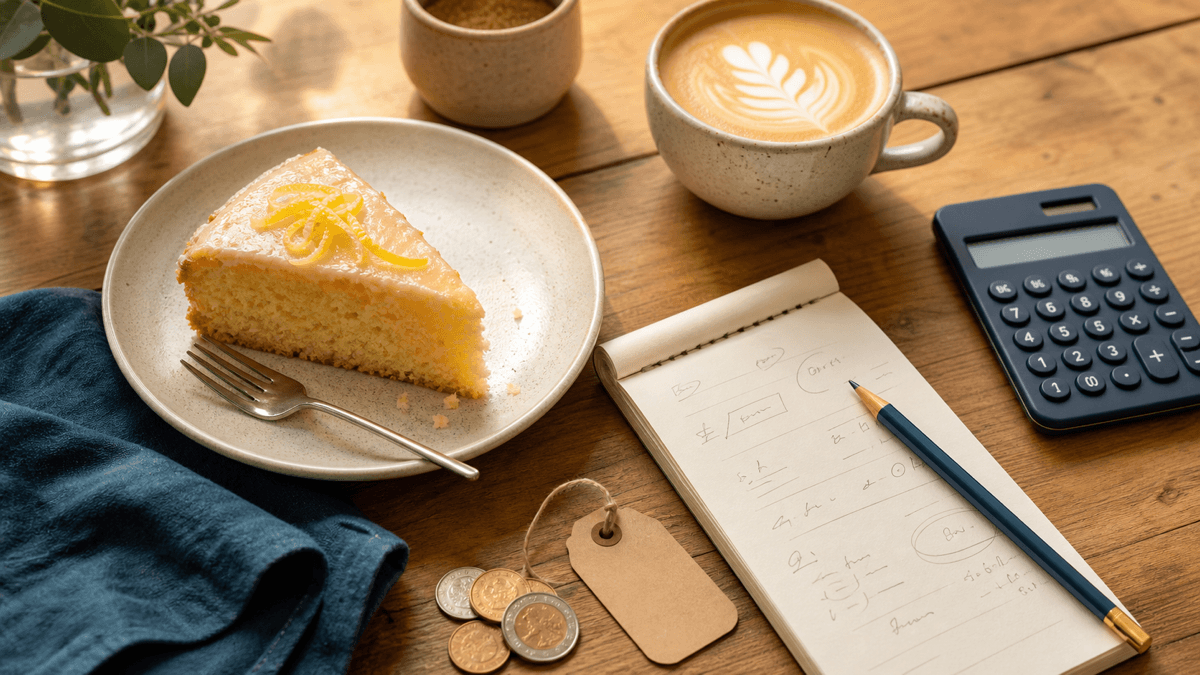
"I add 70% to everything, so I'm making 70% margin."
I have heard a version of that sentence from more café owners than I can count. Confident, quick, and wrong. Not a little wrong. Wrong by enough to be the difference between a site that pays you a wage and one that doesn't.
If you add 70% to your costs, you are not making a 70% margin. You are making a 41% gross margin. The two numbers feel like they should be close. They are nearly thirty points apart.
This is the single most common pricing mistake in independent hospitality, and the frustrating thing is it has nothing to do with effort or care. People who track every invoice and weigh every recipe still trip over it, because markup and margin sound interchangeable and they are not. One is calculated on your cost. The other is calculated on your selling price. Mix them up and you will consistently think you are more profitable than you are.
Let's fix it properly, with the maths laid out so you never have to second-guess it again.
The two numbers, plainly
Both markup and margin describe the gap between what something costs you and what you sell it for. They just measure that gap against different starting points.
- Markup is the gap expressed as a percentage of your cost.
- Margin is the gap expressed as a percentage of your selling price.
Same gap. Different denominator. That is the whole trick, and it is why the numbers never match.
Take a flapjack that costs you £1.00 in ingredients and packaging. You sell it for £2.00.
- The gap is £1.00.
- As a percentage of cost (£1.00), that is a 100% markup.
- As a percentage of selling price (£2.00), that is a 50% margin.
Exactly the same flapjack, exactly the same pound of profit, two completely different percentages. Neither is wrong. But only one of them is the number your accountant, your P&L and your bank balance actually care about, and it is the margin.
Why this quietly eats your profit
Here is the trap. Markup always looks bigger than the margin it produces. So if you target in markup and think you are targeting in margin, you systematically overestimate how much money you are keeping.
Say you have decided you need a 65% gross margin on food to cover your labour, rent and overheads and still take a wage. Sensible target. Now say you price by adding 65% to cost, because in your head "65% on top" equals "65% margin."
That 65% markup gives you a 39% margin. You are 26 points short of the target you thought you were hitting. On a £1.20 sandwich filling, you have priced it at £1.98 when the margin you actually needed wanted closer to £3.43. Every sandwich walks out the door carrying less than two-thirds of the contribution you were counting on.
Do that across a menu, every day, for a year, and it is not a rounding error. It is the reason the numbers at the year end never match the optimism at the counter.
The confusion bites hardest in exactly the places that already feel tight:
- Low-cost, high-volume items. Coffee, traybakes, cookies. A small percentage gap on cost translates to real money once you multiply by hundreds of covers a week. The same trap bites whenever you put the maths behind a retail shelf of beans, bakes and merch, where a markup that feels generous can still leave a thin margin.
- Anything you discount. Knock 20% off a price you set in markup and the margin damage is far worse than it looks, because the discount comes straight off the thin slice you were keeping. (More on that in the true cost of discounting - the maths there is the same trap from the other side.)
- New lines you price by feel. "That feels about right" is almost always a markup judgement, and almost always lands below the margin you needed.
The conversion, both ways
You do not need to memorise a formula, but it helps to have it written down once so you can sanity-check any price.
Markup to margin (you know your markup, you want the margin):
margin = markup / (100 + markup)
A 70% markup: 70 / 170 = 0.41, so a 41% margin. There's that opening sentence, settled.
Margin to markup (you know the margin you need, you want to know what to add to cost):
markup = margin / (100 - margin)
Need a 65% margin? 65 / 35 = 1.857, so a 186% markup. To hit a 65% margin you add 186% to your cost, not 65%. That gap is the entire point of this post.
And the cleanest one of all, the formula your P&L actually uses:
margin = (selling price - cost) / selling price
Cost £1.20, price £3.43: (3.43 - 1.20) / 3.43 = 0.65. A clean 65% margin. Notice the denominator is the selling price, every time. That is the tell. If you are dividing by cost, you are calculating markup, whatever you are calling it.
A worked example: the cake slice
Let's run a real one all the way through, because this is where it stops being abstract.
You make a lemon drizzle. A slice costs you £1.20 once you've counted flour, butter, eggs, sugar, lemons, the case, and a fair share of the gas to bake it. You want to know what to charge.
The markup mindset. "I'll do a healthy markup, say 150%." That feels generous. 150% of £1.20 is £1.80, so you price it at £3.00.
You tell yourself you're making 150%. You are not. Your margin is:
(3.00 - 1.20) / 3.00 = 60% margin.
A 60% margin on a cake slice is fine. But you thought you were keeping 150% and you are keeping 60%, and that misread is exactly how people set prices that feel comfortable and starve the business.
The margin mindset. Now price the same slice properly. You know from your food cost percentage work that cake needs to land around a 70% gross margin to carry its share of labour and overhead. So:
1.20 / (1 - 0.70) = 1.20 / 0.30 = £4.00.
At £4.00, your margin is a clean 70% and you're keeping £2.80 a slice. At the markup-led £3.00, you were keeping £1.80. That is £1.00 a slice left on the table, on an item you genuinely believed was well priced.
Sell forty slices a day and that is £40 a day, comfortably over £14,000 a year, on one cake. Not from raising prices recklessly. From pricing to the margin you'd already decided you needed, instead of to a markup that felt about right.
To be clear, £4.00 might be too punchy for your market and £3.50 might be the sensible landing spot once you weigh what customers will bear. That is a real decision. But make it knowing it is a 66% margin you've chosen to accept, not a "150% markup" you've miscounted into. Pricing is allowed to bend to your market. It should never bend because you got the maths wrong. There's a fuller walk-through of balancing those two pressures in how to set menu prices and protect your margins.
Quick reference: markup to margin
Pin this somewhere. These are the conversions that come up most often behind a café counter.
| Markup (added to cost) | Resulting gross margin |
|---|---|
| 25% | 20% |
| 50% | 33% |
| 70% | 41% |
| 100% | 50% |
| 150% | 60% |
| 186% | 65% |
| 200% | 67% |
| 233% | 70% |
| 300% | 75% |
| 400% | 80% |
Read it the right way round and the lesson jumps out. To clear a 75% margin you need to quadruple your cost in the price - a 300% markup. The everyday "double it" rule of thumb (a 100% markup) only ever gets you to 50%. For most food and drink, 50% is not enough to cover labour, rent, waste and VAT and still leave a wage. That is why so many menus that "feel" well marked up still don't pay.
Two habits that keep you honest
You don't need a finance degree to stay out of this trap. You need two habits.
1. Always state the number as a margin. When you talk about a price, internally or with your team, say "that's a 68% margin," never "that's a 200% markup." It is a small discipline and it forces every price onto the same scale your P&L uses. The moment you let markup language back in, the misreads creep back with it.
2. Target margin, then back into the price. Decide the margin a category needs first - drinks here, cakes there, lunch over there - then use cost / (1 - margin) to find the price. Don't pick a markup and hope the margin lands somewhere good. Start from the margin you need and work backwards to the till.
Do those two things and the whole problem disappears. You stop guessing, you stop overestimating, and the number you quote yourself is the number that shows up at the year end.
Where Brikly Fits
Everything in this post is doable on paper. The hard part is keeping it true once costs move and the menu grows.
CostingBrik works in true gross margin on every recipe, full stop. There is no markup field to misread - every recipe shows the margin your selling price actually produces, calculated against the price, the way your P&L does it.
When an invoice comes in and your butter or your flour moves, the margin on every affected recipe updates automatically. You don't re-do the sums. The lemon drizzle that was a 70% margin last month and slipped to 64% because butter jumped shows you that it slipped, and flags it against your target so you can decide what to do.
MenuBrik builds on the same numbers to show which items are quietly running below where you want them, and PulseBrik rolls the lot into your weekly margin picture. If you just want to sanity-check the maths from this post on a few of your own recipes, the free recipe costing tool will do the conversion for you in a couple of minutes.
The honest version: software doesn't price your menu for you. You still decide what your market will bear. It just makes sure that when you decide, you are looking at a real margin and not a markup wearing a margin's name tag.
Ed O'Brien has run Hunters Cake Company for 17 years across cafés in Witney, Burford, and a bakery in Carterton, Oxfordshire. He's building Brikly - modular tools that give independent café owners the same data the big chains have, without the big chain price tag.