
Maternity and paternity leave in a café: the cost, the cover, the reclaim
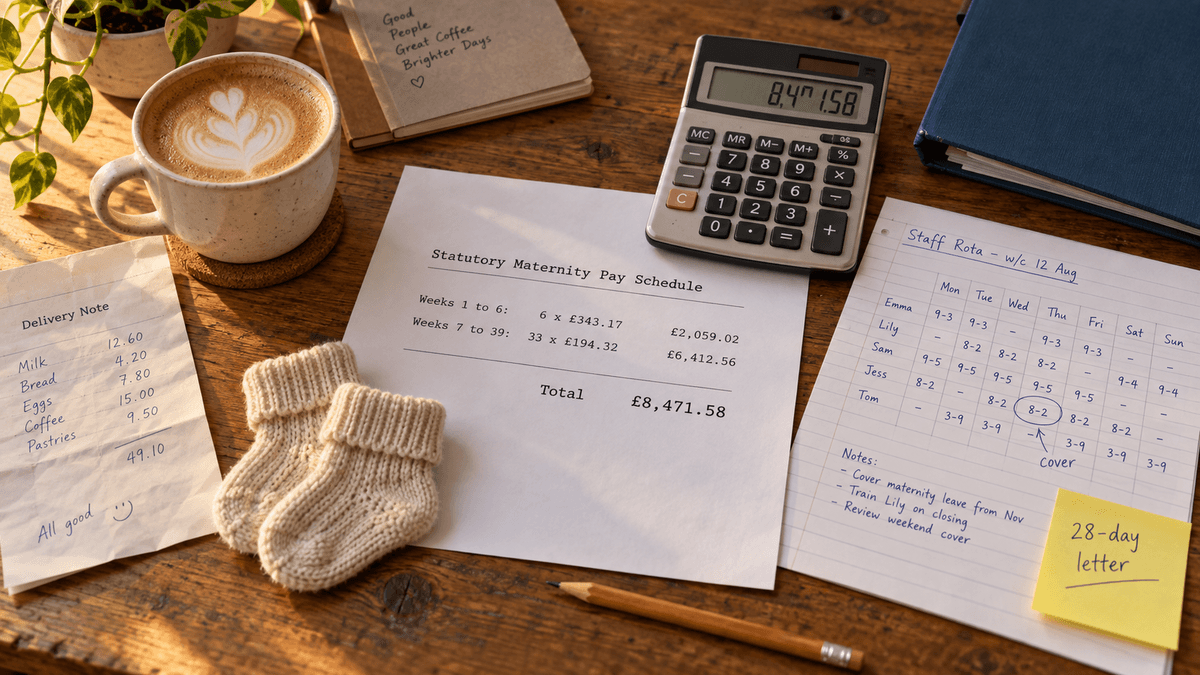
Your barista asks for five minutes after close. They are pregnant, due in the spring, and nervous about telling you. Once they have gone home you are doing sums on the back of a delivery note, and the sums look frightening.
Mostly they are the wrong sums. Statutory maternity pay (SMP) comes back from HMRC: 92% of it as standard, slightly more than all of it for small employers. What costs you is the holiday that keeps building, recruiting and training the cover, and getting the process wrong.
This covers England, Scotland and Wales. Northern Ireland has its own legislation, and paternity leave there still needs 26 weeks' service.
What you owe, and when
Notice, and your 28-day reply. The employee tells you at least 15 weeks before the due week. In GOV.UK's employer guide: "You must then confirm their leave start and end dates in writing within 28 days." They can move the return date with eight weeks' notice.
Leave from day one. Up to 52 weeks, however long they have worked for you. "You cannot refuse maternity leave or change the amount of leave your employees want to take." It can start 11 weeks before the due week; the two weeks after the birth are compulsory.
Paid antenatal time. Antenatal care is paid time off at their normal rate. The partner gets unpaid time off for two appointments, up to six and a half hours each.
The risk assessment
Regulation 16 of the Management of Health and Safety at Work Regulations 1999 requires you to assess the risks to new and expectant mothers. The HSE says your general assessment must already cover women of childbearing age, with an individual one once they tell you in writing. Act on the first conversation anyway. Where a risk cannot be avoided, adjust their conditions or hours, offer suitable alternative work on terms not substantially less favourable, or suspend them on paid leave, in that order.
The HSE lists sitting or standing for long periods, lifting or carrying heavy loads, temperature and stress. In a café I would add milk crates, flour sacks, the steam wand, a hot kitchen and a wet floor. Put a stool behind the bar and give the deliveries to someone else.
You must also provide somewhere to rest. The HSE says it should include somewhere to lie down if necessary and, for a breastfeeding returner, somewhere private to express and store milk: "toilets are not a suitable place".
Paternity leave is day one now
Since 6 April 2026, paternity leave and unpaid parental leave have been day-one rights, Acas confirms. The employee gives you the due date at least 15 weeks ahead and the leave dates at least 28 days ahead, then takes one or two weeks, "consecutively or separately", within 52 weeks of the birth.
The pay is not day one: statutory paternity pay (SPP) needs 26 weeks' service and average earnings of at least £129 a week, and pays £194.32 or 90% of average weekly earnings (AWE), whichever is lower.
The money
Statutory maternity pay
For 2026/27 the rates are 90% of AWE for six weeks, then £194.32 or 90% of AWE, whichever is lower, for 33 weeks. To qualify, the employee needs 26 weeks' continuous service into the qualifying week, the 15th week before the due week, and average earnings of at least £129 a week.
They owe you 28 days' notice of SMP and should give you proof, usually a MATB1, within 21 days of it starting. With no proof 13 weeks in, you need not pay. Anyone who does not qualify gets form SMP1 within seven days of your decision and may claim Maternity Allowance, which costs you nothing.
What comes back
You pay SMP through payroll and reclaim it on your Employer Payment Summary (EPS), deducting it from what you owe HMRC:
- 92% as standard.
- 109% with Small Employers' Relief, if you paid £45,000 or less in Class 1 National Insurance "(ignoring any reductions like Employment Allowance)" in the last complete tax year before the qualifying week.
That is employee and employer NI together. For a baby due by 24 July 2027 the year tested is 2025/26: a 30-hour barista on that year's £12.21 generated about £2,625 of both, so around 17 take you to the limit.
If you cannot fund SMP, HMRC can pay in advance: apply up to four weeks before the first payment. The EPS is a job for whoever runs your payroll, so tell them the week you find out.
The worked example
Illustrative, at 2026/27 rates; SMP and the living wage rise each April, so later weeks and holiday taken on return cost more.
- A barista aged 22 or over, so auto-enrolled, on 30 hours a week at the April 2026 National Living Wage of £12.71, paid weekly, qualifying for SMP.
- AWE: 30 x £12.71 = £381.30, assuming steady hours (it is an eight-week average).
- They take all 52 weeks.
- Employer NI: 15% above £96 a week (HMRC's weekly figure for the £5,000 threshold): (£381.30 - £96) x 15% = £42.80 a normal week.
- Employer pension: 3% above £120 a week (the £6,240 qualifying earnings lower limit over 52).
SMP and the NI on it
| Weeks | Weekly SMP | Total |
|---|---|---|
| 1 to 6 | 90% of £381.30 = £343.17 | £2,059.02 |
| 7 to 39 | £194.32, lower than £343.17 | £6,412.56 |
| Total SMP | £8,471.58 |
SMP is pay, so employer NI applies: (£343.17 - £96) x 15% = £37.08 a week for six weeks, £222.48, then (£194.32 - £96) x 15% = £14.75 a week for 33 weeks, £486.75. £709.23 in all.
The reclaim
- At 92%: £8,471.58 x 0.92 = £7,793.85 reclaimed, £677.73 left. Add the NI and £1,386.96 is yours to carry.
- At 109%: £8,471.58 x 1.09 = £9,234.02 reclaimed, £762.44 more than you paid out. Less the £709.23 of NI, you finish £53.21 ahead.
For most small cafés, the frightening £8,471.58 costs nothing.
What does not come back
Holiday. GOV.UK: "The employee still builds up ('accrues') holiday" through the leave: 5.6 weeks plus any contractual extra, or for irregular-hours staff 12.07% of their average hours over the previous 52 weeks. Over 52 weeks here:
- Hours: 5.6 x 30 = 168
- Pay: 168 x £12.71 = £2,135.28
- NI: 5.6 x £42.80 = £239.68
- Pension: 3% x (£381.30 - £120) x 5.6 = £43.90
- Total: £2,418.86 of paid time off with no hours behind it
If the leave year ends mid-leave, both the four weeks and the extra 1.6 carry forward.
Pension. During paid leave, your contributions continue on the pay they would have earned: 3% x (£381.30 - £120) x 39 weeks = £305.72. Check with your provider.
Cover. A 52-week fixed-term hire on the same hours:
- Wages: 30 x £12.71 x 52 = £19,827.60
- NI: 52 x £42.80 = £2,225.60
- Pension: 3% x (£19,827.60 - £6,240) = £407.63
- Total: £22,460.83, what the barista would have cost at work
Cover replaces pay you are no longer making, not a second salary. Recruitment and training come on top.
| 92% reclaim | 109% reclaim | |
|---|---|---|
| SMP not recovered | £677.73 | minus £762.44 |
| NI on SMP | £709.23 | £709.23 |
| Pension during paid leave | £305.72 | £305.72 |
| Holiday, with its NI and pension | £2,418.86 | £2,418.86 |
| Extra cost of the leave year | £4,111.54 | £2,671.37 |
If your employer NI stays under the £10,500 Employment Allowance, the £948.91 of NI on the SMP and holiday costs nothing, leaving £3,162.63 and £1,722.46.
Holiday is the biggest line either way, and the table leaves out covering those weeks: about the same again.
Paternity, for scale: on the same pay, two weeks' SPP is 2 x £194.32 = £388.64. At 92%, £357.55 reclaimed, £31.09 left, plus £29.50 of NI. At 109%, £423.62 reclaimed, £34.98 over, so £5.48 ahead after the NI.
During the leave
- Keeping-in-touch days. Up to 10, "without bringing her maternity leave to an end", by agreement. Never in the two weeks after the birth, and any work on a day counts as a whole day. Agree the pay first.
- SPLIT days. Up to 20 more if they switch to shared parental leave, again by agreement.
- Redundancy protection. Since April 2024, if their role becomes redundant between the pregnancy news and 18 months after the birth, you must offer any suitable alternative vacancy, "even if other employees are also suitable" (Acas). Paternity leave is not covered.
- Their job back. Back at or before 26 weeks, after ordinary maternity leave alone: the same job. Back later: the same job or, if that is "not reasonably practicable", one that is suitable and appropriate.
Planning the cover
Tell the cover hire in writing, on day one, that the job ends when the absent employee returns. Section 106 of the Employment Rights Act 1996 then makes that a "substantial reason" for ending it, though the ending must still be fair. From 1 January 2027 unfair dismissal rights start after six months, so a year-long cover hire will qualify.
Plan for both dates moving. Pregnancy-related sickness in the four weeks before the due week starts leave, and any SMP, automatically.
Hire early for a fortnight's overlap: about £863.88 here (2 x £431.94 of pay, NI and pension). To cover from inside, start with the bank list from the sickness absence cover plan. Either way, the new hire calculator shows a cover hire's hourly cost on your rates, holiday shown separately.
This week
- Draft the 28-day letter: start date, return date, the eight-week rule.
- Find your Class 1 NI total (employee plus employer, before the allowance) for 2025/26 if the baby is due by 24 July 2027. £45,000 or under means 109%.
- Ask your payroll how they claim SMP on the EPS.
- Add pregnancy to your risk assessment: lifting, standing, heat, steam, and somewhere to rest.
- Ring-fence the holiday for anyone on long leave: £2,418.86 in the example.
The maternity pay comes back. The holiday, the cover and the paperwork are the parts to plan.
Ed O'Brien has run Hunters Cake Company for 17 years across cafés in Witney, Burford, and a bakery in Carterton, Oxfordshire. He's building Brikly - modular tools that give independent café owners the same data the big chains have, without the big chain price tag.