
The 48-hour rule: managing sickness absence when your staff can't push through
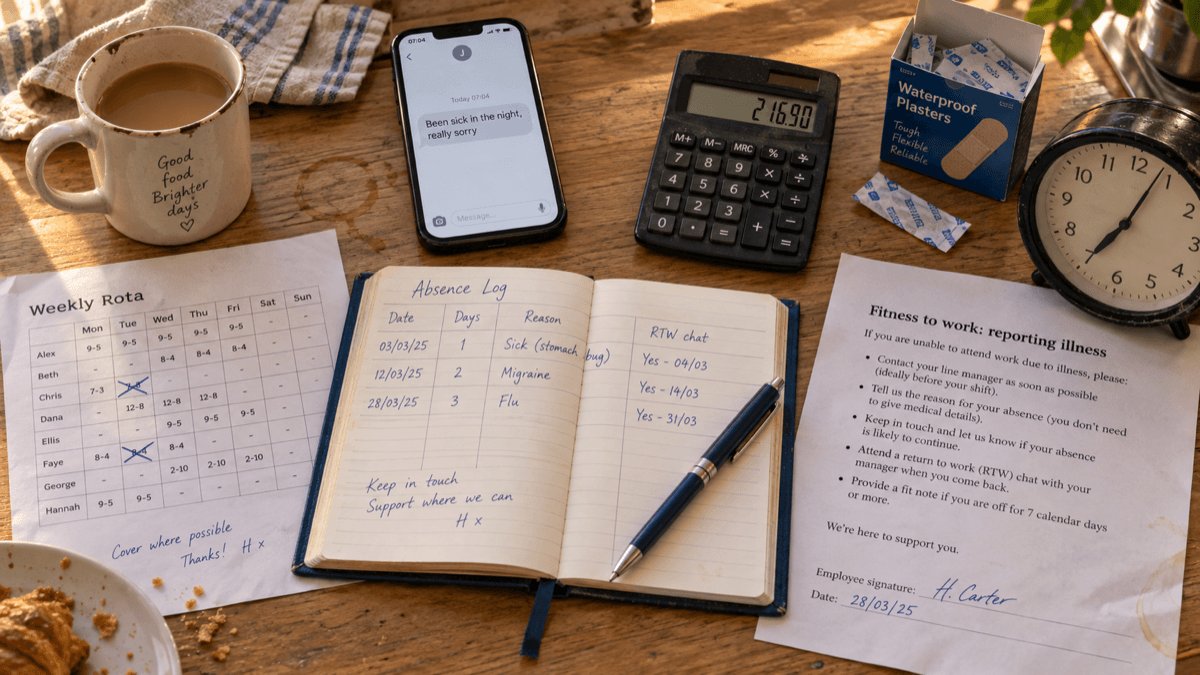
It is 7am on a Tuesday and your phone buzzes. Been sick in the night, really sorry.
That one text is two problems. Your food handler has to stay away from open food until 48 hours after their symptoms stopped, and since April a day off sick costs you statutory sick pay from the very first one.
In an office, that person weighs it up and probably comes in. In your café it is not their call, or yours.
The 48-hour rule, plainly
Diarrhoea and vomiting are the main symptoms of illness passed on through food, and the Food Standards Agency's fitness-to-work guidance is blunt: "Managers must exclude staff with these symptoms from working with or around open food, normally for 48 hours from when symptoms stop naturally."
Three things operators get wrong.
The clock starts when the symptoms stop. Not when they first felt rough, not when they last worked. Settled at 2am Tuesday means clear from 2am Thursday. Tuesday and Wednesday are gone.
It covers everyone, not just the kitchen. Food hygiene law applies it to anyone entering a food-handling area "in any capacity" where contamination is possible. Your barista, your weekend front-of-house, whoever is on the dishwasher.
It is 48 hours away from open food, not automatically 48 hours off work. In theory you give them non-food duties. In a small café, where whoever is on shift makes the coffee and clears the tables, there are none.
Note the word normally. Some infections need formal exclusion and medical clearance first, which is a call for your local authority or a doctor, not for you at 7am. The guidance covers England, Wales and Northern Ireland; Food Standards Scotland publishes its own with the same rule.
What your team has to tell you
Food hygiene law obliges the affected person to report the illness immediately. The FSA lists what counts.
- Diarrhoea or vomiting
- Stomach pain, nausea, fever or jaundice
- Someone they live with having diarrhoea or vomiting
- Infected skin, nose or throat
That third one surprises people: a team member whose partner has been up all night is supposed to tell you.
Cuts count too. Food Standards Scotland says working with food is usually fine if the infected area is fully covered by a distinctively coloured waterproof dressing. Anyone whose infected wound cannot be covered effectively stays away from any work that could contaminate food until it can be.
What one exclusion costs you now
Three things changed on 6 April 2026 under the Employment Rights Act 2025. Waiting days are gone, so sick pay runs from the first full working day. The lower earnings limit is gone, so your eight-hour-a-week weekend person is in scope. And for 2026/27 the weekly rate is £123.25 or 80% of average weekly earnings, whichever is lower, for up to 28 weeks. I covered the mechanics in what the April 2026 SSP changes mean for part-time hospitality staff.
Put that next to the 48-hour rule: you cannot let a food handler push through, so short absences you used to absorb for free now cost you.
The worked example
Say a barista, 21 or over, on the National Living Wage of £12.71 an hour, 25 hours a week across five days. She texts at 7am on Tuesday. Symptoms stopped around 2am.
- Average weekly earnings: 25 x £12.71 = £317.75
- 80% of that: £317.75 x 0.8 = £254.20
- Weekly SSP is the lower of £254.20 and £123.25, so £123.25
- Five qualifying days, so the daily rate is £123.25 divided by 5 = £24.65
- Clear at 2am Thursday means she is off Tuesday and Wednesday: two qualifying days
- If she is still unwell, SSP payable is 2 x £24.65 = £49.30, all of it from day one
If her symptoms have genuinely stopped and you keep her off purely as a precaution, she may be fit but suspended, so you could owe normal pay rather than SSP: more expensive, not less. Take advice if you are often in that position.
Under the old rules, three waiting days meant a two-day absence paid nothing. The whole £49.30 is new.
Then the cover: two shifts of five hours. At £12.71 plus the 27% loading for employer NI, pension and holiday accrual from my post on rota'd hours versus paid hours, that is about £16.14 an hour, so £161.40.
One stomach bug, on the sick pay reading: £49.30 plus £161.40 = £210.70.
Run your own figures through the free SSP calculator, then use the government's for the amount you actually pay.
A system in seven parts
1. A reporting rule. A phone call rather than a text, before a set time, to a named person. That is my recommendation, not the law: an employee need only tell you by your deadline, or within seven days if you set none. Seven days is no use at 7am, and a call gets you the symptoms.
2. Self-certification, then a fit note. For seven days or less, no fit note is needed; just ask the person to confirm they were off sick when they return. A fit note is needed once someone has been ill more than seven days in a row, including weekends and bank holidays. Calendar days, not working days: the commonest mistake in absence paperwork.
3. A five-minute return-to-work chat. Acas says this is not a legal requirement, just an informal chat with the line manager soon after someone returns. Do it anyway, the same way every time: private, records read beforehand, same questions. Mine are these five.
- Are you well enough?
- What do you need from me?
- Here is what you missed.
- Do we need a plan for next week?
- What do you want the team to know?
4. A record of every absence. Acas says to record the number of absences, the length of each and the reason for each: the reasons are what show you patterns. Log it on the day. A diary filled in all at once, in one pen, the week before an inspection, does not look like a record.
5. Pattern spotting, and the Bradford Factor. The common score is number of absences x number of absences x total days absent, over a rolling 12 months. Occasions squared, times days off: it weights frequency heavily. The formula is usually traced to Bradford University School of Management in the 1980s, though the university has never confirmed it. Either way it is a convention, not a legal standard.
Take our barista. Over the rolling year, four single days plus the two-day stomach bug: 5 occasions, 6 days, so 5 x 5 x 6 = 150. Her colleague, off one solid block of six days with a chest infection, scores 1 x 1 x 6 = 6.
Same six days lost, a score twenty-five times lower. The formula measures disruption to your rota, not how ill anybody was.
6. Trigger points, handled like an adult. More than 200 is a common starting point, nothing more official, and Acas is clear about what follows: an employer should not use review points to automatically trigger disciplinary action. Keep disability-related absence out of any score, or you invite a discrimination claim under the Equality Act 2010 (the Disability Discrimination Act 1995 in Northern Ireland). And an absence you required, by excluding someone under the 48-hour rule, is one you caused.
7. No-shows are a separate process. Unauthorised absence, in Acas's terms, is not turning up without permission or without following your reporting procedure. Try work contacts, then personal, then the emergency contact: occasionally the reason nobody called is serious. If it becomes conduct, follow the Acas Code of Practice on disciplinary and grievance procedures, currently the 2015 version. In Northern Ireland, the LRA's equivalent Code.
Two things that catch operators out
Holiday keeps building. Statutory holiday accrues while someone is off sick, however long they are off, and holiday lost to illness carries into the next leave year. Nor can you force someone onto annual leave when they are eligible for sick leave.
Writing down the reason means handling health data. The ICO treats health data as special category data, but it draws a useful line: a sickness record names the condition, an absence record says "sickness" and nothing more. Either is allowed. Be clear why you collect it, and keep it off the staff-room wall: the ICO's employment guidance has long said not to publish league tables of individual sickness records.
Have a cover plan before you need one
The 48-hour rule means losing people at no notice. Know your genuine minimum: for most small cafés it is two, and below that you are not trading. Keep a bank list of three or four names who will pick up a shift, written somewhere other than your head. Cross-train deliberately: if only one person can work the espresso machine, one stomach bug closes your coffee offer.
Then the bit everybody skips: when you agree the cover, put it on the rota. The favour shift arranged by text on a Friday is the biggest reason a café's planned hours and paid hours never match: the absence gets covered, and nothing gets written down.
Confidence in management is one of the three areas behind your food hygiene rating, and your rating is dragged down by the weakest one. A signed induction record and a dated absence log are that section's evidence.
Absence logging, Bradford Factor scoring and return-to-work checklists are part of what we are building in StaffBrik, for when the notebook stops being enough.
What to do this week
- Write the 48-hour rule on one side of A4. What to report, to whom, by when, what happens next.
- Add it to induction and get it signed, existing staff too. Most have never heard the household-illness part.
- Set your reporting deadline. A call, not a text, to a named person, by a stated time.
- Print a self-certification form and diary the seven-calendar-day fit note mark.
- Start an absence log today. Date, days, reason, and whether the chat happened.
- Write your five return-to-work questions and use them every time.
- Cost your last three absences: sick pay plus the cover you bought.
- Sort your bank list and your two gating skills.
None of this is about doubting anyone. The people who worry about letting you down are usually the ones who should be at home. The system means the decision is already made before your phone buzzes.
Send them home. Log it. Have the chat when they are back. That is the whole job.
Ed O'Brien has run Hunters Cake Company for 17 years across cafés in Witney, Burford, and a bakery in Carterton, Oxfordshire. He's building Brikly - modular tools that give independent café owners the same data the big chains have, without the big chain price tag.