
Mice move indoors in October: what your café's pest control should look like
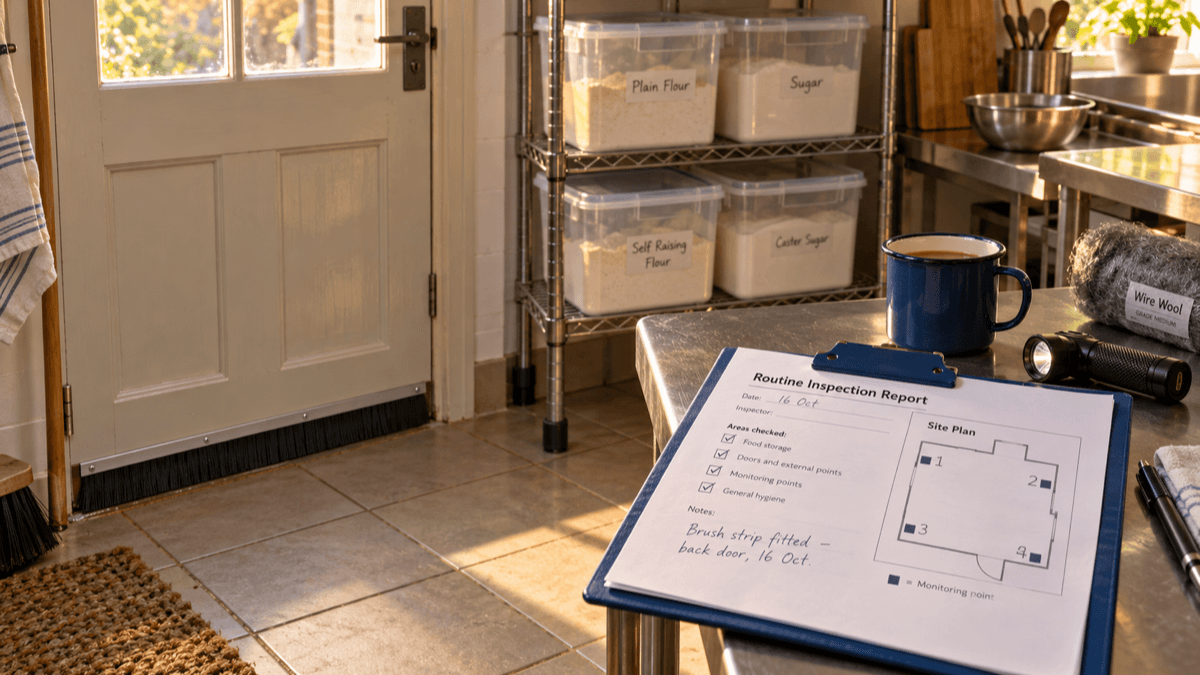
The clocks go back next weekend. The nights get cold, the hedgerows stop feeding anything, and every mouse within a few hundred metres starts taking an interest in the warm building with the bakery smell and the back door that gets propped open for deliveries.
Pest controllers will tell you autumn is when their phones get busy. A café is warm, dry and full of food, and most of us leave small gaps in the defences every day without noticing.
This post covers what the law asks of you, what an inspector looks for, how to buy pest control without getting stung, where the gaps usually are, and what to do on the morning you find droppings by the flour bin. That morning goes a lot better if you've decided in advance what happens.
The legal detail below is for England. Wales, Scotland and Northern Ireland have their own equivalent food hygiene regulations, and Scotland runs a pass / improvement required inspection scheme rather than the 0 to 5 rating.
What the law actually requires
The core rule is short. The retained food hygiene regulation, Regulation (EC) 852/2004, Annex II, says: "Adequate procedures are to be in place to control pests."
Around that sit a few related requirements in the same annex:
- Premises must be laid out and built to permit good hygiene, "in particular, pest control".
- Windows that open to the outside must, where necessary, have insect-proof screens that come off for cleaning.
- Refuse stores must be kept clean and, where necessary, "free of animals and pests".
Notice what it doesn't say. There is no legal requirement to have a pest control contract. The FSA's Safer Food Better Business pack says only that you "could employ a pest control contractor". The duty to have adequate procedures is yours, not the contractor's, though in practice a contract is how most cafés prove the procedures exist.
One more law worth knowing: under the Prevention of Damage by Pests Act 1949, the occupier of any non-agricultural land must notify the local authority in writing "forthwith" if they learn that rats or mice are living on or resorting to it "in substantial numbers". A single mouse in the dry store isn't that. A proper infestation might be.
What an EHO looks for, and what it does to your rating
Pest control is scored under structural compliance, one of the three areas in the Food Hygiene Rating Scheme. As I wrote in what actually moves the needle on a 5-star food hygiene rating, your rating is held down by your worst area, so a pest problem can cost you stars however good your fridges are.
The FSA's Brand Standard, the guidance inspectors use to turn scores into ratings, describes what each structural score might look like in practice. The pest wording climbs like this:
| Structural score | Pest wording in the Brand Standard | Best rating possible |
|---|---|---|
| 0 | "Evidence of effective pest control" | 5 |
| 5 | "Evidence of adequate pest control" | 5 |
| 10 | "Satisfactory pest control" (minor proofing may be needed, "no evidence of current pest activity") | 4 |
| 15 | "Evidence of current pest activity" | 2 |
| 20 | "Evidence of pest infestation" | 1 |
| 25 | "Evidence of widespread pest infestation" | 0 |
That last column comes from the Brand Standard's rule that no single score can exceed a ceiling for each rating: nothing above 5 for a 5, nothing above 10 for a 4 or a 3, and so on. So one visit that finds current mouse activity can take a 5-star café to a 2 on structural score alone. And where a failure is about how you work as well as the building, say food left open on the floor, the Brand Standard says it should count against the hygiene score too.
Inspectors use judgement, not a lookup table, but the direction is clear. On a normal day they want no signs of current activity, proofing in decent repair, food off the floor and covered, bins lidded, and evidence you're managing it: recent visit reports, and proof you did what the contractor recommended. Three reports in a row recommending the same door brush strip tells an inspector something about how the place is run.
When they can close you
Under regulation 8 of the Food Safety and Hygiene (England) Regulations 2013, an officer satisfied there's an imminent risk of injury to health can serve a hygiene emergency prohibition notice on the spot, which can mean immediate closure, with a copy displayed "in a conspicuous place". The council has three days to apply to a magistrates' court for an order, and the closure lasts until the authority certifies the risk has gone.
Council enforcement policies regularly list serious vermin infestations as a trigger. Many will also accept a voluntary closure instead, where you agree in writing to shut until it's fixed. Plymouth City Council's guidance puts it plainly: no notice is displayed where the operator closes voluntarily, and carrying on trading without extra precautions "is not an option". Be aware that voluntary closure normally means giving up the right to compensation that comes with the formal procedure.
Contract or pay per call-out?
You can ring someone when something appears, or pay a monthly fee for routine visits and cover. I'm not going to quote market rates, because I couldn't find published figures I'd trust and prices vary by region, premises size and how many bait points you need. What I can give you is a way to compare quotes.
What a contract should include
Ask every contractor to quote against the same list:
- Routine visit frequency. How many inspections a year, and are they a fixed schedule or "up to"?
- Which pests are covered. Rodents only, or crawling and flying insects too? Is a wasp nest extra?
- Emergency call-outs. Included or charged? And the response time in writing: same day, next working day, 48 hours?
- A written report after every visit, with findings, treatments used, and recommendations ranked by urgency.
- A site plan or bait station map showing where every monitoring point is, numbered, so you and the inspector can see the coverage.
- A proofing survey, and whether proofing work is included or quoted separately.
- Membership. Ask whether they're a BPCA or NPTA member, and what methods they'll use. Since July 2024 only licensed professional controllers can use glue traps in England.
Comparing like for like
Here's the method, with made-up numbers to show the shape of it, not market rates. Three quotes for the same café:
| Quote A | Quote B | Quote C | |
|---|---|---|---|
| Monthly fee | £35 | £45 | £55 |
| Annual fee | £420 | £540 | £660 |
| Routine visits a year | 6 | 8 | 8 |
| Call-outs | £95 each | Included | Included |
| Insects covered | No | Yes | Yes |
| Annual price rise | Not stated | Capped at inflation | Not stated |
Quote A looks cheapest. Add two call-outs in a bad autumn and it's £420 + £190 = £610, more than Quote B, with fewer visits and no insect cover. Per routine visit, A is £70, B is £67.50 and C is £82.50.
Then hold them against pay per call-out. Say a one-off mouse treatment is £150 for the first visit and £75 for each of two follow-ups: £300. Cheaper than a year of contract, if you only ever need it once. But you get no routine inspections, no reports, no bait map, and you're phoning round strangers on the worst morning of the month. That's the real argument for a contract: not insurance against mice, but the paper trail that shows your procedures are adequate.
The auto-renewal trap
Pest contracts behave like your waste and card terminal contracts: a minimum term, a notice period buried in the terms, and an automatic rollover at a new price if you miss the window. Consumer cooling-off rules don't help when you've signed as a business. Find the minimum term, the notice period and the price-increase clause, then diarise the date the notice window opens, not the end date. I went through the method for this in auditing the contracts that renew themselves, and the pest contract fits straight into it.
Proofing: where the gaps usually are
Contracts deal with pests that get in. Proofing stops them getting in. The British Pest Control Association says a mouse needs a gap of only around 5 to 6mm, roughly the eraser end of a pencil, and recommends a brush strip on any exterior door with a gap bigger than 4mm.
Walk your building with a torch and check:
- Door sweeps. Back doors, fire doors, the cellar door. Lie on the floor and look for daylight underneath. Brush strips wear out, so check the ones you already have.
- Pipe and cable entries. Where services come through the wall, often behind the dishwasher or under the sink. BPCA suggests wire wool set in cement; Plymouth's guidance warns against paper, bubble wrap or expanding foam, because pests chew through them.
- Air bricks and vents. Damaged covers, missing mesh.
- The bin area. Lids that don't close, split bags left beside bins. SFBB points out that open lids and drainage holes on external bins can let pests in.
- Deliveries. The door propped open while the driver unloads, and the goods themselves: SFBB says not to accept a delivery showing signs of pests, such as gnawed packaging.
- Cardboard. Outer cases are nesting material. Decant into lidded containers and get the cardboard out the same day.
- The places you don't look. Behind the coffee machine, under the bottom shelf, the bags of flour on the floor "just for today".
With a production bakery full of flour sacks, I think about the dry store more than most. Everything sits off the floor on racking and anything opened goes into a lidded tub. Dull, and exactly what an inspector wants to see.
Daily checks and records
SFBB says check regularly, put reminders in your diary, and record contractor visits with their recommendations and when you carried them out. A sensible routine:
- Opening, daily. Dry store floor, under shelving, behind equipment, the back door, before food comes out.
- Closing, daily. No food or dirty plates left out, bins lidded, back door shut and sweep intact.
- Every delivery. Packaging intact, no gnaw marks or droppings on cases.
- Weekly, outside. Bin area, weeds, rubbish, damaged walls and vents.
- After each contractor visit. File the report and record the date you dealt with each recommendation.
Records only count if they're done at the time. SafetyBrik, our free food safety diary, can hold these daily checks with a timestamp and a name, and if you're still on a folder, the case for moving food safety diaries off paper is mostly about exactly this kind of check.
The morning you find droppings
Decide this now, write it down, and make sure whoever opens up knows it. Here's the sequence.
- Stop production in the affected area. Don't carry on making sandwiches next to it while you think. If it's the dry store, nothing comes out of it until you've checked.
- Look properly before you clean. Photograph it and note exactly where. Then check the rest of the building: one sighting in the dry store is a very different morning from droppings in three rooms.
- Call your contractor. If you have a contract, this is what the emergency response time is for. Write down when you called and when they're coming.
- Decide whether to open. If it's confined to one area you can shut off, with no food prep there and no activity elsewhere, you may be able to trade with that area closed. If there's fresh activity where you prepare food, or you can't contain it straight away, close. If unsure, ring your council's food team: closing voluntarily beats having the decision made for you.
- Bin anything that might have been touched. SFBB is clear: "If you think food has been touched by pests in any way, throw it away." Open packs, food in bags or cardboard, anything uncovered. Sealed, hard, undamaged containers can be cleaned on the outside and kept. When in doubt, it goes.
- Deep clean. Wear disposable gloves. Equipment, surfaces and utensils that might have been touched should be washed, disinfected and dried, as SFBB puts it. Empty the shelves, clean behind and under equipment, and use a disinfectant suitable for food areas.
- Find the way in. Work with the contractor on proofing. Treatment without proofing is just waiting for the next one.
- Record all of it. What you found, where, the time, what food you discarded, who you called, what was done, and when you reopened. SFBB: "Write down what went wrong and what you did about it in your diary."
- Step up the checks. Daily checks become twice daily for a few weeks, and the contractor's follow-up visits go in the diary too.
What a bad morning actually costs
To show why the prevention side is worth paying for, here's an illustrative café closing voluntarily for two days:
- Lost turnover: £1,100 a day ex-VAT, so £2,200.
- Staff paid anyway: four people on seven-hour shifts at the fully loaded £15.93 an hour, £446.04 a day, so £892.08.
- Discarded stock: say £300 of dry goods, opened packs and anything in cardboard.
- Emergency treatment, if you're not on a contract: the £300 from earlier.
That's around £3,700, before the rating, the reviews and the weeks it takes regulars to stop wondering. A year of Quote B is £540. Check your insurance too: business interruption wording around closure by an authority varies a lot, so read yours now rather than on the day.
The takeaway
Pest control isn't really about mice. It's about showing you'd thought about mice before they turned up.
Before the cold sets in: get three quotes and compare them line by line, diarise the renewal window, walk the building with a torch looking for 5mm gaps, and make the daily checks something that gets done and written down. Then put the bad-morning plan on one sheet, pinned where whoever opens up will see it.
Most autumns, none of it gets used. That's the point.
Ed O'Brien has run Hunters Cake Company for 17 years across cafés in Witney, Burford, and a bakery in Carterton, Oxfordshire. He's building Brikly - modular tools that give independent café owners the same data the big chains have, without the big chain price tag.