
The Misc button is eating your sales data
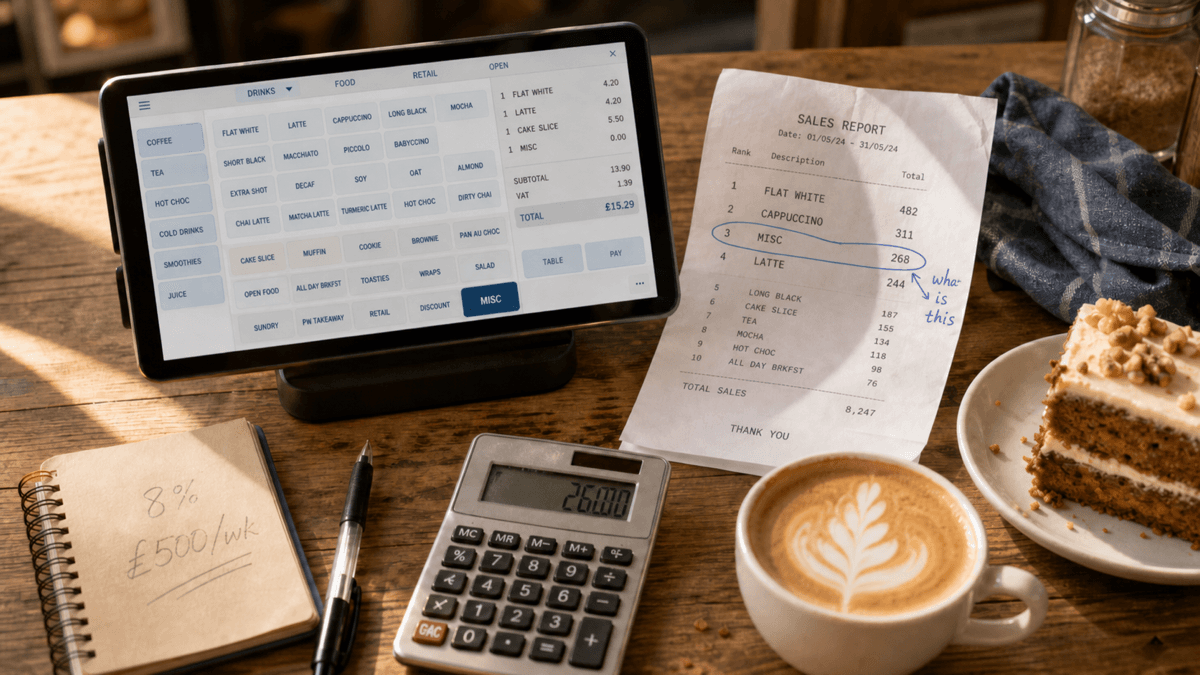
Pull your last 90 days of sales by item and rank them. Flat white at the top, probably. Cappuccino, latte, the bacon roll. Then somewhere around third place, sitting there like it owns the building: Misc.
Or Open Food. Or Sundry. Or whatever your till calls the button staff press when the right one does not exist.
If that button is in your top ten, you do not know what you sell. Not roughly. Not approximately. You genuinely do not know, because a meaningful slice of your turnover is recorded as a price with no product attached.
Everything downstream of that is fiction.
Till buttons rot, and nobody notices
No café sets up a bad till layout. They set up a good one on opening week, when the menu had 22 items and the owner built it on a wet Sunday.
Then three years happen.
Open keys become a shortcut. A builder wants a coffee at a price you agreed on the phone. Staff hit the open key, type £2.50, done. Fine once. Muscle memory by month three.
Catch-all buttons appear. One button called "Cake slice" at £4.20, because you were rotating six cakes and did not want six buttons. Sensible at the time. Now you have no idea whether the lemon drizzle or the carrot cake is carrying that category.
Duplicates breed. There is a "Flat White", a "Flat white" and a "FW Takeaway". One of them was created by a staff member who could not find the first. Your report splits the same drink three ways and all three look mid-table.
Dead buttons stay forever. The winter spiced latte is still on the grid in August. So is the sandwich you delisted in 2024.
New specials get keyed under old buttons. The quiet killer. You run a peach and burrata plate for six weeks, never build a button, and tell the team to ring it under "Brunch plate". Six weeks of sales for a dish you were genuinely trying to evaluate, filed under something else.
Then there is the speed problem. If the flat white button is on screen two and the americano is on screen one, a busy barista at 8:40am hits americano. It is 40p out. Nobody complains. The customer gets their coffee.
What it actually costs: the maths
Let us take a plausible independent café. Turnover around £6,250 a week, so roughly £325,000 a year.
The Misc problem. Eight per cent of takings goes through the open key. That is £500 a week.
£500 x 52 = £26,000 a year of turnover you cannot attribute to a single product.
Not lost money. Worse in some ways: money you have banked but cannot learn anything from. You cannot cost it, cannot see its margin, cannot decide whether it deserves a place on the menu.
The catch-all problem. The "Cake slice" button rings at £4.20. Your lemon drizzle is £4.20. Your carrot cake, which takes longer and costs more, is meant to be £4.80. You sell about 90 slices a week and roughly 40% of them are carrot.
36 slices x 60p = £21.60 a week, or £1,123 a year given away because one button was easier than two.
The wrong-button problem. Say 15 flat whites a day get keyed as americanos. Flat white £3.80, americano £3.40.
15 x 40p = £6 a day. Six days a week, 52 weeks = £1,872 a year.
That is £29,000 of turnover either unattributable or quietly undercharged, from a till layout nobody has looked at properly since 2023.
Why it poisons everything downstream
Here is the chain reaction.
Your sales mix is wrong. The point of ranking your menu by sales value to find the 10 to 15 items carrying the business is that the ranking tells you where to spend your attention. If Misc is at number three and your carrot cake is buried inside a catch-all, the ranking describes a café that does not exist.
Your reordering is wrong. You think you sell 54 lemon drizzles a week because that is what the cake slice button says. You actually sell 54 slices of something. So you bake to the wrong split, bin lemon on Thursday and run out of carrot by Saturday lunchtime. Every week.
Your delisting decisions are wrong. The item you are about to cut for poor sales may be selling fine under someone else's button. The item you are about to protect may be a phantom.
Your costing links break. Recipe costing only tells you what actually made money when it is joined to real POS lines. If the till line says Misc, there is nothing to join it to, so your gross profit by item is calculated on maybe 88% of what you sold.
Your integrations amplify it. This is the bit people get wrong when they start connecting their POS to costing and accounting tools. An integration does not clean your data, it moves your data faster. Connect a rotten button layout to three other systems and you have four systems confidently agreeing on a wrong number.
The 30-minute audit
Do this once, with a coffee. It is genuinely half an hour.
1. Pull 30 days of sales by item. Square is Reports then Item Sales. Lightspeed is Sales by Item. Epos Now is Product Sales Report. Export to CSV.
2. Calculate your Misc percentage. Add the net sales of every open key, sundry, miscellaneous, manual price and "other" line. Divide by total net sales.
- Less than 1% is fine. Genuine oddities.
- Between 1 and 3% needs a look.
- More than 3% means your reporting is not trustworthy, and you should stop making menu decisions from it until it is fixed.
3. Sort alphabetically and hunt duplicates. Near-identical names will sit next to each other. Highlight every pair.
4. Sort by units ascending and find the dead. Zero sales in 30 days means seasonal or gone. Under about five units in 30 days needs a reason to exist.
5. Count your buttons and compare to your menu. Forty sellable items and 96 buttons is one problem. Forty items and 22 buttons is a different one.
Write the four numbers down: Misc percentage, duplicates, dead buttons, total buttons versus menu items. That is your button hygiene score, and you will want it again in three months.
If you are on Square, the Square category analyser does the first pass for you on your last 90 days with no setup, which is a quick way to see how bad the picture is before you commit an afternoon to fixing it.
Rules for a clean layout
Fixing it is not complicated. Holding it is the hard part, so make the rules boring and explicit.
One button per sellable item. If a customer can order it at its own price, it gets its own button. Six cakes means six buttons, or a cake category with six items inside. Not one button and a shrug.
Modifiers are modifiers, not new buttons. Oat milk, extra shot, takeaway cup, gluten free bread. These attach to an item, they do not become one. Modifier extras carry a real cost, and you cannot see it if they are baked into a hundred separate item buttons.
Name things one way and stick to it. Write the convention on a card by the till: product first, size second, no abbreviations. "Latte Large", not "Lge Latte" and "L Latte" and "Latte (large)". Three names is three lines in your report.
One person owns button creation. The highest-value rule on the list. Nobody creates a till button except whoever owns the menu. Everyone else can request one.
Every special gets a button before it gets a shift. Even for a two-week run. Especially for a two-week run, because the point of a short run is to find out whether it works.
Kill the open key, or fence it. Most tills let you rename it, restrict it to a manager PIN, or force a text description. If you must keep one for genuine oddities like a deposit or a lost property charge, make it require a typed reason. The friction is the feature.
Keeping it clean: ten minutes a month
Buttons rot the way a walk-in fridge gets messy. Not in one dramatic event, in a hundred small reasonable decisions.
Put ten minutes in the diary, same day each month, and run three checks:
- Misc percentage. Above 1%? Something happened this month that needed a button and did not get one. Find out what.
- New buttons created this month. Should be a short list, every one recognisable, and every one checked for the eat-in VAT rule a rebuilt till button quietly loses. An unfamiliar name means someone else has the keys.
- Zero-sales buttons. Nothing sold for two consecutive months comes off the grid. Archive rather than delete so the sales history survives.
Ten minutes, twelve times a year. Two hours annually to keep every downstream report honest.
Clean buttons make everything else worth doing
Once your till layout matches your menu one for one, your sales mix report stops being a rough guide and becomes a decision-making document. You can rank by sales value and believe the ranking. You can join sales to recipe costs and get a gross profit per item that is not silently missing 8% of your trade. You can look at a slow seller and know it is genuinely slow rather than hiding inside a catch-all.
This is where a tool earns its place. MenuBrik pulls your POS sales mix and joins it to your CostingBrik recipe costs, so each till line becomes a margin figure rather than just a number. But it can only match what your till recorded. Feed it a Misc key and it will faithfully tell you your third-best seller is a mystery.
No software fixes button hygiene. That is a half-hour audit and one rule about who is allowed to create buttons.
Go and pull your last 30 days. Find your Misc percentage. If it is more than 3%, you have found the cheapest improvement available to your business this month, and it costs nothing but an afternoon with the till.
Ed O'Brien has run Hunters Cake Company for 17 years across cafés in Witney, Burford, and a bakery in Carterton, Oxfordshire. He's building Brikly - modular tools that give independent café owners the same data the big chains have, without the big chain price tag.