
You changed the menu. Did your till's VAT change with it?
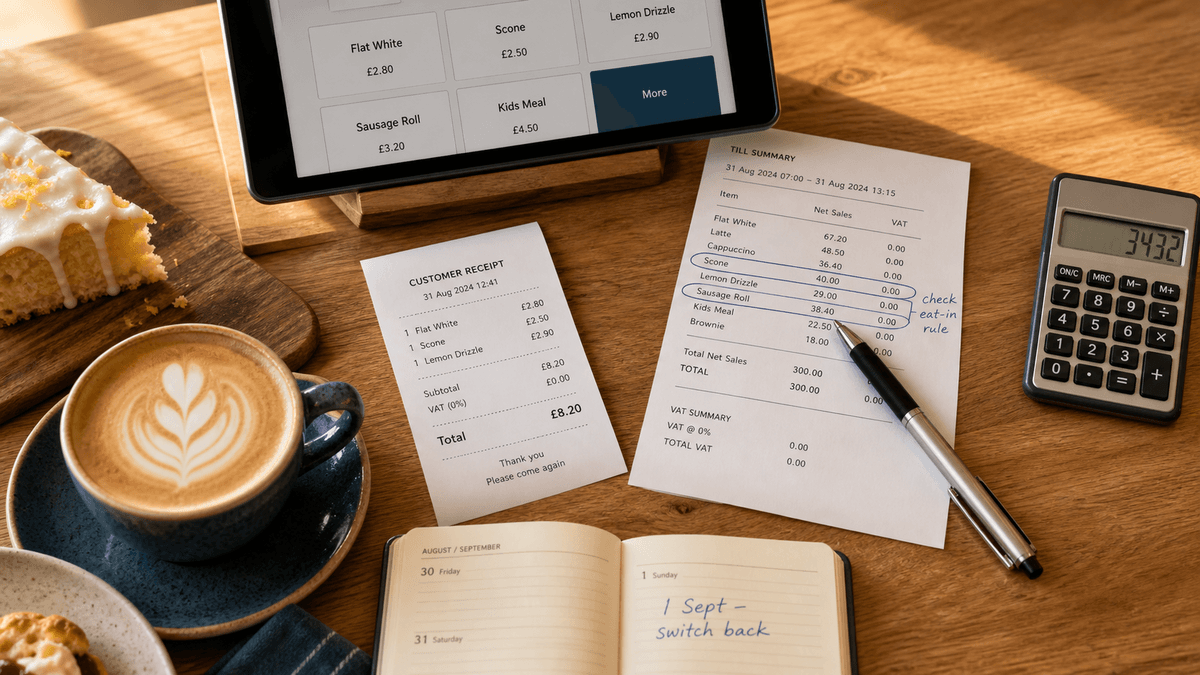
Every menu change is a catalogue edit. Someone sits down with the till, builds the new lines, retires the old ones, and gets the grid looking right before Monday morning.
What nobody checks afterwards is the tax setting on each new item.
It is not a field that shouts at you on a busy build screen. The item saves happily without it. It sells, the receipt prints, and the Z-report at close looks entirely plausible. Nothing tells you that an eat-in item has been ringing at 0% since March.
Till VAT is not a set-once job. It comes loose every time you touch the catalogue.
What actually breaks when someone rebuilds a till item
In most tills, VAT is not a number you type onto the item. It is a link between the item and a separate tax object, sometimes with a conditional rule on top that fires depending on whether the sale is eat-in or takeaway. Links break. Here is where.
A new item starts life outside the tax. In Square, when you set up a VAT rate you choose whether it applies to "all current and future taxable items" or to a hand-picked list. If you picked the list, because the zero-rated bakes needed excluding, that was sensible at the time. It also means every item created since sits outside that rate until someone adds it.
Rebuilt is not the same as edited. If the new almond croissant was created fresh rather than edited over the old one, it is a new object, and every rule that pointed at the old one now points at something you have archived.
Conditional rules are scoped to categories. If your eat-in 20% rule is attached to the Cakes category and the new traybake lands in Specials, the rule does not cover it. Nothing errors. It just does not apply.
Modifiers sit outside the rules entirely. Square's guidance is blunt about this: tax rules apply to the items in a basket, and you cannot set tax rules for item modifiers. If you have priced anything meaningful as a modifier, check how it is taxed.
Second sites drift separately. A rate can be applied at selected locations only, so a new device or a second shop with a hurriedly copied catalogue gives you two versions of the truth.
Why the Z-report will not tell you
The error is invisible in the one report you actually read, and customers do not query the VAT line on a receipt.
Café prices are VAT-inclusive. A £3.60 slice of cake takes £3.60 through the till whether it is standard-rated or zero-rated, so your gross take does not move by a penny. All that changes is the split between net sales and VAT, and across three hundred lines in a day, six items missing a rule shifts the VAT total by a few pounds.
Your return is then built from those same till totals, so it is perfectly internally consistent. It reconciles. It just reconciles to the wrong number, because consistency is what you check and correctness is what you assumed. Gross profit looks better too, because the reporting treats the full price as turnover, so the affected lines quietly become your best performers.
The audit: three reports and twenty minutes
Do this with a coffee. Three exports, one pass.
Report one: sales by item, last 90 days, with tax collected. In Square that is Reports, then your item sales report, exported to CSV. You want net sales and VAT collected per item side by side. Then look for three patterns:
- Items with eat-in sales and no VAT collected at all
- Hot items with takeaway sales and no VAT collected, since hot takeaway food is standard-rated
- Cold takeaway items carrying 20% that you would expect to be zero
Report two: sales split by VAT rate. In Square that is Reports, then Accounting, then VAT, which shows taxable and non-taxable sales together. Compare this quarter's zero-rated share of turnover against the same quarter last year. Trade mix moves slowly, so a step change almost always lines up with the day somebody edited the catalogue.
Report three: the item library itself, newest items first. Every item built since your last menu change gets checked by hand against its tax setting and, if you use them, its dining option rule. If your till will not sort by date created, work from your own list of what changed. That list is usually much shorter than you fear.
For anything flagged, four questions settle it: is it hot when sold, is it eaten on the premises, is it in the always-standard group of confectionery, crisps, ice cream, soft drinks, alcohol and hot drinks, and is it part of a catering supply. If those feel shaky, the complete guide to UK café VAT on food and drink lays out the buckets properly.
One more check while you are in there. A dining-option rule only fires if staff actually pick the dining option. Skip the prompt in a rush and the rule never runs, so the split behind the eat-in versus takeaway margin difference on iced drinks and cakes is not the split you are really trading.
On Square, the Square category analyser gives you the 90-day category shape with no setup if you want a faster first look.
A worked example: six rebuilt items and a quiet quarter
Take a plausible independent doing £6,500 a week. In March they refreshed the bakes counter: six items retired, six built fresh rather than edited. The eat-in rule never got attached to the new ones.
Those six lines take roughly £480 a week between them, and say 55% of that is eaten in. That is about £264 a week of eat-in sales ringing at zero, so thirteen weeks gives £3,432 of eat-in sales that should have carried 20% VAT. The prices were VAT-inclusive all along, so the under-declared VAT is £3,432 divided by 6, or around £572 for the quarter.
Not a catastrophe. But nobody spotted it for three months, and a full year would be roughly £2,290. The quieter cost is worse: throughout, the gross profit on six of the counter's best sellers was overstated, and every ranging decision made on those numbers inherited the error.
Locking the till so it cannot drift again
Fixing it once is the easy half. These are the rules that stop it coming back.
- One person owns tax settings. Same principle as never letting anyone create a till button except whoever owns the menu. Requests are fine. Access is not.
- Default new items into the standard rate, then exempt deliberately. An item you are wrongly charging VAT on shows up in your rate split immediately. One you are silently not charging does not.
- Use a build checklist. Name, category, price, VAT rate, dining option behaviour, who signed it off. Five lines on a card by the office computer.
- Check the categories your conditional rules point at, not just the rules themselves. New category, no cover.
- Keep a dated log of every tax setting change. Deadly boring, and the one thing that turns a correction from a forensic exercise into a ten-minute job, because you know which day the behaviour changed.
If you find an under-declaration: correcting it without panicking
First, fix the till, so the error stops today either way. Then work out the net value of the errors across the affected periods, remembering that mistakes in both directions net off. HMRC's rules here are more forgiving than they sound. If the net value of errors on previous returns does not exceed £10,000, you adjust your VAT account and put it right on your next return. Between £10,000 and £50,000 you can still do that, provided the net value does not exceed 1% of your box 6 figure. Above that, or if an error was deliberate, you tell HMRC separately.
Two practical notes. The window is four years from the end of the accounting period the error was in. And form VAT652 is gone: HMRC withdrew it in September 2025, so notifications now go through HMRC's online route for reporting VAT return errors or in writing.
On penalties, the position is calmer than the panic suggests. HMRC's compliance handbook says a penalty for a careless inaccuracy disclosed unprompted can be reduced, and reduced to nil where the quality of the disclosure is good. Finding it yourself and saying so beats being asked about it. Deliberate is a different conversation entirely.
Take the numbers to your accountant rather than picking the method yourself. The maths is easy; the judgement is what you pay them for.
The 1 September switchback nobody has diarised
One date is worth putting in the diary this week.
The temporary 5% rate on children's meals in Revenue and Customs Brief 5 (2026) runs from 25 June to 1 September 2026 inclusive. So 1 September is the last day at 5%, and 2 September is the first day back at 20%. It only ever applied to meals held out for sale as children's meals and eaten on the premises. Takeaway never qualified.
If you coded it, somebody reverses that after close on 1 September. A reverse edit under time pressure, on items that already carry non-standard tax handling, is precisely the change that drops a rule.
If you looked at it in June and decided it was built for the chains rather than for independents, you have nothing to switch back. You will still be building a September menu in the next fortnight, which is the same risk from the other direction.
So: 1 September, switch back. 2 September, run reports one and two on the previous day's trade.
The point of all this
Nobody sets out to get till VAT wrong. It drifts because the catalogue is a living thing, and the tax rules attached to it are invisible during the one job most likely to knock them off.
The audit needs nothing but a till export and twenty minutes. MenuBrik pairs your POS sales, item by item, with your live CostingBrik costs, so an odd-looking line shows up as its own row rather than vanishing into a Z-report total. Useful if you would rather have it watched every month than remember to look.
Pull the last 90 days today and sort by VAT collected. If anything with eat-in sales is sitting on a zero, you have found this month's cheapest fix.
Ed O'Brien has run Hunters Cake Company for 17 years across cafés in Witney, Burford, and a bakery in Carterton, Oxfordshire. He's building Brikly - modular tools that give independent café owners the same data the big chains have, without the big chain price tag.