
PPL PRS music licence: the café cost nobody warns you about
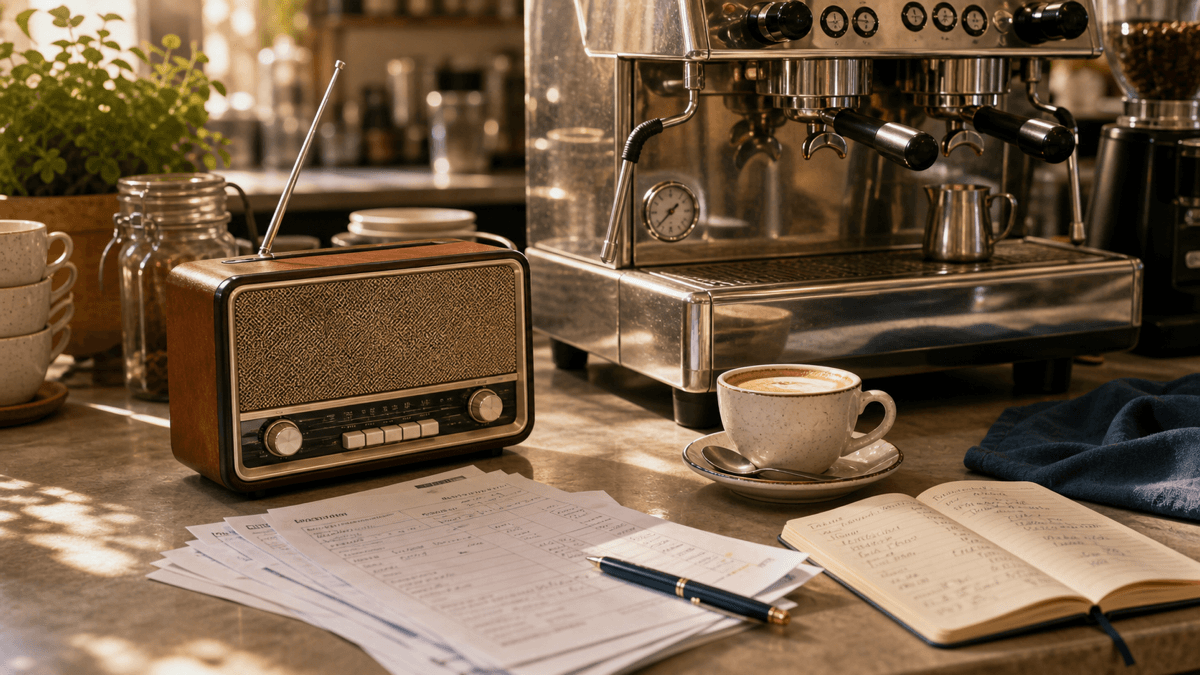
When I started Hunters Cake Company, I had no idea a café needs a music licence.
We weren't even running a playlist out front. There was just a radio on in the kitchen for the bakers, the way every kitchen I'd ever worked in had a radio on. Turns out that alone puts you on the hook. Most operators find this out the same way: a letter arrives one morning, and suddenly there's a bill for something you didn't know existed.
So here's the plain-English version, before the letter turns up.
What TheMusicLicence actually is
There are two separate rights wrapped up in any piece of recorded music. One covers the recording itself (the performers and the record company). The other covers the composition (the songwriter and publisher). Playing music in public uses both.
It used to be that you'd deal with two different bodies for this: PPL for the recording, PRS for Music for the composition. A few years back they combined the two into a single licence called TheMusicLicence, administered jointly through PPL PRS. One licence, one bill, one organisation to deal with. That part, at least, they made simpler.
The legal basis is the Copyright, Designs and Patents Act 1988. Playing live or recorded music in public without permission is copyright infringement, and you can be pursued for it. The licence is how you get that permission.
Who needs one (yes, including the kitchen radio)
This is the bit that catches people out.
Almost any business that plays recorded or live music where staff or customers can hear it needs TheMusicLicence. It doesn't matter whether the music is there to set the mood for customers or just to keep the kitchen sane at 6am. If it's audible outside a purely domestic setting, it counts as a public performance.
That means a licence is required for:
- A playlist or radio playing front of house
- A radio in the kitchen, even if no customer ever hears it
- Music through a TV or any digital device
- Live music, open mic nights, or a musician in the corner at the weekend
If you run total silence, you don't need it. Everyone else almost certainly does.
What drives the cost
There isn't one flat fee. What you pay depends on how much music you use and how big the space is, and PPL PRS work it out from a handful of factors:
- The audible area in square metres: roughly, the wall-to-wall space where the music can be heard, including back-of-house
- How many staff you have, and your customer capacity
- The type of premises and how central music is to what you do
- How the music is played: background radio is one thing, regular live events, multiple TV screens or a DJ are another
For a small independent café running a bit of background music, it's a modest annual figure rather than a frightening one. The cost climbs as the space gets bigger, the music gets more prominent, or you start putting on live events. The honest move is to get a quote for your actual setup rather than trust a number you read in a blog post, because the variables really do swing it.
The key word is annual. This is a recurring overhead, not a one-off. It sits alongside the other fixed costs that never make the headlines, in the same bracket as the insurance cover every café needs but few budget properly for. It belongs on the same list as every other contract in your café that renews itself.
The streaming trap
Here's where most operators quietly slip up, myself included in the early days.
A personal Spotify, Apple Music or Amazon Music account is for personal use only. Playing it in your café breaks those services' own terms. They're built for you on the sofa, not for a room full of paying customers. Plenty of cafés run a personal account anyway, and for a long time I was one of them.
Two things people get wrong about this.
First, a streaming subscription is not a public performance licence. Spotify, the radio, none of them grant you the right to play music in public. That right comes from TheMusicLicence and nowhere else. So even if you switch to a proper commercial music service, you still need the licence on top.
Second, PPL PRS will happily license you regardless of where the music comes from. They are not the Spotify police. They'll take your fee based on a personal account playing through a phone behind the counter without blinking. The catch is that the compliant route is a business music service such as Soundtrack Your Brand, and a licence that covers broad streaming use across a venue can get expensive indeed. That was the part that surprised me most.
What happens if you ignore it
PPL PRS do checks. They contact businesses, they follow up, and where a venue has been playing music unlicensed they can pursue backdated fees for the period you should have been covered. Because the underlying issue is copyright infringement, in principle you can also be sued for damages.
In practice it rarely gets to court for a small café. What it does mean is that "we'll sort it later" is a bet against your own back catalogue of unpaid years. Far cheaper to start covered.
How to budget for it
Treat it like any other unavoidable fixed cost and build it into your numbers from day one.
- Decide deliberately how you'll source music. Silence, a business music service, or live performances each carry different costs and obligations.
- Get a real quote for your premises rather than guessing. Audible area and staff numbers are the big levers.
- Put it in your fixed overheads next to rent, the energy bill that keeps creeping up, and business rates that have climbed again this year. It belongs in the same line of thinking.
- Fold it into your cost per cup. Every fixed overhead you ignore is margin you've quietly lost.
That last point is the whole game. The music licence is small on its own, but it's one more item in the stack of rising costs hitting cafés this year, and the ones that sink you are usually the ones you never wrote down. Tracking the overheads that sit behind every coffee, the way CostingBrik does alongside your ingredient costs, is what stops a stack of small forgotten bills from eating a margin you thought was healthy.
None of this is a reason to run a silent café. Music is part of why people sit and stay. Just go in knowing it's a line on the budget, decide how you'll do it properly, and don't let the letter be the first you hear of it.
Ed O'Brien has run Hunters Cake Company for 17 years across cafés in Witney, Burford, and a bakery in Carterton, Oxfordshire. He's building Brikly - modular tools that give independent café owners the same data the big chains have, without the big chain price tag.