
Café Insurance Explained: What You Actually Need (And What You're Overpaying For)
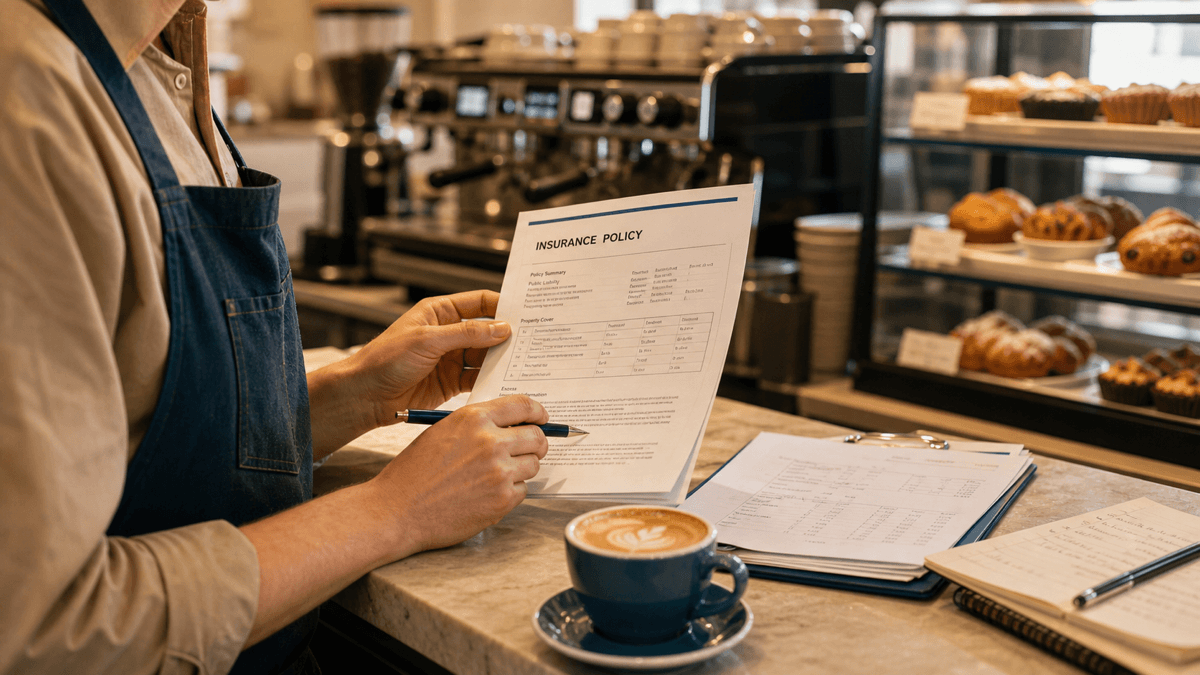
Insurance is the line on your P&L that you almost certainly got wrong - in one of two directions.
Either you panic-bought every cover a broker mentioned and now pay for things you'll never claim on. Or you went for the cheapest quote, ticked a box, and have no real idea what your policy covers until the day you need it. Most operators have never actually read theirs.
Let's fix that. Here's what a UK independent café genuinely needs, what's padding, and how to bring the cost down without leaving yourself exposed.
A quick caveat before we start: this is general information, not insurance advice. Your premises, lease, and risks are specific to you, so always use a specialist hospitality broker for your own cover.
The one cover that's actually the law
Most insurance is a judgement call. One isn't.
Employers' liability insurance is legally required the moment you have staff. That includes part-timers, casual weekend baristas, and in many cases unpaid helpers. The standard minimum cover is £5 million, though most policies offer £10 million as a baseline.
This isn't a soft obligation. Trading without valid employers' liability cover can land you a fine of up to £2,500 for every day you're uninsured. You also have to display the certificate where staff can see it, or make it available digitally. The certificate is only half of it: if a claim ever lands, the insurer will ask for the accident book entry, which is why the safety records a café must keep matter as much as the cover.
If you genuinely run the place single-handed with no employees at all, you may not legally need it. But the day you take on your first weekend hire, it becomes non-negotiable.
The covers you genuinely need
Past employers' liability, nothing else is the law. But a handful of covers are essential for any café that wants to survive a bad day.
Public liability
This is the big one after employers' liability. It covers you if a member of the public is injured or their property is damaged because of your business.
A customer slips on a wet floor. Someone is scalded by a flat white handed across the counter. A passer-by trips on your pavement seating. Public liability covers the legal costs and compensation when that happens, and in hospitality it happens more than you'd think.
Cover is usually offered at £1 million, £2 million, or £5 million. For a café, £5 million is increasingly the standard ask, especially if your landlord or a market organiser requires it.
Product liability
If your food or drink makes someone ill, this is what responds. A bad batch, an allergen that slipped through, undeclared nuts in a brownie.
The good news is that product liability is almost always bundled with public liability as a combined policy, so you rarely buy it separately. Just check it's actually included rather than assuming.
Buildings, contents, equipment and stock
Whether you need buildings cover depends entirely on your lease. If you own the premises, you need it. If you rent, read your lease carefully - many commercial leases make the tenant responsible for insuring the building, or for reimbursing the landlord's premium. Plenty of operators wrongly assume the landlord has it covered.
Contents, equipment and stock cover is for everything inside: your espresso machine, ovens, fridges, furniture, tills, and the stock on your shelves. For a café, your equipment is often your single biggest asset, so this is rarely optional. A commercial coffee machine alone can run to several thousand pounds to replace.
Business interruption
This is the cover people most regret skipping.
Business interruption replaces your lost income if something physical stops you trading - a fire, a flood, a burst pipe upstairs that closes you for six weeks. Your buildings and contents cover pays to repair and replace. Business interruption pays the wages, the rent, and the lost profit while your doors are shut.
A café can be physically rebuilt in two months and still be killed by two months with no turnover. This is the one I'd push hardest on.
Stock spoilage
A specific, café-relevant cover. If your fridge or freezer breaks down and the stock inside spoils, deterioration of stock cover pays for the loss.
For anyone holding meaningful chilled or frozen stock - dairy, cakes, prepped food - it's worth having. Check whether it's already part of your contents policy or a bolt-on.
The covers that are sometimes padding
Now the ones to think about rather than reflexively buy.
- Money cover. This protects cash on the premises, in transit to the bank, and sometimes at the owner's home. It mattered far more when cafés were cash-heavy. If you've gone largely cashless and most of your takings land straight in your account, the case for generous money cover weakens considerably. Worth knowing your card mix here - the same till data that shows you which dishes actually make you money also tells you how much cash you really handle.
- Legal expenses. Covers solicitor costs for disputes - employment tribunals, contract rows, debt recovery. Genuinely useful if you have staff, but it's often sold as a pricey add-on when a modest level of cover does the job. Compare it against what's already bundled.
- Cyber insurance. A few years ago this was easy to dismiss for a café. Less so now. If you hold customer data, run a loyalty scheme, take online orders, or store card details, a breach is a real risk and cyber cover responds to it. If you take nothing but contactless payments through a third-party provider that holds the data, your exposure is lower.
- Business vehicle cover. Only relevant if you deliver, do outside catering, or run a van. Your personal car insurance won't cover business use, so if you're dropping off catering orders, you need this. If you never leave the premises, skip it.
The honest summary for a typical small café: employers' liability if you have staff, public and product liability, contents and equipment, business interruption, and stock spoilage form the core. Everything else is a considered add-on, not a default.
How premiums are set, and how to bring them down honestly
Insurers price on risk. The more predictable and well-managed you look, the less you pay. Here's where you have real influence.
- Claims history. A clean record is the single biggest lever over time. Frivolous claims push your premium up for years, so weigh small claims against the long-term cost.
- Security and fire precautions. Good locks, an alarm, a working fire suppression system, serviced electrics, and clean extraction all reduce risk and premium. Many of these you'd want anyway.
- Combine your covers. A single combined café policy is almost always cheaper than buying public liability here, contents there, and business interruption somewhere else. It's also far easier to manage at renewal.
- Pay annually if you can. Monthly instalments usually carry interest, often dressed up as a "small admin charge." Paying the year up front frequently works out several percent cheaper. If cash flow is tight, that trade-off may still be worth it, but know you're paying for it.
- Review at renewal, every year. Insurers quietly bump renewals on the assumption you won't switch. Get a comparison quote annually. Loyalty is rarely rewarded.
Rates aren't the only fixed cost climbing this year. Business rates are rising sharply for cafés and restaurants in 2026, and there are other easily overlooked compliance costs to carry too, like the PPL PRS music licence cafés are legally required to pay if you play music for customers. With so many fixed overheads creeping up, trimming an over-stuffed insurance policy is one of the few savings genuinely in your control.
The underinsurance trap nobody warns you about
This is where good operators get caught, and it's worth understanding properly.
When you take out contents or stock cover, you declare a value - the "sum insured." Insurers assume that figure is honest. If it isn't, the average clause kicks in.
Here's how it bites. Say your contents are actually worth £80,000 but you declared £40,000 to keep the premium down. You suffer a £20,000 loss and put in a claim. Because you insured for only half the true value, the insurer pays only half the claim - £10,000. You're left £10,000 short, even though your loss was well under the amount you insured for.
Under-declaring doesn't just risk a total-loss shortfall. It scales down every claim, including small ones.
The fix is simple and costs nothing: declare honestly, and update your figures when you buy a new oven or fit out a second site. How your business is structured affects your liability too, which is worth weighing alongside your cover - we cover that in sole trader versus limited company for a café.
Your policy review checklist for this week
You don't need to become an insurance expert. You need to spend twenty minutes with your current policy and ask the right questions. Do this now:
- Pull out your schedule and actually read it. Confirm you have valid employers' liability cover if you have any staff, and that the certificate is on display.
- Check your sums insured. Are your contents, equipment and stock declared at full replacement value? If you've bought kit since you last looked, they're probably too low.
- Confirm business interruption is included and that the indemnity period reflects how long a real rebuild would take - 12 to 24 months, not a hopeful eight weeks.
- Check what's bundled versus bolted on. Is product liability inside your public liability? Is stock spoilage covered? You may be paying twice, or not at all.
- List the questions for your broker: Am I underinsured anywhere? What would average clause do to a claim? Is anything here I genuinely don't need? Can I save by combining covers or paying annually?
The goal isn't the cheapest policy or the most cover. It's the right cover, honestly declared, with no money wasted on padding and no nasty surprise on the day you claim.
Read your policy this week. It's the one admin job that quietly protects everything else you've built.
Ed O'Brien has run Hunters Cake Company for 17 years across cafés in Witney, Burford, and a bakery in Carterton, Oxfordshire. He's building Brikly - modular tools that give independent café owners the same data the big chains have, without the big chain price tag.