
The £4 flat white question: raising café prices without losing customers
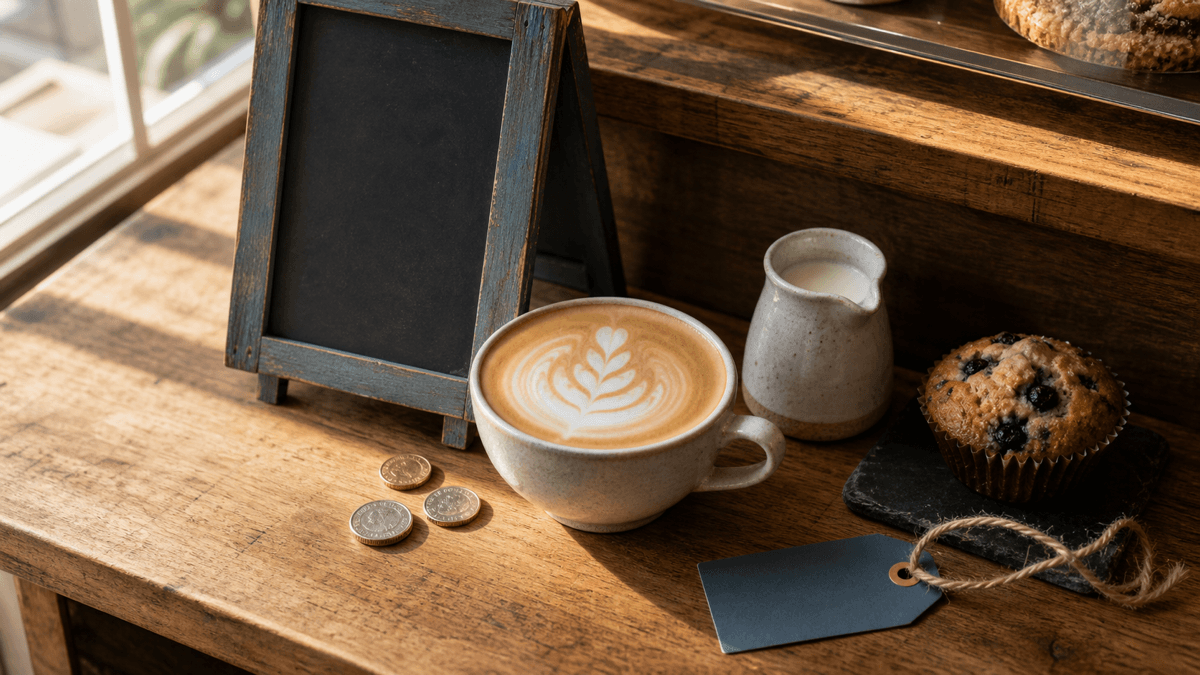
You agonise over a price rise for six weeks. You finally do it. You lose a regular the next morning and spend the rest of the week wondering if it was a mistake.
Here's the uncomfortable bit. It's almost never the price rise that costs you the customer. It's the way you did it.
In 2026, with food inflation still grinding, the National Minimum Wage up again, business rates biting and energy nowhere near pre-2022 levels, raising prices is not optional for most indie cafés. The cafés losing customers over it are the ones doing blanket raises with no anchor, no script for regulars, and no plan for the rollout. The ones quietly getting away with it are doing the same thing - just better.
This is the playbook.
The £4 flat white question
Is £4 a real psychological threshold for a UK indie flat white in 2026? Yes and no.
Yes, in the sense that customers do notice round-number jumps. The leap from £3.80 to £4.00 reads differently to them than £3.60 to £3.80, even though it's the same 20p.
No, in the sense that it's not a universal cliff. A £4 flat white in Shoreditch is unremarkable. The same price in a market town in the Midlands might cause raised eyebrows. And if your espresso is genuinely good, your milk is properly textured and your café feels like somewhere people want to be, £4 is fine almost everywhere.
The point is this: don't decide based on your gut, decide based on your specific items and your specific customers. Test on items, not on the menu.
The pre-rise prep window
Give yourself four to six weeks before you flip the switch. Most owners skip this and that's where it goes wrong.
Recost your full menu first
You cannot communicate a price rise confidently if you don't actually know which items have headroom and which are already underwater. Walk through every recipe with current invoice prices.
A proper recost usually surprises you. The brownie you've been selling at 70% gross margin is now at 58% because cocoa has done what cocoa has done - more on that in the 2026 cocoa price rise piece. The flat white you assumed was a banker is sitting on tighter margin than the filter you barely sell.
If you've not run the numbers in 6+ months, start with our walkthrough on how to calculate food cost percentage. You need this before you decide a single price.
Identify your top 5-10 items by cover-spend
Not by units sold. By contribution to total takings.
Most cafés have a Pareto curve where roughly 20% of the menu drives 70-80% of spend. Those are the items where pricing decisions matter most. The peppermint tea you sell four cups of a week is a rounding error. The flat white, the cappuccino, the sausage roll and whatever your signature item is - those move the business.
If you're not sure which items those are, that's exactly what a sales-mix view in MenuBrik is for. The tool sorts your POS data by contribution so you can see your real top 10 in about ten seconds.
Decide what rises, by how much, and in what order
Don't raise everything at once. Pick two or three high-margin items first. Move them. Wait. Watch the data. Then move the next batch.
Update everything in advance
This is the bit nearly everyone gets wrong. Same-day rollout matters more than people think.
- Printed menus
- Chalkboards and A-frames
- Online ordering platforms (Deliveroo, UberEats, your own)
- QR menus
- Square / Toast / SumUp button prices
- Loyalty app prices if applicable
- Your own website menu, as text, because it is one of the places an AI answer about your cafe reads from (more in the 12 October Weekly Grind)
A customer who sees £4 on the chalkboard, £3.80 on Google and £4.20 on Deliveroo concludes you don't know what you're doing. Update them all the night before. Walk in fresh the next morning.
Timing matters more than you think
Don't do it in January
Everyone is broke. Everyone is grumpy. Dry January has cratered your sit-in covers. Your customers are already in a defensive mood about money. This is the worst possible week to nudge the flat white up 20p.
Tie it to a seasonal menu change
The cleanest cover for a price rise is a new menu. Spring/summer launch, autumn refresh, Christmas menu - any of these naturally introduce new prices because there are new items on the board. The rise stops feeling like a rise and starts feeling like "the new menu is here."
Don't broadcast it
This sounds counter-intuitive but it's the single most important rule. Subtle outperforms shouty. Every time.
Anchoring: give them a more expensive option
The single most underused trick in indie pricing.
Introduce a premium version of your hero item. A £5 oat flat white made with a single-origin espresso. A £4.80 specialty pour-over. A loaded brunch toast at £12.50.
Two things happen.
First, some customers buy it and your average spend per cover quietly goes up. Second, and more importantly, the £4 standard flat white now looks like the sensible mid-range choice instead of the expensive option. You've anchored the menu upward without raising the original price by a penny extra.
The same trick is why every restaurant has one wine on the list that's miles more expensive than the rest. It's not really for sale. It makes everything else look reasonable.
The regular customer script
If a regular notices and says something, you need a sentence ready. Short. Honest. No apology.
Something like:
"Yeah, milk's up again, had to nudge the flat white up. Good to see you though."
That's it. Notice what it does:
- Acknowledges the change directly. Doesn't pretend nothing happened.
- Gives a one-line reason that's true and recognisable (everyone knows milk has gone up).
- Doesn't list every cost pressure you're under.
- Doesn't apologise like you've done something wrong.
- Pivots to warmth - "good to see you" - which is what they actually came in for.
Brief your team on a version of this in their own words. Awkward over-explaining is what makes a price rise feel guilty.
What not to do
A short list of own goals worth avoiding.
- Don't shave portions to hide a rise. Customers notice the smaller brownie or the slightly stingier scoop of granola before they'd ever have noticed 30p. Portion shrink is the fastest way to feel cheap.
- Don't raise everything at once. It's lazy and the data tells you nothing.
- Don't blame suppliers in front of customers. Even if the supplier price rise was real, making it their fault makes you look like you can't run a business. Take ownership of the price.
- Don't apologise. You're running a small business in a high-cost economy. You're allowed to charge a fair price.
- Don't forget that rent is part of this. If your lease renewal just landed with a 30% step-up, your prices have to reflect that. Don't subsidise the landlord out of your own margin.
Test on items, not on the menu
Pick two or three high-margin items. Move them. Wait two weeks. Read the data.
If covers hold and unit sales on those items hold within 10%, the rise has worked. Move the next batch. If unit sales on one specific item collapse, that item was sitting at its price ceiling. Walk that one back, leave the others where they are.
This is how you find your actual price ceilings without blowing up the whole menu.
Track the metrics that matter
You don't need a dashboard with 40 numbers. You need four.
- Weekly covers. Are people still coming in?
- Item mix shift. Are people trading down from the flat white to the americano because of the new price?
- Average spend per cover. Total revenue / number of covers. This is the number that tells you if the rise actually landed.
- Refund and complaint rate. A small spike is normal. A sustained spike is a signal.
If you have PulseBrik or any decent P&L tool, average spend per cover is the headline number. Covers can stay flat and your week can still get materially better if spend per cover ticks up 40p.
For the underlying logic on which items deserve the rise and which don't, the menu pricing fundamentals piece walks through it properly, and the flat white cost breakdown shows exactly what's hiding inside a single cup.
When it goes wrong
Sometimes one item bombs. Sales collapse 30% in a fortnight on the new price. That's data, not failure.
Walk it back. Quietly. The customers who pushed back on the price will notice. Treat it as a "we listened" moment, not a defeat. Most people will respect you more for it, not less.
The cafés that get stuck are the ones that dig in on a bad price out of pride. Don't. The menu is a living thing.
The bigger truth
In 2026, the maths is not on your side. Dairy is up, coffee is up, cocoa is up a lot, your wage bill went up in April, and your landlord wants their slice too.
You almost certainly need to raise prices. The cafés quietly doing it well are the ones still here in 2028. The ones that won't are the ones who froze, ate the margin, ran out of cash, and closed.
The takeaway
Raising prices is a craft. Done badly it costs you regulars. Done properly it's invisible.
The short version of the playbook:
- Recost the whole menu before you touch a single price
- Find your top 10 items by cover-spend, focus there
- Update every surface the night before, no exceptions
- Time it with a seasonal menu, never in January
- Add a more expensive anchor option
- Brief your team on a short, unapologetic script
- Move two or three items first, watch the data, then move more
- Walk back anything that clearly bombed, no shame in it
If you can do all that, the £4 flat white isn't a threshold. It's just a price.
Ed O'Brien has run Hunters Cake Company for 17 years across cafés in Witney, Burford, and a bakery in Carterton, Oxfordshire. He's building Brikly - modular tools that give independent café owners the same data the big chains have, without the big chain price tag.