
Same recipe, different cost: why site two runs three points behind
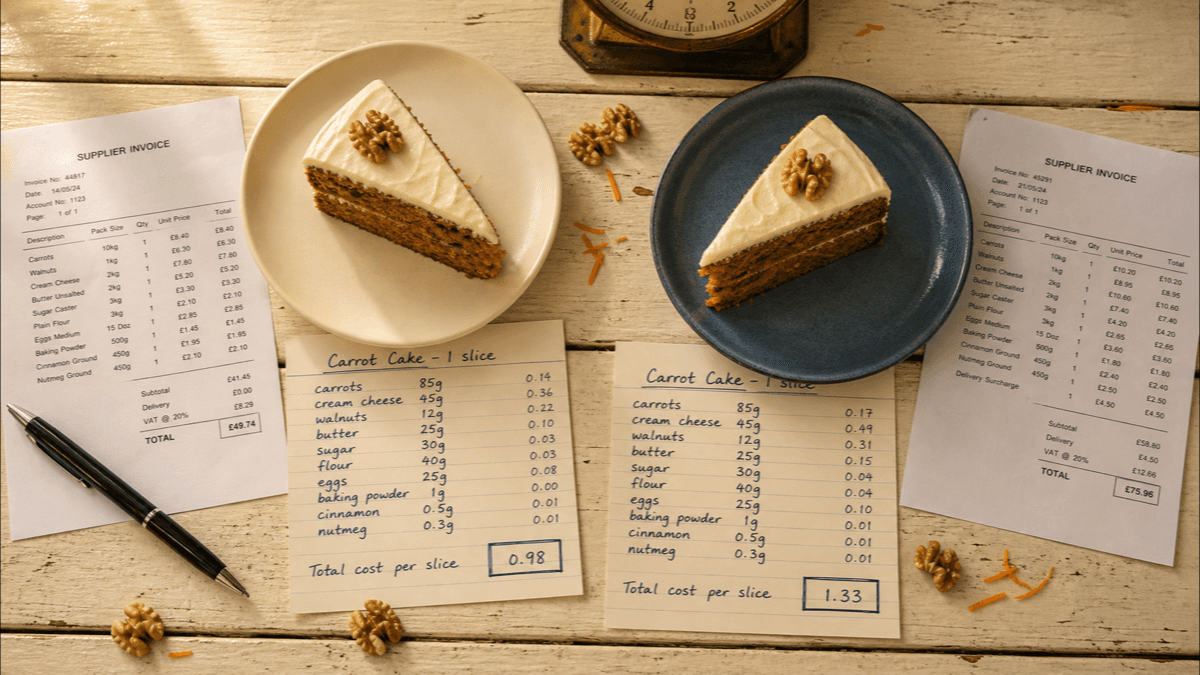
Same recipe card. Same supplier list. Same price on the menu board. And site two is running three or four points of gross profit behind site one, month after month, and nobody can tell you why.
It's almost never one big thing. If it were one big thing you'd have found it by now. It's six small things stacking on top of each other, none of them worth a conversation on its own, all of them adding up to a number that shows on the P&L. And until you can see the two costings side by side, line by line, you will keep guessing at which.
The blended cost that describes neither site
Most operators cost a recipe once. One card, one cost, one GP number, used everywhere. It's the sensible thing to do when you have one kitchen, and it quietly stops being sensible the day you open a second one.
The problem isn't that the blended number is wrong. It's that it's an average, and an average of two different realities describes neither of them. If site one makes the dish for 95p and site two makes it for £1.10, a company-wide card showing £1.02 tells you the dish is fine. It is fine at site one. At site two it's eating your margin, and the average is doing a very good job of hiding that.
This is how a site can lose money for a year without anybody noticing. Group GP looks acceptable. The strong site is carrying the weak one, and because you're looking at one blended figure you never see the carry. When you compare yourself against gross profit benchmarks, you're comparing a number that no single site in your business actually achieves.
Six reasons the same dish costs different money
Here's what's usually going on. You'll recognise most of these, and you'll probably have three or four running at once.
1. Different suppliers, or different accounts with the same supplier
The obvious one, and only half the story. Yes, sometimes the smaller site buys from a local greengrocer because the wholesaler's van doesn't come out that far. But more often it's the same supplier, two accounts, two price lists.
Volume tiers are the culprit. Site one buys 25kg of butter a week and sits on the middle tier. Site two buys 5kg and pays list. Same product code, same lorry, different price per kilo, and nothing on either invoice flags it.
2. Delivery charges and minimum orders
If a site sits under the free-delivery threshold, it pays carriage. Carriage doesn't attach itself to any one ingredient, so it never shows up on a recipe card, but it's real money spent to get ingredients through the door.
A quiet site paying £13 a week in carriage on £650 of ingredients is running a 2% uplift on everything it buys. That's a couple of pence on most dishes. It's also two full points off some of them.
3. Pack size
The busy site buys the 5kg because it goes through it. The quiet site buys the 1kg, because the 5kg would be past its best before it was finished. Perfectly sensible decision on the floor. Completely different cost per kilo.
This is the gap that hides best, because both invoices look normal until you compare suppliers on a per-kg basis. Nobody is being ripped off. The smaller pack simply costs more per gram, always has, and that difference lands on every portion the small site serves.
4. Waste and shrinkage
Here's the one that isn't about buying at all. Two sites can pay exactly the same price per kilo and still have different costs per portion sold.
Lower footfall means a batch sits longer. More of it gets binned. The cost per kilo hasn't moved, but the cost per sold portion has, because you're spreading the same spend across fewer sales. A quiet site binning one slice of cake in fourteen is carrying a 7% waste load. The busy site binning one in twenty is carrying 5%. That gap is pure margin.
5. Portioning drift
Different people, different hands, no shared spec. The scoop at site one is a 30ml scoop. At site two it's a dessert spoon and a generous mood.
Nobody is doing anything wrong. There's just no written gram weight, so the plate reflects whoever built it. Portioning drift is the cause operators are most reluctant to look at and the one that's cheapest to fix, because it costs you a set of scales and a laminated card.
6. Prep location
If one site bakes and the other takes finished product from the first, there's an internal transfer happening, and in most businesses it is either double-counted or not counted at all.
Not counted looks like site two receiving free cake. Its food cost looks brilliant and site one's looks terrible, because site one bought the ingredients. Double-counted looks like both sites carrying the ingredient cost. Either way, two sets of numbers that don't mean anything. This is the single most common reason a multi-site P&L stops making sense. There are three ways to charge a café for what another site makes, and each one hides something different.
How to compare like-for-like
The method is simple enough. It's the discipline that's hard.
Cost the recipe once per site. Not once for the business. Same ingredient list, same gram weights, but each site's own prices from each site's own invoices. You already do this instinctively for cup sizes, where each size gets costed as its own recipe rather than scaled from the small one. Sites work the same way.
Compare at ingredient-line level, not dish level. "Site two's carrot cake costs 15p more" is a fact, not a finding. You can't act on it. "Site two's cream cheese costs 4p more a slice because it buys 300g packs instead of the 1.65kg tub" is something you can pick up the phone about.
Rank the gaps by pounds, not percentage. This is where most people go wrong. The biggest percentage gap on a cost card is almost always a cheap ingredient. Site two's carrots might be 30% dearer, which sounds alarming until you notice it's a penny a slice. Meanwhile a 15% gap on cream cheese is four times the money. Sort by pence, work down from the top, stop when the numbers stop mattering.
A worked example: one carrot cake, two sites
One recipe, fourteen slices, sold at £5.25 including VAT at both sites. That's £4.375 ex-VAT on the till. Illustrative UK 2026 trade prices, ex-VAT, and they're illustrative rather than a quote.
| Line | Site 1 | Site 2 | Gap | What's going on |
|---|---|---|---|---|
| Cream cheese, 45g | £0.28 | £0.32 | +£0.04 | 1.65kg catering tub at £6.21/kg vs 300g packs at £7.17/kg |
| Walnuts, on top | £0.13 | £0.17 | +£0.04 | Same price per kg. Spec says 12g, site 2 uses 16g |
| Butter, 25g | £0.16 | £0.18 | +£0.02 | £6.40/kg on the volume tier vs £7.20/kg at list |
| Carrots, 40g | £0.04 | £0.05 | +£0.01 | 25kg sack at £0.95/kg vs greengrocer at £1.25/kg |
| Flour, sugar, oil, eggs, spice | £0.29 | £0.29 | £0.00 | Identical. Same account, same packs |
| Delivery surcharge, per slice | £0.00 | £0.02 | +£0.02 | Site 2 pays £13/wk carriage on £650 of buying, a 2% uplift |
| Waste allowance | £0.05 | £0.07 | +£0.02 | 1 slice in 20 binned vs 1 in 14 |
| Cost per slice | £0.95 | £1.10 | +£0.15 |
Now the margins, both on the same £4.375 net sale.
- Site 1: £4.375 less £0.95 = £3.425 gross profit, which is 78.3%
- Site 2: £4.375 less £1.10 = £3.275 gross profit, which is 74.9%
A gap of 3.4 points. And the whole of it is that 15p, which is 3.4% of £4.375. The pounds and the percentage are the same fact told twice.
Look at where the 15p actually came from. Not one disaster. Two lots of 4p, three lots of 2p, and a penny. No single line is worth a meeting. Together they're the difference between a cake that performs and one that doesn't.
The volume matters too. If site two sells 22 slices a day, six days, fifty weeks, that's 6,600 slices and just under £1,000 a year of gross profit on one line of a menu that probably has forty. Run the same six causes across everything site two sells, and a site turning over £4,500 a week ex-VAT is looking at somewhere around £7,600 a year.
The one that isn't on this card
Both sites bake their own cake here, which is why the ingredient lines differ at all. If site two took finished cakes from site one's kitchen instead, none of those lines would exist and there'd be a single transfer line in their place. That line is the one worth checking first in your own business, because in my experience it's either missing or counted twice more often than it's right.
I bake in Carterton and serve in Witney and Burford, so I've had both versions of this wrong at different times. A Burford scone and a Witney scone are the same recipe and two genuinely different costs, and pretending otherwise didn't make it stop being true.
Fix it, or price for it
When you find a gap, there are only two honest answers, and picking neither is what most people do.
Fix it where the cause is a decision. Consolidate the order so both sites clear the free-delivery minimum on one drop. Move the small site onto the larger pack if the shelf life stands up. Write the gram weight on the card and put a scoop next to the tub. These are cheap, and they close real money.
Price for it where the cause is structural. A quiet site will always waste more of a perishable than a busy one. A site off the delivery run will always pay more for fresh produce. That's not a failing, it's the shape of the business, and the honest response is to charge a bit more at that site rather than pretend the cost isn't there. Plenty of two-site operators run slightly different price lists. Customers cope with it far better than owners expect.
What to do this week
- Pick three dishes. Your best sellers, the ones that carry the most gross profit. Not the whole menu.
- Pull one recent invoice per site for the main ingredients in those dishes. Same week if you can.
- Work out cost per kg, litre or each for both sites, from the pack size on the invoice. This is the step that surfaces the pack-size gap on its own.
- Write the two cost cards side by side, line by line, with a gap column in pence.
- Sort by pence and look at the top three lines. Ignore everything under 2p for now.
- Decide fix or price for each one, write the decision down, and put a date on it.
- Check your transfers. If anything moves between sites, confirm it's counted exactly once, at one site, at cost.
An afternoon's work, and you'll know more about your second site than you did last year.
Where Brikly fits
This is the job CostingBrik is built for. It's multi-location by design: ingredient prices are tracked per site from each site's own invoices, so the same recipe carries a real cost at each location rather than one blended average that flatters the weak one.
You upload the invoices you already receive. When a price moves at one site, the recipes at that site recalculate and the other site's numbers stay where they are, because they should. You get a per-site GP on every dish instead of a company figure that hides the site you need to look at.
It won't tell you whether to fix the gap or price for it. That's your call, and it depends on things no software knows about your rooms and your customers. But it will show you the gap, at ingredient-line level, without you spending an afternoon with two invoices and a calculator.
Ed O'Brien has run Hunters Cake Company for 17 years across cafés in Witney, Burford, and a bakery in Carterton, Oxfordshire. He's building Brikly - modular tools that give independent café owners the same data the big chains have, without the big chain price tag.