
Cup sizes and the price ladder: what 40p to go large actually earns you
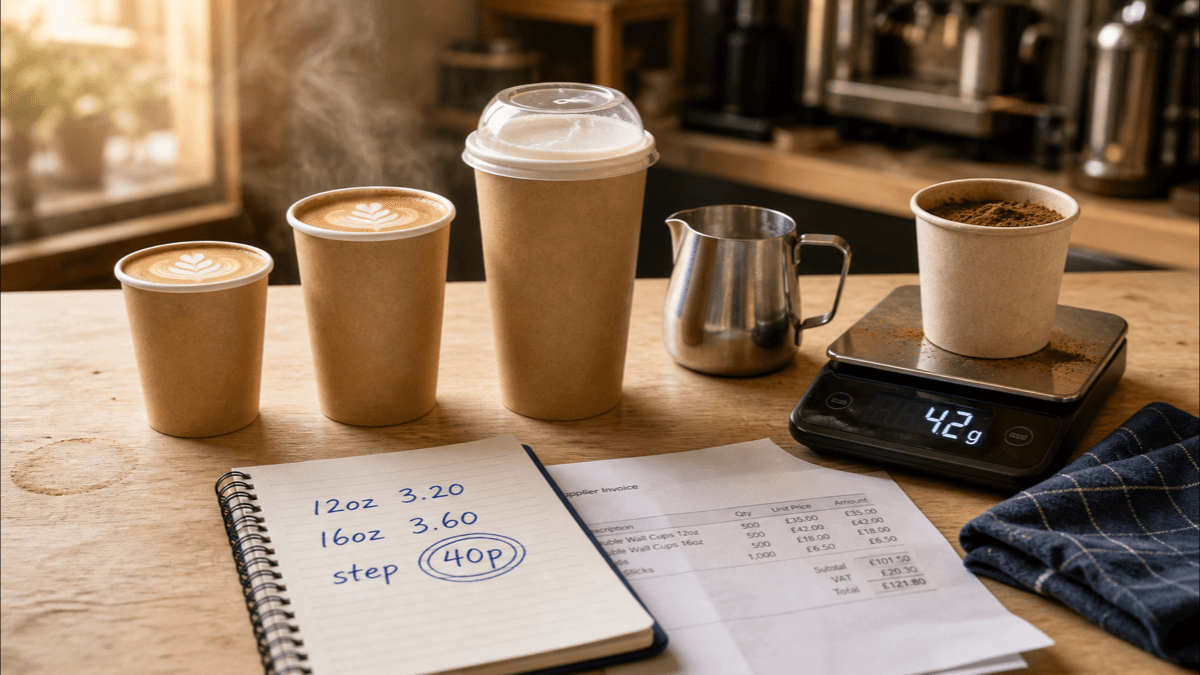
Somebody asks for a large. You tap the 16oz button, add 40p, and get on with the queue.
That 40p is a price. It sits on your menu alongside every other price, and unlike the others it has almost certainly never been checked. Ask most operators where the size step came from and the answer is some version of "it's what we've always done" or "it's what the place down the road charges."
Meanwhile a 16oz cup holds 33% more liquid than a 12oz. A 16oz latte costs you about 14% more to make. Those two numbers being different is the entire subject of this post.
This is not about add-ons. Charging properly for oat milk, syrups and extra shots is its own reckoning. Size is a separate lever, and it behaves differently on different drinks. Get it wrong and you can upsell your way into less profit per litre of milk you pour.
What actually changes between sizes, and what doesn't
Before any arithmetic, it's worth being clear about which parts of a drink genuinely scale with the cup. Most of them don't.
Milk: the one that really scales
This is the main event. A 12oz latte takes roughly 280ml of milk once you allow for a 60ml double shot in the cup. A 16oz takes around 380ml. That's 36% more milk, and milk is usually the single largest ingredient line in the drink.
If a size upgrade costs you anything meaningful, it's almost always the milk.
Coffee: often exactly the same
Here's the one people miss. In most UK cafés a 12oz latte and a 16oz latte both get a double shot. Same 18g dose, same basket, same grinder setting. The cup got a third bigger and your coffee cost did not move a penny.
Some cafés pull a triple in the 16oz. If yours does, that's a real cost for the card. If it doesn't, then on your most-sold drink the ingredient you obsess over most is fixed across the size ladder.
Cup, lid and sleeve: pence, not proportions
A 12oz compostable cup is around 13p, a 16oz around 15p. The lid is usually the same 90mm lid on both, at about 5p. A sleeve is a few pence more if you use one.
So the packaging step is roughly 2p. Not 33% more. Two pence.
Labour: identical
The drink takes the same time to make. Same grind, same tamp, same extraction, same pour. The barista does not spend 33% longer on a large. Your labour cost per drink is flat across the size ladder, which is the single most favourable fact about upselling size.
Syrups, powders and sauces: the wildcard
This is where it gets messy. On a hot chocolate, a chai or a mocha, the flavour base scales with the cup, or it's supposed to. Whether it actually does depends on whether anyone is measuring. A scoop is a scoop, a pump is a pump, and "a bit more for the big one" is not a recipe.
The maths, three drinks, one 40p step
Let's put real numbers on it. Illustrative UK 2026 trade prices, ex-VAT:
- Whole milk £1.05/litre
- Espresso beans £22.00/kg
- House filter beans £13.00/kg
- Drinking chocolate powder £8.50/kg
- Cups: 12oz 13p, 16oz 15p, lid 5p on both
One thing to get straight first. Hot drinks carry 20% VAT, eat in or takeaway. So a 40p step at the till is not 40p of turnover. It's 40p / 1.2 = 33.3p. Nearly 7p of your size step goes to HMRC before it does anything for you. Compare a step straight against ingredient cost and you're flattering yourself by a fifth.
The 12oz vs 16oz latte
12oz at £3.60: 18g espresso 39.6p, 280ml milk 29.4p, cup and lid 18p. Cost 87.0p.
16oz at £4.00: the same 18g espresso 39.6p, 380ml milk 39.9p, cup and lid 20p. Cost 99.5p.
The extra cost of going large is 12.5p. The extra net turnover is 33.3p. So the large puts 20.8p more cash margin in the till than the small.
That's a size step doing its job.
The filter coffee
Batch brew at 55g of coffee per litre. A 12oz serve is about 18.7g of beans at 24.3p, plus 18p of packaging, so 42.3p against a £2.80 price. A 16oz serve is about 25.0g at 32.5p, plus 20p, so 52.5p against £3.20.
Extra cost: 10.2p. Extra net turnover: 33.3p. Extra cash margin: 23.1p.
Filter is the best size upgrade on your menu and almost nobody pushes it, because the cash amounts feel small and there's no latte art to show for it.
The hot chocolate
12oz at £3.60: 30g of powder 25.5p, 300ml milk 31.5p, cup and lid 18p. Cost 75.0p.
16oz at £4.00: 42g of powder 35.7p, 410ml milk 43.1p, cup and lid 20p. Cost 98.8p.
Extra cost: 23.8p. Extra net turnover: 33.3p. Extra cash margin: 9.5p.
Same 40p step, same cup jump, and the large hot chocolate earns you less than half what the large filter earns. Both powder and milk scale, and there's no fixed espresso dose absorbing the difference.
Side by side
| Drink | 12oz cost | 16oz cost | Extra cost | Extra net turnover | Extra cash margin |
|---|---|---|---|---|---|
| Filter coffee | 42.3p | 52.5p | 10.2p | 33.3p | +23.1p |
| Latte | 87.0p | 99.5p | 12.5p | 33.3p | +20.8p |
| Hot chocolate | 75.0p | 98.8p | 23.8p | 33.3p | +9.5p |
Three drinks, one identical price step, and a two and a half times spread in what that step actually earns.
Cash margin beats percentage, but read it properly
Here's where operators go wrong in both directions, so it's worth being careful.
| Drink | GP% 12oz | GP% 16oz | Cash margin 12oz | Cash margin 16oz |
|---|---|---|---|---|
| Filter coffee | 81.9% | 80.3% | £1.91 | £2.14 |
| Latte | 71.0% | 70.2% | £2.13 | £2.34 |
| Hot chocolate | 75.0% | 70.4% | £2.25 | £2.35 |
Look at the latte. The GP percentage falls from 71.0% to 70.2% when you go large. And yet the large is unambiguously the better sale, because it banks 21p more actual money for the same barista time and the same second of counter space.
You pay your rent in pounds, not percentages. If your team has ever hesitated to push the large because "the margin's worse on it," that's a percentage misreading a cash improvement. It's the same confusion that turns up when people mix up markup and margin and end up pricing from the wrong end of the sum.
Now the other direction. "Any uplift is a good uplift" is not true either.
The hot chocolate adds 9.5p, and to get it you pour 37% more milk and 40% more powder. If your dairy invoice goes up 10p a litre, that large loses another 1.1p of its uplift. A step earning 9.5p has almost no room in it.
So the honest test on any size step is not "is the percentage still good" and not "is the cash positive." It's is the cash uplift big enough to be worth the extra ingredient and the extra exposure. Twenty-odd pence on a latte, yes. Under ten pence on a drink where everything scales, probably not at that price.
Three ways the size step goes wrong
1. The step that's too small
This is the expensive one. Take the same hot chocolate and put a 30p step on it instead of 40p. That's 25p of net turnover against 23.8p of extra cost. You have poured an extra 110ml of milk and 12g of chocolate for 1.25p.
Drop it to a 20p step, which plenty of cafés run, and the sum turns negative. 16.7p of turnover against 23.8p of cost means you lose 7.1p every time someone goes large. Every successful upsell makes the day slightly worse.
2. The step that's too big
The opposite failure is quieter, because nothing looks wrong. The large just stops selling.
Say you push the latte step from 40p to 80p, taking the 16oz from £4.00 to £4.40. Every large you do sell now earns 54p more than a small instead of 21p. Lovely. But your large mix falls from 35% of latte sales to 8%, because £4.40 crosses a line in people's heads that £4.00 doesn't.
Across 100 lattes a day: at the old step you take £220.29 in gross margin. At the new step, with the collapsed mix, you take £217.33. You've gained on every large and lost the upsell on 27 drinks a day. That's about £3 a day, or roughly £920 a year, quietly gone. No complaint, no feedback, just a button nobody presses any more.
3. The flat step applied across everything
Which brings us back to the table. One step across the whole hot drinks menu undercharges the drinks where everything scales and leaves money behind where nothing does.
The fix is not complicated. Filter and americano can carry a smaller step than 40p and still be your best upgrades. Lattes and cappuccinos sit comfortably where they are. Hot chocolate, chai and mocha need a bigger step, usually 60p to 70p, because the flavour base scales alongside the milk. Same principle as building up a flat white's real cost line by line: once you can see which lines move and which don't, the pricing decision makes itself.
If nobody measures, none of these numbers are real
Everything above assumes the 12oz gets 280ml and the 16oz gets 380ml. In most cafés both are poured by eye.
A barista steaming for a 16oz reaches for the big jug and fills it to a comfortable level, not to a line. Pour 420ml instead of 380ml and you've added 4.2p, a fifth of the uplift. Steam more than you need and tip 60ml down the sink and that's another 6.3p gone.
The hot chocolate is worse. A heaped scoop instead of a level one on the large is easily 10g over, which is 8.5p, which is 89% of the entire cash uplift on that drink. Two heavy hands on the same morning and the large hot chocolate is a worse sale than the small.
And check your cups. Nominal sizes drift between suppliers: one "12oz" holds 340ml, another 355ml. Fill both to the same visual point and your recipe is wrong by 15ml before anyone has been careless.
What to do this week
You don't need to reprice the menu. You need three numbers per drink and half an hour.
- Cost each size as its own recipe. Not one latte recipe with a note about sizes. A 12oz latte and a 16oz latte are different products with different costs. Until they're costed separately you cannot see the step at all.
- Measure the actual pour. Weigh the milk in each size, weigh the chocolate scoop, and use the real figures rather than the intended ones.
- Work the step ex-VAT. Divide by 1.2 before comparing it to cost. On a 40p step, 6.7p was never yours.
- Set the step per drink, not per menu. Smaller on filter and americano, unchanged on milk coffees, bigger on hot chocolate, chai and mocha. Three tiers is plenty. You don't need a step for every line.
- Check what your POS says about the size mix. Pull the last 90 days and see what share of each drink sells large. Under 10% and your step is probably too high. Over 50% on a drink with a thin step and you have a volume problem hiding behind a healthy-looking sales report.
- Re-derive after any milk price move. Milk is most of what scales, so the dairy invoice changes every step you've just set.
Where Brikly fits
Size steps go unexamined because costing every size separately is dull, repetitive work, and the moment a supplier price moves you have to do it again.
CostingBrik holds each size as its own recipe with its own ingredient quantities, so a 12oz latte and a 16oz latte carry their own costs and their own margins. The size step stops being a habit and becomes a decision with a number underneath it. When milk moves 8p a litre on an uploaded invoice, every size of every milk drink recalculates on its own, so a step that no longer clears its cost surfaces instead of sitting there quietly.
MenuBrik (coming soon) covers the other half: what actually sells. Costing tells you what each size earns, sales mix tells you how often anyone picks it. You need both. A brilliant step on a large that is 4% of sales is worth very little; a poor step on a large that is half your lattes is worth a great deal.
The 40p is a price. Treat it like one.
Ed O'Brien has run Hunters Cake Company for 17 years across cafés in Witney, Burford, and a bakery in Carterton, Oxfordshire. He's building Brikly - modular tools that give independent café owners the same data the big chains have, without the big chain price tag.