
Your self-employed weekend baker is probably a worker
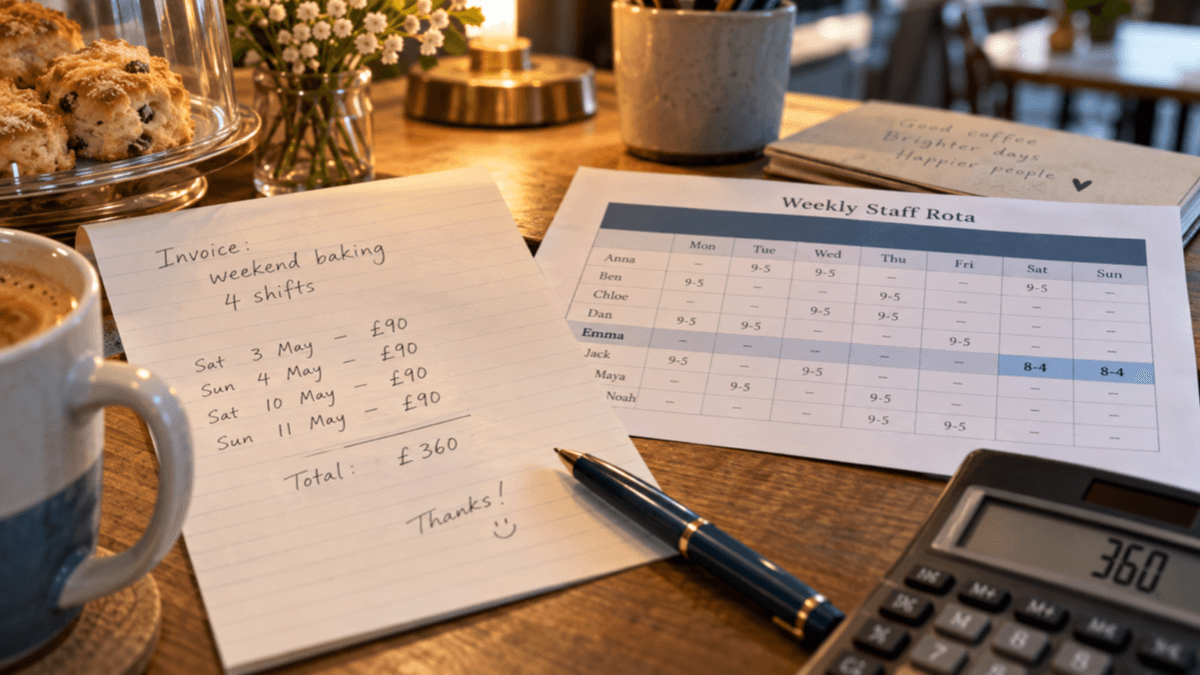
Two bits of paper on the office desk, and they disagree with each other.
The first is a handwritten invoice from your weekend baker: a flat weekly figure, no VAT number, paid by bank transfer. The second is the rota, her name in the same two slots since February.
The invoice says self-employed. The rota is closer to the truth, because status is decided by what actually happens rather than by what you agreed, and nobody can contract out of it, including her. It is the question that comes before day-one rights: not what she is owed, but what she is.
What actually changed in 2026
The Fair Work Agency was established on 7 April 2026, pulling the old labour market enforcement bodies into one place. Now the honest version.
HMRC still delivers minimum wage enforcement under contract until the function transfers in April 2027, and holiday pay enforcement will not begin before then. The agency's delivery plan for 2026 to 2027 names social care and construction as examples of high-risk sectors. Hospitality is not among them, whatever you may have read, though an open list of examples is not the same as being ruled out.
The change that bites is quieter. From 6 April 2026, section 35 of the Employment Rights Act 2025 requires you, in England, Wales and Scotland, to keep records adequate to show you have complied with holiday entitlement and holiday pay, and to keep them for six years. Failing to keep them is a criminal offence, and if you treat someone as self-employed you keep none for her at all.
Round 24 of the naming scheme landed on 3 September, putting hospitality names in a government press release, two McDonald's franchisees and a KFC in Brentford among them. Naming is considered from £500 of arrears.
From 1 October 2026 the right to work duty extends beyond employees to people on worker's contracts and to individual sub-contractors, which is exactly this population. The checking routine is worth ten minutes if you pay anyone on invoice.
Three statuses, and the one that bites
UK law recognises three: employee, worker and self-employed. Most of what is written about status argues about the first and the third, which is why almost none of it helps a café.
The famous tests decide employee status. Minimum wage, paid holiday and pension auto-enrolment attach to worker status, a lower bar. Section 230(3)(b) of the Employment Rights Act 1996 catches anyone who undertakes to perform work personally for another party whose status is not by virtue of the contract that of a client or customer of any profession or business undertaking carried on by the individual. The National Minimum Wage Act 1998 uses the same words, so the minimum wage follows worker status.
GOV.UK puts it plainly: casual labourers, including someone hired for a single day, get the minimum wage. The clearest exception is self-employed people running their own business.
The three tests, in café shapes
Control
Whose recipes, whose oven, whose opening time, who decides when the sourdough goes in. HMRC's Employment Status Manual frames it as personal service for a wage, control in a sufficient degree, and other terms consistent with employment.
A cake maker who bakes her own recipes in her own unit, sets her own prices and supplies four other cafés is running a business, and you are her customer. A baker on your hours, your mixer and your spec is doing your job.
Personal service and substitution
Not whether the contract says she can send someone. Whether she ever has, and whether you would take whoever turned up at half five with no introduction.
A deep-clean firm that sends three different people in a month, whose names you neither know nor need, is substituting for real. A clause you would have to approve is not an unfettered right.
Mutuality of obligation
HMRC's formulation is an irreducible minimum of obligation on each side, and people treat it as the escape hatch. It has not been one since the Supreme Court dealt with it in PGMOL, the football referees' case.
A DJ booked for one evening in December is a genuine one-off. A weekend slot filled by the same person all year is not: she turns up, you pay her for the shift.
CEST, and what it does not settle
CEST is HMRC's own tool and HMRC will stand by the result, provided your inputs are accurate and you follow the guidance. Worth running. Not the end of it.
CEST answers the tax question. Acas is explicit that status for tax and status for employment rights are different questions under different regimes. "Self-employed for tax" does not tell you she is not a worker owed holiday pay.
What she really costs
Illustrative numbers, hypothetical café. A baker works Saturday and Sunday, 5:30am to 2:00pm: 8.5 hours a shift, 17 hours a week. She invoices a flat £210 a week across 46 weeks, taking six weeks off unpaid because she is self-employed.
The effective rate. £210 divided by 17 hours is £12.35 an hour, against a National Living Wage of £12.71 from 1 April 2026, the rate for anyone 21 or over. She is 36p an hour under the minimum wage.
What those hours should pay. 17 x £12.71 = £216.07 a week, and across 46 weeks, £9,939.22. The shortfall is £6.07 a week, and £6.07 x 46 = £279.22 for a single year.
The holiday she has never had. Statutory holiday is 5.6 weeks, which for irregular-hours and part-year workers like her accrues at 12.07%. 12.07% of £9,939.22 = £1,199.66.
| Line | Amount |
|---|---|
| Pay for hours worked, 782 hours at £12.71 | £9,939.22 |
| Holiday accrued at 12.07% | £1,199.66 |
| Employer NI, 15% above the £5,000 threshold | £920.83 |
| Employer pension, 3% of qualifying earnings | £146.97 |
| True annual cost | £12,206.68 |
Both the NI and pension lines run off pay plus holiday of £11,138.88, clearing the £10,000 auto-enrolment trigger. Against 46 invoices at £210, or £9,660, the real cost is £2,546.68 higher: a 26.4% uplift, about where a mostly hourly-paid team lands. If she were your only employee, the £10,500 Employment Allowance would absorb that NI line and the uplift drops to about 17%; with an existing team the allowance is usually already spent.
At £9,660 a year she sits below the £12,570 personal allowance and the primary threshold, so if this is her only job there is no income tax and no employee National Insurance to recover. The bill is employer NI, holiday and pension.
Three years of it
If the arrangement were reclassified, at today's rate: arrears of 3 x £279.22 = £837.66, plus a 200% penalty of £1,675.32, halved to £837.66 if you pay within 14 days. Two years of unpaid holiday under the current backstop is 2 x £1,199.66 = £2,399.32. Employer NI on what you actually paid is (£9,660 less £5,000) x 15% = £699 a year, so £2,097. Backdated pension is 3 x £146.97 = £440.91.
Total with the penalty halved: £6,612.55. Three years of invoices came to £28,980, so that is 22.8% of everything you paid her. At the full penalty it is £7,450.21, and neither figure carries employer NI on the arrears and holiday themselves.
Two caveats. Arrears are recalculated at the rate in force when the notice is served, so a flat £210 that sat above older rates may produce less for earlier years, or nothing. And two years of holiday is the current position rather than a settled ceiling: it is under appeal in Afshar v Addison Lee, and the breach of contract route in the civil courts reaches six years, £7,197.96 here on its own.
Fixing one you already have
- Work out the real position first. Hours actually worked, what you paid, what the rate was each year.
- Do not tidy the paperwork. Backdating a contract, or bolting on a substitution clause she never used, turns a costing error into something worse.
- Decide what you are correcting. Payroll from next month is a different decision from settling the history. A correction is the point at which people take advice.
- Look before anyone asks you to. A voluntary declaration, where you find the shortfall and repay it first, generally carries no penalty and no naming. It closes the moment an investigation opens.
- Know the 14-day rule. Paying arrears and half the penalty within 14 days halves it, but the clock starts when a notice is served, so it is no reason to wait.
- Be straight with her. She can bring a tribunal claim, but she is not the only way in: a complaint can be made to HMRC on her behalf, and HMRC opens investigations off its own risk modelling. From 1 October 2026 the tribunal limit rises from three months to six, one of the dates in the Employment Rights Act rollout.
Putting her on the books is not a box tick either: gross-to-net, a Full Payment Submission on or before payday, pension assessment every cycle, a minimum wage recheck at every rate change, all of it work that decides whether you run payroll yourself or outsource it. She also starts accruing leave she can ask to take, usually in the fortnight you can least spare her, so read the rules on refusing a holiday request before December.
Her holiday records are then a legal document you hold for six years.
This week
- List everyone you pay on invoice. Bakers, kitchen help, weekend chefs.
- Put the rota next to each invoice. Same hours every week, on your kit, in your building, is your answer.
- Do the division. Weekly invoice divided by hours actually worked, against £12.71.
- Run CEST for the tax position, remembering it does not decide worker status.
- Cost one of them properly with the new hire calculator before you talk to anybody.
The invoice was never the answer. It is what you were looking at instead of the rota.
Ed O'Brien has run Hunters Cake Company for 17 years across cafés in Witney, Burford, and a bakery in Carterton, Oxfordshire. He's building Brikly - modular tools that give independent café owners the same data the big chains have, without the big chain price tag.