
Is Veganuary worth a special? Costing a January plant-based lunch
You're finalising December orders this week, and somewhere on the list is a question about January. Do you add a Veganuary special to the board, and if so, what goes on the order to make it?
Build it from a new shopping list and the special costs 179.7p a plate before anything is wasted, and you'll be binning half-used bags of vegan cheese all month. Build it from what's already on your shelves and the same £8.50 lunch costs 96.5p, with nothing left over when January ends.
Here's what the evidence says about Veganuary demand, a special designed to a target cost for a hypothetical café, and the allergen and labelling points that catch people out.
VAT and allergen labelling law are UK-wide. The allergen guidance quoted is the Food Standards Agency's, which covers England, Wales and Northern Ireland. In Scotland the regulator is Food Standards Scotland, which publishes its own guidance.
Where a price isn't linked to a source it's my illustrative UK trade figure, ex VAT, at November 2026 levels. The Brakes prices linked below are its logged-out prices, which it says reflect an average customer discount, so your account price may differ. Use your own invoices.
What the evidence says about Veganuary
Veganuary's own figures are self-reported
Veganuary says about 30 million people worldwide took part in 2026. Read the method before you plan around it. Its 2026 results come from online surveys, mostly by YouGov, of 13,529 adults across its core countries, fieldwork 20 to 29 January. The share who said they'd taken part was then applied to population estimates.
That's a reasonable way to measure a campaign. It's still people saying they took part, scaled up, and the figure comes from the organisation running the campaign. Up to 2023 the headline was a count of website sign-ups: 706,965 that year. The two series can't be compared.
Other polls disagree, a lot
| Figure | Who asked, and when | What was asked |
|---|---|---|
| 3% of Britons | YouGov's own poll, published 23 December 2025 | Intend to go vegan for January (3% already vegan, 90% not taking part) |
| 12% of UK adults | YouGov for Veganuary, 2,152 adults, 24 to 27 October 2025 | Likely to take part |
| 19% of UK adults | The Harris Poll UK for The Grocer, 1,000 adults, January 2026 | Taking part |
Three polls, three answers. "Likely to take part" and "taking part" can both include people having a few plant-based lunches, not just people going fully vegan for a month. Only one of the three was paid for by Veganuary. The Grocer's poll found two thirds of participants had chosen plant-based options before without going fully vegan.
The age split is the useful bit. The Harris poll had 37% of its youngest group (24 to 34) eating vegan or plant-based in January, against 18% of 45 to 54-year-olds and 6% of 55 to 64-year-olds. A café near a college or a co-working space is in a different market from one in a market town on a Tuesday.
Meat-alternative sales are falling. Lentils aren't the problem
Supermarket data is a cleaner signal than surveys, and it isn't kind to meat replacements.
- Plant-based meat: GFI Europe's analysis of Circana data, reported by Just Food, has UK supermarket sales down 7.3% in value in 2025, to £294.6m, on a 9.4% fall in volume. The GFI Europe report says the fall may be overstated, because some sales moved to Aldi and Lidl, which the data leaves out.
- Plant-based milk held steady: value up 0.5% to £419.3m, though volume slipped 2.2%.
- The wider meat-free category was down 4.8% in value and 6.5% in volume going into Veganuary 2026, according to The Grocer's Top Products Survey. The growth that's left is "increasingly coming from innovation around simpler, whole-food formats" rather than "highly engineered meat alternatives".
Eating out, Mintel's 2026 foodservice report says "only 12% of UK diners typically" order plant-based alternatives when they eat out or order a takeaway. Its summary: "moderation is winning over replacement."
So plenty of people want a plant-based lunch now and then, especially younger customers. Fewer want a burger pretending to be beef. That points to a soup, a grain bowl or a hummus sandwich, not a fake chicken wrap.
And January is January. NIQ's hospitality tracker had like-for-like sales at the big managed groups down 0.1% in January 2026, after a 2.9% rise in December. "January is always a tough month for hospitality," said NIQ's Karl Chessell. A Veganuary special won't change that. What it can do is give a few customers a reason to come in, without leaving you with dead stock.
Price first: where the special sits on a January board
The method is the one in designing a dish to a target cost: choose the price, take off VAT and the gross profit you need, and design to what's left.
Our hypothetical café's January lunch, all costed in earlier posts:
- Soup of the day, 400ml bowl with bread, £6.50: 86.1p to make, 84.1% GP, from costing soup of the day
- Soup and a sandwich deal, £9.50: a 300ml cup of soup and any sandwich, 77.4% GP eaten in
- Warm halloumi grain bowl, £9.50: 67.3% GP
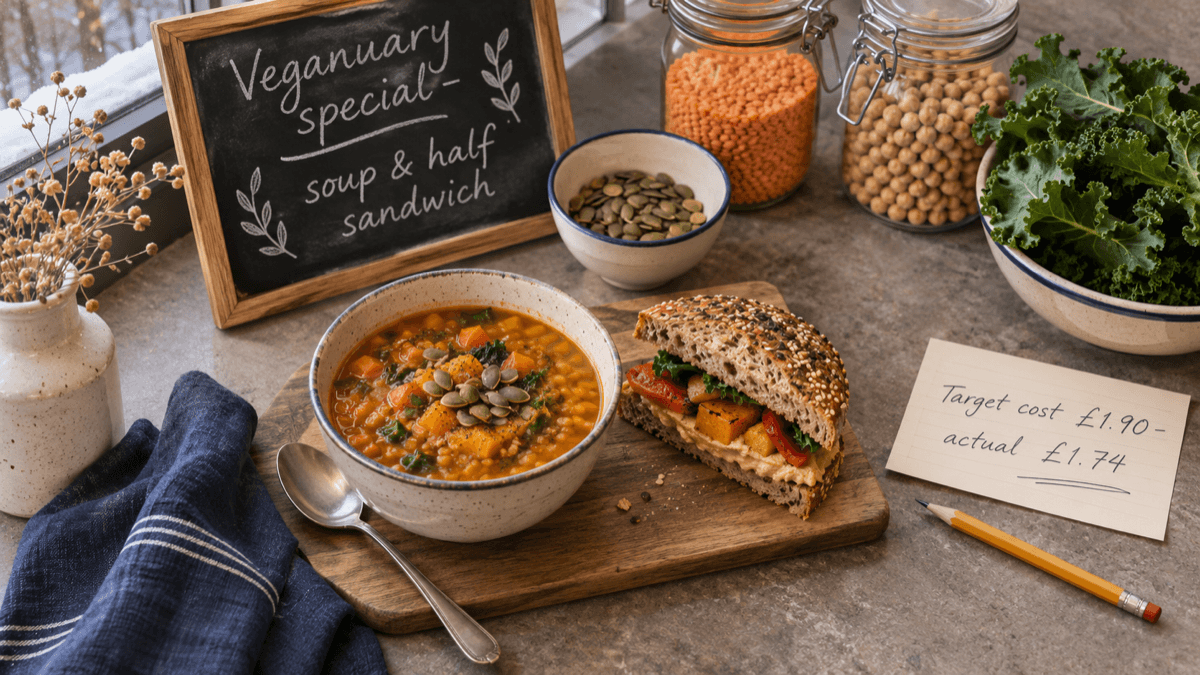
The special goes between the soup and the deal: a 400ml bowl of the lentil and winter vegetable soup with half a sandwich instead of bread, at £8.50.
| Step | Sum | Figure |
|---|---|---|
| Menu price, incl VAT | Your choice | £8.50 |
| Net price, eaten in | £8.50 / 1.2 | 708.3p |
| Target GP | Your choice | 75% |
| Maximum cost | 708.3p x 0.25 | 177.1p |
| Design window, 5 to 10% under | 177.1p x 0.90 to x 0.95 | 159.4p to 168.2p |
Why 75%? The deal it sits next to runs at 77.4%, and a plate that's mostly soup shouldn't earn much less. It's a choice, not a rule. Eaten in, the whole plate is standard-rated. To take away, hot soup is 20% and a cold half sandwich is zero-rated, so it's a mixed supply; the soup post works through that split, and it applies here unchanged.
Version 1: the Veganuary shopping list
Here's the special as it often gets built: someone sees the Veganuary range in the wholesaler's brochure and orders it. Soup, plus a toasted half sandwich of plant-based chicken, vegan cheese and vegan mayo on seeded bread.
| Line | Spec | Cost |
|---|---|---|
| Lentil and winter vegetable soup | 400ml at 107.2p/L | 42.9p |
| Garnish: seeds, herb oil | 5.0p | |
| Seeded bread (800g loaf at £2.80, 14 slices) | 1 slice | 20.0p |
| Plant-based chicken pieces, £11.77/kg | 60g | 70.6p |
| Vegan grated cheese, £11.09/kg | 25g | 27.7p |
| Vegan mayonnaise, £4.50/kg | 15g | 6.8p |
| Baby spinach, £6.00/kg | 10g | 6.0p |
| Napkin | 0.7p | |
| Eat-in cost | 179.7p |
One slice of bread is a half sandwich: one round, cut in two, makes two specials. At £8.50, version 1 makes 528.6p of GP, 74.6%. It's 2.6p over the maximum before anything goes wrong.
Then something goes wrong. The vegan cheese comes in 1kg bags, and the Brakes listing says: "Once opened, place in airtight container and consume within 5 days." Sell five specials a day and five days uses 625g. The other 375g goes in the bin, so each special sold carries 44.4p of cheese, not 27.7p. Version 1 is now 196.3p and 72.3%, 19.2p over budget.
The cheese isn't outrageous. Brakes lists a grated mature cheddar at £6.79 a kilo, so the vegan one is about 63% dearer by weight. The trouble is that nothing else on the menu uses it, and the same goes for the chicken pieces. They're frozen, so they keep, but on 1 February they're freezer space and cash tied up in a product with no other job.
Version 2: build it from the shelves
Start from what's already on the order. The soup is costed. Our café's halloumi bowl already uses chickpeas and tahini; the soup and the bowl already use carrots, onions and squash. Half a sandwich of roast vegetables and hummus needs nothing new except, perhaps, a seeded loaf.
The soup, and what makes it vegan
The soup of the day post costed the pot: £10.72 for 10.0 litres, so 107.2p a litre and 42.9p for a 400ml bowl. With two slices of bread, plant spread, garnish and napkin it came to 86.1p eaten in, 84.1% GP at £6.50.
No dairy, no egg, no honey in the pot, and the house stock is vegetables and water. Its vegan status on the plate depends on what you serve with it: the bread, the spread and anything in the garnish. Version 2 swaps the bread and spread for the half sandwich, so it's the seeded loaf's label that counts.
Hummus, as a sub-recipe
Made from the same 2.5kg tins of chickpeas, at the 65% drained yield used in the target-cost post:
| House hummus | Quantity | Cost |
|---|---|---|
| Chickpeas, drained (£2.95/kg drained) | 1.0kg | 295.0p |
| Tahini (£5.00/kg) | 250g | 125.0p |
| Lemon juice (£2.80/L) | 100ml | 28.0p |
| Garlic (£6.40/kg) | 20g | 12.8p |
| Rapeseed oil (£1.90/L) | 100ml | 19.0p |
| Ground cumin (£13.00/kg) | 5g | 6.5p |
| Salt, iced water | 250ml | 1.0p |
| Batch | 487.3p |
About 1.65kg comes out of the processor, so it's 295.3p a kilo, and 40g is 11.8p.
The bought alternative: a North West wholesaler lists a 1kg catering tub at £3.99, so 40g is 16.0p. House hummus is cheaper on ingredients, but it takes about 15 minutes hands-on. At 26.5p a minute, the fully loaded rate in the soup post, that's 9.6p a portion, so 21.4p all in against 16.0p for the tub. As with the soup stock, either is fine. Pick one on purpose, and if it's the tub, read its label for the same things you'd check on bread.
Roast vegetables, by the tray
| Roast vegetable tray | Quantity | Cost |
|---|---|---|
| Butternut squash (£1.50/kg) | 2.0kg | 300.0p |
| Carrots (85p/kg) | 2.0kg | 170.0p |
| Brown onions (90p/kg) | 1.0kg | 90.0p |
| Rapeseed oil (£1.90/L) | 80ml | 15.2p |
| Smoked paprika and cumin (£13.00/kg) | 10g | 13.0p |
| Salt and pepper | 2.0p | |
| Batch | 590.2p |
The vegetables are the soup's, at the soup's prices. Five kilos as bought is about 4.4kg peeled and trimmed, and with an illustrative 20% roasting loss about 3.5kg comes off the trays: 168.6p a kilo, so 60g is 10.1p. Weigh your own trays in and out.
The plate
| Version 2 | Spec | Cost |
|---|---|---|
| Lentil and winter vegetable soup | 400ml | 42.9p |
| Garnish: seeds, herb oil | 5.0p | |
| Seeded bread | 1 slice | 20.0p |
| House hummus | 40g | 11.8p |
| Roast vegetables | 60g | 10.1p |
| Baby spinach | 10g | 6.0p |
| Napkin | 0.7p | |
| Eat-in cost | 96.5p |
At £8.50 that's 611.8p of GP, 86.4%, and 80.6p under the maximum. It isn't in the design window; it's well below it.
That headroom is yours to spend or keep. You could put some of it into what makes the plate sell: a better loaf, a spoon of dukkah, a few pickled red onions. Or keep it, because January is the month the margin has to pay the rent. What I wouldn't do is drop the price to match the cost. A special at a confident price reads as a good lunch; a cheap one reads as clearance, which is the point the post on running specials that protect margin makes about framing.
The worst day for version 2 is a part-tub of hummus and a part-tray of vegetables, a few pounds of ingredients, and both can be made in smaller batches as you learn the numbers. I'd treat both like the soup: label every tub with the date it was made, and use the three-day rule the soup post quoted from Safer Food, Better Business.
Against your usual January lunch
| Eaten in | Price | Net | Cost | GP% | Cash GP |
|---|---|---|---|---|---|
| Soup bowl with bread | £6.50 | 541.7p | 86.1p | 84.1% | 455.6p |
| Soup cup and sandwich deal | £9.50 | 791.7p | 178.9p | 77.4% | 612.8p |
| Halloumi grain bowl | £9.50 | 791.7p | 259.0p | 67.3% | 532.7p |
| Special, version 1 | £8.50 | 708.3p | 179.7p | 74.6% | 528.6p |
| Special, version 2 | £8.50 | 708.3p | 96.5p | 86.4% | 611.8p |
The question every special has to answer is where its customers came from. For version 2, against what they'd otherwise have bought:
- The soup with bread: the special earns 156.2p more.
- The halloumi bowl: 79.1p more.
- The soup and sandwich deal: 1.0p less, which is a rounding error.
- Someone who wouldn't have come in: 611.8p you didn't have.
Version 2 doesn't need a single new customer to pay its way. Every swap is neutral or better. Version 1 is different: a deal customer who switches to it leaves you 84.2p worse off, and that's before the cheese bin.
Labour, beside the margin
The half sandwich isn't free to make. A minute at the pass to build it is 26.5p, and its share of the hummus and the vegetable trays (20 minutes for the trays, about 58 portions) adds 9.6p and 9.1p: 45.2p of labour, against a few seconds to slice two pieces of bread. The soup's own 42.4p a bowl is the same either way. I keep labour beside GP rather than inside it, as in the earlier posts, but it's worth knowing the special asks a little more of the kitchen than the soup it's built on.
The watch-outs
Dead stock on 1 February
The rule for a January special: nothing on the order that has no other job in February. If a dedicated product makes the dish, ask three things before you order it.
- What's the smallest pack, and its life once opened? A 1kg bag with five days' life is a bag you'll bin half of at five specials a day.
- What else on the menu uses it? If the answer is nothing, it's a January-only cost, and you'll still have some on 1 February.
- Is there a whole-food version? Chickpeas, lentils, beans and roast vegetables are what the market is buying more of anyway, and they're on your order already.
Range creep is the other trap. One good vegan plate on the board beats four half-hearted ones, each with its own part-used tub in the fridge.
"Vegan" is not "free from milk and egg"
This is where good intentions go wrong. GOV.UK's vegan food labelling guidance says: "There is no legal definition of vegan food in UK law, but businesses must label food accurately and not be misleading." A vegan claim means no animal ingredients were used on purpose, and "A vegan label does not guarantee that the product contains no ingredients of animal origin."
Customers don't always know that. The FSA's allergen guidance for food businesses warns that "Customers sometimes assume that vegan meals are free-from animal based allergens" (egg, fish, crustaceans, molluscs and milk), and tells you: "You need to be clear about this risk in the food you provide." FSA research found 62% of people allergic to animal-based products, or buying for someone who is, felt confident that vegan-labelled products were safe for them.
A free-from claim is a different, much stronger thing: "A free-from claim is a guarantee that the food is suitable for all with an allergy or intolerance." In a kitchen that toasts cheese sandwiches in the same press and butters bread with the same knife, you can usually say vegan honestly and free-from not at all.
The FSA's precautionary allergen labelling guidance is the bridge:
- "May contain" goes with "vegan". "Precautionary allergen labelling can also be used in combination with vegan or vegetarian labelling."
- Only after a risk assessment. It "should only be used when a risk of allergen cross-contact within the supply chain is identified that cannot be removed", and it isn't a substitute for good practice.
- Never with free-from for the same allergen. "A food cannot carry both labels for example "free-from milk" and "may contain milk.""
- Loose food can be told, not labelled. For non-prepacked food it "could be orally, by staff, or visually on signs at the premises."
If you wrap half sandwiches ahead for a grab fridge, they're prepacked for direct sale, and the PPDS rules for cafés mean a full ingredients list with allergens emphasised. Made to order at the counter, they're not.
And vegan isn't allergen-free. Version 2 contains celery (the soup), sesame (the tahini, and maybe the seeds), and cereals containing gluten (the bread). Version 1's vegan cheese lists oats as its allergen and the chicken pieces are soya. Put the special into the allergen matrix before it goes on the board, not after.
The labels that make it vegan
The animal ingredients that sneak in are rarely the obvious ones. Check every label in the build:
- Bread. Some loaves contain milk, butter or honey. Check the seeded loaf, and the bread the soup normally goes out with.
- Spread. Not every "spread" is plant-based. Clover, for one, lists buttermilk in its ingredients. If the soup is going out with bread and a plant spread, it has to be one that is.
- Bouillon and sauces. A bought bouillon can contain milk, and Worcestershire sauce traditionally contains anchovies, which are fish, and fish is one of the 14.
- Garnish and dressings. Honey in a dressing, pesto with cheese in it, an egg-glazed crouton.
Even bought products labelled vegan aren't a guarantee. In lab tests by Hampshire and Kent Scientific Services, 24 of 61 vegan-labelled products were found to contain egg or dairy. That's one more reason to keep the special close to whole ingredients you can see.
Oat milk: the same answer every time
A Veganuary customer will probably order an oat flat white with the special. Whatever your plant milk policy is, it needs to give the same answer on every till button, from every member of staff, and on the board. The arguments for charging, absorbing or blending are in should you charge extra for oat milk, and none of them changes in January.
If you're tempted to waive the surcharge just for January, remember what happens on 1 February: bringing it back looks like a price rise. Starbucks UK used the first week of Veganuary 2022 to drop its plant milk charge across all 1,020 UK stores, with no end date. If you want to make a change, make it permanent and cost it first.
Staff who can answer the question
The customer at the till will ask two things: is it vegan, and is it safe for my allergy. They're different questions. Before 1 January, every person on the rota should know:
- What's in the special, line by line, including the bread and the spread.
- What else on the menu is already vegan, so they can point people to it, and what looks vegan but isn't (the honey flapjack, the pesto, the butter on the griddle).
- The answer on milk and egg allergy, from your own risk assessment. Something like: "It's made with no animal ingredients, but in a kitchen that handles milk and egg, so I can't promise it's safe for an allergy."
- "Let me check" when they don't know. Never a guess.
So, is it worth it?
Built from stock, a Veganuary special has very little downside. It earns as much as anything else on the January board, it doesn't need new customers to pay its way, and if it doesn't sell you've lost a few pounds of hummus and vegetables. If it pulls in a handful of younger customers or a workplace team doing Veganuary together, that's money you wouldn't otherwise have had, in a month that's hard going anyway. Veganuary says taking part is free for businesses, logos included, so the board is the only marketing cost.
Built from a dedicated shopping list, it's a closer call. It earns less than the deal it competes with, it adds waste you'll only see in the bin, and it leaves stock behind. Unless your customers are the 24 to 34-year-olds the Harris poll points to, I wouldn't.
If the special lives in CostingBrik, the hummus and the roast vegetable tray can each be a sub-recipe used as one line in the plate, and when a processed invoice changes the price of chickpeas, tahini or squash, the recipes using them are re-costed.
Decide by 1 December
- Look at your own customers, not the national polls: age, office trade, and how many ask for vegan options now.
- Write the price before the recipe. Net price, target GP, maximum cost and design window.
- Build it from the order you already place. Anything new must have a job in February too.
- Cost it line by line, sub-recipes included, and compare its cash GP with what customers would otherwise buy.
- Read every label in the build, bread and spread first, and add the special to the allergen matrix.
- Decide your "may contain" answer from a risk assessment, and write the line staff will say.
- Settle the oat milk policy for the whole year, not for January.
- Brief the rota before the Christmas rush, then put it on the board for 1 January.
- Set a review date, say 15 January, and drop it if it isn't selling.
The free recipe costing calculator will do the sums for both versions in a few minutes. Veganuary might not fill your café in January. A special built from what you already stock doesn't need it to.
Ed O'Brien has run Hunters Cake Company for 17 years across cafés in Witney, Burford, and a bakery in Carterton, Oxfordshire. He's building Brikly - modular tools that give independent café owners the same data the big chains have, without the big chain price tag.