
Which price goes in the recipe? Last invoice, average, or the one you fear
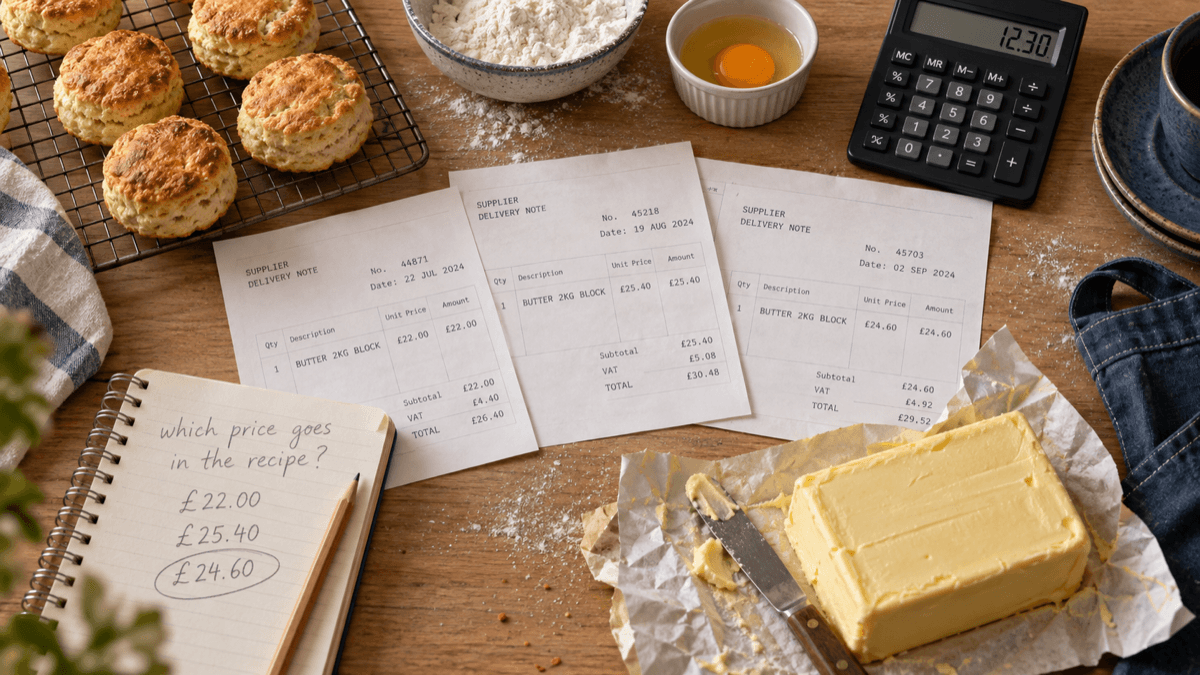
Three invoices from the same supplier. The same 2kg block of butter, the same product code, six weeks apart. Three different prices.
The scone recipe needs one number. You have three.
Most costing advice walks past this, as though the price were a fact you look up rather than a choice you make. It is a choice, and the three obvious ways of making it fail differently on different ingredients.
The three candidates, and where each one lets you down
Last paid
Cost at the price on the most recent invoice. It is honest about today, which is the main thing you want from a cost. If butter went up a fortnight ago, your margin changed a fortnight ago, and the recipe should say so.
One failure mode, and it is a big one: last paid is only as good as the last line. A club-line promotion, a substitution accepted at half six in the morning, a case price sitting in a pack price column, or a line read on the wrong unit, and the whole costing rests on a number that was never really the price of anything.
Right in principle, fragile in practice. The work is not choosing a method. It is checking the line.
Rolling average
Average the last three months, or six, or twelve. It does smooth out a one-off promotion. But an average describes the past and you sell scones in the present.
Its real problem is lag. Input prices are sticky on the way up and reluctant on the way down. Through a run-up the average sits below what you are actually paying for months, so you under-cost your busiest lines. On the way down it leaves money on the counter.
Take a matcha powder that moves from 7.0p a gram in March to 10.3p a gram by July, a 47% rise in three steps. A six-month average through that has you costing matcha at a price you had not paid since spring.
The worst recent price
Take the highest of the three and call it prudent. I understand the instinct: if you are going to be wrong, be wrong in the direction that protects you.
Except it hides your real margin, so you cannot tell a good dish from a mediocre one. It also trains you to shrug: if the recipe already carries the worst price you have seen, a genuine rise lands and nothing changes.
Prices fall, too. A bread line that jumps by roughly a third in the spring and comes back to where it started by summer is common enough, and anyone still costing off the peak is pricing a bestseller off a number that stopped being true months ago.
The working answer, and the four cases that break it
For a kitchen with a service to run: cost on the latest price you actually paid, keep every earlier price, and read the direction. The history is what makes that safe. It tells you whether the newest price is a step in a trend or a wobble round a stable line.
There is no public trade price to check yourself against, either. The big national wholesalers keep their prices behind a customer login, and you only see a live price once you hold an account. Wholesale market indices give you direction, not the price you would pay, so your own invoices are the only fresh price source you own.
So the price in the recipe is a decision you make from a trail. Four situations break the simple version.
The promotion or club line. Short-dated stock, a rep pushing volume, a club price on the shelf. Cost at the price you expect to pay next month. Put the promo in the recipe and the margin vanishes the day it ends.
The substitution. Cost the substitute while you use it and flag the card with a date, because a substitution has no end date attached and the temporary swap quietly becomes the permanent recipe. Check the portion too. Say a substitute cheddar comes in at £4.90 a kilo instead of £5.30, which looks like a 7.5% saving, until it takes 45g rather than 40g to cover the same bread: £0.2205 a toastie instead of £0.212, which is 4% more, not less.
The pack-size change. Recompute per kilogram or per litre before you compare. Butter that moved from 250g to 227g at the same money is a 10% rise wearing a disguise, and it will not show up on any price-change report because the price did not change. The like-for-like per-unit comparison comes before the opinion.
The credit. A credit note is a money document, not a price signal: returning five cases tells you nothing about what the product costs. What does move the effective price is a discount or return line netting off inside an ordinary invoice, or a supplier reissuing at a corrected rate.
A swing list, and everything else
A handful of lines move constantly and the rest sit still for a year. Write a swing list of the ones that genuinely move: for most cafés coffee, cocoa, butter, eggs, oat milk and cooking oil. Review those monthly, off your own invoices.
The case for a list rather than one blanket rule is that lines in the same category move in opposite directions at the same time. In AHDB's UK wholesale dairy figures for August 2026, from spot trades between 27 July and 30 August, butter strengthened £130 a tonne to £3,450, up 4% on July, while sitting 43% below the £6,050 a tonne of August 2025. Bulk cream was down 41% year on year, skimmed milk powder up 24%.
Rising month on month and falling hard year on year at once: the neatest argument against averaging I have seen this year.
Headlines need the same caution. Coffee's ICO composite indicator averaged 287.29 US cents a pound in August 2026, effectively unchanged from 287.26 in July, yet that flat month held a mid-month rally and a full reversal, with intra-day volatility at 13.7%. A flat average is not a calm market. Nor is the futures price the price you pay: our coffee post traced a roaster move from £18/kg to £21.50/kg, about 6p a cup. Cocoa is the same shape: the world market, quoted in dollars, averaged around US$3,260 a tonne across 2023 before going past US$11,000 in 2024.
Everything off the swing list can run on the bands from the 20-minute recipe cost staleness audit: under 6 weeks old is current, 6 to 16 weeks is worth a look, over 16 weeks treat as a guess.
What it is actually worth on a scone
Illustrative UK 2026 trade prices, ex-VAT, not sourced from any one supplier. Same supplier, same 2kg block, three deliveries: 22 July at £11.00 a kilo (a club line), 19 August at £12.70, 2 September at £12.30. Last paid is £12.30, the rolling average £12.00, the worst recent £12.70, and the stale promo £11.00.
The batch makes 25 scones. Everything except butter comes to £1.75: flour £0.90, sugar £0.15, milk £0.32, baking powder £0.16 and an egg for the wash at £0.22. It takes 250g of butter, so 10g a scone.
| Price used | Butter in the batch | Batch cost | Cost per scone | GP at £2.20 ex-VAT | GP% |
|---|---|---|---|---|---|
| Last paid, £12.30/kg | £3.075 | £4.825 | £0.193 | £2.007 | 91.2% |
| Rolling average, £12.00/kg | £3.000 | £4.750 | £0.190 | £2.010 | 91.4% |
| Worst recent, £12.70/kg | £3.175 | £4.925 | £0.197 | £2.003 | 91.0% |
| Old promo price, £11.00/kg | £2.750 | £4.500 | £0.180 | £2.020 | 91.8% |
Those are ingredient gross margins on a VAT-exclusive selling price and nothing else: no labour, no packaging, no wastage, no jam and no cream. A plain scone carries almost no ingredient cost against a counter price, which is why the percentage looks enormous. It is not profit.
Butter is £3.075 of a £4.825 batch, 63.7% of what the scone costs you, so here the butter price is the costing. And yet at 200 scones a week, 10,400 a year, the worst-price version costs you £41.60 of margin against last paid, and the July club line left in the recipe under-recovers £135.20 across the year. The full spread between the three methods is £72.80 a year.
Now break the latest line instead. That 2 September delivery was one 2kg block at £24.60. Read correctly, £12.30 a kilo. Read as a 1kg pack it lands in the recipe at £24.60 a kilo, the batch costs £7.90 and the scone costs £0.316. GP at £2.20 drops to £1.884, or 85.6%. Against the correct 19.3p, that is 12.3p a scone of cost that never happened: £1,279.20 a year.
Choosing between last paid, average and worst recent moves this scone by 0.7p. One line read on the wrong unit moves it by 12.3p.
The spreadsheet version
If your costs live in a sheet there is no method at all. The price in the cell is whatever somebody typed last, and last week's price looks identical to March's. That is break four in our piece on every recipe costing template column and where it breaks. Add a price date column if you add nothing else.
What CostingBrik does with an invoice price
It is the same answer. CostingBrik does not ask you to pick a method: recipes cost at the latest price you actually paid, and every earlier price stays on the Price History tab with its date, supplier and source. Where an invoice does not state the unit it billed in, it stops and asks rather than guessing, because a wrong guess there would be costed forever.
This week
- Pick your five biggest ingredients by spend. Usually milk, coffee, a bread or flour line, butter and one protein.
- Find the last three invoices for each. Write the prices side by side, per kilo, litre or each, ex-VAT.
- Put the latest one in the recipe. Not the average. Not the worst.
- Check that latest line is real. Right pack, right unit, no promo, no substitution, no credit muddled into it.
- Write the direction next to it. Up, down or flat.
- Diary the swing list for the first of next month. Everything else waits for the 16-week rule.
The free recipe costing calculator will do the per-portion arithmetic as you go, without a login.
Last paid, average or worst recent is worth under a penny on a scone. Whether the price behind it came off a real line, on the right unit, in the right pack, is worth twelve. Go and look at the last three invoices for your biggest ingredient, not to pick a method, but to find out whether the number you have been costing off ever existed.
Ed O'Brien has run Hunters Cake Company for 17 years across cafés in Witney, Burford, and a bakery in Carterton, Oxfordshire. He's building Brikly - modular tools that give independent café owners the same data the big chains have, without the big chain price tag.