
Accident book, RIDDOR and the burn that becomes a claim: the safety records a café must keep
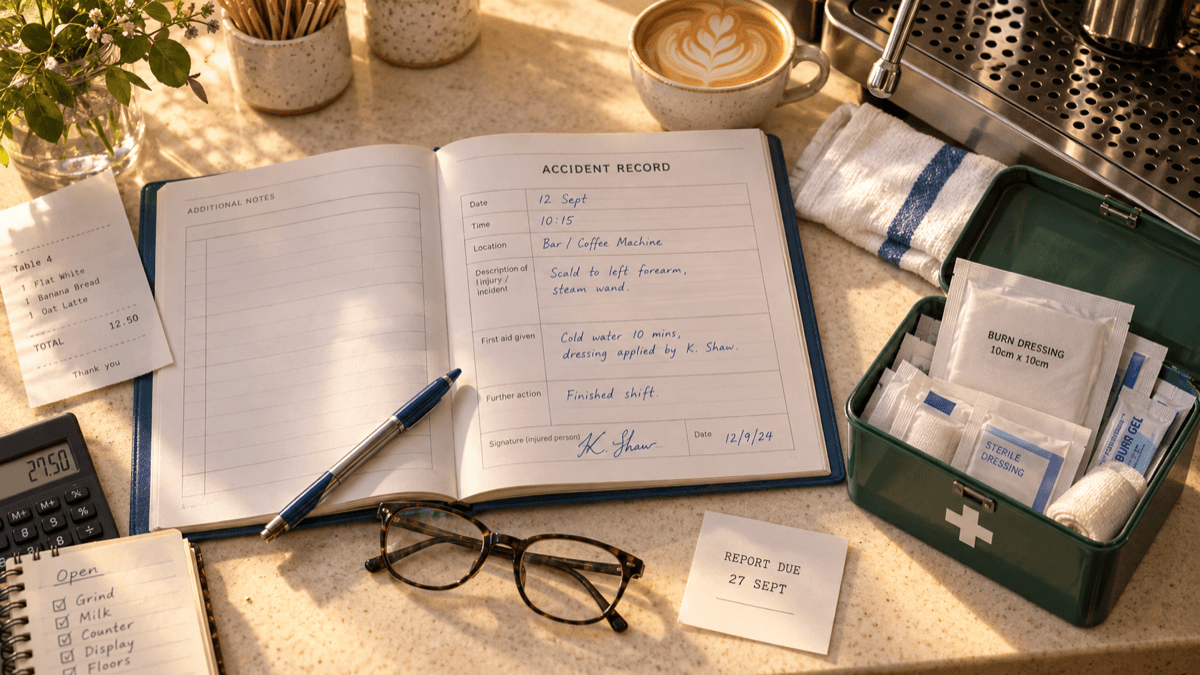
It is the Saturday rush and your barista catches her forearm on the steam wand. She runs it under the cold tap, says she is fine, carries on, and nobody writes anything down.
Eighteen months later a letter arrives from a solicitor.
The problem is not the burn. It is the gap between the burn and the letter, and what you have to put in that gap.
Four safety records matter here. Two are only required once you pass a headcount, and the internet is bad at saying which two.
Record one: the accident book
The accident book gets described online as a duty on every employer. It is not.
Regulation 25 of the Social Security (Claims and Payments) Regulations 1979 bites on an employer who normally employs 10 or more people at the same time, on or about the same premises. Below ten, you keep accident records in whatever form you choose, provided they are stored in line with data protection law. That is the legal fact; my own view is you keep one from your first employee, because it is the only asset you have the day a claim lands.
HSE publishes one, BI 510, about £8 at the time of writing, with 50 perforated forms so sheets can be removed and stored securely. Accident records are sensitive personal data, so a book left open on the pass is the wrong answer. Entries must be preserved for at least 3 years from the date of the entry. Read the "at least" properly: a floor, not a cue to shred on year three.
Record two: the RIDDOR report
RIDDOR is the Reporting of Injuries, Diseases and Dangerous Occurrences Regulations 2013. Your enforcing authority for a café is your local authority environmental health department, the team that does your hygiene inspection, not HSE. You do not report to the council direct, though: every RIDDOR report is filed through HSE, online at riddor.hse.gov.uk or by phone, and HSE passes it on.
Report without delay, with the full report received within 10 days:
- Any work-related death, suicides excepted. If an employee dies within a year of the accident from a specified injury under regulation 4, notify the death without delay, even if you reported the injury at the time.
- Specified injuries to workers under regulation 4: fractures other than to fingers, thumbs and toes; amputations; an injury a doctor diagnoses as likely to cause permanent blinding or permanent reduction of sight in either eye; crush injuries to the head or torso that damage the brain or the internal organs of the chest or abdomen; burns covering more than 10% of the body or damaging the eyes, respiratory system or other vital organs; scalping needing hospital treatment; loss of consciousness from head injury or asphyxia.
- A non-worker taken directly from the scene to hospital for treatment of an injury caused by a work activity.
- Dangerous occurrences from Schedule 2. Mostly industrial, but the pressure systems entry catches the failure of a closed vessel or its pipework that could have killed someone, reportable whether or not anybody was hurt. Your espresso boiler letting go, not the slip on the wand.
Report within 15 days an accident leaving a worker away from work or unable to do normal duties for more than 7 consecutive days, and a listed occupational disease as soon as you receive the diagnosis.
All of it goes online, on one of five forms; only fatal accidents and specified injuries to workers can be phoned in, on 0345 300 9923. Save the reference number and PDF: you must keep your own record of every reportable injury, disease or dangerous occurrence.
The Saturday burn, counted properly
Illustrative, but the counting trap is real. Say the burn happens on Saturday 12 September and the forearm blisters overnight. She cannot do her normal duties from Sunday 13 September, and is back on them on Monday 21 September.
It is not a specified injury: a forearm scald is no fracture or amputation, and it does not cover more than 10% of her body or damage her eyes, respiratory system or vital organs. So nothing to notify without delay. Now count: the day of the accident does not count, but weekends and rest days do.
13, 14, 15, 16, 17, 18, 19, 20 September = 8 consecutive days unable to do normal duties.
8 is more than 7, so this is reportable, and 12 September plus 15 days makes the report due by 27 September.
Now shift it by a day, and say she is back on Sunday 20 September.
13, 14, 15, 16, 17, 18, 19 September = 7 consecutive days.
7 is not more than 7, so no RIDDOR report is due. But 7 is more than 3, and an over-three-day incapacitation must still be recorded. The accident book entry is that record.
One day of recovery separates a reportable incident from a merely recordable one. In both versions, the entry you wrote on the Saturday is the only thing you have.
Customers, and the café disease
That customer rule has sharp edges. A friend's car counts as much as an ambulance. X-rays are not treatment; a dressing, stitches, a cast or surgery are. A precautionary trip with no apparent injury is not reportable, and a GP practice is no hospital.
Then the disease nobody reports. Occupational dermatitis is reportable where work involves significant or regular exposure to a known skin sensitiser or irritant, and new cases in catering run at twice the general industry average. Dishwasher over hand washing-up, gloves and moisturiser, sore hands reported early.
Records three and four: the two assessments
The risk assessment. Every employer must assess the risks to employees and to people not in their employment. That is regulation 3(1) of the Management of Health and Safety at Work Regulations 1999, with no headcount threshold. The threshold is on the writing: you record the significant findings, and any group especially at risk, at five or more employees, which is also where a written health and safety policy kicks in.
Fire works differently. In England and Wales, since section 156 of the Building Safety Act 2022 came into force on 1 October 2023, the fire risk assessment must be recorded in full with no headcount threshold at all, one of the seven things genuinely required to open a café. Scotland has not followed: under regulation 8 of the Fire Safety (Scotland) Regulations 2006 the recording duty still bites at five or more employees, or where the premises needs a licence or registration, or where an alterations notice is in force.
Review the assessment whenever something significant changes: a new machine, layout or chemical. One trigger is absolute. You must not employ a young person until you have made or reviewed an assessment accounting for their inexperience, lack of awareness of risks and immaturity. That means writing down where they stand on the slicer, the mixer, the fryer and the hot water tap. Fifteen minutes, once, and it belongs with the permits and hour caps for school-age staff.
The first-aid needs assessment. The Health and Safety (First-Aid) Regulations 1981 apply to all workplaces, including those with fewer than five employees, and to the self-employed. You assess your hazards and your size, and what that assessment produces is the requirement. HSE's minimum is three things: a stocked kit, an appointed person to take charge of the arrangements, and information for staff about them.
Where the assessment shows a trained first-aider is unnecessary, that appointed person is the minimum, and they need no first-aid training. Nor is there a mandated kit contents list: HSE's list is a suggestion, and HSE states that buying kits built to the British Standard is not a regulatory requirement. Suppliers tell you it is required because they sell those kits. That is a good idea presented as a legal duty, which is a different thing.
Two things go on the wall. Either display the HSE-approved health and safety law poster or give each worker the equivalent leaflet. And employers' liability cover of at least £5 million is required from the moment you take on staff, with fines of up to £2,500 a day uninsured and £1,000 for not displaying the certificate. There are narrow exemptions, an unincorporated family business employing only close relatives, or a company whose only employee owns half the shares, but if you employ anyone outside that, assume it applies. Read what your café insurance actually covers alongside this.
Eighteen months later
Personal injury claims in England and Wales generally run to a three-year limit under the Limitation Act 1980, from the date the cause of action accrued or, if later, the injured person's date of knowledge. Scotland has an equivalent three years under the Prescription and Limitation (Scotland) Act 1973, where time under legal disability by reason of nonage is disregarded, so the clock for a sixteen-year-old Saturday worker does not simply start on the accident.
Do not read three years as a hard stop. Date of knowledge pushes it out, courts have a discretion, and a claim you assumed was dead may not be, so if a letter arrives, ask a solicitor. What you control is the record, and an entry written on the day is the difference between defending a claim and settling one.
The people who read accident books for a living read them the way an environmental health officer reads a temperature diary: same pen throughout, entries bunched on a page, a tidy narrative written months later. A good entry is boring and specific:
- What happened, in plain words, with the date and time.
- What was done, immediately. Cold water for how long, dressing applied, who by, sent home or finished the shift.
- Who saw it, by name. A witness beats your memory.
- What happened next. Time off, GP visit, whether normal duties were affected and from when. That last field decides whether RIDDOR applies.
Add a signature, a date, and a phone photo of the spill or broken guard. Honest gaps beat fake completeness. Near misses are not a legal record for a café, since only Schedule 2 dangerous occurrences are reportable, but log them anyway: a near miss tells you where the accident will happen next, and writing it down is the instinct that earns a five-star hygiene rating.
Twenty minutes a month, and four jobs this week
Put twenty minutes in the diary on a quiet Tuesday, repeating. Read the last month's entries and fix the thin ones while people still remember. Check the dressings for expiry. Update the assessment if anything changed; if nothing did, write "reviewed, no change" and the date.
This week:
- Buy an accident book even under ten employees. About £8, and the cheapest insurance in the building.
- Find your employers' liability certificate, confirm it is displayed and the cover is at least £5 million.
- Do the first-aid needs assessment on one side of A4. Hazards, headcount, the appointed person, what is in the box. Then tell your staff.
- Write down where young workers stand on the slicer, the mixer, the fryer and the hot water tap.
SafetyBrik, the free Brik we are building, will carry the risk assessment and the training log, with old versions kept. The accident book and the RIDDOR report stay yours.
None of this stops the burn. Saturdays are Saturdays and steam is hot. It means that when the letter comes, you are reading a record written on the day by someone who was there, rather than reconstructing a Saturday from eighteen months ago.
Ed O'Brien has run Hunters Cake Company for 17 years across cafés in Witney, Burford, and a bakery in Carterton, Oxfordshire. He's building Brikly - modular tools that give independent café owners the same data the big chains have, without the big chain price tag.